- Via Christa
- » Library
- » Thomas Parker Boyd
- » The Voice Eternal: A Spiritual Philosophy
The Voice Eternal: A Spiritual Philosophy
By Thomas Parker Boyd
.
.
This book’s purpose is to furnish a statement of the Spiritual Philosophy of Life with special reference to physical health. We make no claim for the originality of any ideas here expressed. The author has given the substance of these chapters in lectures, to his classes, and to his patients. They have proved their helpfulness, and people have made many urgent requests to have them put into more permanent and available form.
We send these chapters forth in the hope that they may bring help to a steadily increasing company of people. The purpose is to interpret the truth in the language of modern thought so that these good people may see that every blessing of the good God, both temporal and spiritual, is available right where they are, without forsaking religion for self-appointed vendors of vagaries, and without depriving themselves of the advice of trained physicians, which they often need.
Many medical professions are using the agencies of mental and spiritual powers. Their contributions to the advance of sound mental therapeutics are known to anyone who cares to know, although a conservatism has usually marked it, born probably of an instinctive distrust of illogical statement and unreasoning enthusiasm. If we serve these purposes, the author will feel amply repaid for the effort.
Thomas Parker Boyd
San Francisco, California, 1912
.
Chapter I. The Life Within Love of life is the primal impulse. Self preservation is the first law of nature. To love your neighbor “as thyself” is the final test of our noblest impulse—love. The record of Earth’s greatest example of altruism displays the fact that it was “for the joy that was set before him” that “he endured the cross.” Existence is sweet, and if we consent to its limitation in one sphere, we clearly understand that it will have proportionally larger action in another sphere, for the abundant life is the ultimate goal toward which we move. This instinct for complete life is constitutional with us. We can no more deny it than we can deny ourselves. The pilgrim across the world of sense and sensation voices only one cry—“life!” What is life? The answer varies according to one’s experience of living. “It’s a vapor,” answers one. “It’s the response to environment,” says another. “It is to know God,” is the response of still another. “It is the gratification of every impulse.” “It’s only good morning, good night, and good bye,” are other answers. “Life is a mode of motion,” says my scientific friend. What is motion? “A manifestation of active energy.” And that? “The unseen potentiality that fills and constitutes all things—a universal substance out of which all material things appear, and back into which they disappear as unseen elements of energy that defy analysis. All things are made of this infinitely extended substance, and by it they consist.”
If we approach the question from the standpoint of physics we trace life back to molecules, thence to atoms, thence to electrons, and finally to ions, and he has arrived in the realm of the invisible. By another method he finds that all material things are traceable to some eighty odd simple elements of matter,
1 94 elements are known to occur naturally on Earth, comprising the first 94 entries of the periodic table (atomic numbers 1–94). This includes 83 primordial elements that have existed since Earth’s formation and 11 additional elements that occur in trace amounts as decay products of uranium and thorium.
Call it God, infinite substance, mind, or spirit, it is the source and the goal of existence. We came from it. We return to it. In this excursion from it we find all the elements of a drama, ranging from the comic to the tragic, according to how we take life’s shifting scenes, too lightly or too seriously. It takes most people a lifetime to discover that, to our senses, things stand in an inverse ratio to their reality and value. To our sense-perception, matter and its associated sensations of ease, pain, pleasure, etc., are the dominant things. To our sense-perception, matter and its associated sensations of ease, pain, pleasure, etc., are the dominant things, while to mental and spiritual perceptions, mind with its attendant products of thought and truth are the supreme facts. Matter is changing and transient, but substance or spirit is unchanging and eternal.
This Infinite substance, spirit, mind,life, the source and content of all things, is One. It exhibits itself in myriad forms—star, stone, herb, bird or human—but it is one life, one substance. The ocean, whose substance fills every gulf, bay, cove and strait, leaves each its individuality and relative importance, according to the volume of ocean it expresses, yet retains its claim on each as part of the whole. Infinite substance finds form and expression in innumerable individual cases, each important according to the degree of the Infinite Life finding expression, yet each a part of the one life. These individual expressions of the Infinite life are grouped into the various orders of being because they follow a certain norm or type of expression called a law. The measure of obedience to this law determines the place and importance of any order of being. For example, the living rock obeys one part of the law of expression, and it has inertia or rest. The worm obeys two parts of the law, and adds motion to its expression of life. The bird obeys three or more parts of the law and adds flight, song, vision, maternal instincts, and nest-making. The more complex the organism, the greater number of laws it can obey, the higher its order of life because the richer is its expression and experience of the Infinite Life. Now man, the most complex of all material organisms, can respond to more of these laws, and so most completely expresses the Infinite life for above the animal kind, he adds reason, judgment, imagination, faith, hope, love, and other attributes and qualities of the Divine Life, unknown, save in elemental forms, to the lower orders of existence. The achievement of personal consciousness, and other marks of personality, capable of expressing these higher qualities rationally and intentionally, which answers the question, “How much is a man better than a sheep?”–Matthew 12:12. It gives each soul the immortality of the Infinite life, but clothes one with personal consciousness, while the other remains in cosmic consciousness. The power to express these faculties and moral qualities constitutes the image of the Creator within us, our divine character which would otherwise remain a dreamy abstraction.
We received everything in us from the Infinite Source, “the Father of the spirits of all flesh.” Nothing has nor will evolve in us that was not involved in the first living cell. Our entire equipment for expressing the divine life, with “the power both to will and to do,” is of that One whose image we are. Few of us express it in equal degree because we furnish a lesser or greater channel through which the divine life may flow. He who has opened more avenues of expression and can keep them open is a better medium through which the divine life may speak. For example, just as the amperage and voltage, referring to the volume and intensity of an electric current, determine the action and results of that subtle energy, so in a life of great endowment, of many gifts of “ten talents,” the amperage is large, and the possibilities for expressing the Divine Life are many. If the voltage is low, the sense of duty blunted, the estimate of privilege small, the aim of life mundane, then the will’s dynamics are inoperative, and the results are small. “As a man thinks in his heart, so is he.”–Proverbs 23:7. If the amperage is small, the capacity is limited, and the gifts few. If the voltage is high, the sense of duty is exalted, ideals noble, purposes inflexible, then his will’s dynamics enable him to blaze and burn his way through the world like the live wire of omnipotence that he is. Such souls accomplish more, manifest more of the divine life than the large amperage, low voltage people. Yet, if the large amperage, ten-talent person has correspondingly high voltage, he expresses the divine life as a genius.
You bring your endowments, your native qualifications into life with you, but set your potency for results within you as you grow. The sovereignty of your will sets the potential of your mastery of the world pressures around you—your development of your gifts to their utmost capacity, your cultivation of nobility of purpose, concentrating your energies to the chosen tasks, everything that means the mastery of soul over self. We are unconcerned with the amperage of life, but we are fully concerned with its voltage. You can do anything that you want to do and believe that you can do. The very fact that you feel the impulse to do is the sure sign that the life within you inspires the desire, and simultaneously promises the power of fulfillment. You can be anything you desire, for desire is the longing of the infinite iife to find expression through you in that special way. You have only to call on the powers of the life within and set them to the task, knowing that “faithful is He who has promised, who also will do it.”
Herein lies the solution to the riddle of existence: To take a part of the infinite life, give it an individuality by incarnating it in human flesh, multiplying and projecting it through human personality, polishing and refining it through the vicissitudes of material environment, until it expresses so much of the Infinite Character that to have seen it is to have seen God. You must hold as a cardinal principle that the capacity to express life is an expansive thing, as surely as the power to do so is cumulative. The latent possibilities of divinity are in you awaiting development. They are unlimited, so that though you do not know yet what you shall be, if you accept your task and do it, you shall be like God.
I am One with Infinite Life. Infinite Life
dwells in me and fills me with health, peace and plenty.”
Chapter II. The Shining Pathway
Life is not stationary, nor can it be. The living body is constantly changing by the ceaseless vibrations of the life within. The mental powers are forever built up or depleted by the thoughts that flow from them, the truth they discover, which reacts upon them. The tides of the divine life with its truth and power move forever onward through human life, and tarry not. Certain by-products abide, which make up character, and even character is a progressive thing.
The maintainance and renewal of life require three distinct methods: First, the life of the body is constantly renewed by the use of other material forms that incorporate divine energy. Were the body solely mind we could renew it mentally. Yet even the most confident idealist cannot live more than forty days without eating, about five days without liquids, and about two minutes without breathing. We must eat God’s material substance in which He has stored energy suited to the need. Second, we must renew and maintain our mental energy and activity by feeding on the truth found everywhere in the world about us and in the organized experiences of men. Third, we must renew our spirit by constantly appropriating the life of God’s spirit. We can do so because we have within us a kindred spirit which receives constant renewal of spiritual energies from the Father’s spirit. And there is no other way of life.
To build and preserve the body, we use material compounds of the infinite substance, which yield certain elements of life that keep the body living. The food we eat, the water we drink, the air we breathe, all yield their life to us. This is everywhere true. The living rock yields its life to the soil, the soil yields its life to vegetation, vegetation in turn to the animal, the animal yields its life to humankind, and we yield our life to and for our fellow man. This illustrates the method by which the Infinite life ministers to us of its boundless store, and expresses itself in our body, mind, and soul, revealing a shining upward path up which we move toward God. This general law of the surrender—of incorporated energy in the lower forms of life for the renewal of the higher—is God’s way of glorifying sacrifice, a dying into higher life. The energy in the clod becomes beauty, fragrance, flower and fruit. The energy of animal and vegetable life is carried up in consciousness to become intelligence and affection in man. Man’s bodily energies serve his soul’s mental life, and his mental forces serve his spirit, which in turn lifts its energies to God, clothed in personality and full God-consciousness.
The mental and spiritual life operate on the same principle, for each soul’s thought and achievement not only builds it up, but augments the power of achievement in other lives. The soul of man was an Idea, a thought before he became a thinker; he feeds his growing mental life on the living truths which others have discovered, for which they have laid down their lives, and on those truths which he discovers by responding to the vibrations of the Infinite life within him. Our emotions, finer feelings, aspirations, longing, and our more spiritual activities are responses to the stimulus of the divine character finding expression through us. We are ready to say, with the assurance of its meaning and truth, the apostle’s declaration, “In God we live and move and have our being.”
We live out our life in the Life of God, and we cannot live apart from Him. We must eat God’s bread, drink His water, breathe His air, think His thoughts, and express the qualities of His character. Our life is inseparably bound up in the life of God, whose we are and whom we serve. Our business in the world is to express human life in God’s terms. To carry life from crude animalism to complete spiritual supremacy, where it is a divine work to live a human life so that men shall think of God. That is our task, although we may make sorry work of it. Some may turn their divinity to a diabolism, but no soul can ever successfully deny its birthright, nor permanently quench the flame of the divine life. God cannot die, nor can we stifle or eradicate these divine attributes. They will rise again to struggle for mastery, and at last find perfect expression. We are living out our lives in the Life of God.
Now the converse of this is also true. God lives out His Life in the world’s life and all things therein, His highest expression being man. As the mountain is worn down by erosion until the granite becomes the valley soil, clothed with vegetation, radiant with color, fragrant and golden with fruit, so does the material expression of divinity move up into its highest form, man. The Divine Life plays man as a musical instrument until animalism, crudities and credulities are smoothed, human consciousness blooms into God-consciousness, and the fruits of the Living Spirit are manifest. It may sound easy, but the process is difficult. God is not having a good time. It has taken heat, cold, earthquakes and aeons of time to get the earth ready to manifest mankind, and He has been a long time to wrestle our species upward. Every human being at birth matriculates into the University of Hard Knocks, whose tutors of pain, trouble, and trial, seek to emancipate him from the hereditary strains of the ages and carry him up from cosmic to personal consciousness, eliminating the ignorance of self-limitation and separateness, and leading him to wisdom and the unlimited life of a godlike being. Over and over he must learn his lessons until they become a part of himself. He does not always enjoy the process. One day he throws down the textbook and quits school, but next day finds him at the task, for God does not discharge the teachers and school goes on. By and by man understands the purpose of life’s school, and finally graduates with honor, with the degree of Self Master.
Although the task is slow, the end is sure. In every age someone has attained it, such as Enoch, who walked with God, Abraham, who was a friend of God, and Jacob, who so triumphed over self as to become a prince of God. To emphasize the thought, the Old Testament says at least three times that “God clothed himself” with human form. In each case, He did so for a specific purpose, to show their generation, and us, what He can do for us when we realize our own Divine Nature, and allows the Infinite Life of God to have full expression in us. Chief among them all was the Master “who learned obedience by the things which he suffered, and was made perfect.” A few have graduated with signal honors, having learned how to minister to others. It is manifestly the purpose of the Infinite to bring the whole race up to similar perfection of knowledge and character for service. The worst situation hold to the thought that you are being fitted for service to others in a similar position, and that when you have mastered the lesson you, too, shall find the needy at your door for the very service that you are now fit to give.
The tragedy is that few of us accept our birthright in all that it means, and fewer still are bold enough to claim our heritage of God dwelling in us. For in truth, He lives out His Life in the life of the world and humanity. He lives and moves and has His Being in us. It is in us that the Divine Life finds perfect expression in the terms of humanity. Divine Love, compassion, and all other similar qualities are, and must remain, unknown quantities to us save as we see and know them in the lives of those with whom God clothes Himself. And really what does any human being know about the divine patience, or kindness, or love, or other qualities of the divine character except as he has seen them in a mother or friend who was an incarnation of these qualities? What did we know of God as a Father until one came and so lived the Father’s life before men that when they saw him they saw the Father? And what can we know of God unless in addition to bibles, creeds, and forms, we so catch the spirit of the Master and so incarnate God, that “men shall take knowledge that we have been with Jesus and have learned of him”?
The great teacher, Jesus of Nazareth, kept the secret of that life, so simple and so marvelous in its power, before his disciples by repeatedly declaring that his words and the works were not his, but his Father’s. “The words I speak unto you are not mine, but the Father’s.” “The works that I do are not mine but the Father’s.” “The Father who is in me doeth the works.” “I am in the Father and the Father in me.” “The Father and I are one.” “He that hath seen me hath seen the Father also.” As God clothed Himself with that man of Nazareth, and made him to manifest the oneness of the human and the divine life, so Jesus prayed that his disciples might realize their oneness with God as he realized it. A man cannot be made something that he already is, and oneness with God is an inherent fact. No better illustration can be found than the story of the prodigal son, who was his father’s son in the midst of beggary and prodigality. He had something of his father’s likeness despite the rags with which his sins had clothed him. And when he returned to his own, his father did not say, “I will take this beggar and wash him, and clothe him, and then adopt him as my son.” What he said was, “For this my son was dead, and is alive again; he was lost, and is found!”
All the sacramental agencies of the church, such as baptism, etc., are not to make a man a child of God in fact but to bring him to full realization of that fact. Just as long as we view the incarnation of God as a distinct historical fact which took place once only, then we are ready to join in that purely human impulse to say, “Blessed is the womb that bare thee and the paps which thou hast sucked.” But when we get the full meaning of the Master’s words and life, that the incarnation is repeated in every life, we can join in his significant rejoinder, “Yea, rather blessed is he that doeth the will of God.” To become conscious of oneness with God is the burden of his prayer and life, yet with all the perversity of human misunderstanding, we misread the words and try to foster a oneness with our fellows which is impossible until we first realize our oneness with God, which in the mind of Jesus was of supreme importance. This alone could enable them to do the work that he did, and even greater works than he did, so the burden of his most wonderful recorded prayer was for the realization of this oneness. It may help us in thinking of this oneness to conceive of a being with two fields or directions of expression or experience, the manward and the godward. All wisdom and knowledge is experienced in the divine consciousness, but when it comes to the human side of it we express only relatively. Of the things in the unlimited life of God we catch prophetic glimpses in our hours of vision, but the far-reaching material and spiritual facts of existence are not fully open to us. “Of that hour knoweth no man, nor the angels, nor the Son, but the Father only.” This was the Master’s statement of the limitations in the earth-life of the sons of God. We know not now but we shall know hereafter. Here then is an enigma in the mathematics of spiritual life, that one and one make one, never more, never less, and He is the One, or you are the one as you have the boldness to claim it.
Of all those qualities of character that place the stamp of the divine character upon us, such as love, joy, peace, patience, etc., few of us bring more than one or two to any degree of perfection. Only one, two or three at most of all our forty and more faculties reach any degree of perfection or fruition in one existence. Yet we see enough to know what we shall be, when we realize and manifested perfect oneness, when every divine quality shall find perfect expression. Every faculty shall reach its zenith, manifesting the power that works in us, for it shows a shining pathway of attainment that shall share here and hereafter the throne of the divine power. Here, because the consciousness of this divine dignity begins here, “Beloved now are we the Sons of God, and it doth not yet appear what we shall be, but we know that we shall be like him when he shall appear.” Now this appearance is not some flaming apparition in the sky. It is a subjective apprehension by the person who believes God to be the Supreme Good, and honestly desires to know Him, so that he may carry out His perfect Will. Jesus said of such, “Blessed are the pure in heart for they shall see God.” Seeing God, we see everything else in its true proportions. We see in ourselves the image of God. We know that our character, our purposes, and our whole life are at one with God. We see that divine image in everyone. Loving God, we must love His image. Hatred can no longer have a place in us. Fear is cast out by a perfect love. Now are we the children of God.
A Sunday school teacher described the character of Jesus of Nazareth, without saying his name, and asked her class who it was. She was surprised when one little hand went up and one little voice said, “That’s my mamma! It sounds just like her.” The child was right, for her mother was “the express image of God’s person.” The child’s pure mind could see no difference between the love of God exhibited in her mother and the love of God in Jesus of Nazareth, for the simple reason that there is no difference. “For that which may be known of God is seen in us, because God hath revealed it in us.”–Romans 1:19. “It doth not appear what we shall be.” The perfect manifestation is here in its inception, and from now on in its completeness. We must bring all of our faculties to completeness. All the years of time and the aeons of eternity are God’s and ours. All the worlds now and to be, all the potencies now at work and yet to unfold, are for this one thing, to bring us to full Godlikeness. We have entered a way of progress that never limits our advance, a shining pathway through the earth and heaven. Our path moves onward and upward to the throne of God, and the Perfect Day.
I shall now manifest the Life of God in perfect health, peace and plenty.”
Chapter III. The Good Medicine
Hear the parable of the modern prodigal. A man, who had lost sight of his parentage, lived for years as an orphan, forfeiting all the privileges belonging to one of noble birth. One day divine joy invaded him when he learned that his father, a wealthy and benevolent man, still lived and yearned for his son that he might bestow upon him the things that were his by right. The dawn of this truth of the indwelling Life of God, the inherent oneness of all life in Him, brings a joy that “doeth good like a medicine,” and ushers in the full day of a heritage that is adequate to meet the demands of the life within us. The steps of fully entering upon this inheritance are, first to receive the fact as such, to dwell upon it, and affirm it until he passes from the realm of affirmation into realization. This is the second step, to develop the fact into the atmosphere and habit of life. He may accept it as a scientific or philosophical concept, but as he dwells upon it with all that it means to him it passes often imperceptibly into an experimental truth in which he rejoices without the necessity of making any affirmation.
Having accepted the fact of our Divine Heritage, and having fully satisfied ourselves as to our title, we begin to inventory its content. The first of these is that God is love, truth, health, peace, power, plenty, and that hatred, fear, falsehood, sickness, disease, weakness, and poverty can have no place in the perfectly manifested life of the Infinite God. Apart from His material forms of expression, God is not sick, has neither pain, disease, nor any such thing. The Infinite life is attended by imperfect results only within the limits of material expression, hence the presence of the seeming evil, or imperfect good. And while pain, disease, and sin, are inseparable attendants of man's expression of the Absolute, they do work together for good, so that eventually, “where sin abounds grace does much more abound.” Even the Man of Nazareth was subject to these vicissitudes of limitation, for they began with Herod who “sought the young child's life,” and ended with his death on the cross. Yet always, as at Nazareth, “He passed through their midst and went his way” until his work was done.
Concerning this process of working out the Infinite life into material expression, we must accept the patent fact of pain and disease of the body and mind. We cannot deny the fact of them any more than we can deny the reality of earthquakes, mountain-building, or the reality of time eroding those mountains into fertile valleys, ready for rich harvests. We may turn an intellectual somersault and deny the reality of pain, by denying the reality of the material forms in which we feel pain. While the “seen” things are temporal, it does not alter the fact that they are forms of expression of the Infinite substance or life. We cannot question their reality though their forms change or disappear. Even if our philosophy could persuade us of the non-reality of pain, our experiences of toothache, flu, or food poisoning are sufficient to persuade us otherwise. We accept pain, etc., as inevitable attendants to the transformation occurring in the material Life of God about us and in us. This fact immediately becomes an interpreter of our experiences and a challenge to us to accept our heritage. “The whole creation groans and travails together in pain till now…waiting for the manifestation of the Sons of God.” The challenge everywhere is to climb to higher expression of Divine Life, and pain always attends that movement. The seed you plant in spring in the soft, warm loam is a life bound by a shell, narrow and limited. Sun, rain, and earth’s influences move upon it. The life within the seed hears the call to rise into a higher life expression, and at last it breaks its binding. The pain of a new birth comes, the seed splits its narrow shell and expands into a larger expression of life in beauty, fragrance, or fruit.
We are creatures of time, of the senses, of animalism. Our experiences are mostly of our material life. One day the truth that makes us free begins to play upon the life within us through a song, a prayer, a beautiful service, or a good life. We hear the call of the divine life and the hour of decision comes, the agony of a new birth, and we become a citizen of eternity, conscious of the indwelling God. We have therefore to deal with pain, disease, and sin, as facts to our consciousness. We cannot get rid of them by denying them, which only emphasizes them and inclines them to stay. We acknowledge them as facts, then turn our attention to those greater facts of ease, comfort, and goodness which are in God who dwelleth in us. Thus we pass from the human consciousness of sin and disease to the God-consciousness of perfect health and peace. Pain is an attendant fact at every step of moving upward into larger life, from seed to human. We could well say, “Thank you pain! By you I have come into higher, larger life.” Pain and diseases may be results, but they are not punishments. Instead we shall think of them as signals announcing wrong conditions and challenging us to move up out of them. They are ideas we have received from our families, have inherited from past years of wrong thinking and wrong living, or from deliberate or unconscious violations of the laws of life. The penalties of pain and disease stay with us because we did not learn their meaning, until they become enthroned in us and obsess us. Having some psychic quality, they refuse to leave without a struggle, or a mighty, authoritative command.
Accepting your heritage of oneness with the Infinite life, talk with yourself, “Why pain? God who dwells in me has no pain, nor is He sick, nor has He disease. Pain is the infallible symptom that the Infinite Life is leading up to some higher expression of itself, which does not yet fully manifest within me. Some obstruction in heart, mind, will, or imagination impedes the full tides of the Infinite Life with its irresistible health and perfect peace. It is a call to prepare for a fuller invasion of the Divine Life. I must find the obstruction and remove it. It may be error of thought or action, one or both. I set myself now to the task of setting to right the inner recesses of my life, to be in perfect harmony with the Divine Life, and so, perfect health.”
In opening the channels to the flow of the Infinite Life, we have as much to unlearn as to learn. A good memory is invaluable, while a good forgettery is above the price of rubies. The trouble is that we forget the things we should remember, and vice versa. Let us now unlearn some things. We have learned most of our ideas of right and wrong under the tutelage of “Thou shalt not.” If we live under this negative motive, we invite fear and worry and the whole brood of attendant ills. Under the reign of fear, the things we fear eventually come upon us. Our fear invites them to come in and stay.We need to shift our point of view, the motive of our acts over to the positive side of things. “Thou shalt” is divine law’s positive, constructive side, which makes love the motive, not fear, and this is the highest expression of the divine life within you—“God is Love.” Dwelling here in the motive of Love, you can stand at the gates of the City of Soul with such calmness and assurance of the presence of Infinite love, peace and power that all such visitors as fear and worry will vanish and leave you in peace.
This impelling power of love is not a passing spasm of emotional joy, but a glorious joy of service, a sense of divine right and place in the world. The commonest task becomes clothed with the character of a sacrament, work will have a new dignity, sleep a sublime renewing, eating will be no longer a bolting of food, or for mere gustatory pleasure, but a process whose thoroughness imparts the divine dife. Keeping the laws of life will not win a perfunctory door prize or get you “home to heaven.” The spontaneous action of love finds obedience to the law is the only means of perfectly expressing the divine life in us. In other words the supreme aim of life is to attain the character and moral likeness of God here and now, by practicing the presence of God in every part of life's activities. Prepare for this invasion of love, health, peace, and power. Open every avenue of life for the flood tides of the Infinite Being. Put away fear, worry, doubt, tradition, negatives and self-limitations of every kind. Replace them with positives. Do it now!
You may have accepted the fact of your oneness with the Infinite Life, yet do not realize the experience of its perfect peace and power and health. Do not try to force these any more than you would try to force darkness from a room. Calmly hold before your mind this perfect ideal as yours by right and choice, seven times a day. It must be yours by realization if you earnestly desire, fully believe, and firmly will it so to be. Just as sunlight presses upon the world to replace the darkness, so does the Infinite press upon you from every side. It moves through every avenue to banish pain, disease, gloom, fear and worry, by filling you with ease, peace, joy, hope, and cheerfulness. The truth is, most people fail to realize their oneness with the Infinite because they have been too busy looking for some imaginary line to cross that divides the human from the divine. No such line in fact exists. Calmly accept the fact, claim the fact, declare it, and you will inevitably pass from human-consciousness into God-consciousness, enter the mastery of all conditions of his life, and so begin to fulfill the command, “Be ye therefore perfect, even as your Father in heaven is perfect.” God wants you to be well and strong and good. He wants you to be a whole person!
I accept pain as a growing pain, calling me up to a
higher manifestation of life. I am one with love that casts out fear.”
Chapter IV. The Pronoun of Power
This is the age of egoism gone to seed—the assertion of the ego as the most important thing in the world, the adjustment of all facts to the self, the converging of all the lines of perspective to find a common point in the self. No one has yet determined just what this self is. It refuses to submit to chemical analysis or mental solution. However, self does like to be talked about, and finds that experience so pleasant that it talks about itself. Hearing a hypochondriac dwell upon his ills and troubles, real or imaginary, mostly the latter, is ludicrous. One might smile if the havoc wrought were not so pathetic. Yet egotism, this thing of dwelling so much on oneself, is a common fault with a multitude no one classes as “nervous.” Nothing is more boring than someone who insists on talking about himself, when we want to talk about ourselves. Egotism reaches the limit of sufferance in mock humility when it talks in terms of “poor me, I'm unworthy and weak.” They tell the truth, and since they think and talk that way, they will stay that way.
Egoism may also pave the way to your real part and place in the world. Lift up your head, put out your chest, walk a little heavier on your heels, accept your nature, character, and destiny as divine. Let your egoism find vent in union with the Infinite Ego. Take your place in the world as a child of God, as one in whose life God walks among men. Does it seem very different from what you actually realize and manifest of this incarnate life, to what the ideal is, to what you may be? It is only a seeming. The distance is a creation of your own thought. The earthliness of your humanity makes such a racket that you cannot hear the voice, or realize the nearness and reality of your divinity.
It took the impetuous, fiery Moses, forty years at the onerous and lonesome task of herding sheep, before he could get himself still enough to hear the voice of the “I AM THAT I AM” within him. While egoism, the “I am” of Moses, was the limit of his progress in consciousness, he was still, and only, the “son of Pharaoh’s daughter.” After years in solitude, his self-consciousness became merged into God-consciousness, and he could hear the voice within him saying, “I AM THAT I AM.” Then he ceased to be called the son of Pharaoh’s daughter. He had become the mouthpiece, the incarnated presence and power of Jehovah’s personality, ready and commissioned to deliver Israel. From that hour, in every time of perplexity, he had only to call upon this Infinite life within, to realize that Infinite resources were ready to divide a sea, to feed a multitude, or to shake a kingdom.
The only safety valve for this worldwide exaggerated self-consciousness is to merge it into God-consciousness, to let the egoism of the personal “I am,” be absorbed in the Infinite One, the “I AM THAT I AM.” The Oriental solution is to lose the human consciousness in the vast sea of universal consciousness. The Occidental idea is to emphasize the Ego, tending to complete separateness of consciousness, while the Christian conception is to foster a oneness with a finite and an Infinite side of consciousness. We use the exercises of prayer, devotion, praise, and service, set in the most beautiful forms by which to reach Godlikeness. Why wait forty years for the fiery passions of life to abate, or even for forty days, to realize the “I AM THAT I AM” within you? You need not seek the desert silence, nor cloistered seclusion. Follow the directions of the Master who taught us the secret of oneness with the Father: “Enter into thy closet, and…shut thy door.” You will not hear this great Voice of the Spirit at first, save in the solitude. You must find a time daily alone. You may not take your dearest earthly friend into this aloneness. After a while you will learn to hear the voice within in the midst of any tumult, but at first you must enter and shut the door. Wherever you are, as you read this, enter now this great within, close the eyes, ears, and all the doors of sense. You can do it.
Have you not had your attention so engrossed on some magnificent scene, or some work of art, that you did not hear your friend speak? Have you not been “thinking” and passed your friend on the street, looking straight at him with no sign of recognition, and “come to” with a start after you had passed? So turn your mind from the things of time and sense, enter this silent house, insulated and isolated, and be still! Contemplate your divine birthright, to realize and manifest the fullness of the Infinite life. Climb the path trod by prophets and seers in every age, “take off thy shoes from thy feet.” Let your approach be so reverent and trusting that you need give only to walk up and stand before God. Bathe your spirit in His Infinite life and peace and love and health. See your own true self in Him, as in a mirror.
Settle for yourself the old conflict that nearly rent the early Christian church: Is this living God, before whom you stand, the same substance of which He has made you, or just like it but different? In Greek there is but an “iota’s” difference
1 Homoousion, meaning “like substance,” or Homoiousion, meaning “one substance.”
Jesus “spoke as one having authority.” He didn’t argue, or try to prove anything. No intellectual heat is apparent in the tremendous truths he uttered. He didn’t seem to discover any new truth by logical process, but he did speak what he himself was, and having announced the truth, he let men do what they would with it. The potency of his words lay in the fact that they were the Father’s, who sent him. They were not what he thought, but what he was. With his consciousness of his oneness with God came the sense of authority to speak, and “it was done,” to command, and “it stood fast.” Deaf ears heard at his touch, blind eyes opened at his word, the lame man leaped, and the mute spoke. Even the elements obeyed his command. Never a moment’s hesitation delayed his consciousness of oneness. “Take up thy bed and walk”—“I will, be thou clean.”
The omnipotent “I can,” had its seat of authority in him, because God dwelt in him, and he knew and asserted it with all that it meant. Knowing just when this oneness became a fact is not as important as when he became conscious of the fact. Some have claimed that it was at conception, others that it was at his birth, still others fix the time at his circumcision, or at his experience in the temple with the doctors of the law. Some think it was at his baptism, or during his temptation, but the real truth is that there was no time when it occurred. It was an eternal fact in the life of God. Men have confused the fact of his oneness with the consciousness of that fact. This consciousness may not be specifically dated. It may well have been a process, as was the consciousness of his Messiahship.
But one day he announced that his mission was to minister to the physical miseries of mankind. And soon the hour arrived he became conscious of it and opened his ministry. All else followed. That is the supreme moment for us all. Inevitably the time comes when we accept our divine heritage and see something of what lies before us. We break with bigotry and narrowness, and enter a world of divine humanity. However, most do not know it, will not receive it, and like swine, on whose level they live, will turn and rend you when you cast this pearl of truth before them. Facing such a career, more than one soul has said, “Mine hour is not yet come.” Yet the hour arrives when the perplexed appeals to you, when you must feed the hungry, give the thirsty drink, help the needy, set free the diseased, pain-ridden and obsessed. You will face the great question, “Can I manifest the Divine ‘I AM’ in this case?” Your hour has come, and the “I AM THAT I AM” of Infinite potentiality becomes the “I can” of achievement. Pain will depart at your touch, sorrow will flee at your word of comfort, your hand shall wipe away the tears, and devils of psychic obsessions will depart at your word of command. You will so manifest the Power of God that you will realize that you have entered the second degree of the life more abundant, whose password is “I can.”
Pause here a moment, enter the chamber of reflection, and ponder the resources that are yours. Imagination cannot sound the height or depth of the “I AM THAT I AM” and “I can” to which you have attained. A voice will speak to you and say, “If this is true, if you are the Son of God, if you have a divine gift, if the fullness of divine life dwells in you, you can command that these stones be made bread. Sell this gift for bread. Business is business, and you can make money from this power.” Will you sell out for bread? Before you answer, recall that “all things are yours, and you are Christ’s and Christ is God’s.” Why should you barter this divine gift for something that is already potentially yours? Would the full possession of the divine gift prove an obstacle to higher service?
Again the voice will say, “If divine power is in you, if you have a gift of God, make a display of it. Set the multitudes agape with the wonders you can show them, make a show of yourself. It doesn’t matter what you do. You cannot fail.” Be careful here. Remember that one who “did not many mighty works” in a certain place, “because of their unbelief.” All results are conditioned on something. Even God would fail if He violated His own Laws. Spectacular as some of Jesus’ works were, he met the demand to do them for “show” with the answer, “There shall no sign be given.” The tempter will say again, “Granted that you are a Son of God, that you and God are one, that the Infinite ‘I AM’ dwells in you, is you—call it by another name, fall down and worship tradition, the accepted order of things. Why should you choose the cross of persecution the pharisees of sectarianism will lay upon you? Why court the derision of doctors of medicine by presuming to live in health, or even to die without their assistance? Choose an easier way.” Here then is your final test. Will you claim your birthright, call it by its true name, and go forth to manifest its Power in that name? Look at your motive. Do you desire perfect health, so that you may fully manifest the Infinite health, and that you may serve in full vigor, ministering health to others? Do you desire the peace of God, so that dwelling in perfect peace, you may speak the word of peace to the troubled souls of earth?
Do you desire wealth, so that you may have leisure to serve and means to lighten the load of the heavy-laden? Do these motives seem worthy of one who can say, “I AM THAT I AM?” If so, then speak that word that spoke worlds into existence, bringing order out of chaos, and humanity out of dust—the word upon which pivots your whole future destiny—“I do”—and enter the third degree of the most Abundant Life, of which “I do” is the password.
<
Let these words, “I am, I can, I do,” be the one triune potentiality before which you bow and say, “Whose I AM, and whom I serve.” These are the words that marshal all the Godlike powers, and cause them to move out with irresistible pressure to assault the gates of pain, poverty, fear, disease, and death, and to end them with the challenge: “Oh pain, sin, death, where is thy sting or thy victory?”
Avoid two mistakes, one of which is to wait until you realize the Divine Power’s fullness before claiming it and beginning to manifest it. Instead, respond to the first call that will surely head your way. Speak to it in the name of the “I AM THAT I AM,” and you will marvel at the result. Each successive use will enlarge your manifesting power. Beware the mistake of thinking that you can keep unused this Infinite life. The Dead Sea is dead because it gathers but never gives, except by evaporation: You are not an evaporator, you are a pipeline. As you freely pour out this life, the flood tides of Infinite life will pour in, “pressed down, shaken together, running over.” The pronoun of power, “I am,” opens the floodgates of the abundant life, so that the speech is resonant with power, the eyes glow with Light, the fingertips tingle with healing energy, the whole body vibrates with an irresistible power for health. Your very shadow, like that of Peter, blesses those upon whom it unconsciously falls.
I can do all things through Christ.
I now manifest divine peace, health, and plenty.”
Chapter V. The Man on Crutches
At first glance, man is materialistic. In this world we see things as material objects, think in material forms, speak in material terms, and live life in a very material way. These material things are the crutches on which our soul limps until it learns to walk alone. Our consciousness of material things is evident in all our thoughts and actions. We can adopt a lofty Idealist philosophy and deny the reality of material things; however, we still have a very material hunger that must be fed material food. We write material books on which we file material copyrights and for which we insist on receiving material dollars. Yet when we meet the business end of a bee, we experience material evidence of feeling material pain. So our materialism constantly plays havoc with our Idealist philosophy. This is a part of our inheritance from the various stages of material evolution. Debating whether our material form came from a monkey or a clod is needless. The real question is how far have we progressed from monkey or clod on our journey toward God. Materialism clings, and we cannot shake it off in a moment, any more than we can shake off our shadow on a sunny day.
Not one in a thousand can think of God as the universal spiritual substance, without body or parts. We think of God as a man. Every race of man does the same. We project the material terms and forms of our ideas, and clothe a gigantic man-God with them, thus creating God in our own image, reversing the original order—that we were made in His image. Now we have clothed this God with such Infinite Power that the thought of comparing ourselves with Him awes us. The ancient psalmist, answering his own question—“What is man?”—exclaimed, “Thou hast made him a little less than God.” Translators were afraid to give humanity its true dignity, so they made it read, “a little lower than the angels.” That mistranslation is typical. God made us with all created things under our feet, but we promptly put them all over our head. We have been trying to climb out from under them ever since.
In the record of those glimpses of the Infinite Life, God is spoken of as a man, speaks as a man, feels as a man, and so strong is this materialistic notion of God that people in all ages have wanted to see God, and instead of that vision have worshiped the sun, moon, stars, the bull, the ram, natural forces, our reproductive powers, every form in which the divine creative energy has been manifest. These were substitutes for the reality. In the wilderness journey, when Israel had lost sight of Moses in the mount, they said to Aaron, “Make us gods that shall go before us, for, as for this Moses we know not what has become of him.” They wanted gods that they could see. A brazen calf in sight was better than a wonder-working person out of sight. This is ever the human heart’s cry—to see God. The Infinite, in trying to find itself in material expression, sets about to answer the demand, which it has created. God has appeared in dreams and visions, by Urim and Thummin, by prophets and seers, by subjective voice and by objective providence, until He came in that one perfect manifestation of the Divine Life, Jesus of Nazareth, who said truly, “He who has seen me has seen the Father also.” Even his most spiritual disciples exulted in the fact that they had seen and touched the Word of Life. The materialist’s long quest ends here. We may lay aside our crutches. God is no longer in some far off heaven, but on earth, no longer round about us, but in us, of us—us.
Just as truly as in the miracle of the loaves and fishes, none could tell where the natural bread and fish ended and the supernatural bread and fish began for the simple reason that there was no difference, being of One substance. No one can tell just where the purely human life ends and the Infinite life begins, because they are one, with no difference. As Jesus said, when we minister unto the least of these, we minister unto him. As he questioned Saul of Tarsus, “Why persecutest thou me,” when Saul was actually persecuting Christ’s followers. Yet after all these object lessons, we are only slowly accepting the fact that God does indeed dwell in flesh upon the earth. When it comes to some inevitable results of that truth, our materialism still asserts itself. We are still on crutches. Like Moses, who was slow of speech and had Aaron be his mouthpiece, a crutch to lean on, we have developed a whole system of crutches by which we “permit” God to minister the divine life. For the Infinite life adapts itself to our stage of development, as it did with Moses and the Israelites. They said, “Speak thou to God for us, and let Him speak to thee, and thou to us, but let not God speak to us lest we die.” Most of mankind must still have a minister of religion, a priest, to speak to God for them, and speak to them for God. So be it. We may not knock away the crutch of the masses and drop them into the mire, simply because we can walk alone, can walk and talk with God.
When our stammering tongues cannot express what we think and feel in our worship and praise, we use rich, beautiful liturgies to present our feelings and thoughts toward this formless spirit, which takes form in us. We feel the need of a symbol of the Infinite life incarnate in flesh, an object lesson to teach us the fact of the divine presence in our life, in all its forms, and the method by which the Infinite life is imparted to us. We turn to the supreme Christian symbol, the Holy Eucharist, which reveals the Infinite as forever being offered for us; thus we have a material symbol of how God constantly imparts the Infinite life to us. If we believe that that we receive the Divine life only in the moment we receive the material elements, our mistake will be as great as when we think that the elements have been transformed into the physical reality of the Saviour’s body. In the one case we rob ourselves of the supreme joy of living our lives every moment in the life of God, and in the other we mistake the crutch for the living thing it symbolizes.
We need some material aid to help us in cleansing the soul of its earthliness, the residuum of past actions and passions in our lives. The symbol of baptism llustrates how the Divine life’s incoming tides purify the soul, and restore it to its pristine beauty. Many of our ills disappear at the word of authority of the life within us, in harmony with the Master’s word, “Be it unto thee even as thou wilt.” “Ye shall ask what ye will and it shall be done.” But often, in spite of our consciousness of God, pain or trouble may loom so large in our conscious experience that we do not triumph over it. Then we must enlarge our stock of crutches, and turn to some master or expert in the mental and spiritual practices, which the Master warranted when he said, “If two of you shall agree as touching anything it shall be done.” This second person, standing outside the atmosphere and sensation of our affliction and seeing clearly the health of the Infinite dwelling within us, can help to hold our wavering will and faltering faith to the ideal of a spiritual fact now becoming a material fact in the body. Thus we can may find relief which we could not otherwise. If even this fails, we may turn to the physician for a material crutch to lean upon. And why should we apologize for it? The Infinite life is constantly ministered to us in food, drink, and air. Do we dishonor the Infinite life within us, by eating bread when hungry, drinking water when thirsty, or breathing deeply to oxygenate the blood, and renew our flagging energies? Do we deny the Infinite life when we take prescribed medicine or vitamins and minerals? Of course not!
When you overeat or miss-eat, and most of us do this, do you quit eating permanently, or do you reform your diet and habits? If you’ve over-doctored or mis-doctored, shall you abstain or reform? Perhaps men will someday learn to live without eating, but that time is not yet! We may conceive a time when men shall live the perfect Life of God on earth, and not need medicine. Some have already learned how to do so. Yet it’s a long process to bring a world of souls to a state of so perfectly manifesting the divine life that “none of the inhabitants shall say I am sick.” Until then, happily for us, God has planted “a tree of life, whose leaves are for the healing of the nations,” in each soul, which is a physical materia medica with proven potencies.
One may successfully imagine his spiritual tree of Infinite life and energy, in rapt contemplation, appropriate its healing potency, and live in health. Another, who is still on crutches, may feel compelled to turn the leaves of a material tree or herb into a powder to swallow, and by its energy find his way to health. Do not scorn him for it. He is doing the best he knows. Most people do this and will continue to do so for a long time to come. Man can’t get off his crutches in a day. Jesus didn’t heal all the world’s sick when he was here. Yet the number of those who’ve progressed in the divine life far enough to manifest it in perfect health without the use of material form is increasing.
anything you believe you can be,
anything you will to be.
The life of the Spirit is imparted to me every moment.
I accept everything as an expression of the Spirit in material form.
My body receives life from the Spirit’s life in material forms.”
Chapter VI. The Path of Least Resistance
The climber ascending Mt. Hood can choose one of two routes, the shorter, more precipitous one from the north, or the longer, more gradual one from the south. In one case, the journey is in the opposite direction from what it would be on the other, but both reach the same goal. He who seeks the summit of self-mastery where peace, health, power, plenty, and the reality of the glorious vision of a perfect or whole life abide, will find two seemingly opposite routes, yet each leads to the coveted goal.
Ego asserts itself in positive aggressiveness, which says, “I am, I can, and I shall master all things in my life.” Following this law of direction, an adept will move steadily forward to condition the circumstances of his life. He says to poverty, “All the potencies of Infinite Abundance dwell here. I am swinging wide the door of my life, and opening every avenue of action for plenty to come in. Infinite plenty is seeking me, wants to make me its instrument of expression, and its agent for others. I am content to be its incarnation in any degree. Plenty will come to me just as fast as I can give it adequate and divine expression. I have conquered poverty, for I am plenty and prosperity. I hold before me the vision of being surrounded with plenty, comfort and usefulness.” Thus the adept will pass from the medieval error that poverty is a virtue.
As a mystic seeker he says to fear and worry, “The Infinite life, whose perfect expression is love, fills me to the exclusion of all else. I am made perfect and complete in this love that casts out fear and fills its space. I fear no worldly shadow that has no reality in the presence of Infinite love? I honor Infinite love by knowing that it keeps me in all my ways. I no longer worry about something that seems to threaten me because I know that Infinite love assures me that ‘no evil shall befall me.’ When I am sorely beset, this Infinite love assures me that ‘All things work together for good’ for me. Every challenge is but the advance agent of some greater blessing for which it is preparing the way of the Lord. So if it comes, I shall say, ‘Thank you. What message, what good are you leading my way?’ Thus I shall overcome evil with good.”
He says to pain and disease, “You no longer have dominion over me, no longer usurp a place in this divine life of mine, or obsess me with sensory images of pain and weakness. You shall give way to the mighty tides of Infinite health now surging within me. You have no substance, no meaning, save to announce the passing of my life up into larger expression, ease and usefulness. You are a ‘growing pain’ that I shall cast off as a troubled dream. For I am health, ease, and power. My vision of myself is virile strength and health. I behold myself dwelling in the Life of God, filled and clothed with the expression of perfect health.”
In this direct, positive way, we challenge the right of every obstacle that would hinder perfect expression of the Divine Life, and by the irresistible impact of this sheer determination, sweep them out of the way. This may seem to picture life as a very strenuous affair. A life that’s worthwhile is strenuous. The Master, in calling men and women to follow him, did not hide from them the difficulties they must face. The “survival of the fittest” principle is still in operation. Many souls, by temperament and character, are so equipped to live in this militant, direct way to resist all the forms in which evil meets them, and find that it flees from them, and his obsessions disappear.
Even those of a strong nature occasionally find mountains too high for them to scale. While they can dispose of nineteen visitations of adversity, fear, or disease, the twentieth one will stick and refuse to budge. It will neither go nor be forgotten. Two things are possible to do. One is to augment your own abilities by annexing those of a friend, and so fulfill the conditions of a marvelous increase of power. “If two of you shall agree as touching anything, it shall be done”—not may be or can be, but shall be done. Here two wills agree, and because of that agreement, God grants unlimited Power.
If this other person, healer, or friend, is not available, then the other general law of procedure remains, redirection of your attention. Many find this to be the most and only successful way they can continue. Disease, pain, fear, or worry, or another idea, which may or may not yet have come, fixates and obsesses the mind into paralysis. Each effort finds it seated more firmly in place. Then you turn to the method of redirection of attention: Choose another idea replace the obsession. Holding your mind on this new rival thought may be difficult at first, but by persistence it will become stronger as your attention to it waxes and the old idea dims as attention to it wanes. The process resolves itself into the will power to direct attention to an idea that will eventually exclude other ideas of undue mental prominence. The new thought will often entirely displace the undesirable one in an incredibly short time!
We often do this unconsciously, at the ocean’s shore or a lake for instance. As you gaze upon the ocean’s heaving expanse, lifting its fathomless depths up toward the sky, you may shiver to think of being within range of its power. As you ponder, the ocean becomes vocal through your subconscious mind, and slowly, rhythmically sings its song of power: “In me are gathered the immensity of mighty powers. The wildest storms of earth fall asleep on my bosom. The raging torrents of earth’s rivers are gathered into my depths. The roar of the tempest, the flash of lightning, the roll of thunder, are but the time-beat of the earthly song that I have heard from creation’s hour. Yet if thou will know my law, and boldly commit thyself to my bosom, I become a pleasing highway bringing together the ends of the earth and carrying blessings to the farthest habitation of man.” The subconscious absorbs strength and power from this embodiment of power, aiding the soul and its body to health and strength.
Go to the mountains and forests and you see countless tons of vegetation pushing upward in the face of the laws of gravity, yet you hear not a sigh or groan. Soon you feel the living vitality of that unseen Power of which these lofty giants of their kind are the images, raising you despite of earth’s drag. You may behold a wild flower blooming in some secluded place. It gaily tosses its head to the breeze, without worry about whether it shall rain or shine, whether frost shall spoil its beauty, whether any eye shall see its beauty, or any delight in its fragrance. As you consider how this flower grows without worry or care, but simply remains rooted in the conditions of its life, finding itself clothed with glory, the sense of rest in the place where you are, takes hold, and joy and gladness are yours. You have, by keeping still in the presence of Infinite strength, found your strength renewed.
The secret path of nonresistance remains. It is sometimes better to bend than to break, better to walk ’round the mountain than to scale its heights. A stream flowing down the mountain side, finding a rock in the way, doesn’t try to batter its way through the rock, but takes the way of least resistance, and so makes a channel along which it can move, and gradually wear away that very rock. Many souls try to batter down temperamental barriers, or hammer through the rock of some limitation instead of finding the way of least resistance. Perhaps a man lives by trying to sell goods, an occupation that brings him no inner contentment. He ought to be farming, teaching, practicing law, healing the sick, or preaching some gospel of peace. His intuitive sense always says he’s doing the wrong thing, as an inner longing pushes him to do something else. This dissatisfaction is the voice of his soul prophesying what he may be or ought to be. However, he’s started in the wrong vocation and is afraid to experiment by changing, so he batters away at the intangible yet ever-present obstacle of discontent and drags an anchor of dissatisfaction through life. Yet, one day he chooses the way of least resistance, no matter if it seems a step upward or downward, and lo! He finds peace, and the sense that he is moving in the most open channel to the Infinite life.
These maladjustments in life furnish most of its tragedies. Many chose their parents’ profession, or one their friends suggest, and for many other reasons than a natural aptitude. Country living may best suit the city-bred. The small-town youth might flourish best in urban life. Your friends’ opinions, your parents’ desires, or your own judgment is an infallible guide in choosing your life’s work. That inner voice, which clamors for action in its own chosen way, holds before you what you ought to be, plays an anvil chorus on your soul’s front door, making such a din that you cannot live and work in comfort. This voice is the soul as prophet, voicing the will of the Infinite life, which would find fullest expression in you, leading you into a state without inner friction, and keeping you in perfect peace. It seems to stand at the opening of your real place of service and say, “This is the way, walk ye in it.”
Records of those who have patiently borne life’s ills, believing that the way would emerge into view, fill human history. They have eventually become the world’s leaders. They have looked back on the school of adversity, from which they graduated with full honors, as a great accomplishment, because it led them to the full realization of the Divine Life. Any of these ways, direct, indirect, or the way of least resistance, may become royal highways of life along which the soul may mount up to its own destiny.
Weakness flees before the idea of power.
I forget my troubles by helping others. I am made in the image of God.
I love because the Divine Nature in me is love.
I love the image of God in others, so I do not fear others.
I love the image of God in myself; therefore, I shall not fear myself.
The image of God in me is perfect love, health and strength.
I now express that divine image and all its qualities in my life.
Because God lives in my life, I am now perfect health, love and peace.”
Chapter VII. The Parable of the Christmas Tree
We must consider personal traits of character and variations in temperament, for they help or hinder our realization of this divine life within us. Our early training and environment are large factors we must deal with while solving the problem of perfectly living the divine life. Heredity pours in a stream of influences that sometimes threaten to engulf us and blot out our soul-consciousness of our divine nature, dignity, and destiny. The Infinite life within stands in the face of these impediments, ready to work with or despite them, awaiting only our choice. Your will-power controls the floodgates of the Infinite life, which will pour in, recreating environments, overhauling temperaments, and transforming the evil tendencies of heredity into engines of good. You can be anything you want to be, and do anything you want to do, if you work at it intelligently and with determination. Nothing is out of your reach. Believing in this unlimited life that dwells in you, and in your right and power to call upon it, all things are possible. You can laugh at impossibilities and shout, “It shall be done!” Whether you travel by the beaten paths of faithful trust, or by the philosophical road of idealism, the means and the end are alike and the result is assured. The conditions of realization are the full acceptance of the atonement with God, and the truth of the soul’s inherent powers to partake and manifest the Divine Nature.
One person realizes this with seemingly little effort of faith or will, while another attains to it only after long and painful effort. The influences of heredity may explain it as varying physical constitution and mental temperament. A more familiar and satisfactory answer to many will be found in two scriptures and a modern parable. 1 Corinthians 12 enumerates the gifts of the Spirit, while Galatians 5 lists the fruits of the Spirit. Faith, the power to believe things seen or unseen, is both a gift and a fruit, the difference between them being like the difference between a Christmas tree and a fruit tree. In the one case, the products on the tree are the result of action outside the tree and its processes of growth. In the other, an inward process of the tree-life itself produces the fruits. Faith as a fruit is the result of right thinking, careful training, and correct observation of our experience and others’. Faith is confidence founded on knowledge of its object. Faith’s three great fields of action in our material life are in the operation of the laws of nature, and of cause and effect, and in our fellow-man. Just as our faith in the laws of nature, or those of cause and effect, is based upon their known and uniform action, so is our faith in our fellow determined by our knowledge of his character and resources. We may have no confidence in a total stranger, but if he bears a certificate of worth from our intimate friend who knows him, that changes it and we trust it and we trust him because of our friend’s knowledge of him. Our faith in God is confidence based on our knowledge of his character and resources as they are manifested to or in us, or our friends. This fruit of faith, the result of a process going on within us, is an ever increasing quality. The prophecy of the Infinite Life is “It shall come to pass.” The history of human experience is “It came to pass.” Faith moves forward to full fruition on these two facts. The fruits of faith rapidly grow in one person, while the process is painful and slow in another. One requires a sign “to cast a rod on the floor and let it become a serpent,” which is enough for him. Another, who seeks after wisdom, had to be “shown,” to make it “reasonable.” Some may even tamper with the facts in evidence and the laws of belief until they find themselves unable to believe anything. Their life is henceforth barren.
As we turn to faith as a gift, we find people believing in things for which they have no adequate reason. Yet thus believing, they endure, triumph, attain “as seeing the invisible,” and inevitably realize it in visible form. One soul may stand in the presence of an impossible task and with no earthly knowledge of ways or means, calmly affirm, “It shall be done”—and it is! You may meet some who are utter strangers, yet by some intuitive sense you perceive their worth and trust them, a faith that has no material or objective warrant. Some souls, without conscious preparation or known process, seem to step into absolute confidence in the Infinite God, and appropriate His unlimited power for their needs. They need not struggle to realize the truth. They believe, act upon that belief, and the thing is done. Thus, one person seems to effortlessly grasp the peace, the plenty, the health, the power of the Infinite life. Another halts, hesitates and stumbles over the truth, and even when he sees it, finds it difficult to realize. Do not falter or covet a gift that you may not have, for there is a more excellent way—the faith that works by love. For while gifts of all sorts may fail, the fruit of patient persistence in well-doing, prompted by love, can never fail. Love sends us to minister to someone more unfortunate than we are, and in the face of his greater affliction, our own seems as nothing. Centering our attention on helping him, we forget our own troubles for the time. If we could keep busy long enough so that we permanently turn our attention to other things, most of our ills would die of simple neglect. The vast majority of nervous people are so busy thinking and talking about themselves, that the first step in their relief is to get them thinking about, talking of, and working for something or somebody else. Altruism acts as the witty Frenchman said of medicine, “It entertains the patient while nature cures him.” Altruism is born of love whose very language is giving. God loved and gave—we love and give, and are doubly blest in doing so, bringing benefit to others, and health to ourselves.
The exercise of faith conditions all mental and spiritual results, and indirectly all physical benefits. “According to your faith” is the divinely appointed measure of success. We may proclaim and really think that we have little faith, until someone with the note of attainment and certainty in his voice comes to us. The glow of health in his eyes and face, the air of conscious mastery in his whole bearing causes our latent faith to leap into activity at his word or touch, and we shed our ills as a miracle. If we do not meet such masters of the powers of life, we settle down to the humdrum of dead level existence. Yet one day in our reading or meditations, the Voice Eternal speaks within, saying, “All things are yours, and ye are Christ’s and Christ is God’s.” “Ye are dead and your life is hid with Christ in God.” We begin to see how our own ego has been living a life separate, apart from the eternal springs of existence, and it is indeed a limited, miserable, dead affair. We behold our ego, our self, ascending into the realm of infinite being, where our lives are merged into his, hid in him. Here we abide in the fullness of life, health, plenty. No plant that He hath not planted shall prosper. We behold our ills, the untimely fruits of our erring, doubting, fearing mortal thinking, having no place nor part in the full life into which we have entered, drop from us. Those fruits of peace, joy, hope, and rightness, which issue only into health and wholeness, the visible proofs that indeed we see God, and live in Him now clothe us.
The limitless Life of God is in me. I shall trust and not be afraid.
I shall be well, happy, and prosperous.
Faith sets every divine power into action.
In the hour of adversity, I believe in the Lord to see
the goodness in the land of the living.
All things are possible to me, for I believe where I cannot see the way.
The powers that are for me are mightier than those against me.
Because God is with me, all things shall work out for good.
I can accomplish the work given me to do.”
Chapter VIII. The Last Thing in the World
Hope is almost invaluable as a preventive agency. One of the three cardinal virtues that abide, hope is the last thing in the world, since it remains when all else is gone. As an anchor, hope holds the drifting soul because it grasps the mysteries of God beyond the veil of seen things. We call it “a living hope,” into which God has begotten us, because it is born of our trust in the reality of the visions of the eternal future. Hope’s place is equally prominent in philosophy.
Science, focusing on the processes and problems of world-making and world-destiny, discovers grounds for a rational hope in “a far-off divine event, toward which the whole creation moves,” the result of an ages-long struggle of material existence. Science sees a vast evolutionary process, from the first biological cell to the complex organism of mankind. This process involves relative failure and apparent experiments groping toward better types of life, as if some Being were slowly yet surely perfecting His expression, mastering the difficulties of such growing material expression, and finding an ever greater self-realization in the development of the life of the material universe. Hardships, suffering, misery, struggle, and death in the world are incidental to the difficulties of His task, bound up with the adverse conditions that universally attend the raising of low, potential forms of energy to ever higher forms.
These problems of earthly existence are necessary factors in all upward progress. As we leave them behind when they serve their purpose, science predicts the elimination of every form of evil. Science beholds man as the crown of this evolutionary process, using this stage of development to project the life within him into higher form. Prompted by some deep, some deathless impulse, we constantly reach to cooperate with this dynamic Infinite life. In conditioning and expressing life to lessen suffering, disease, and death, we shall finally eliminate them, and produce a civilization with no moral or disease death rate. Physical man has his day until his intellect pushes to the fore. The mental man has its day, followed by a day of spiritual activity, of inspiration, when the drive to perfect self-knowledge and expression reveals patience, love, faith and kindness. Thus is God evolved in human form because God was involved in the antecedents of human existence. Our hope is secure, for if “God only hath immortality,” we who partake of the life of God from which we are inseparable, also partake of His immortality.
We reject some hypotheses about the relation between the physical and mental life: (1) that consciousness and mind, brain and body act one upon the other as two distinct beings or substances (the view of popular psychology), or (2) that the mind is only a product of the body, a variant form of bodily action (the materialist philosophers’ view). We accept the Idealist’s view that we have evolved mind, body, and consciousness as different forms of expression of the same being, who is essentially spiritual, sometimes reporting as mental, sometimes as physical, but eventually always in both. While science knows only the mental and physical forms of life, it doesn’t deny that others exist. In fact its findings demand an innermost essence of existence to which the mental or subjective life stands nearest, and from which the mental and physical life proceed. Thus we see our dual ancestry, (1) the flesh and its mind and (2) the spirit, the soul, which makes God our Father, and enables us to say, “My Father and I are one,” and “before Abraham was, I AM.” The whole economy of human existence hinges on which of these two ancestries is supreme. The struggle is as old as the human race and as new as the last-born babe. Recognizing that life cannot reach the heights of freedom until the spirit gains ascendancy, Jesus said, “Unless one is born of the spirit, he cannot enter the kingdom of God.” Unless we live in the spirit, where the motives and ideals of the spiritual life hold mastery, we cannot know the “righteousness, peace, and joy” that life is intended to bestow. We are apt to dwell too much on the idea of mutual influence between mind and body, and body and mind. Trying to heal the one by healing the other, we fail to emphasize the spiritual source of life, the spiritual I AM, whose infinite peace, health and ease expresses in parallel in mind and body. This does not mean that life will have no conflicts, but we can say, “Thanks be to God who gives me the victory!”
While science may discover grounds for such hope as this, theology beholds God dwelling in the flesh, manifesting the divine character in such a way that to see such a one is to see the Father. Theology names that combination the “Son of God,” and says, “Beloved now are we the Sons of God.” It bids us to come to that point of spiritual supremacy where we can say “I live, and yet not I live, but Christ lives in me,” and as its proof we go about doing good. Our quest ends here. Whatever field of knowledge we choose, all paths lead to our divine birthright, the privilege of living the life of God in the world, of manifesting all those qualities of the divine character that men can know only as they see them incarnate in human life, and eventually to realize the completeness of the divine life in us. When faith has fought its last battle, and love has run its last merciful errand of service, hope, the ultimate thing in the world, will still tower over the wrecks of time. Hope will stretch out expectant hands to receive the perfect fruition of God dwelling in the flesh. Something in us answers to our own. “Dwelt there no divineness in us, how could God’s divineness win us?” Follow this Voice Eternal along the highways of peace, plenty, health, and power until your kingdom is perfected, until the “fearful,” the “unbelieving,” and all “liars” are cast out, and you can “surrender it to God, who shall be all in all.”
My hope is in God who dwelleth in me.
I steadfastly trust to the end.
Chapter IX. The Christ Light in Us
To gain the full significance of the truth of the indwelling God, see revealed the most beautiful and influential conception of the spiritual ideal embodied in the gospel message in such verses as: “I live, and yet not I, but Christ lives in me.” “Ye are dead, and your life is hid with Christ in God.” “Till Christ be formed in you.” This is the heart of the gospel, the key to its storehouse of life, health, love, and power. It brings out the mystical phase of the Christ-life so prominently that one is likely to ask what place it can have in a scientific, and philosophical religious movement. The answer is simple: The power of a suggestion concerning a person or a supposed truth depends on our conception of the scope of the truth, or the character and power of the person in whose hands we place our welfare. We are far more likely to trust an experienced physician with a great reputation, than we are a young doctor just out of the medical school. If a mere novice suggests a mental or spiritual healing practice, his suggestions will probably have little influence on us. If we view him as a master or an adept in such wisdom, then we grant him the voice of authority, and expect results. If we conceive a partial and limited truth when we give ourselves healing suggestions, our results will be meager. Yet if we endow truth with the character of a universal law, we greatly magnify our resulting health and welfare. If we think we are “poor and weak,” we greatly weaken or counteract our self-suggestions. If we face our ills with the thought that “I can do all things through Christ that strengtheneth me,” our suggestions will carry the authority of the Son of God, and they cannot fail.
The place of the Christ in any plan for moral, social or physical betterment is secure, for the highest authority that we can give a movement is to quote him as its leader. For a person to have truly found the Christ Light within, is to have started on the pathway of wisdom that will at last unfold and solve every problem of life. Yet we must be sure that we have found him in the true sense of the term. Jesus said, “Of myself I can do nothing. The Father that dwelleth in me He doeth the works.” The human Jesus could not do those mighty works, but the divine Christ in him could and did. We must recognize Jesus’ essential humanity because he so often spoke and acted and lived like a man. We must also recognize his divinity because he so often spoke and acted like a divine person. The human Jesus was weary with long journeys, arduous toils, and ceaseless vigils. He fainted on the last journey and died on the cross. The divine Christ opened the eyes of the blind, cast out devils, raised the dead, healed the lepers, and said to the tired world, “Come unto me and find rest.” That same dual nature is consciously in every man and woman. The purely human with its ills, aches, sorrows and troubles, stumbling through life so self-centered and engrossed that we rarely glimpse the divine nature of which we partake—a Christing, an anointing that abides so that “we need not that any man teach us” as St. John says. Acting as mere humans, we fail to call on the Christ power within us to banish our ills, diseases, and troubles, and enable us to live in the fullness of peace, health, love, and power. The Jesus who said, “Come unto me,” was not the human but the divine Christ that dwelt within him. He worked always to get those who came to him to look to the Father who was abiding in him, whose words he spoke, whose works he did, and of whom he could say, “I and the Father are one,” that they might realize their oneness with the Father as he had realized it.
Finally he told his disciples that it was better for them that he should go away, else the Comforter would not come—they could not gain their inheritance while they still depended on him. He had to make them see that the Father is the object of all seeking. The Father was waiting to become the anointed Christ, the Light in them, as He is waiting to illumine us. They were so busy clinging to the mortal Jesus’ loaves and fishes, the evidence of the senses, that they would cling to his personality. Unless he went away, they would never know that the same mighty spirit of truth was waiting to manifest in them when they recognized their oneness with him. The Infinite power, which previously had but one power station, was now to have a station in everyone who accepted their divine heritage. Each soul who chooses the divine shall manifest those same marvelous virtues that wrought the blessings of peace and health at the touch and word of the Master. “Out of his heart shall flow rivers of living water.”
To teach men and to lead them into these privileges, the Master left certain symbolic forms, representing the entry into and manifestation of the Christ-life. St. Paul said that when one is “baptized into Christ” he “puts on Christ.” In other words, attending the outward form of every religious element is a spiritual inner knowing, the conscious recognition that the Christ of God is in us as He was in Jesus of Nazareth. For instance, the act of Confirmation directs attention to the sevenfold gifts of the Holy Spirit, which now abides in him waiting to be called on to display that power. The consecrated elements of Communion feed the body, and suggest how God constantly imparts His life to the life within us. A Christian life consists in following the example of Christ, submitting to his ordinances, imitating his good works and seeking to obey a Christ and a God who hears our petitions and forgives our sins and leads us home to heaven. The Christ-life looks to the Christ Light, and lets it manifest the divine presence and power as the Son of God within us, a state of conscious oneness with God that enables us to say, “All things are mine, and mine is Christ’s and Christ is God’s.”
The story of Jesus, asleep on the fishing boat in the midst of a raging storm, illustrates the meaning of the Christ-life. His Divine Presence did not keep the wind from blowing, the boat from rocking, nor the disciples from feeling terrified. However, when they awakened him, he arose and at once manifested the Divine Life: He rebuked the wind and the sea and a great calm followed. Life has rocked our boat with disease, sorrow, poverty, worry, and what not, simply because we do not awaken the Christ Light in us and call upon it to manifest in us the hope of glory. “Beloved now are we the sons of God…and we shall be like him when He shall appear.” In other words, when we manifest the Christ Light, we will be like Jesus of Nazareth, in whom all fullness of love, of life, of power, of joy, of all good dwelt. When we are complete in this Christ-life, we can boldly say, “In Christ all things are mine.” “I can do all things through Christ which strengthens me.” If you are manifesting sickness, your attention is fixed upon the circumference of life. Turn to the center of your Being where the Infinite dwells and say, “Christ is my life. Christ is my health. Christ is my strength. Christ is perfect. I now manifest Christ.” Say it with the certainty that it is the truth of all truths, and you will feel the fountain of your life overflow with a strange new Power that radiates through sickness, disease and pain, and displaces them by manifesting the health that was in Jesus.
Suppose that you need, not want, but need money. You can cash this cashier’s check every day of your life: “My God shall supply all your need according to his riches in glory by Christ Jesus.”–Philippians 4:19. Now read this intelligently: “My God”—that’s the banker’s name—“shall supply”—that’s His promise to pay—“all your need”—the size of the check—”according to His riches”—the bank’s capital—”in glory”—the bank’s location—“by Christ Jesus”—the cashier’s name. Why should you think and manifest poverty when your Father is rich and holds the wealth of worlds in His hands? Say to yourself, “Christ is my abundant supply. He is here in me now and greatly desires to manifest himself as my supply. His desires are fulfilled now, and I am filled full of all needed things.” Don’t ask how he will do this. It will probably be in a way you would never dream of. Just hold to the thought that he is your abundant supply, that he will honor your faith a hundredfold. You have only to choose to have him do this for you, and having once put the matter in his hands, let it rest with him who longs to be the abundance of all things that you need. Never try to take it back, but say to yourself, “It is done; God hath blessed us with all spiritual blessings in heavenly places in Christ.” You need only to wait in perfect faith for the manifestation of that which you have asked.
Trusting the Christ Light in you for all things when you first begin isn’t easy. It’s not a spontaneous habit, but comes after repeated effort and proof that it is the royal highway to peace, plenty, and power. You begin by trusting him with small things, but come to trust him for all things. No scholar, historian or theologian has ever satisfactorily explained what Jesus was doing before he began his mission. Yet we know that he did not reach this faith in a moment. He held fast to Christ Light within until he manifested “the faith of the Son of God.” Begin by thinking and acting this way and you will come to know the Christ, the spirit of truth. The keyword to all this attainment is now. God knows but one time, the eternal now. Saying or believing that soul’s salvation or bodily health are somewhere in the future sets them just beyond your grasp. Now is the accepted time for all forward movements for your personal welfare. God’s work is finished in you now, in the moment you believe. The Christ Light may lead you to walk in ways that you would not have chosen. Yet the Christ’s voice as the Light within will direct you unerringly where God wants you to go. Abraham followed the inner voice from one act of faith to another until God said, “Because thou hast done this I will both bless thee and make thee a blessing.”
Let’s consider some practical help. Why should you worry about tomorrow? You cannot live it till it arrives, and then only a moment at a time. Fill the present now with hope, trust, praise and service. Why worry for tomorrow? Sufficient for the day is the evil thereof, and the good of it. When worry-fog darkens your path, shine all the optimism of faith in the Christ on it. Say, “Every worry-thought only weakens me for the conflict to come. It may never arrive, so I’ll not concern myself until then. I shall conserve all my powers to meet it in triumph.” The second idea always to hold in mind is, that the Christ that was in Jesus must always be doing good, must be pointing out the secret that deliverance from every ill of this life. The truth of the Father is in you and patiently waiting and working till you awaken to this understanding of life. Have you grasped the truth? Pass it on. Does Christ, dwelling in you, become the dominant, triumphant factor in your life? Pass it on, with all the tact and patience of Jesus, telling one to go and show the health authorities, and another to tell no one. Go about doing good. Help to awaken the sleeping passenger on board so many storm-tossed lives.
Christ is health, strength, peace, plenty.
Christ dwells in me. I now manifest Christ.
Chapter X. The Spiritual Basis of Health
“Not by might nor by power, but by My Spirit saith the Lord,” reveals in so many words that all Power is spiritual in the final analysis. In all earthly things, first is what is natural, then what is spiritual. All material things are the expressions of profoundly spiritual things. By the study of the spiritual dimension of material things, we come to the correct view. Paul says, “For the invisible things of God, even His eternal Power and Godhead, are clearly seen through the creation of the world, being understood by the things that are made.” God has built the universe according to plan, and made us in His image. We make the first great step toward our knowledge of God when we master knowledge of ourselves, for self-mastery is based on self-knowledge. We must first know who and what we are to understand what we may become. We have a material body, with a spiritual body dwelling in and coextensive with it, with organs of similar function. The Master spoke of this spiritual body when he said, “They have eyes to see which see not, and ears to hear which hear not,” etc. Vision power is from within. Illumination comes by the regenerating influence of conscious contact with the spirit of God. We develop our conscious mind in stages as a function of this union of a spiritual and material being. Our conscious mind, with its various methods of reasoning, is equipped to be our monitor of truth and error in this world. The superconscious is the real immortal, spiritual part of us, by which we identify and are inseparably joined with the Infinite Spirit. Spirit manifests through the subconscious as “flesh and blood,” and we must develop the elements of the divine character here. The subjective argues with the objective, which points out a better way. All the tides of the Infinite life move into us from the subjective side, but must be guided and used as directed by the objective side.
Every age has its method of contacting this Infinite Life and using its powers and energies. A life devoted to meditation, prayer, and good works will manifest more of that Spirit than one that does not. People under great emotional stress, peril, or danger to country, will do prodigies of valor. At such times the eyes will flash, the face will glow, and a new, strange energy will fill the body. A weak, fragile body is imbued with tireless strength, and the devout soul, realizing this, says, “I couldn’t have done it myself! God helped me!” The Bible, the supreme authority on the spiritual experiences of mankind, abounds in illustrations of this. What we accomplish under the pressure of great crisis, as we contact God, we can achieve by knowing and applying the laws of the spiritual life, by accepting and affirming our oneness with the Spirit, and so letting God augment our strength, by identifying with Him. Our measure of power lies in what we give the Spirit to work in and through.
No essential difference exists between the power that is manifest in the normal life when we speak the healing word, or with the hand that gives healing touch—both actions born of an abiding sense of the Infinite, and the power that manifests in the word or touch under the sense of a mighty tide of spiritual inspiration. Whatever the difference is, it consists of quantity or volume and not of quality—it is all of God. Yet we must always credit the works to their Divine Source, as our Master attributed his miracle-working power to the Father. “The works that I do, I do not of myself, but the Father that dwells in me, He does the works.” He referred his words to the same source: “The words that I speak unto you they are spirit and they are life.” “I will, be thou clean.” “Take up thy bed and walk.” Similarly, life is always emphasizing our absolute dependence on the Spirit. “Without me ye can do nothing” is the true statement from which we derive all our power to do anything, from the smallest duty, to the epoch-making acts. Therefore, we must refer the whole question of power to God. “I have read once, yea twice, that power belongs to God.” On the other hand, such words as, “Ye shall ask what ye will” and “Be it unto thee even as thou wilt,” seem to place the conditioning of that power within ourselves. In a word, God works power in as you work it out. It is merely a question of how to let that divine power find expression in you.
The two main factors in transmission of electric power are insulation and carrying capacity, or the size and quality of the wire. No matter how rapidly the armature may sweep over the magnetic field, unless these two conditions are favorable, little or no power will be transmitted. Unless these same conditions are present in spiritual activities, no reception or transmission of spiritual energy will result. The limitless power of the Living God is pressing to express in us and through us. We release it in prayer, religious meditation, patience under great affliction, heroic fidelity to great ideals and principles, loving service, and fervency. Those souls most effective as instruments for the Spirit, have had no other thought of how to attain, except by ceaseless vigils, fasting, and importunate prayer. Our Lord himself found it necessary to go apart into mountain and desert places where he might commune with his Father, and where he and his disciples recuperated their depleted vitality. Being alone with God has no parallel greatness, although the method of its practice may differ. You can by practice hold your objective faculties in a passive state, inhibit all conscious thought and subconscious prompting, and so open wide the channel of the superconscious. The limitless Power of God flows through superconscious mind to accomplish any purpose toward which it is directed, so that “ask what you will and it shall be done.”
The faculty of will determines the volume of power that can manifest through you. When you have insulated against the world, you can say with a sense of perfect authority, “I will, be thou healed,” and know that it shall be done! Study the methods of focusing the will power, insulating it against conflicting desires, and you can calmly draw the will-power you need in life’s emergencies without clenching your fists, setting your jaw, or frowning. The perfect illustration of this idea is a trolley car, running along with its outstretched arm reaching up for to power to operate. A sense of utter dependence on the Spirit’s power keeps the inner eye forever on the source of power, and the subjective arm reaching up to touch the live wire of omnipotence. From this comes the confidence to say to a sick friend, “You are going to be better, and you will return to perfect health,” and to know that it will be as you have said. Until you are consciously in touch with the Spirit, you will lack positive certainty when you speak the healing word. Establish this and you will contact the source of what you need so you may live with a minimum of ills and a maximum of comfort while serving in the world.
If it seems that your experiences contradict this, remember that few of us have had the advantage of a good start in the world. Besides hereditary impediments, the ignorance, superstition, and general blundering of those in charge of us have created in us wrong-headed ideas of inferiority and inadequacy. Many start with some abnormal conditions, the blunders and follies of youth, and the mistakes that grow from early-learned family pattern of preudice and bigotry. We must realize and undo them before we can begin living a normal life. You may mistakenly enter a dead-end career and find you must unload that baggage before you can find the right path in life. You cannot impart to others what you do not possess. Your first great problem is your mastery of you! Discovering the vast unused reservoir of power within you is the challenge to begin a campaign of self-knowledge and the use of these powers to undo the ravages of disease, break the power of bad mental and physical habits, and climb to the plane of normal living.
Self-mastery requires, first, the conviction that the virtues and faculties available within you and to you are sufficient for all your needs. All possible needs are anticipated and provided for in your spiritual endowment. Second, these powers are under your control if you so choose; they will do anything you set them to do, and nothing but what you set them to do. Sickness, pain, or ill-fortune, they are acting without your authority, and as the master of the house you must command them to manifest just what you want, nothing else. You must not raise the question of who is running the house for a moment. Assert this with all the will power you can command—“I am the Master of my own life!” Then you must face two very important factors: First, progress will often be slow. You cannot reconstruct yourself in a day. You must face the proposition that an assault may not be enough to take the stronghold that requires a siege. So you must have patience and let your soul abide in the peace of God within you, knowing that you cannot fail. econd, sometimes you will feel worse than better after the first attempt. This may be due to the chemical changes that occur because of the new thought powers you have set in motion. It may arise out of the conflicting thoughts you are sending to your subconscious mind. For instance, you suggest to you that your ills or troubles will end, a doubt arises in your mind, which is stronger than your health suggestion, and as a result, you are worse than you were at first. You must be prepared to meet these two difficulties. They do not always arise, but often they do. It is well to provide against a lapse of faith, due to a temporary failure.
One thing becomes very apparent as we practice this divine science. The human element is always cropping out, so that we must forever use terms that apply to human activity. Yet always we sense something beyond the range of the purely human, so that we cannot avoid using the terms that belong only to things divine. Nothing in this life is purely human, and nothing is purely divine. These are terms of accommodation. No one can tell where one ends and the other begins. They are in fact one. However boundless the subconscious resources may seem, it grows from the fact that it is merged into the Infinite Spirit of which it is an individual expression. This power is of God the Infinite Spirit, and that it is essentially spiritual.
True, we may use methods that seem very human, such as mixing clay with spittle to anoint a blind man’s eyes, yet only the method is human. The powers themselves are divine, and the results are equally divine. When we are soothing a wounded spirit with words of comfort, driving out some mental obsession by sheer power of personality, quieting an aching member of the human frame by manipulation, using some material remedy of proven potency, or employing the surgeon’s knife to remove some abnormal tissue, we are doing the works of God. We are God’s agents in that particular service. Though we may not use any outward form of prayer or religious exercise, the patient’s very assumption that it is of God and in harmony with his faith, is of immense help. Religious faith is the one peerless dynamic in this world. It has built every civilization of history, and when perverted or allowed to become a stationary, it has been the destroyer instead of an evolutionary force.
The fact that God wills our undertaking makes it irresistible. We have the greatest sense of authority over disease and pain when we are the most conscious of attunement with the Infinite. This grows not only from the suggestion, but from the fact. Stand on the foundation fact of your oneness with God, then become passive and receptive to every intimation of the Spirit. Believe that because you have God dwelling in you, nothing limits what you may have or do. Then, with unshaken purpose of will, determine to manifest the power of God, and your knowledge of God will multiply your health, happiness, peace and power.
He who has seen me has seen the Father.
The Spirit manifests the things of Christ in me.”
Chapter XI. The “Word” for Well-Being
No book is so rich in healing suggestion as the Bible. Its psychology is always correct. Beginning with the childhood of humanity, it deals largely with the motive of fear because fear is the most elemental and powerful of emotions in undeveloped humankind. Slowly it moves out to other motives as the rule of action. Like all true history, the Bible deals with the facts in the special realm it undertakes to chronicle. From its beginning to its close, its one theme is life, with all that pertains to it. The Old Testament is the history of the childhood of humanity, while the New Testament is the history of humanity coming into its maturity. In the one, Fear holds a large place, while in the other, Love holds the place of the supreme motive.
The first question of the Old Testament is, “Where art thou?”—picturing an offended deity seeking a fearing, sinful soul to inflict upon it a merited punishment. The first question of the New Testament is “Where is he?”—featuring a needy and devout soul seeking to find the God of love to worship Him. Now while these are the characteristics of the parts of the Bible, it is true that in that far off age all an enraptured spirit caught glimpses of a better day, and a better way of serving the Lord. The sweet singer of Israel comforted his soul with that wonderful thought, so that even at the entrance of the shadow of death, “I will fear no evil, for Thou art with me.” For the same reason he would not “fear the terror by day, nor the arrow that flies by night, nor the pestilence that walks in darkness, nor the destruction that wastes at noonday.” Because he had made the Most High his habitation, no evil should befall him, neither any plague come nigh his dwelling!
As we enter the New Testament teaching, we replace Fear of God’s anger with confidence in God’s Love. We pass out of the negative realm of “Thou shalt not” into the positive realm of “Thou shalt” The first word of the angel to Joseph was, “Fear not, Joseph.” The first word to Mary was, “Fear not, Mary.” The word of the Master so often was “Fear not—be not afraid—peace be with you” because the whole trend of the gospels is toward love as the supreme motive of action. He condensed the negative forms of the law of fear into two great positive constructive sentences, so that forever afterward Love should, be the fulfilling of the law.
True, the Ten Commandments will be essential to human welfare while the nature of humanity continues in its present stage of existence and development, but when will one arise who shall reach such heights of inspiration as to be able to put these laws into constructive and correct psychological form, with love as their motive? To make the thought clearer the following is suggested as a stepping stone in the right direction:
1. I am the God of Love.
2. Worship me in Spirit and in Truth.
3. Revere the name of God.
4. Keep all days holy and rest one day in Seven.
5. Honor thy parents and so add years to thy life.
6. Hold sacred the life of God that is in you.
7. Let thy love for all things be with a pure heart.
8. Be honest.
9. Speak the truth.
10. Desire earnestly the best things.
You need not wait for such a form to become authoritative with the sanction of the church. That will come along in good time.
Meanwhile these words and others rich in devotion and ripe with ages of testing form an arsenal of spiritual weapons of offense and defense against every ill that besets us in wrong thought forms. We formulate some of these under proper headings for use in meditation and affirmation when we must meet the evils that may assail us from the mental and spiritual sides of our life.
For the hour when fear and worry are our foes, open the treasury of God’s Word as we have worked it out in human experience and read: I will fear no evil for Thou art with me.
Fear not for I AM with thee, be not dismayed for I AM thy God. I will strengthen thee; I will help thee; yea, I will uphold thee with the right hand of my righteousness.
Be strong and of good courage; be not afraid, neither be thou dismayed, for the Lord thy God is with thee whithersoever thou goest.
That we being delivered from the hand of our enemies might serve him without fear all the days of our life.
I know whom I have believed and am persuaded that he is able to keep that which I have committed to him against that day.
Perfect love casts out fear.
For the day when you feel weak: In the Lord God is everlasting strength. I can do all things through Christ which strengthens me.
They that wait upon the Lord shall renew their strength.
He is able to do exceeding, abundantly above all that we ask or think.
Be strong and of good courage . . . the Lord thy God goeth with thee; He will not fail nor forsake thee.
When poverty comes as an armed robber: My God shall supply all your need according to his riches in glory by Christ Jesus.
And hath blessed us with all spiritual blessings in heavenly places in Christ Jesus.
In my Father’s house are many mansions. I go to prepare a place for thee.
Thou shalt remember the Lord thy God; for it is He that giveth thee power to get wealth.
Thou shalt not borrow, but thou shalt lend to many nations.
Diligent in business, fervent in spirit, serving the Lord.
He feeds the ravens; shall He not much more care for you?
When faith is weak: Have the faith of God.
I had fainted unless I had believed to see the goodness of the Lord in the land of the living.
All things are possible to him who believes.
Ye shall ask what ye will and it shall be done unto you.
Your Father knows what things ye have need of before you ask Him.
Great is thy faith, be it unto thee even as thou wilt.
When your happiness is eclipsed: A merry heart does good like a medicine.
If ye know these things, happy are ye if ye do them.
Happy is he that hath the God of Jacob for his help.
All things work together for good to them that love God.
Rejoice in the Lord, and again I say, rejoice.
These things have I spoken unto you that your joy might be full.
For wakeful hours: He giveth his beloved sleep.–Psalm 127:2
Come unto me all ye that labor and are heavy laden and I will give you rest.–Matthew 11:28.
I will lay me down in peace and sleep, for Thou makest me to dwell in safety.–Psalm 4:8.
There remains therefore a rest for the people of God; they that believe do enter into rest.–Hebrews 4:9.
His banner over me was love.–Song of Solomon 2:4.
Thou shalt lie down and thy sleep shall be sweet.–Proverbs 3:24.
When your enemies trouble you: The Lord shall cause thine enemies that rise up against thee to be smitten before thy face. They shall come out against thee one way, and flee before thee seven ways.–Deuteronomy 28:7.
Love your enemies. Pray for them that despitefully use you.–Matthew 5:44.
Father forgive them, they know not what they do.–Luke 23:34.
And now shall mine head be lifted up above my enemies round about me.–Psalm 27:6.
If thine enemy hunger, feed him.–Romans 12:20.
To find peace: Great peace have they that love thy law and nothing shall offend them.–Psalm 119:165.
Thou wilt keep him in perfect peace whose mind is stayed on thee because he trusteth thee.–Isaiah 26:3.
Peace I leave with you; my peace I give unto you.–John 14:27.
The peace of God that passes all understanding shall keep your hearts and minds through Jesus Christ.–Philippians 4:7.
Peace on earth, good will toward men.–Luke 2:14.
For healing: I AM the Lord that heals thee.–Exodus 15:26.
He heals all thy diseases.–Psalm 103:3.
The prayer of faith shall save the sick.–James 5:15.
The sun of righteousness shall arise with healing in his wings.–Malachi 4:2.
The leaves of the tree are for the healing of the nations.–Revelation 22:2.
Thy faith hath made thee whole.–Matthew 9:22.
I cried unto thee and thou hast healed me.–Psalm 30:2.
He sent his word and healed them.–Psalm 107:20.
For times of great affliction: When thou passest through the waters I will be with thee; and through the rivers they shall not overflow thee; when thou walkest through the fire thou shalt not be burned, neither shall the flame kindle upon thee.–Isaiah 43:2.
Our present afflictions, which are for a moment, work out for us an exceeding great and eternal weight of joy.–2 Corinthians 4:17.
Weeping may endure for the night but joy comes in the morning.–Psalm 30:5.
These are all rich in comfort, for they are the organized experiences of God’s people. There can be none better, for a suggestion is measured in its power by the conception the receiver has of the authority and power of the person giving it, and by the greatness of the truth it holds.
Dwell upon these words that the eternal God has spoken to and through His people, and soon a mighty uplift of mind and body comes.
Many modern forms of suggestion are short and in the language of the day, but these from the treasury of humanity are rich with ages of trial and proof. When we interpret them in the light of humanity’s oneness with God, they offer an intimacy of contact and an efficacy of action that cannot fail.
I am the architect.
My subconscious is the servant, the builder.
It shall build my plans, and report only normal sensation.
My body is the temple of God.
It shall be clean and well.
I honor God by living in perfect health.”
Chapter XII. The Law of Suggestion
People often ask, “What book gives the form of suggestions I can use in specific cases?” No two cases are just alike, any more than any two people are just alike.
We can hardly do more than to give the general principles of suggestion with a few illustrations of their use. To help those who would know and use the power of suggestion for their own and others’ good, we will give an outline of first principles with illustrations. If you will intelligently and persistently follow them, you will get results in any case amenable to suggestion.
The mind is conscious, subconscious and superconscious. The superconscious is the Voice of the One, or of the Christ Light within you. We best understand it as pure, sure knowing the truth. The conscious deals with that realm of sensation and thought of which we take cognizance. The subconscious deals with those sensations, thoughts, and activities of which we are unconscious.
The conscious side of the mind is the master of the house of the Lord, usually called the body. It is the architect of life and destiny. It creates the ideals for body, mind and character. It is equipped with every method of reasoning so that it may determine what is good or bad, right or wrong, in a world where these are entangled.
The conscious mind can reason by induction, i.e., it can take many separate facts and draw from them a general principle or law. It can reason by deduction, i.e., it can take a given fact and draw from it every logical sequence.
It can reason by comparison, i.e., it can take a proposed fact, compare it with a known fact, and determine its probable truth or value. It can reason by analysis, i.e., it can separate a proposition into its elements and determine their relative value.
The conscious mind can reason by synthesis, i.e., it can take many related facts and bind them into a consistent whole. It is therefore peculiarly fitted for such a world as that in which we live, but it would have no place in a world where only truth and right existed.
The subconscious is the servant in the house. It can reason only by deduction. It cannot compare any suggested fact with a known one because it can hold but one idea at a time. The subcoonscious cannot therefore tell whether a thing is good or bad, true or false. Its deductions from any suggested fact are perfectly logical, but if a false premise is involved it has no means of detecting the fallacy. The subconscious is essentially the builder of the body and cannot originate anything. It can only carry out hereditary tendencies, traditional ideas or things suggested by the conscious mind. It is as tenacious in holding to a good idea or habit as it is in holding a bad one. It will work out any idea the conscious mind hold over it.
If we repeat that idea often enough, it will work it out automatically, without any conscious thought taking place. It is the seat and creature of habit. All habits are subconscious, and we produce them by repeating a conscious thought. The more often we repeat the thought, the more rapidly we will form the habit. or instance if a man smokes one cigar a month, he will not get the habit very quickly. If he takes one per week, he will get it four times as fast. If he takes one per day, he will get the habit thirty times as fast. Any idea whether good or bad becomes a habit of the subconscious works on the same principle.
Set times for “entering the silence.” To think of the things you want to take form in your life is a good practice. The more often you do it, the quicker you obtain results. Affirm repeatedly the things you want, or just steadily hold them in thought. The subconscious takes the thought and begins to work it out into experience. To get results quickly you must set the will to hold the conscious mind on the thing you want to be, and keep it off the thing you do not want. You must (1) begin by thinking of the thing as something desirable, (2) as something you believe you may have, and (3) as something you are determined to have. Then you must think the thing about yourself, and keep it up until the idea has become a fixed habit of the subconscious. Then you and the thought have become one, for you become what you persistently think about.
“As a man thinks in his heart so is he.” Health, strength, happiness, success, prosperity, in fact following this method can secure anything. In thinking to form health habits, success habits, or any other sort, remember to use only the positive, constructive thought forms, and refuse to allow their opposites any place in the conscious thinking. You can, for instance, say to yourself a score of times, “I do not have the headache,” and when you have finished your suggesting, the strongest idea you have given your mind is “headache,” and in due time it will arrive as usual. Yet, if you say, “I shall spend the day in perfect comfort. Sensations of ease, etc., shall fill my head,” thinking these ideas persistently will impress the idea of ease and comfort on the subconscious, and it will continue to work them out.
Pain will go only when you fill the subconscious with the idea of ease. Poverty will go only when you displace it in the thought habits with the idea of prosperity or plenty. Bad luck will end when you begin to think of your good luck. Failure gives way to the persistent thought of success. Fear gives place to love. Hope routes despondency. Doubt yields to faith. Weakness must go before the thought of strength. Self loses its sense of isolation by identifying itself with God. Every form of obsession ends by the full realization of self mastery.
The functions of the conscious and subconscious are not an arbitrarily designated, but based upon known facts of physiology and psychology. Bones, muscles, nerves, and blood vessels, and various fluids make up the body. The tissues of the body are composed of cells, estimated at 30-40 trillions. The muscles are divided into two classes known as voluntary and involuntary. The nervous organism is divided into the cerebrospinal and sympathetic systems. The cerebrospinal system, consisting of the brain and spinal cord, furnishes the nerve equipment to voluntary muscles. The conscious mind, with its seat of authority in the brain, presides over this so that we move the body, arms, limbs, and other voluntary parts of the body by the action of the conscious mind.
Nerves from the sympathetic system largely equip the involuntary muscles such as the heart, stomach, liver, kidneys, and the organs of the pelvic region. The sympathetic system center is the solar plexus, sometimes called the “abdominal brain”, which is the seat of authority of the subconscious mind. Under its direction, the heart keeps beating, the blood keeps moving, the stomach digests food, the liver and other organs do their work whether we sleep or wake.
Incidentally, the subconscious carries on the work of repairing and creating the 30-40 trillion cells of the body, each equipped with a sensory and a motor nerve, a capillary from the veins and arteries, and a branch of the lymphatic system. Through these various channels the subconscious is busy every moment running supply trains to the cells and running funeral trains away from them. Its place as the builder of the body is therefore undisputed. For while these two nervous systems are intimately connected and related, their normal functions are practically independent, so that they carry on all the functions of the internal organs without our giving them a conscious thought. In fact, a normally healthy person never has occasion to think of the stomach or heart or other organs at all. The less he does so, the better.
The most depressing experience is to listen to the detailed account of the aches and pains and ills of people who delight to dwell upon their troubles. The exceptions to this are those who persist in talking about or dwelling on their dreadful experiences, fears and apprehensions, which they always magnify, if they are not wholly imaginary. They are ignorant of the powers whose laws they are unconsciously setting into action, but the result is none the less deadly. Such people ought to be treated and mentally reeducated to avoid playing with deadly agencies. This may sound harsh, but it is judicious. When the conscious mind dwells upon such things, the thought is at once sent to the subconscious, which immediately telegraphs the abnormal thought form through the sympathetic nervous system to every involuntary muscle and organ of the body. Immediately, it begins to work out an imitation of the idea originated in the conscious mind. The effect may be only a brief “depression of spirits,” but if repeated, it becomes a habit that deranges the action of one or more organs of the body. They may not affect the integrity of the tissue of the organ. Nevertheless, they may very seriously impair its action, so much so that it is sometimes difficult to tell from an organic disease.
In this way such thoughts as fear, worry, grief, trouble, traditional notions about hereditary influences, do their deadly work, derange the functions of the body, and work havoc to our health, happiness, and usefulness. Instructing the patient in the laws of his own mind causes the cure. Show him just how he has been unconsciously wrecking his own health. Carry it over into the realm of ethics, and show him that to know what is good and fail to do it is to be an intentional sinner. For what he knows, he must do or be a sinner, at least physiologically. He must fill the conscious mind with the truth in thought images of health, happiness and usefulness. A cheerful philosophy such as is set forth in this book will banish doubts, fears, the “blues,” and all such like and speedily relieve the body of its ills.
We attain every good in God’s world by obeying the laws by which that good finds expression. A person may think, “I AM prosperity,” until Gabriel sounds his trumpet, but unless he obeys the law by which prosperity finds expression, by being “diligent in business, fervent in spirit, serving the Lord,” he will probably remain poor all his life. One may say, “I AM health,” neglect to take proper exercise, feed his body on an unbalanced diet, fail to observe dietetic, hygienic, or other laws of health, and wonder why his “thought” doesn’t create a perfectly healthy body. “Faith without works is dead,” said James, a noted healer of the early church. Health without observing its laws is impossible. If one does not know the laws, he needs to consult someone trained in such knowledge, and begin the truly great and often heroic achievement of knowing himself.
No single scheme of diet or living can fit everyone. Physiological reasons back the saying that “what is one man’s meat is another’s poison.” The whole matter of applying the laws of living is a personal affair, a thing to be worked out by the individual for himself. Some may say, “I live a Christian life,” and fill their mind with such notions as—one holy day and six profane ones make a week, some duties are sacred while the rest are secular, God is pleased with poverty, sickness, anything short of “wholeness” (a whole person the whole time). If they depend on someone else doing what they can do for themselves, they will never come to the heights of self-mastery, and will get little of the joy and peace and power that is the right of one who lives the real Christ-life. Jesus found that the greatest drawback to spiritual progress was that the people believed so many things that were not true. Therefore he said, “Ye shall know the truth and the truth shall make you free.” The truth in any realm of life cannot fail to produce the desired results.
Chapter XIII. The Material Accessories to Health
No spiritual philosophy of health can be complete which omits a due consideration of the material means that support the welfare of the physical body that is the temple for the life of God that dwells here for a time. The body is a fact, and no amount of mental juggling can alter that fact. he materials that we take into the body tremendously influence its welfare. The body is the Life of God expressed in material form, just as the soul is the life of God expressed in immaterial form.
Certain laws of expression, which vary according to the form of life, govern the life of God. If the Infinite Life is expressed in spiritual form, it flows into that form by direct spiritual contact of the individual life with the Spirit of all life. If life is expressed in material form, it is constantly maintained by life imparted through material forms, as the living soil imparts its life to vegetation, vegetation to the animal, and both to our body. The human body receives living energy from various material forms such as food, water, air, etc., while our spiritual body receives its energy direct from God. Even here certain symbols and material forms help the process. No sane person expects his body to be fed by purely spiritual means without the agency of material forms.
Certain laws govern how these material agencies minister their energy to the body most efficiently. To know these laws is our first duty. We make no reference here to materia medica because we assume its use, and we regard the physician as God’s agent, dealing in divine powers, which many people need at times to use. The author is not a physician, and is writing for the people who do not need material remedies, whose attention needs to be turned to the mental and spiritual powers in and about them.
Bones, muscles, nerves, tissues, and fluids make up the body. Its one supreme purpose is furnishing a dwelling place for an unseen being that fills every part of it, and governs its every action from one ultimate center, the brain. Just how matter and Spirit maintain this connection so that the vibrations of unconscious matter become conscious mental images is largely speculative. We may trace all the steps, know the laws of nutrition, but still cannot tell how the same food will give the weightlifter’s arm one form of energy, the fine texture of the poet’s brain another, and a subtle form of energy called personal magnetism. However, we may know the building processes of the body, and the values of the various material agents and the methods of their use.
The body is forever changing. Two opposing processes are at work in this change. One is the constructive process, which builds the body, the other is the destructive process, which tears it down. From the cradle to the grave this builder and destroyer are contending for mastery. In childhood and youth the builder has the advantage, in adulthood it maintains the supremacy, as we advance in years the destroyer inexorably gains the lead. When the builder can no longer keep the body in repair as a fit instrument, we move out to life on other planes of existence. Nutrition is the chief problem in this process of building materials.
The main hypothesis of homeopathic medicine is that since the body is composed of some twelve or more chemical salts maintained in proper proportion, a disturbance of that proportion causes its ills, and that by administering the needed salt, health would result with the restored balance. Certain “tissue remedies” were prepared to carry out the theory. People continued to be sick and die at the same rate as before. Since humanity learned that we might “eat of the tree of life and live forever,” we have dreamed of some ideal food regime by which we might keep the body in permanent repair. We have not realized this dream, and the most fearful specter that haunts our imagination is that of being compelled to live century after century in this failing human body.
Whether the thought of humanity sets the bound or the will of the Infinite, we know that by some law it is appointed unto us to move out of this temple of the body eventually. Until then we are concerned with the question of materials for the building and repairing of its ever-changing cells. Nutrition is the supreme problem, which involves (1) the question of materials, and (2) the means of transporting them to the 30-40 trillion cells of the body. For the cell is the unit. Its welfare means the welfare of the whole body.
About five thousand different proteins express in two hundred different cell types in the human body. Five great classes of food elements provide the materials, which are proteins, fats, carbohydrates (sugars and starches), water, and minerals. Next to air, water is the most important in preserving the life of the body. Seventy percent of the body weight is water. Three and a half to four pints of liquids daily are necessary to maintain that proportion, and to furnish liquids for digestive and other purposes giving the body form. Water enters the chemical composition of the tissues, rendering them pliable. It acts as a solvent in various ingredients of food and renders them capable of absorption. It is the chief ingredient in all body fluids such as blood and lymph. We cannot too greatly emphasize the purity of the water we drink.
The use of various mineral salts is to regulate the specific gravity of blood and other body fluids; to preserve the chemical reaction of blood and excretions and secretions; to preserve tissues from disorganization and putrefaction; to control the rate of absorption; to enter the composition of bones and teeth; to aid the blood to hold certain substances in solution. It stimulates the appetite and benefits gastric secretion. The quantity and kind of food required depends on the individual, the nature and amount of his work, and the climatic conditions under which he lives. Wholesome bread, vegetables, milk, and water, with a certain amount of meat and fat, form the basis of all diets in the temperate zone, for they best sustain life. A mixed diet is manifestly best.
So that all the body’s tissues and fluids may remain in good condition it is necessary that we feed them all the ingredients necessary for their well being, in proper proportion, in the form most agreeable to the individual, and of the kind requiring a minimum of digestion. Any diet that proposes one definite list of food supplies to suit everyone is unreasonable. We may safely follow certain general principles, however. Hard labor calls for increasing amounts of all articles of food to make up for the increased wear and tear. A fattening diet must increase the carbohydrates. A reducing diet must lessen fats and carbohydrates and increase proteins. Brain work calls for easily digested foods. We give this simple outline in the hope that the reader will find a good book on dietetics, read and practice it.
Equally important with the question what shall we eat is how shall we eat? A typical sign of the times is, “Gone to lunch, Back in ten minutes.” Many people dig their graves with their teeth, and many others dig it faster by failing to use their teeth. Digestion is both a chemical and a mechanical process. Mastication, the churning effect of the stomach, the peristaltic and vermicular actions have to be thorough and vigorous. Chewing is dependent on the voluntary muscles. It will not do itself as the others will, and we must do it thoroughly. We should reduce every mouthful to a semi-liquid before swallowing. This mixes the saliva with it, and thus prepares it for the action of the gastric juice, the pancreatic juices, the bile and intestinal ferments. The process of digestion depends on the thoroughness of the mastication, but also on the still more important process of assimilation.
What shall it profit us if we have all needed variety of food if it comes to the digestive tract in such condition that the assimilative agencies shall be unable to extract the substance from it? One has but to study a chart of the intestinal tract to see that the millions of little mouths pumping away for nutrition as the food materials pass by demand that it shall be in as nearly a liquid state as possible. The blood circulation transports the food materials to every cell of the body. It also carries oxygen from the lungs to all the cells, and carries carbon-dioxide, salts and acids to the various organs of elimination.
The breathing greatly affects the effectiveness of this function of the circulation. It is surprising how many people never learn how to breathe properly. Proper breathing is so important that whole systems of natural healing make it their chief stock in trade. To see how the “divine breath” contributes to well-being, just practice the following exercise: Place your hand on the abdomen just above the navel and inhale, then as you exhale, let the hand press inward. Practice this until you can do it well.
Now, place the hands astride the hips, thumbs behind, and after inhaling as deeply as possible, bring the intercostal or rib muscles into play, taking more breath with them and pushing the hands outward. Now, with the muscles of the upper chest, which have so far been still, lift the chest while you inhale the last possible particle of air. Exhale by lowering the process and you will have discovered nature’s great blood purifier. Deep breathing in the open air, on sleeping porches, or with open windows is a first aid to recovering vigor.
The blood circulation and deep breathing are also related to exercise. Most common ills, from the discomfort of cold extremities to the more serious complaints of a torpid liver, indigestion, constipation, etc., arise from poor circulation, due largely to the lack of proper exercise. When Nebuchadnezzar—a man given to having bad dreams—developed a clear case of liver trouble, so that none of his court or friends could live with him, Daniel sent him out to walk on all fours and live on a vegetable diet until he came back to his right mind. The “Nebuchadnezzar walk” once or twice around the room, on arising and retiring, will work wonders in many forms of visceral inaction. Besides many systems of physical culture, most of which are beneficial, a thorough manipulation by a good chiropractor will work wonders in a worn out and nervously depleted organism, and if repeated will keep the body in vigorous health.
The care of the skin is an individual study. An early saint of the church, of whom they said that “he never trimmed his hair or beard, never ate meat, never drank wine, and never took a bath,” probably died of some kidney or lung trouble. Today one authority advocates the cold bath for every sort of ill. Another calls for hot baths, mineral baths, electric light baths, or another variety. Some people can violate all the rules of sanity and sanitation and seem to suffer little immediate bad results. However, the number is not large enough to be encouraging. Let everyone choose just what is best concerning caring for his or her skin.
Doubtless many other points are worthy of mention in the proper care of the body. We might take even this brief resume of the essentials to show that it is much work to keep the body in health. We do most of the care of the physical health automatically as a matter of habit, so that if we learn the right way, it is at least as easy as the wrong way. We shall keep the temple clean and in perfect health, and be spared the distress of having to call in the doctor to cleanse it with a scourge of cords.
The primal impulse of the Infinite life is creation. God imparts this Creative Impulse to living creatures in whom it expresses itself. The Infinite life is so perfect, so complete that nothing can add to its completeness, which is omniscient, omnipresent and omnipotent. Such perfect wisdom, love and power has no object but itself. To relate to the Infinite life, theologians conceive of a trinity in which the One God lives in three expressions of being. This arrangement provides a social life within the Infinite God, and the possibility for innumerable expressions of the Creative Impulse throughout the Infinite life. Thus many creatures are endowed with the procreative power of the Creative Impulse, all steadily ascending in expression until they become “the brightness of His glory and the express image of His person”—beings who shall be like Him for they are one in Him. Nature reveals this process of increasing complexity, which the Darwinists limit to body instincts and form, and call it “evolution.” Metaphysicians and mystics tend to view it as the ascension of consciousness from unconscious to conscious Godlikeness. No single theory satisfies all the various fields of inquiry. The materialists see the creative process as the “survival of the fittest” as life reaches higher forms of expression. The ancient philosophers start from the idea of intelligence ascending from the most primitive forms to ever greater degrees of rationality.
The Creative Impulse is inherent in each form of life, from the lowest forms to the highest. The impulse to generate more of its kind is second only to the impulse to live, and it unerringly finds the conditions favorable to that end. Animal life does not understand the mystery of mating, it merely obeys the Creative Impulse set in motion by light, sound and color, and moves towards its consummation—as it is written, “Not one of these will go missing, not one will lack her mate, because He has ordered it by His mouth, and He will gather them by His Spirit.”–Isaiah 34:16. Love’s divine quality arises out of this Creative Impulse by which a man and a woman are drawn toward each other unto the consummation of this divinely-given impulse to produce a new creation. The Creative Impulse within us finds its normal outlet in the reproduction of its kind, and we see its abnormal expression in large sections of many cities where an Inferno of wasting, disease, and death reigns that out-Dantes Dante.
We see the secondary normal expressions of the Creative Impulse in our creative skill in providing the modern comforts of life, conveniences of travel, communication, learning, and labor. The sex preference is the primal and distinctive characteristic of this Creative Impulse. The world owes a vast debt of gratitude to those who have turned all their energies of this Creative Impulse to creating great works and noble ideals of life. Any of us can recall cases of young people becoming religious enthusiasts, with a burning desire to save humanity, or a devotee of art or literature or the drama, etc. In most of such cases, a happy marriage and children have restrained these enthusiasms for the time, because life has settled into its usual channel of expression. Now these early enthusiasms are not extinct, let us hope. After the reproductive period of life has passed, the Creative Impulse emerges from the ripened experience, enriched knowledge, and deepened understanding, and rises upward into all those noble forms of expression in service that makes the later half of life the crown and glory of humanity.
Because of this Creative Impulse, superb, virile men and women are always marked by a strong sexual organization. Those who have wrought most, best and longest in the world of achievement have found that conserving these creative sexual energies in the body tends to recreate the body itself, giving luster to the eye, resonance to the voice, vigor to the step, and abounding energy and health for the most arduous undertakings. Students of the hidden powers deep within us claim that by exercising the intention, we may transmute these energies into a fluid vitality, carried throughout the body, building it up, and regenerating it.
Holding such a constructive idea in the mind is a tremendous suggestion to the subconscious mind’s unlimited command over the bodily functions, and it will do the work, even if the vital-fluid theory is incorrect. We have only to take time to instruct the subconscious mind about what we want it to do, set it to the task by the firm, unyielding pressure of the will, so that it may know we intend to accomplish the task, and the subconscious will begin regenerating the body as a fit temple for the living soul to dwell in. Many medical authorities contend that the vast majority if not all cases of nervous and functional derangements of whatever form, arise out of and have a distinct sex reference. Anyone who has dealt with the steadily increasing volume of nervous cases coming up for treatment can attest to this contention. Additionally, it is in substantial accord with the Bible, the most authoritative book on the history of human life. It seems wise then to sound a note of warning in today’s language, against the prodigal waste of energy by which past and present generations are filling the world with a race of nervous wrecks. We need to point out the rewards that accrue right now from wise maintenance of vital energies as the rational way by which we may realize and retain a normal manhood and womanhood. We may produce a new generation. We cannot continue practically to ignore how much influence that heredity pours into our lives.
In the last analysis of life, God is the Author of it all. Not only is He the “Father of the spirits of all flesh,” but of the bodies as well. The body and soul are parallel manifestations of the spirit of life, and all living things take on this dual character. Following the biologist back to the first living cell, we have a body and a soul. When the first dual cell divided into two, the child took on the characteristics of the parent cell, and this law of double hereditary influence held through every variation and improvement. We see it in the human body in the vestigial remains of certain outgrown organs, the little tip at the top of the ear, the atrophied muscle that once moved the ear, which some people can still wiggle, the appendix, and some forty other insignia of our animal ancestry. As we have inherited these influences of our animal ancestry in our bodies, we shall also expect to find that we have inherited similar insignia of the character of our ancestry in our souls. These soul qualities are so marked that the Bible likens man to more than thirty different animals—the bear, fox, donkey, hog, peacock—and many more, whom we have all known going about in human form.
If we trace our line of descent back to the year AD 1000, we are the direct channels for the mental and physical influence of sixteen million ancestors. Naturally the influence decreases as the square of the distance of the ancestors increases, our immediate parents influencing us more strongly as a rule than our grandparents. The children of the same parents often differ radically, because the conditions of mind, body, and environment were totally unlike at the time of generation, and gestation. In view of hereditary influence, answering the question why we are what we are is not difficult. Heredity, with the environment it produces, may furnish settings for the problem of life in which we work out individual expressions of personal character, but the power that works in us is apart from these. These hereditary influences hinder the Divine Spirit living out its life in us as it struggles toward perfect expression.
The spirit-crowned human is the ideal that sets the pace for everyone. We may not choose our ancestry but we can choose our destiny, and in doing so, we may so order the ancestry of our posterity as to give it radically different conditions under which to manifest the Divine life. The Creative Impulse, whose processes have produced these hereditary conditions, is essentially blind, moving in the general direction of the reproduction of species. The ideal generation awaits not only a procession of rational selection under the supervision of calm judgment rather than blind passion, but is still further deferred by the prospective parents’ culpable ignorance of how their nervous, mental, and moral states influence the unconceived and the unborn. “The parents have eaten sour grapes and the children’s teeth are set on edge.”–Ezekiel 18:2. Out of three sections of moral monstrosity, murder, adultery, and theft have shown an alarmingly increasing volume, and no doubt can remain as to the influence of prenatal states.
Recall also the age-long effects of war, which has killed billions of people since the song “Peace on earth” was first sung. War has created a spirit of wholesale murder that the cultivation of the spirit of militarism still fosters. These have fostered a disregard for the sanctity of life, and have created a worldwide atmosphere of thought through the agency of the press. Daily the news media spreads the harrowing details of murder, leaving in the minds of the susceptible a residuum out of which further murders are born. Happily, a better informing education, offers hope. Arbitration is proving that right makes might rather than that might makes right. In the interest of a new generation, we must balance the influence of heredity and the thought atmosphere in which we live. Yet, we must not lose sight of our divine birthright, in whose infinite power we can overcome all these adverse influences.
Many people have experienced an abrupt conversion to a better life. People explain such a phenomenon in various ways, but it is the way of the Infinite life righting a wrong condition and restoring a person to his or her standing as a conscious son or daughter of God—a “new generation” in possession of all the powers and privileges that consciousness of oneness with God imparts. Such a miracle of grace is cause for endless gratitude to God. However, the stubborn fact remains that such a case is the exception and not the rule, and that God puts the responsibility of a new generation on us. We must create heredities, environments, and a worthy ancestry for our posterity. Then only will we fully establish the kingdom of heaven on the earth.
Chapter XV. Emotional Chemistry
Thought powers are creative, especially when they are born in the emotional nature. “As a man thinks in his heart so is he”—so he looks, so he acts, so he feels, so he is. We have all quoted the Master’s words, “Keep thy heart with all diligence, for out of it are the issues of life.” Yet we have perhaps never thought how profoundly the affectional and emotional nature influences the health, and the character. Desires born in our affections and emotions do color our thinking, give our imaginations wings, bias our judgments, and influence our wills. We accept the facts but do not suspect the subtle chemistry by which our emotions cause sure and certain pathological changes in the chemical secretions of the body. Such emotions as anger, fear, jealousy, hatred, worry, the blues and all the dark passions change the alkaline secretions to acid, and the acid to alkaline. They fill the body with subtle poisons that affect unfavorably all the tissues.
When the cells’ nourishing elements are incomplete, the nerves are starved, and the whole system becomes depleted. This lowered vitality invites all sorts or germs to come in and take up their abode and multiply. Our knowledge of emotional chemistry is yet in its infancy, but we do know that sudden bad news takes away the appetite, causes fainting, and other physical ills. We know that headache, lassitude, and weakness follows anger. We know that fear temporarily paralyzes the nerve centers of the stomach, and heart, while hurry and worry burns up the nervous energies, leaving only clinkers and slag to irritate the nerves. Recorded cases show that a nursing mother’s violent fit of anger caused poisonous secretions in her milk, which threw the baby into spasms. The perspiration and saliva show chemical reaction, so that detecting the particular emotion that held sway at the time the secretion was made is possible.
Every mental healer is familiar with the occasional cases in which the patient was perceptibly worse after the first treatment, owing to the conflict between the old chemical forces, caused by the wrong methods of thinking, and the new chemistry, caused by the new and healing truth. The ancient Stigmatics, who longed to reproduce in their own bodies the physical marks of the crucifixion, believed that they could, and persisted in their ascetic and rigorous exercises until they succeeded in causing the stigmata to appear in hands, feet and side. This emotional chemistry is the secret of their success. Morbid emotional thinking can cause such alterations of tissue as to defy the physician to tell whether a disease is organic or functional. Keep it up and you will secrete enough poison to fill the body with disease, and “enjoy poor health” all your days.
The old metaphysicians conceived the idea that disease had its origin in unwholesome emotions, and they prepared a long list of ills with their emotional causes. For instance, covetousness or impatience would cause bad breath; doubt, fear, etc., would produce asthma; hot temper and jealousy produced boils, and so on through a long list of the various ills that found their correspondence in some mental state. Now one would not care to subscribe to that whole list, but they were grasping at the truth: Those ill thoughts do cause a change in the chemical secretions of the body, and so open it to the attacks of all sorts of disease. A mentality that is evil-oriented, with its wrong thought habits, will throw the whole body into the wrong kind of chemistry and make it a target for all sorts of ills. Now if a momentary spasm of anger or other evil passion can produce such effects as are apparent in the lives of multitudes, what must be the effect on the bodies of those who live in one perpetual spasm of anger, fear, worry, jealousy and the like? Deadly poisons fill their bodies, and we recognize them on sight. For as a person thinks in his heart, so he looks.
Think of the effects of mourning—to clothe oneself in black, hold the insignia of sorrow before one and compel others to live up to it, constantly to whet the keen edge of grief—heathen signs of sorrow. When I pass away, if my friends respect my feelings and faith, they will all wear white, for hope is the whitest light this world has ever seen. We have done comparatively little to learn the chemistry of right thinking, although we have sung the praises of cheerfulness to every sort of time and tune. Few people know or really care just how one material substance will start or stop the chemical action of another material substance. All that most people care to know is that every poison has its antidote. Yet they need to know that a law of mental and spiritual chemistry exists by which every passion that disturbs the poise of the soul, upsets the mind, and fills the body with disease has its antidote.
The great trinity of spiritual potencies abides under the label of faith, hope and love. Put love over your anger and its horrid brood. Replace hurry, worry and anxiety with hope. Instead of fear, put calm confidence in the unfailing goodness of your Heavenly Father, and in your own ability to achieve what you undertake. These spiritual potencies will properly balance the chemical secretions, filling the body with ease, health, and power, making life a perpetual joy. You are destined to become a tangible expression of the emotional state in which your soul lives in body, mind, and spirit.
To fill your body with sensations of health, sweetness, and power, fill your emotional life with faith-emotions, hope-emotions, love-emotions, for these stimulate the right chemistry. The greatest of these is love, for it is the most influential, contagious thing in the world. Love blesses the giver until “out of his heart shall flow rivers of living water,” and blesses the receiver, for he becomes eventually an artesian well to refresh the weary passerby with his testimony. We have not yet discovered how Jesus of Nazareth set up such chemical changes in the bodies of those he healed of all sorts of diseases. Most probably we do not do it because we do not believe we can do it. Yet we shall someday comprehend the meaning of this divine chemistry and know how to call upon these divine agencies with such a sense of mastery that we shall produce a civilization free of death from disease and moral failure, “whose inhabitants shall never say ‘I am sick.’”
CHapter XVI. Formulas and Affirmations for Self Help
The way to self-mastery is plain. The following formula is a workable statement of the powers that bring things to pass. Its parallel with the spiritual philosophy of life is perfect. You need not spend years of time and dollars in money for lessons. Just take hold of the handles of this mental battery and hold on until its full power gets into operation. Something will happen. You will learn how to help yourself. The formula has four factors:
The Ideal: It matters not whether it is perfect health, or personal influence and power among men, or prosperity in your material affairs. Just fill out the picture mentally. Imagine yourself as possessing this ideal. Picture yourself as surrounded by every feature of your ideal. Build an air castle, as complete as your imagination can finish it, then go in and take mental possession of it. Do this seven times a day.
The Desire: Earnestly desire the reality of your ideal. Wishing a thing to be true is the first step to believing that it can be true, and that is next to willing that it shall be true. Earnestly desire it for your own comfort and success. Wish it to be real for the good you could do unto others. Long for it that you may more fully express the Divine life in you, and so honor God “whose you are and whom you serve.” In another words, this is prayer, for “Prayer is the soul’s sincere desire, uttered or unexpressed.”
The Belief: Earnestly believe in the “Power that is within both to will and to do.” Take that Power into your confidence. Trust it to keep your heart beating, your blood circulating, the digestive and assimilative processes going. You trust in perfect confidence that it will make all the metabolic changes in the body without a doubt as to the outcome. You lie down to sleep, without a question that it will keep your heart beating. If you had an idea that it would stop during the night, you wouldn’t sleep a wink that night. Now if you can put so much confidence in this hidden intelligent Power inside you, just pull out another stop, and believe that it will do these things just as you want them done. Intelligently direct it to do things just as you want them done, instead of some haphazard way, and you will find that it will keep the confidence inviolable. “According to your faith shall be done unto you.”
The Will: This is the directing agent. It comes next in order, for “Faith laughs at impossibilities, and cries, ’it shall be done.’” Every power in your life and outside it pivots finally on your faculty of will. “Be it unto thee even as thou wilt,” makes “all power in heaven and in earth,” subject to that will, when it aligns with the Divine—you can be anything you believe you can be and that you will to be. Will takes the unseen things and makes them appear to the eyes or other senses. It takes your ideals and builds them into realities. Follow this formula, and it will bring strength out of weakness, ease out of disease, plenty out of penury, and personal power out of impotence.
.
Thomas Parker Boyd
1864 –1936
Episcopalian theologian, D.D., PhD,
teacher, preacher and author
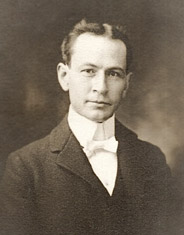
Thomas Parker Boyd originally published The Voice Eternal: A Spiritual Philosophy of the Fine Art of Being Well in San Francisco, CA, 1912, 2nd ed. 1914, 3rd edition, incorporating the author’s additional intended changes, copyright 2016, The Society of the Universal Living Christ.