- Via Christa
- » Library
- » Plato’s Dialogues
- » Jowett’s Introductions to Plato’s Dialogues III
Introductions to Plato’s Dialogues III
By Benjamin Jowett
Of all the works of Plato the Symposium is the most perfect in form, and may be truly thought to contain more than any commentator has ever dreamed of; or, as Goethe said of one of his own writings, more than the author himself knew. For in philosophy as in prophecy glimpses of the future may often be conveyed in words which could hardly have been understood or interpreted at the time when they were uttered (cp. Symposium 210 foll., 223 D)—which were wiser than the writer of them meant, and could not have been explained by him if he had been interrogated about them. Yet Plato was not a mystic, nor in any degree affected by the Eastern influences which afterwards overspread the Alexandrian world. He was not an enthusiast or a sentimentalist, but one who aspired only to see reasoned truth, and whose thoughts are clearly expressed in his language. There is no foreign element either of Egypt or of Asia to be found in his writings. And more than any other Platonic work the Symposium is Greek both in style and subject, having a beauty ‘as of a statue,’ while the companion Dialogue of the Phaedrus is marked by a sort of Gothic irregularity. More too than in any other of his Dialogues, Plato is emancipated from former philosophies. The genius of Greek art seems to triumph over the traditions of Pythagorean, Eleatic, or Megarian systems, and ‘the old quarrel of poetry and philosophy’ has at least a superficial reconcilement. (Republic x. 607 B.)
An unknown person who had heard of the discourses in praise of love spoken by Socrates and others at the banquet of Agathon is desirous of having an authentic account of them, which he thinks that he can obtain from Apollodorus, the same excitable. |516| or rather ‘mad’ friend of Socrates, who is afterwards introduced in the Phaedo. He had imagined that the discourses were recent. There he is mistaken: but they are still fresh in the memory of his informant, who had just been repeating them to Glaucon, and is quite prepared to have another rehearsal of them in a walk from the Piraeus to Athens. Although he had not been present himself, he had heard them from the best authority. Aristodemus, who is described as having been in past times a humble but inseparable attendant of Socrates, had reported them to him (cp. Xenophon Memorabilia i. 4).
The narrative which he had heard was as follows: —
Aristodemus meeting Socrates in holiday attire, is invited by him to a banquet at the house of Agathon, who had been sacrificing in thanksgiving for his tragic victory on the day previous. But no sooner has he entered the house than he finds that he is alone; Socrates has stayed behind in a fit of abstraction, and does not appear until the banquet is half over. On his appearing he and the host jest a little; the question is then asked by Pausanias, one of the guests, ‘What shall they do about drinking? as they had been all well drunk on the day before, and drinking on two successive days is such a bad thing.’ This is confirmed by the authority of Eryximachus the physician, who further proposes that instead of listening to the flute-girl and her ‘noise’ they shall make speeches in honour of love, one after another, going from left to right in the order in which they are reclining at the table. All of them agree to this proposal, and Phaedrus, who is the ‘father’ of the idea, which he has previously communicated to Eryximachus, begins as follows:—
He descants first of all upon the antiquity of love, which is proved by the authority of the poets; secondly upon the benefits which love gives to man. The greatest of these is the sense of honour and dishonour. The lover is ashamed to be seen by the beloved doing or suffering any cowardly or mean act. And a state or army which was made up only of lovers and their loves would be invincible. For love will convert the veriest coward into an inspired hero.
And there have been true loves not only of men but of women also. Such was the love of Alcestis, who dared to die for her husband, and in recompense of her virtue was allowed to come |517| again from the dead. But Orpheus, the miserable harper, who went down to Hades alive, that he might bring back his wife, was mocked with an apparition only, and the gods afterwards contrived his death as the punishment of his cowardliness. The love of Achilles, like that of Alcestis, was courageous and true; for he was willing to avenge his lover Patroclus, although he knew that his own death would immediately follow: and the gods, who honour the love of the beloved above that of the lover, rewarded him, and sent him to the islands of the blest.
Pausanias, who was sitting next, then takes up the tale:—He says that Phaedrus should have distinguished the heavenly love from the earthly, before he praised either. For there are two loves, as there are two Aphrodites—one the daughter of Uranus, who has no mother and is the elder and wiser goddess, and the other, the daughter of Zeus and Dione, who is popular and common. The first of the two loves has a noble purpose, and delights only in the intelligent nature of man, and is faithful to the end, and has no shadow of wantonness or lust. The second is the coarser kind of love, which is a love of the body rather than of the soul, and is of women and boys as well as of men. Now the actions of lovers vary, like every other sort of action, according to the manner of their performance. And in different countries there is a difference of opinion about male loves. Some, like the Boeotians, approve of them; others, like the Ionians, and most of the barbarians, disapprove of them; partly because they are aware of the political dangers which ensue from them, as may be seen in the instance of Harmodius and Aristogeiton. At Athens and Sparta there is an apparent contradiction about them. For at times they are encouraged, and then the lover is allowed to play all sorts of fantastic tricks; he may swear and forswear himself (and ‘at lovers’ perjuries they say Jove laughs’); he may be a servant, and lie on a mat at the door of his love, without any loss of character; but there are also times when elders look grave and guard their young relations, and personal remarks are made. The truth is that some of these loves are disgraceful and others honourable. The vulgar love of the body which takes wing and flies away when the bloom of youth is over, is disgraceful, and so is the interested love of power or wealth; but the love of the noble mind is lasting. The lover should be |518| tested, and the beloved should not be too ready to yield. The rule in our country is that the beloved may do the same service to the lover in the way of virtue which the lover may do to him.
A voluntary service to be rendered for the sake of virtue and wisdom is permitted among us; and when these two customs—one the love of youth, the other the practice of virtue and philosophy—meet in one, then the lovers may lawfully unite. Nor is there any disgrace to a disinterested lover in being deceived: but the interested lover is doubly disgraced, for if he loses his love he loses his character; whereas the noble love of the other remains the same, although the object of his love is unworthy: for nothing can be nobler than love for the sake of virtue. This is that love of the heavenly goddess which is of great price to individuals and cities, making them work together for their improvement.
The turn of Aristophanes comes next; but he has the hiccough, and therefore proposes that Eryximachus the physician shall cure him or speak in his turn. Eryximachus is ready to do both, and after prescribing for the hiccough, speaks as follows: —
He agrees with Pausanias in maintaining that there are two kinds of love; but his art has led him to the further conclusion that the empire of this double love extends over all things, and is to be found in animals and plants as well as in man. In the human body also there are two loves; and the art of medicine shows which is the good and which is the bad love, and persuades the body to accept the good and reject the bad, and reconciles conflicting elements and makes them friends. Every art, gymnastic and husbandry as well as medicine, is the reconciliation of opposites; and this is what Heracleitus meant, when he spoke of a harmony of opposites: but in strictness he should rather have spoken of a harmony which succeeds opposites, for an agreement of disagreements there cannot be. Music too is concerned with the principles of love in their application to harmony and rhythm. In the abstract, all is simple, and we are not troubled with the twofold love; but when they are applied in education with their accompaniments of song and metre, then the discord begins. Then the old tale has to be repeated of fair Urania and the coarse Polyhymnia, who must be indulged sparingly, just as in my own art of medicine care must be taken that the taste of the epicure |519| be gratified without inflicting upon him the attendant penalty of disease.
There is a similar harmony or disagreement in the course of the seasons and in the relations of moist and dry, hot and cold, hoar frost and blight; and diseases of all sorts spring from the excesses or disorders of the element of love. The knowledge of these elements of love and discord in the heavenly bodies is termed astronomy, in the relations of men towards gods and parents is called divination. For divination is the peacemaker of gods and men, and works by a knowledge of the tendencies of merely human loves to piety and impiety. Such is the power of love; and that love which is just and temperate has the greatest power, and is the source of all our happiness and friendship with the gods and with one another. I dare say that I have omitted to mention many things which you, Aristophanes, may supply, as I perceive that you are cured of the hiccough.
Aristophanes is the next speaker: He professes to open a new vein of discourse, in which he begins by treating of the origin of human nature. The sexes were originally three, men, women, and the union of the two; and they were made round—having four hands, four feet, two faces on a round neck, and the rest to correspond. Terrible was their strength and swiftness; and they were essaying to scale heaven and attack the gods. Doubt reigned in the celestial councils; the gods were divided between the desire of quelling the pride of man and the fear of losing the sacrifices. At last Zeus hit upon an expedient. Let us cut them in two, he said; then they will only have half their strength, and we shall have twice as many sacrifices. He spake, and split them as you might split an egg with an hair; and when this was done, he told Apollo to give their faces a twist and re-arrange their persons, taking out the wrinkles and tying the skin in a knot about the navel. The two halves went about looking for one another, and were ready to die of hunger in one another’s arms. Then Zeus invented an adjustment of the sexes, which enabled them to marry and go their way to the business of life. Now the characters of men differ accordingly as they are derived from the original man or the original woman, or the original man-woman. Those who come from the man-woman are lascivious and adulterous; those |520| who come from the woman form female attachments; those who are a section of the male follow the male and embrace him, and in him all their desires centre. The pair are inseparable and live together in pure and manly affection; yet they cannot tell what they want of one another. But if Hephaestus were to come to them with his instruments and propose that they should be melted into one and remain one here and hereafter, they would acknowledge that this was the very expression of their want. For love is the desire of the whole, and the pursuit of the whole is called love. There was a time when the two sexes were only one, but now God has halved them,—much as the Lacedaemonians have cut up the Arcadians,—and if they do not behave themselves he will divide them again, and they will hop about with half a nose and face in basso relievo. Wherefore let us exhort all men to piety, that we may obtain the goods of which love is the author, and be reconciled to God, and find our own true loves, which rarely happens in this world. And now I must beg you not to suppose that I am alluding to Pausanias and Agathon (cp. Protagoras 315 E), for my words refer to all mankind everywhere.
Some raillery ensues first between Aristophanes and Eryximachus, and then between Agathon, who fears a few select friends more than any number of spectators at the theatre, and Socrates, who is disposed to begin an argument. This is speedily repressed by Phaedrus, who reminds the disputants of their tribute to the god. Agathon’s speech follows: He will speak of the god first and then of his gifts: He is the fairest and blessedest and best of the gods, and also the youngest, having had no existence in the old days of Iapetus and Cronos when the gods were at war. The things that were done then were done of necessity and not of love. For love is young and dwells in soft places,—not like Ate in Homer, walking on the skulls of men, but in their hearts and souls, which are soft enough. He is all flexibility and grace, and his habitation is among the flowers, and he cannot do or suffer wrong; for all men serve and obey him of their own free will, and where there is love there is obedience, and where obedience, there is justice; for none can be wronged of his own free will. And he is temperate as well as just, for he is the ruler of the desires, and if he |521| rules them he must be temperate. Also he is courageous, for he is the conqueror of the lord of war. And he is wise too; for he is a poet, and the author of poesy in others. He created the animals; he is the inventor of the arts; all the gods are his subjects; he is the fairest and best himself, and the cause of what is fairest and best in others; he makes men to be of one mind at a banquet, filling them with affection and emptying them of disaffection; the pilot, helper, defender, saviour of men, in whose footsteps let every man follow, chanting a strain of love. Such is the discourse, half playful, half serious, which I dedicate to the god.
The turn of Socrates comes next. He begins by remarking satirically that he has not understood the terms of the original agreement, for he fancied that they meant to speak the true praises of love, but now he finds that they only say what is good of him, whether true or false. He begs to be absolved from speaking falsely, but he is willing to speak the truth, and proposes to begin by questioning Agathon. The result of his questions may be summed up as follows: Love is of something, and that which love desires is not that which love is or has; for no man desires that which he is or has. And love is of the beautiful, and therefore has not the beautiful. And the beautiful is the good, and therefore, in wanting and desiring the beautiful, love also wants and desires the good. Socrates professes to have asked the same questions and to have obtained the same answers from Diotima, a wise woman of Mantinea, who, like Agathon, had spoken first of love and then of his works. Socrates, like Agathon, had told her that Love is a mighty god and also fair, and she had shown him in return that Love was neither, but in a mean between fair and foul, good and evil, and not a god at all, but only a great demon or intermediate power (cp. the speech of Eryximachus, 186 D) who conveys to the gods the prayers of men, and to men the commands of the gods.
Socrates asks: Who are his father and mother? To this Diotima replies that he is the son of Plenty and Poverty, and partakes of the nature of both, and is full and starved by turns. Like his mother he is poor and squalid, lying on mats at doors (cp. the speech of Pausanias, 183 A); like his father he is bold and strong, and full of arts and resources. Further, he is in a |522| mean between ignorance and knowledge:—in this he resembles the philosopher who is also in a mean between the wise and the ignorant. Such is the nature of Love, who is not to be confused with the beloved.
But Love desires the beautiful; and then arises the question, What does he desire of the beautiful? He desires, of course, the possession of the beautiful;—but what is given by that? For the beautiful let us substitute the good, and we have no difficulty in seeing the possession of the good to be happiness, and Love to be the desire of happiness, although the meaning of the word has been too often confined to one kind of love. And Love desires not only the good, but the everlasting possession of the good. Why then is there all this flutter and excitement about love? Because all men and women at a certain age are desirous of bringing to the birth. And love is not of beauty only, but of birth in beauty; this is the principle of immortality in a mortal creature. When beauty approaches, then the conceiving power is benign and diffuse; when foulness, she is averted and morose.
“The creative soul creates not children, but conceptions of wisdom and virtue.”
But why again does this extend not only to men but also to animals? Because they too have an instinct of immortality. Even in the same individual there is a perpetual succession as well of the parts of the material body as of the thoughts and desires of the mind; nay, even knowledge comes and goes. There is no sameness of existence, but the new mortality is always taking the place of the old. This is the reason why parents love their children—for the sake of immortality; and this is why men love the immortality of fame. For the creative soul creates not children, but conceptions of wisdom and virtue, such as poets and other creators have invented. And the noblest creations of all are those of legislators, in honour of whom temples have been raised. Who would not sooner have these children of the mind than the ordinary human ones? 1
I will now initiate you, she said, into the greater mysteries; for he who would proceed in due course should love first one fair form, and then many, and learn the connexion of them; and from beautiful bodies he should proceed to beautiful minds, and |523| the beauty of laws and institutions, until he perceives that all beauty is of one kindred; and from institutions he should go on to the sciences, until at last the vision is revealed to him of a single science of universal beauty, and then he will behold the everlasting nature which is the cause of all, and will be near the end. In the contemplation of that supreme being of love he will be purified of earthly leaven, and will behold beauty, not with the bodily eye, but with the eye of the mind, and will bring forth true creations of virtue and wisdom, and be the friend of God and heir of immortality.
Such, Phaedrus, is the tale which I heard from the stranger of Mantinea, and which you may call the encomium of love, or what you please.
The company applaud the speech of Socrates, and Aristophanes is about to say something, when suddenly a band of revellers breaks into the court, and the voice of Alcibiades is heard asking for Agathon. He is led in drunk, and welcomed by Agathon, whom he has come to crown with a garland. He is placed on a couch at his side, but suddenly, on recognizing Socrates, he starts up, and a sort of conflict is carried on between them, which Agathon is requested to appease. Alcibiades then insists that they shall drink, and has a large wine-cooler filled, which he first empties himself, and then fills again and passes on to Socrates. He is informed of the nature of the entertainment; and is ready to join, if only in the character of a drunken and disappointed lover he may be allowed to sing the praises of Socrates: —
He begins by comparing Socrates first to the busts of Silenus, which have images of the gods inside them; and, secondly, to Marsyas the flute-player. For Socrates produces the same effect with the voice which Marsyas did with the flute. He is the great speaker and enchanter who ravishes the souls of men; the convincer of hearts too, as he has convinced Alcibiades, and made him ashamed of his mean and miserable life. Socrates at one time seemed about to fall in love with him; and he thought that he would thereby gain a wonderful opportunity of receiving lessons of wisdom. He narrates the failure of his design. He has suffered agonies from him, and is at his wit’s end. He then proceeds to mention some other particulars of the life of Socrates: |524| how they were at Potidaea together, where Socrates showed his superior powers of enduring cold and fatigue; how on one occasion he had stood for an entire day and night absorbed in reflection amid the wonder of the spectators; how on another occasion he had saved Alcibiades’ life; how at the battle of Delium, after the defeat, he might be seen stalking about like a pelican, rolling his eyes as Aristophanes had described him in the Clouds. He is the most wonderful of human beings, and absolutely unlike any one but a satyr. Like the satyr in his language too; for he uses the commonest words as the outward mask of the divinest truths.
When Alcibiades has done speaking, a dispute begins between him and Agathon and Socrates. Socrates piques Alcibiades by a pretended affection for Agathon. Presently a band of revellers appears, who introduce disorder into the feast; the sober part of the company, Eryximachus, Phaedrus, and others, withdraw; and Aristodemus, the follower of Socrates, sleeps during the whole of a long winter’s night. When he wakes at cockcrow the revellers are nearly all asleep. Only Socrates, Aristophanes, and Agathon hold out; they are drinking from a large goblet, which they pass round, and Socrates is explaining to the two others, who are half-asleep, that the genius of tragedy is the same as that of comedy, and that the writer of tragedy ought to be a writer of comedy also. And first Aristophanes drops, and then, as the day is dawning, Agathon. Socrates, having laid them to rest, takes a bath and goes to his daily avocations until the evening. Aristodemus follows.
If it be true that there are more things in the Symposium of Plato than any commentator has dreamed of, it is also true that many things have been imagined which are not really to be found there. Some writings hardly admit of a more distinct interpretation than a musical composition; and every reader may form his own accompaniment of thought or feeling to the strain which he hears. The Symposium of Plato is a work of this character, and can with difficulty be rendered in any words but the writer’s own. There are so many half-lights and cross-lights, so much of the colour of mythology, and of the manner of sophistry adhering—rhetoric and poetry, the playful and the |525| serious, are so subtly intermingled in it, and vestiges of old philosophy so curiously blend with germs of future knowledge, that agreement among interpreters is not to be expected. The expression ‘poema magis putandum quam comicorum poetarum,’ which has been applied to all the writings of Plato, is especially applicable to the Symposium.
The power of love is represented in the Symposium as running through all nature and all being: at one end descending to animals and plants, and attaining to the highest vision of truth at the other. In an age when man was seeking for an expression of the world around him, the conception of love greatly affected him. One of the first distinctions of language and of mythology was that of gender; and at a later period the ancient physicist, anticipating modern science, saw, or thought that he saw, a sex in plants; there were elective affinities among the elements, marriages of earth and heaven. (Aeschylus Frag. Dan. 38.) Love became a mythic personage, whom philosophy, borrowing from poetry, converted into an efficient cause of creation. The traces of the existence of love, as of number and figure, were everywhere discerned; and in the Pythagorean list of opposites male and female were ranged side by side with odd and even, finite and infinite.
But Plato seems also to be aware that there is a mystery of love in man as well as in nature, extending beyond the mere immediate relation of the sexes. He is conscious that the highest and noblest things in the world are not easily severed from the sensual desires, or may even be regarded as a spiritualized form of them. We may observe that Socrates himself is not represented as originally unimpassioned, but as one who has overcome his passions; the secret of his power over others partly lies in his passionate but self-controlled nature. In the Phaedrus and Symposium love is not merely the feeling usually so called, but the mystical contemplation of the beautiful and the good. The same passion which may wallow in the mire is capable of rising to the loftiest heights—of penetrating the inmost secret of philosophy. The highest love is the love not of a person, but of the highest and purest abstraction. This abstraction is the far-off heaven on which the eye of the mind is fixed in fond amazement. The unity of truth, the consistency of the warring elements of the |526| world, the enthusiasm for knowledge when first beaming upon mankind, the relativity of ideas to the human mind, and of the human mind to ideas, the faith in the invisible, the adoration of the eternal nature, are all included, consciously or unconsciously, in Plato’s doctrine of love.
The successive speeches in praise of love are characteristic of the speakers, and contribute in various degrees to the final result; they are all designed to prepare the way for Socrates, who gathers up the threads anew, and skims the highest points of each of them. But they are not to be regarded as the stages of an idea, rising above one another to a climax. They are fanciful, partly facetious performances, ‘yet also having a certain measure of seriousness’ (197 E), which the successive speakers dedicate to the god. All of them are rhetorical and poetical rather than dialectical, but glimpses of truth appear in them. When Eryximachus says that the principles of music are simple in themselves, but confused in their application, he touches lightly upon a difficulty which has troubled the moderns as well as the ancients in music, and may be extended to the other applied sciences. That confusion begins in the concrete, was the natural feeling of a mind dwelling in the world of ideas. When Pausanias remarks that personal attachments are inimical to despots, the experience of Greek history confirms the truth of his remark. When Aristophanes declares that love is the desire of the whole, he expresses a feeling not unlike that of the German philosopher, who says that ‘philosophy is home sickness.’ When Agathon says that no man ‘can be wronged of his own free will,’ he is alluding playfully to a serious problem of Greek philosophy (cp. Aristotle Nicomachean Ethics, v. 9). So naturally does Plato mingle jest and earnest, truth and opinion in the same work.
The characters—of Phaedrus, who has been the cause of more philosophical discussions than any other man, with the exception of Simmias the Theban (Phaedrus 242 B); of Aristophanes, who disguises under comic imagery a serious purpose; of Agathon, who in later life is satirized by Aristophanes in the Thesmophoriazusae, for his effeminate manners and the feeble rhythms of his verse; of Alcibiades, who is the same strange contrast of great powers and great vices, which meets us in history—are drawn to the life; and we may suppose the less-known characters |527| of Pausanias and Eryximachus to be also true to the traditional recollection of them (cp. Phaedrus 268 A, Protagoras 315 C, D; and compare Symposium 214 B with Phaedrus 227 A). We may also remark that Aristodemus is called ‘the little’ in Xenophon’s Memorabilia, i. 4 (cp. Symposium 173 B).
The speeches have been said to follow each other in pairs: Phaedrus and Pausanias being the ethical, Eryximachus and Aristophanes the physical speakers, while in Agathon and Socrates poetry and philosophy blend together. The speech of Phaedrus is also described as the mythological, that of Pausanias as the political, that of Eryximachus as the scientific, that of Aristophanes as the artistic (!), that of Socrates as the philosophical. But these and similar distinctions are not found in Plato;—they are the points of view of his critics, and seem to impede rather than to assist us in understanding him. When the turn of Socrates comes round he cannot be allowed to disturb the arrangement made at first. With the leave of Phaedrus he asks a few questions, and then he throws his argument into the form of a speech (cp. Gorgias 505 E, Protagoras 353 B). But his speech is really the narrative of a dialogue between himself and Diotima. And as at a banquet good manners would not allow him to win a victory either over his host or any of the guests, the superiority which he gains over Agathon is ingeniously represented as having been already gained over himself by her. The artifice has the further advantage of maintaining his accustomed profession of ignorance (cp. Menexenus 236 fol.). Even his knowledge of the mysteries of love, to which he lays claim here and elsewhere (Lysis 204 C), is given by Diotima.
The speeches are attested to us by the very best authority. The madman Apollodorus, who for three years past has made a daily study of the actions of Socrates—to whom the world is summed up in the words ‘Great is Socrates’—he has heard them from another ‘madman,’ Aristodemus, who was the ‘shadow’ of Socrates in days of old, like him going about barefooted, and who had been present at the time. ‘Would you desire better witness?’ The extraordinary narrative of Alcibiades is ingeniously represented as admitted by Socrates, whose silence when he is invited to contradict gives consent to the narrator. We may observe, by the way, (1) how the very appearance of Aristodemus |528| by himself is a sufficient indication to Agathon that Socrates has been left behind; also, (2) how the courtesy of Agathon anticipates the excuse which Socrates was to have made on Aristodemus’ behalf for coming uninvited; (3) how the story of the fit or trance of Socrates is confirmed by the mention which Alcibiades makes of a similar fit of abstraction occurring when he was serving with the army at Potidaea; like (4) the drinking powers of Socrates and his love of the fair, which receive a similar attestation in the concluding scene; or the attachment of Aristodemus, who is not forgotten when Socrates takes his departure. (5) We may notice the manner in which Socrates himself regards the first five speeches, not as true, but as fanciful and exaggerated encomiums of the god Love; (6) the satirical character of them, shown especially in the appeals to mythology, in the reasons which are given by Zeus for reconstructing the frame of man, or by the Boeotians and Eleans for encouraging male loves; (7) the ruling passion of Socrates for dialectics, who will argue with Agathon instead of making a speech, and will only speak at all upon the condition that he is allowed to speak the truth. We may note also the touch of Socratic irony, (8) which admits of a wide application and reveals a deep insight into the world:—that in speaking of holy things and persons there is a general understanding that you should praise them, not that you should speak the truth about them—this is the sort of praise which Socrates is unable to give. Lastly, (9) we may remark that the banquet is a real banquet after all, at which love is the theme of discourse, and huge quantities of wine are drunk (214 A, 223 B).
The discourse of Phaedrus is half-mythical, half-ethical; and he himself, true to the character which is given him in the Dialogue bearing his name, is half-sophist, half-enthusiast. He is the critic of poetry also, who compares Homer and Aeschylus in the insipid and irrational manner of the schools of the day, characteristically reasoning about the probability of matters which do not admit of reasoning. He starts from a noble text: ‘That without the sense of honour and dishonour neither states nor individuals ever do any good or great work.’ But he soon passes on to more common-place topics. The antiquity of love, the blessing of having a lover, the incentive which love offers to daring deeds, |529| the examples of Alcestis and Achilles, are the chief themes of his discourse. The love of women is regarded by him as almost on an equality with that of men; and he makes the singular remark that the gods favour the return of love which is made by the beloved more than the original sentiment, because the lover is of a nobler and diviner nature.
There is something of a sophistical ring in the speech of Phaedrus, which recalls the first speech in imitation of Lysias, occurring in the Dialogue called the Phaedrus. This is still more marked in the speech of Pausanias which follows; and which is at once hyperlogical in form and also extremely confused and pedantic. Plato is attacking the logical feebleness of the sophists and rhetoricians, through their pupils, not forgetting by the way to satirize the monotonous and unmeaning rhythms which Prodicus and others were introducing into Attic prose (185 D, cp. Protagoras 337). Of course, he is ‘playing both sides of the game,’ as in the Gorgias and Phaedrus; but it is not necessary in order to understand him that we should discuss the fairness of his mode of proceeding. The love of Pausanias for Agathon has already been touched upon in the Protagoras (315 D), and is alluded to by Aristophanes (193 B). Hence he is naturally the upholder of male loves, which, like all the other affections or actions of men, he regards as varying according to the manner of their performance. Like the sophists and like Plato himself, though in a different sense, he begins his discussion by an appeal to mythology, and distinguishes between the elder and younger love. The value which he attributes to such loves as motives to virtue and philosophy is at variance with modern and Christian notions, but is in accordance with Hellenic sentiment. The opinion of Christendom has not altogether condemned passionate friendships between persons of the same sex, but has certainly not encouraged them, because though innocent in themselves in a few temperaments they are liable to degenerate into fearful evil. Pausanias is very earnest in the defence of such loves; and he speaks of them as generally approved among Hellenes and disapproved by barbarians. His speech is ‘more words than matter,’ and might have been composed by a pupil of Lysias or of Prodicus, although there is no hint given that Plato is specially referring to them. As |530| Eryximachus says, ‘he makes a fair beginning, but a lame ending.’
Plato transposes the two next speeches, as in the Republic he would transpose the virtues (iv. 430 D) and the mathematical sciences (vii. 528 A). This is done partly to avoid monotony, partly for the sake of making Aristophanes ‘the cause of wit in others,’ and also in order to bring the comic and tragic poet into juxtaposition, as if by accident. A suitable ‘expectation’ of Aristophanes is raised by the ludicrous circumstance of his having the hiccough, which is appropriately cured by his substitute, the physician Eryximachus. To Eryximachus Love is the good physician; he sees everything as an intelligent physicist, and, like many professors of his art in modern times, attempts to reduce the moral to the physical; or recognizes one law of love which pervades them both. There are loves and strifes of the body as well as of the mind. Like Hippocrates the Asclepiad, he is a disciple of Heracleitus, whose conception of the harmony of opposites he explains in a new way as the harmony after discord; to his common sense, as to that of many moderns as well as ancients, the identity of contradictories is an absurdity. His notion of love may be summed up as the harmony of man with himself in soul as well as body, and of all things in heaven and earth with one another.
Aristophanes is ready to laugh and make laugh before he opens his mouth, just as Socrates, true to his character, is ready to argue before he begins to speak. He expresses the very genius of the old comedy, its coarse and forcible imagery, and the licence of its language in speaking about the gods. He has no sophistical notions about love, which is brought back by him to its commonsense meaning of love between intelligent beings. His account of the origin of the sexes has the greatest (comic) probability and verisimilitude. Nothing in Aristophanes is more truly Aristophanic than the description of the human monster whirling round on four arms and four legs, eight in all, with incredible rapidity. Yet there is a mixture of earnestness in this jest; three serious principles seem to be insinuated:—first, that man cannot exist in isolation; he must be reunited if he is to be perfected: secondly, that love is the mediator and reconciler of poor, divided human nature: thirdly, that the loves of this world are an |531| indistinct anticipation of an ideal union which is not yet realized.
The speech of Agathon is conceived in a higher strain, and receives the real, if half-ironical, approval of Socrates. It is the speech of the tragic poet and a sort of poem, like tragedy, moving among the gods of Olympus, and not among the elder or Orphic deities. In the idea of the antiquity of love he cannot agree; love is not of the olden time, but present and youthful ever. The speech may be compared with that speech of Socrates in the Phaedrus (239 A, B) in which he describes himself as talking dithyrambs. It is at once a preparation for Socrates and a foil to him. The rhetoric of Agathon elevates the soul to ‘sunlit heights,’ but at the same time contrasts with the natural and necessary eloquence of Socrates. Agathon contributes the distinction between love and the works of love, and also hints incidentally that love is always of beauty, which Socrates afterwards raises into a principle. While the consciousness of discord is stronger in the comic poet Aristophanes, Agathon, the tragic poet, has a deeper sense of harmony and reconciliation, and speaks of Love as the creator and artist.
All the earlier speeches embody common opinions coloured with a tinge of philosophy. They furnish the material out of which Socrates proceeds to form his discourse, starting, as in other places, from mythology and the opinions of men. From Phaedrus he takes the thought that love is stronger than death; from Pausanias, that the true love is akin to intellect and political activity; from Eryximachus, that love is a universal phenomenon and the great power of nature; from Aristophanes, that love is the child of want, and is not merely the love of the congenial or of the whole, but (as he adds) of the good; from Agathon, that love is of beauty, not however of beauty only, but of birth in beauty. As it would be out of character for Socrates to make a lengthened harangue, the speech takes the form of a dialogue between Socrates and a mysterious woman of foreign extraction. She elicits the final truth from one who knows nothing, and who, speaking by the lips of another, and himself a despiser of rhetoric, is proved also to be the most consummate of rhetoricians (cp. Menexenus 249 D).
The last of the six discourses begins with a short argument |532| which overthrows not only Agathon but all the preceding speakers by the help of a distinction which has escaped them. Extravagant praises have been ascribed to Love as the author of every good; no sort of encomium was too high for him, whether deserved and true or not. But Socrates has no talent for speaking anything but the truth, and if he is to speak the truth of Love he must honestly confess that he is not a good at all: for love is of the good, and no man can desire that which he has. This piece of dialectics is ascribed to Diotima, who has already urged upon Socrates the argument which he urges against Agathon. That the distinction is a fallacy is obvious; it is almost acknowledged to be so by Socrates himself. For he who has beauty or good may desire more of them; and he who has beauty or good in himself may desire beauty and good in others. The fallacy seems to arise out of a confusion between the abstract ideas of good and beauty, which do not admit of degrees, and their partial realization in individuals.
But Diotima, the prophetess of Mantineia, whose sacred and superhuman character raises her above the ordinary proprieties of women, has taught Socrates far more than this about the art and mystery of love. She has taught him that love is another aspect of philosophy. The same want in the human soul which is satisfied in the vulgar by the procreation of children, may become the highest aspiration of intellectual desire. As the Christian might speak of hungering and thirsting after righteousness; or of divine loves under the figure of human (cp. Ephesians v. 32, ‘This is a great mystery, but I speak concerning Christ and the church’); as the mediaeval saint might speak of the ‘fruitio Dei;’ as Dante saw all things contained in his love of Beatrice, so Plato would have us absorb all other loves and desires in the love of knowledge. Here is the beginning of Neoplatonism, or rather, perhaps, a proof (of which there are many) that the so-called mysticism of the East was not strange to the Greek of the fifth century before Christ. The first tumult of the affections was not wholly subdued; there were longings of a creature
“Moving about in worlds not realized,”
which no art could satisfy. To most men reason and passion appear to be antagonistic both in idea and fact. The union of |533| the greatest comprehension of knowledge and the burning intensity of love is a contradiction in nature, which may have existed in a far-off primeval age in the mind of some Hebrew prophet or other Eastern sage, but has now become an imagination only. Yet this ‘passion of the reason’ is the theme of the Symposium of Plato. And as there is no impossibility in supposing that ‘one king, or son of a king, may be a philosopher,’ so also there is a probability that there may be some few—perhaps one or two in a whole generation—in whom the light of truth may not lack the warmth of desire. And if there be such natures, no one will be disposed to deny that ‘from them flow most of the benefits of individuals and states;’ and even from imperfect combinations of the two elements in teachers or statesmen great good may often arise.
Yet there is a higher region in which love is not only felt, but satisfied, in the perfect beauty of eternal knowledge, beginning with the beauty of earthly things, and at last reaching a beauty in which all existence is seen to be harmonious and one. The limited affection is enlarged, and enabled to behold the ideal of all things. And here the highest summit which is reached in the Symposium is seen also to be the highest summit which is attained in the Republic, but approached from another side; and there is ‘a way upwards and downwards,’ which is the same and not the same in both. The ideal beauty of the one is the ideal good of the other; regarded not with the eye of knowledge, but of faith and desire; and they are respectively the source of beauty and the source of good in all other things. And by the steps of a ‘ladder reaching to heaven’ we pass from images of visible beauty (εἰκόνες), and from the hypotheses of the Mathematical sciences, which are not yet based upon the idea of good, through the concrete to the abstract, and, by different paths arriving, behold the vision of the eternal (cp. Symposium 211 ὥσπερ ἐπαναβαθμοîς τισιν Republic vi. 511 A, B οîον ἐπιβάσεις; τε καὶ ὁρμάς also Phaedrus 247 ff.). Under one aspect ‘the idea is love’; under another, ‘truth.’ In both the lover of wisdom is the ‘spectator of all time and of all existence.’ This is a ‘mystery’ in which Plato also obscurely intimates the union of the spiritual and fleshly, the interpenetration of the moral and intellectual faculties. |534|
The divine image of beauty which resides within Socrates has been revealed; the Silenus, or outward man, has now to be exhibited. The description of Socrates follows immediately after the speech of Socrates; one is the complement of the other. At the height of divine inspiration, when the force of nature can no further go, by way of contrast to this extreme idealism, Alcibiades, accompanied by a troop of revellers and a flute-girl, staggers in, and being drunk is able to tell of things which he would have been ashamed to make known if he had been sober. The state of his affections towards Socrates, unintelligible to us and perverted as they appear, affords an illustration of the power ascribed to the loves of man in the speech of Pausanias. He does not suppose his feelings to be peculiar to himself: there are several other persons in the company who have been equally in love with Socrates, and like himself have been deceived by him. The singular part of this confession is the combination of the most degrading passion with the desire of virtue and improvement. Such an union is not wholly untrue to human nature, which is capable of combining good and evil in a degree beyond what we can easily conceive. In imaginative persons, especially, the God and beast in man seem to part asunder more than is natural in a well-regulated mind. The Platonic Socrates (for of the real Socrates this may be doubted: cp. his public rebuke of Critias for his shameful love of Euthydemus in Xenophon, Memorabilia i. 2, 29, 30) does not regard the greatest evil of Greek life as a thing not to be spoken of; but it has a ridiculous element (Plato’s Symposium 214), and is a subject for irony, no less than for moral reprobation (cp. Plato’s Symposium 218 D, E). It is also used as a figure of speech which no one interpreted literally (cp. Xenophon Symposium 4. 57). Nor does Plato feel any repugnance, such as would be felt in modern times, at bringing his great master and hero into connexion with nameless crimes. He is contented with representing him as a saint, who has won ‘the Olympian victory’ over the temptations of human nature. The fault of taste, which to us is so glaring and which was recognized by the Greeks of a later age (Athenaeus xi. 114), was not perceived by Plato himself. We are still more surprised to find that the philosopher is incited to take the first step in his upward progress |535| (Symposium 210 A) by the beauty of young men and boys, which was alone capable of inspiring the modern feeling of romance in the Greek mind. The passion of love took the spurious form of an enthusiasm for the ideal of beauty—a worship as of some godlike image of an Apollo or Antinous. But the love of youth when not depraved was a love of virtue and modesty as well as of beauty, the one being the expression of the other; and in certain Greek states, especially at Sparta and Thebes, the honourable attachment of a youth to an elder man was a part of his education. The ‘army of lovers and their beloved who would be invincible if they could be united by such a tie’ (Symposium 178 ff.), is not a mere fiction of Plato’s, but seems actually to have existed at Thebes in the days of Epaminondas and Pelopidas, if we may believe writers cited anonymously by Plutarch, Pelopidas Vita 18, 19. It is observable that Plato never in the least degree excuses the depraved love of the body (cp. Charmides 155; Republic v. 468 B, C; Laws viii. 841 ff.; Symposium 211 D; and once more Xenophon, Memorabilia i, 2, 29, 30), nor is there any Greek writer of mark who condones or approves such connexions. But owing partly to the puzzling nature of the subject (182 A, B) these friendships are spoken of by Plato in a manner different from that customary among ourselves. To most of them we should hesitate to ascribe, any more than to the attachment of Achilles and Patroclus in Homer, an immoral or licentious character. There were many, doubtless, to whom the love of the fair mind was the noblest form of friendship (Repiblic iii. 402 D), and who deemed the friendship of man with man to be higher than the love of woman, because altogether separated from the bodily appetites. The existence of such attachments may be reasonably attributed to the inferiority and seclusion of woman, and the want of a real family or social life and parental influence in Hellenic cities; and they were encouraged by the practice of gymnastic exercises, by the meetings of political clubs, and by the tie of military companionship. They were also an educational institution: a young person was specially entrusted by his parents to some elder friend who was expected by them to train their son in manly exercises and in virtue. It is not likely that a Greek parent committed him to a lover, any more than we should to a schoolmaster, in the expectation that he would be corrupted by him, but rather in the hope that his morals |536| would be better cared for than was possible in a great household of slaves.
It is difficult to adduce the authority of Plato either for or against such practices or customs, because it is not always easy to determine whether he is speaking of ‘the heavenly and philosophical love, or of the coarse Polyhymnia:’ and he often refers to this (e. g. in the Symposium) half in jest, yet ‘with a certain degree of seriousness.’ We observe that they entered into one part of Greek literature, but not into another, and that the larger part is free from such associations. Indecency was an element of the ludicrous in the old Greek Comedy, as it has been in other ages and countries. But effeminate love was always condemned as well as ridiculed by the Comic poets; and in the New Comedy the allusions to such topics have disappeared. They seem to have been no longer tolerated by the greater refinement of the age. False sentiment is found in the Lyric and Elegiac poets; and in mythology ‘the greatest of the Gods’ (Republic iii. 388 B) is not exempt from evil imputations. But the morals of a nation are not to be judged of wholly by its literature. Hellas was not necessarily more corrupted in the days of the Persian and Peloponnesian wars, or of Plato and the Orators, than England in the time of Fielding and Smollett, or France in the nineteenth century. No one supposes certain French novels to be a representation of ordinary French life. And the greater part of Greek literature, beginning with Homer and including the tragedians, philosophers, and, with the exception of the Comic poets (whose business was to raise a laugh by whatever means), all the greater writers of Hellas who have been preserved to us, are free from the taint of indecency.
Some general considerations occur to our mind when we begin to reflect on this subject. (1) That good and evil are linked together in human nature, and have often existed side by side in the world and in man to an extent hardly credible. We cannot distinguish them, and are therefore unable to part them; as in the parable ‘they grow together unto the harvest:’ it is only a rule of external decency by which society can divide them. Nor should we be right in inferring from the prevalence of any one vice or corruption that a state or individual was demoralized in their whole character. Not only has the corruption |537| of the best been sometimes thought to be the worst, but it may be remarked that this very excess of evil has been the stimulus to good (cp. Plato, Laws xii. 951 B, where he says that in the most corrupt cities individuals are to be found beyond all praise). (2) It may be observed that evils which admit of degrees can seldom be rightly estimated, because under the same name actions of the most different degrees of culpability may be included. No charge is more easily set going than the imputation of secret wickedness (which cannot be either proved or disproved and often cannot be defined) when directed against a person of whom the world, or a section of it, is predisposed to think evil. And it is quite possible that the malignity of Greek scandal, aroused by some personal jealousy or party enmity, may have converted the innocent friendship of a great man for a noble youth into a connexion of another kind. Such accusations were brought against several of the leading men of Hellas, e.g. Cimon, Alcibiades, Critias, Demosthenes, Epaminondas: several of the Roman emperors were assailed by similar weapons which have been used even in our own day against statesmen of the highest character. (3) While we know that in this matter there is a great gulf fixed between Greek and Christian Ethics, yet, if we would do justice to the Greeks, we must also acknowledge that there was a greater outspokenness among them than among ourselves about the things which nature hides, and that the more frequent mention of such topics is not to be taken as the measure of the prevalence of offences, or as a proof of the general corruption of society. It is likely that every religion in the world has used words or practised rites in one age, which have become distasteful or repugnant to another. We cannot, though for different reasons, trust the representations either of Comedy or Satire; and still less of Christian Apologists. (4) We observe that at Thebes and Lacedemon the attachment of an elder friend to a beloved youth was often deemed to be a part of his education; and was encouraged by his parents—it was only shameful if it degenerated into licentiousness. Such we may believe to have been the tie which united Asophychus and Cephisodorus with the great Epaminondas in whose companionship they fell (Plutarch, Amatorius 117; Athenaeus on the authority of Theopompus, l. xiii. p. 605). (5) A small matter: there appears to be a difference of custom |538| among the Greeks and among ourselves, as between ourselves and continental nations at the present time, in modes of salutation. We must not suspect evil in the hearty kiss or embrace of a male friend ‘returning from the army at Potidaea’ any more than in a similar salutation when practised by members of the same family. But those who make these admissions, and who regard, not without pity, the victims of such illusions in our own day, whose life has been blasted by them, may be none the less resolved that the natural and healthy instincts of mankind shall alone be tolerated ἐν τη̂ ἠμετέρᾳ πόλει; and that the lesson of manliness which we have inherited from our fathers shall not degenerate into sentimentalism or effeminacy. The possibility of an honourable connexion of this kind seems to have died out with Greek civilization. Among the Romans, and also among barbarians, such as the Celts and Persians, there is no trace of such attachments existing in any noble or virtuous form.
(Compare Hoeck’s Creta, vol. 3. p. 106 ff, and the admirable and exhaustive article of Meier in Ersch and Grueber’s Cyclopedia, vol. 16, on this subject; Plutarch, Amatores; Athenaeus, p. 605; Lysias contra Simonem; Aesch. c. Timarchum.)
The character of Alcibiades in the Symposium is hardly less remarkable than that of Socrates, and agrees with the picture given of him in the first of the two Dialogues which are called by his name, and also with the slight sketch of him in the Protagoras. He is the impersonation of lawlessness—‘the lion’s whelp, who ought not to be reared in the city,’ yet not without a certain generosity which gained the hearts of men,—strangely fascinated by Socrates, and possessed of a genius which might have been either the destruction or salvation of Athens. The dramatic interest of the character is heightened by the recollection of his after history. He seems to have been present to the mind of Plato in the description of the democratic man of the Republic (viii. 560; cp. also Alcibiades 1).
There is no criterion of the date of the Symposium, except that which is furnished by the allusion to the division of Arcadia after the destruction of Mantinea. This took place in the year B.C. 384, which is the forty-fourth year of Plato’s life. The Symposium cannot therefore be regarded as a youthful work. As |539| Mantinea was restored in the year 369, the composition of the Dialogue will probably fall between 384 and 369. Whether the recollection of the event is more likely to have been renewed at the destruction or restoration of the city, rather than at some intermediate period, is a consideration not worth raising.
The Symposium is connected with the Phaedrus both in style and subject; they are the only Dialogues of Plato in which the theme of love is discussed at length. In both of them philosophy is regarded as a sort of enthusiasm or madness; Socrates is himself ‘a prophet new inspired’ with Bacchanalian revelry, which, like his philosophy, he characteristically pretends to have derived not from himself but from others. The Phaedo also presents some points of comparison with the Symposium. For there, too, philosophy might be described as ‘dying for love;’ and there are not wanting many touches of humour and fancy, which remind us of the Symposium (64 B, 85 B, 99 A). But while the Phaedo and Phaedrus look backwards and forwards to past and future states of existence, in the Symposium there is no break between this world and another; and we rise from one to the other by a regular series of steps or stages, proceeding from the particulars of sense to the universal of reason, and from one universal to many, which are finally reunited in a single science (cp. Republic vi. 511 B). At first immortality means only the succession of existences; even knowledge comes and goes. Then follows, in the language of the mysteries, a higher and a higher degree of initiation; at last we arrive at the perfect vision of beauty, not relative or changing, but eternal and absolute; not bounded by this world, or in or out of this world, but an aspect of the divine, extending over all things, and having no limit of space or time: this is the highest knowledge of which the human mind is capable. Plato does not go on to ask whether the individual is absorbed in the sea of light and beauty or retains his personality. Enough for him to have attained the true beauty or good, without enquiring precisely into the relation in which human beings stood to it. That the soul has such a reach of thought, and is capable of partaking of the eternal nature, seems to imply that she too is eternal (cp. Phaedrus, 245 foll.). But Plato does not distinguish the eternal in man from the eternal in the world or in God. He is willing to rest in the contemplation |540| of the idea, which to him is the cause of all things (Republic vi. 508 E), and has no strength to go further.
The Symposium of Xenophon, in which Socrates describes himself as a pander, and also discourses of the difference between sensual and sentimental love, likewise offers several interesting points of comparison. But the suspicion which hangs over other writings of Xenophon, and the numerous minute references to the Phaedrus and Symposium, as well as to some of the other writings of Plato, throw a doubt on the genuineness of the work. The Symposium of Xenophon, if written by him at all, would certainly show that he wrote against Plato, and was acquainted with his works. Of this hostility there is no trace in the Memorabilia. Such a rivalry is more characteristic of an imitator than of an original writer. The (so-called) Symposium of Xenophon may therefore have no more title to be regarded as genuine than the confessedly spurious Apology.
There are no means of determining the relative order in time of the Phaedrus, Symposium, Phaedo. The order which has been adopted in this translation rests on no other principle than the desire to bring together in a series the memorials of the life of Socrates.
Endnote
1^ Cp. Bacon’s Essays, 8:—’Certainly the best works and of greatest merit for the public have proceeded from the unmarried or childless men; which both in affection and means have married and endowed the public.’
Top ↑Some dialogues of Plato are of so various a character that their relation to the other dialogues cannot be determined with any degree of certainty. The Theaetetus, like the Parmenides, has points of similarity both with his earlier and his later writings. The perfection of style, the humour, the dramatic interest, the complexity of structure, the fertility of illustration, the shifting of the points of view, are characteristic of his best period of authorship. The vain search, the negative conclusion, the figure of the mid-wives, the constant profession of ignorance on the part of Socrates, also bear the stamp of the early dialogues, in which the original Socrates is not yet Platonized. Had we no other indications, we should be disposed to range the Theaetetus with the Apology and the Phaedrus, and perhaps even with the Protagoras and the Laches.
But when we pass from the style to an examination of the subject, we trace a connexion with the later rather than with the earlier dialogues. In the first place there is the connexion, indicated by Plato himself at the end of the dialogue, with the Sophist, to which in many respects the Theaetetus is so little akin. (1) The same persons reappear, including the younger Socrates, whose name is just mentioned in the Theaetetus (147 C); (2) the theory of rest, which at p. 133 D Socrates has declined to consider, is resumed by the Eleatic Stranger; (3) there is a similar allusion in both dialogues to the meeting of Parmenides and Socrates (
Theaetetus 183 E, Sophist 217); and (4) the inquiry into not-being in the Sophist supplements the question of false opinion which is raised in the Theaetetus. (Compare also Theaetetus 168 A, 210, and Sophist 230 B; Theaetetus 174 D, E, and Sophist 227 A; Theaetetus 188 E, and Sophist 237 D; Theaetetus 179 A, and Sophist 233 B; Theaetetus 172 D, Sophist 253 C, for parallel turns of thought.) Secondly, the later date of the |110| dialogue is confirmed by the absence of the doctrine of recollection and of any doctrine of ideas except that which derives them from generalization and from reflection of the mind upon itself. The general character of the Theaetetus is dialectical, and there are traces of the same Megarian influences which appear in the Parmenides, and which later writers, in their matter of fact way, have explained by the residence of Plato at Megara. Socrates disclaims the character of a professional eristic (164 C), and also, with a sort of ironical admiration, expresses his inability to attain the Megarian precision in the use of terms (197 A). Yet he too employs a similar sophistical skill in overturning every conceivable theory of knowledge.
The direct indications of a date amount to no more than this: the conversation is said to have taken place when Theaetetus was a youth, and shortly before the death of Socrates. At the time of his own death he is supposed to be a full-grown man. Allowing nine or ten years for the interval between youth and manhood, the dialogue could not have been written earlier than 390, when Plato was about thirty-nine years of age. No more definite date is indicated by the engagement in which Theaetetus is said to have fallen or to have been wounded, and which may have taken place any time during the Corinthian war, between the years 390–387. The later date which has been suggested, 369, when the Athenians and Lacedaemonians disputed the Isthmus with Epaminondas, would make the age of Theaetetus at his death forty-five or forty-six. This a little impairs the beauty of Socrates’ remark, that ‘he would be a great man if he lived.’
In this uncertainty about the place of the Theaetetus, it seemed better, as in the case of the Republic, Timaeus, Critias, to retain the order in which Plato himself has arranged this and the two companion dialogues. We cannot exclude the possibility which has been already noticed in reference to other works of Plato, that the Theaetetus may not have been all written continuously; or the probability that the Sophist and Politicus, which differ greatly in style, were only appended after a long interval of time. The allusion to Parmenides at 183, compared with Sophist 217, would probably imply that the dialogue which is called by his name was already in existence; unless, indeed, we suppose the passage in which the allusion occurs to have been inserted afterwards. |111| Again, the Theaetetus may be connected with the Gorgias, either dialogue from different points of view containing an analysis of the real and apparent (Schleiermacher); and both may be brought into relation with the Apology as illustrating the personal life of Socrates. The Philebus, too, may with equal reason be placed either after or before what, in the language of Thrasyllus, may be called the Second Platonic Trilogy. Both the Parmenides and the Sophist, and still more the Theaetetus, have points of affinity with the Cratylus, in which the principles of rest and motion are again contrasted, and the Sophistical or Protagorean theory of language is opposed to that which is attributed to the disciple of Heracleitus, not to speak of lesser resemblances in thought and language. The Parmenides, again, has been thought by some to hold an intermediate position between the Theaetetus and the Sophist; upon this view, Sophist 250 foll. may be regarded as the answer to the problems about One and Being which have been raised in the Parmenides. Any of these arrangements may suggest new views to the student of Plato; none of them can lay claim to an exclusive probability in its favour.
The Theaetetus is one of the narrated dialogues of Plato, and is the only one which is supposed to have been written down. In a short introductory scene, Euclides and Terpsion are described as meeting before the door of Euclides’ house in Megara. This may have been a spot familiar to Plato (for Megara was within a walk of Athens), but no importance can be attached to the accidental introduction of the founder of the Megarian philosophy. The real intention of the preface is to create an interest about the person of Theaetetus, who has just been carried up from the army at Corinth in a dying state. The expectation of his death recalls the promise of his youth, and especially the famous conversation which Socrates had with him when he was quite young, a few days before his own trial and death, as we are once more reminded at the end of the dialogue. Yet we may observe that Plato has himself forgotten this, when he represents Euclides as from time to time coming to Athens and correcting the copy from Socrates’ own mouth. The narrative, having introduced Theaetetus, and having guaranteed the authenticity of the dialogue (cp. Symposium, Phaedo, Parmenides), is then dropped. No further use is made of the device. As Plato himself remarks, who in this as in some other minute |112| points is imitated by Cicero (De Amicitia, c. 1), the interlocutory words are omitted.
Theaetetus, the hero of the battle of Corinth and of the dialogue, is a disciple of Theodorus, the great geometrician, whose science is thus indicated to be the propaedeutic to philosophy. An interest has been already excited about him by his approaching death, and now he is introduced to us anew by the praises of his master Theodorus. He is a youthful Socrates, and exhibits the same contrast of the fair soul and the ungainly face and frame, the Silenus mask and the god within, which are described in the Symposium. The picture which Theodorus gives of his courage and patience and intelligence and modesty is verified in the course of the dialogue. His courage is shown by his behaviour in the battle, and his other qualities shine forth as the argument proceeds. Socrates takes an evident delight in ‘the wise Theaetetus,’ who has more in him than ‘many bearded men’; he is quite inspired by his answers. At first the youth is lost in wonder, and is almost too modest to speak (151 E), but, encouraged by Socrates, he rises to the occasion, and grows full of interest and enthusiasm about the great question. Like a youth (162 D), he has not finally made up his mind, and is very ready to follow the lead of Socrates, and to enter into each successive phase of the discussion which turns up. His great dialectical talent is shown in his power of drawing distinctions (163 E), and of foreseeing the consequences of his own answers (154 D). The enquiry about the nature of knowledge is not new to him; long ago he has felt the ‘pang of philosophy,’ and has experienced the youthful intoxication which is depicted in the Philebus (p. 15). But he has hitherto been unable to make the transition from mathematics to metaphysics. He can form a general conception of square and oblong numbers (p. 148), but he is unable to attain a similar expression of knowledge in the abstract. Yet at length (p. 185) he begins to recognize that there are universal conceptions of being, likeness, sameness, number, which the mind contemplates in herself, and with the help of Socrates is conducted from a theory of sense to a theory of ideas.
There is no reason to doubt that Theaetetus was a real person, whose name survived in the next generation. But neither can any importance be attached to the notices of him in Suidas and Proclus, which are probably based on the mention of him in Plato. |113| According to a confused statement in Suidas, who mentions him twice over, first, as a pupil of Socrates, and then of Plato, he is said to have written the first work on the Five Solids. But no early authority cites the work, the invention of which may have been easily suggested by the division of roots, which Plato attributes to him, and the allusion to the backward state of solid geometry in the Republic (vii. 528 B). At any rate, there is no occasion to recall him to life again after the battle of Corinth, in order that we may allow time for the completion of such a work (Müller). We may also remark that such a supposition entirely destroys the pathetic interest of the introduction.
Theodorus, the geometrician, had once been the friend and disciple of Protagoras, but he is very reluctant to leave his retirement and defend his old master. He is too old to learn Socrates’ game of question and answer, and prefers the digressions to the main argument, because he finds them easier to follow. The mathematician, as Socrates says in the Republic, is not capable of giving a reason in the same manner as the dialectician (vii. 531 D, E), and Theodorus could not therefore have been appropriately introduced as the chief respondent. But he may be fairly appealed to, when the honour of his master is at stake. He is the ‘guardian of his orphans,’ although this is a responsibility which he wishes to throw upon Callias, the friend and patron of all Sophists, declaring that he himself had early ‘run away’ from philosophy, and was absorbed in mathematics. His extreme dislike to the Heraclitean fanatics, which may be compared with the dislike of Theaetetus (155 E) to the materialists, and his ready acceptance of the noble words of Socrates (175, 176), are noticeable traits of character.
The Socrates of the Theaetetus is the same as the Socrates of the earlier dialogues. He is the invincible disputant, now advanced in years, of the Protagoras and Symposium; he is still pursuing his divine mission, his ‘Herculean labours,’ of which he has described the origin in the Apology; and he still hears the voice of his oracle, bidding him receive or not receive the truant souls. There he is supposed to have a mission to convict men of self-conceit; in the Theaetetus he has assigned to him by God the functions of a man-midwife, who delivers men of their thoughts, and under this character he is present throughout the dialogue. He is the true prophet who has an insight into the natures of men, |114| and can divine their future (142 C); and he knows that sympathy is the secret power which unlocks their thoughts. The hit at Aristides, the son of Lysimachus, who was specially committed to his charge in the Laches, may be remarked by the way. The attempt to discover the definition of knowledge is in accordance with the character of Socrates as he is described in the Memorabilia, asking What is justice? what is temperance? and the like. But there is no reason to suppose that he would have analyzed the nature of perception, or traced the connexion of Protagoras and Heracleitus, or have raised the difficulty respecting false opinion. The humorous illustrations, as well as the serious thoughts, run through the dialogue. The snubnosedness of Theaetetus, a characteristic which he shares with Socrates, and the man-midwifery of Socrates, are not forgotten in the closing words. At the end of the dialogue, as in the Euthyphro, he is expecting to meet Meletus at the porch of the king Archon; but with the same indifference to the result which is everywhere displayed by him, he proposes that they shall reassemble on the following day at the same spot. The day comes, and in the Sophist the three friends again meet, but no further allusion is made to the trial, and the principal share in the argument is assigned, not to Socrates, but to an Eleatic stranger; the youthful Theaetetus also plays a different and less independent part. And there is no allusion in the Introduction to the second and third dialogues, which are afterwards appended. There seems, therefore, reason to think that there is a real change, both in the characters and in the design.
The dialogue is an enquiry into the nature of knowledge, which is interrupted by two digressions. The first is the digression about the midwives, which is also a leading thought or continuous image, like the wave in the Republic, appearing and reappearing at intervals. Again and again we are reminded that the successive conceptions of knowledge are extracted from Theaetetus, who in his turn truly declares that Socrates has got a great deal more out of him than ever was in him. Socrates is never weary of working out the image in humorous details,—discerning the symptoms of labour, carrying the child round the hearth, fearing that Theaetetus will bite him, comparing his conceptions to wind-eggs, asserting an hereditary right to the occupation. There is also a |115| serious side to the image, which is an apt similitude of the Socratic theory of education (cp. Republic vii. 518 D, Sophist 230), and accords with the ironical spirit in which the wisest of men delights to speak of himself.
The other digression is the famous contrast of the lawyer and philosopher. This is a sort of landing-place or break in the middle of the dialogue. At the commencement of a great discussion, the reflection naturally arises, How happy are they who, like the philosopher, have time for such discussions (cp. Republic v. 450)! There is no reason for the introduction of such a digression; nor is a reason always needed, any more than for the introduction of an episode in a poem, or of a topic in conversation. That which is given by Socrates is quite sufficient, viz. that the philosopher may talk and write as he pleases. But though not very closely connected, neither is the digression out of keeping with the rest of the dialogue. The philosopher naturally desires to pour forth the thoughts which are always present to him, and to discourse of the higher life. The idea of knowledge, although hard to be defined, is realised in the life of philosophy. And the contrast is the favourite antithesis between the world, in the various characters of sophist, lawyer, statesman, speaker, and the philosopher,—between opinion and knowledge,—between the conventional and the true.
The greater part of the dialogue is devoted to setting up and throwing down definitions of science and knowledge. Proceeding from the lower to the higher by three stages, in which perception, opinion, reasoning are successively examined, we first get rid of the confusion of the idea of knowledge and specific kinds of knowledge,—a confusion which has been already noticed in the Lysis, Laches, Meno, and other dialogues. In the infancy of logic, a form of thought has to be invented before the content can be filled up. We cannot define knowledge until the nature of definition has been ascertained. Having succeeded in making his meaning plain, Socrates proceeds to analyze (1) the first definition which Theaetetus proposes: ‘Knowledge is sensible perception.’ This is speedily identified with the Protagorean saying, ‘Man is the measure of all things;’ and of this again the foundation is discovered in the perpetual flux of Heracleitus. The relativeness of sensation is then developed at length, and for a |116| moment the definition appears to be accepted. But soon the Protagorean thesis is pronounced to be suicidal; for the adversaries of Protagoras are as good a measure as he is, and they deny his doctrine. He is then supposed to reply that the perception may be true at any given instant. But the reply is in the end shown to be inconsistent with the Heraclitean foundation, on which the doctrine has been affirmed to rest. For if the Heraclitean flux is extended to every sort of change in every instant of time, how can any thought or word be detained even for an instant? Sensible perception, like everything else, is tumbling to pieces. Nor can Protagoras himself maintain that one man is as good as another in his knowledge of the future; and ‘the expedient,’ if not ‘the just and true,’ belongs to the sphere of the future.
And so we must ask again, What is knowledge? The comparison of sensations with one another implies a principle which is above sensation, and which resides in the mind itself. We are thus led to look for knowledge in a higher sphere, and accordingly Theaetetus, when again interrogated, replies (2) that ‘knowledge is true opinion.’ But how is false opinion possible? The Megarian or Eristic spirit within us revives the question, which has been already asked and indirectly answered in the Meno: ‘How can a man be ignorant of that which he knows?’ No answer is given to this not unanswerable question. The comparison of the mind to a block of wax, or to a decoy of birds, is found wanting.
But are we not inverting the natural order in looking for opinion before we have found knowledge? And knowledge is not true opinion; for the Athenian dicasts have true opinion but not knowledge. What then is knowledge? We answer (3), ‘True opinion, with definition or explanation.’ But all the different ways in which this statement may be understood are set aside, like the definitions of courage in the Laches, or of friendship in the Lysis, or of temperance in the Charmides. At length we arrive at the conclusion, in which nothing is concluded.
There are two special difficulties which beset the student of the Theaetetus: (1) he is uncertain how far he can trust Plato’s account of the theory of Protagoras; and he is also uncertain (2) how far, and in what parts of the dialogue, Plato is expressing his own opinion. The dramatic character of the work renders the answer to both these questions difficult. |117|
1. In reply to the first, we have only probabilities to offer. Three main points have to be decided: (a) Would Protagoras have identified his own thesis, ‘Man is the measure of all things,’ with the other, ‘All knowledge is sensible perception’? (b) Would he have based the relativity of knowledge on the Heraclitean flux? (c) Would he have asserted the absoluteness of sensation at each instant? Of the work of Protagoras on ‘Truth’ we know nothing, with the exception of the two famous fragments, which are cited in this dialogue, ‘Man is the measure of all things,’ and, ‘Whether there are gods or not, I cannot tell.’ Nor have we any other trustworthy evidence of the tenets of Protagoras, or of the sense in which his words are used. For later writers, including Aristotle in his Metaphysics, have mixed up the Protagoras of Plato, as they have the Socrates of Plato, with the real person.
Returning then to the Theaetetus, as the only possible source from which an answer to these questions can be obtained, we may remark, that Plato had ‘The Truth’ of Protagoras before him, and frequently refers to the book. He seems to say expressly, that in this work the doctrine of the Heraclitean flux was not to be found (p. 152); ‘he told the real truth’ (not in the book, which is so entitled, but) ‘privately to his disciples,’—words which imply that the connexion between the doctrines of Protagoras and Heracleitus was not generally recognized in Greece, but was really discovered or invented by Plato. On the other hand, the doctrine that ‘Man is the measure of all things,’ is expressly identified by Socrates with the other statement, that ‘What appears to each man is to him;’ and a reference is made to the books in which the statement occurs;—this Theaetetus, who has ‘often read the books,’ is supposed to acknowledge (152 A: so Cratylus 385 E). And Protagoras, in the speech attributed to him, never says that he has been misunderstood: at p. 166 C he rather seems to imply that the absoluteness of sensation at each instant was to be found in his words (cp. 158 E). He is only indignant at the ‘reductio ad absurdum’ devised by Socrates for his ‘homo mensura,’ which Theodorus also considers to be ‘really too bad.’
The question may be raised, how far Plato in the Theaetetus could have misrepresented Protagoras without violating the laws |118| of dramatic probability. Could he have pretended to cite from a well-known writing what was not to be found there? But such a shadowy enquiry is not worth pursuing further. We need only remember that in the criticism which follows of the thesis of Protagoras, we are criticizing the Protagoras of Plato, and not attempting to draw a precise line between his real sentiments and those which Plato has attributed to him.
2. The other difficulty is a more subtle, and also a more important one, because bearing on the general character of the Platonic dialogues. On a first reading of them, we are apt to imagine that the truth is only spoken by Socrates, who is never guilty of a fallacy himself, and is the great detector of the errors and fallacies of others. But this natural presumption is disturbed by the discovery that the Sophists are sometimes in the right and Socrates in the wrong. Like the hero of a novel, he is not to be supposed always to represent the sentiments of the author. There are few modern readers who do not side with Protagoras, rather than with Socrates, in the dialogue which is called by his name. The Cratylus presents a similar difficulty: in his etymologies, as in the number of the State, we cannot tell how far Socrates is serious; for the Socratic irony will not allow him to distinguish between his real and his assumed wisdom. No one is the superior of the invincible Socrates in argument (except in the first part of the Parmenides, where he is introduced as a youth); but he is by no means supposed to be in possession of the whole truth. Arguments are often put into his mouth (cp. Introduction to the Gorgias) which must have seemed quite as untenable to Plato as to a modern writer. In this dialogue a great part of the answer of Protagoras is just and sound; remarks are made by him on verbal criticism, and on the importance of understanding an opponent’s meaning, which are conceived in the true spirit of philosophy. And the distinction which he is supposed to draw between Eristic and Dialectic (167, 168), is really a criticism of Plato on himself and his own criticism of Protagoras.
The difficulty seems to arise from not attending to the dramatic character of the writings of Plato. There are two, or more, sides to questions; and these are parted among the different speakers. Sometimes one view or aspect of a question is made to predominate over the rest, as in the Gorgias or Sophist; but in other |119| dialogues truth is divided, as in the Laches and Protagoras, and the interest of the piece consists in the contrast of opinions. The confusion caused by the irony of Socrates, who, if he is true to his character, cannot say anything of his own knowledge, is increased by the circumstance that in the Theaetetus and some other dialogues he is occasionally playing both parts himself, and even charging his own arguments with unfairness. In the Theaetetus he is designedly held back from arriving at a conclusion. For we cannot suppose that Plato conceived a definition of knowledge to be impossible. But this is his manner of approaching and surrounding a question. The lights which he throws on his subject are indirect, but they are not the less real for that. He has no intention of proving a thesis by a cut-and-dried argument; nor does he imagine that a great philosophical problem can be tied up within the limits of a definition. If he has analyzed a proposition or notion, even with the severity of an impossible logic, if half-truths have been compared by him with other half-truths, if he has cleared up or advanced popular ideas, or illustrated a new method, his aim has been sufficiently accomplished.
The writings of Plato belong to an age in which the power of analysis had outrun the means of knowledge; and through a spurious use of dialectic, the distinctions which had been already ‘won from the void and formless infinite,’ seemed to be rapidly returning to their original chaos. The two great speculative philosophies, which a century earlier had so deeply impressed the mind of Hellas, were now degenerating into Eristic. The contemporaries of Plato and Socrates were vainly trying to find new combinations of them, or to transfer them from the object to the subject. The Megarians, in their first attempts to attain a severer logic, were making knowledge impossible (cp.
Theaetetus 202). They were asserting ‘the one good under many names,’ and, like the Cynics, seem to have denied predication, while the Cynics themselves were depriving virtue of all which made virtue desirable in the eyes of Socrates and Plato. And besides these, we find mention in the later writings of Plato, especially in the Theaetetus, Sophist, and Laws, of certain impenetrable godless persons, who will not believe what they ‘cannot hold in their hands’; and cannot be approached in argument, because they |120| cannot argue (
Theaetetus 155 E; Sophist 246 A). No school of Greek philosophers exactly answers to these persons, in whom Plato may perhaps have blended some features of the Atomists with the vulgar materialistic tendencies of mankind in general (cp. Introduction to the Sophist).
And not only was there a conflict of opinions, but the stage which the mind had reached presented other difficulties hardly intelligible to us, who live in a different cycle of human thought. All times of mental progress are times of confusion; we only see, or rather seem to see things clearly, when they have been long fixed and defined. In the age of Plato, the limits of the world of imagination and of pure abstraction, of the old world and the new, were not yet fixed. The Greeks, in the fourth century before Christ, had no words for ‘subject’ and ‘object,’ and no distinct conception of them; yet they were always hovering about the question involved in them. The analysis of sense, and the analysis of thought, were equally difficult to them; and hopelessly confused by the attempt to solve them, not through an appeal to facts, but by the help of general theories respecting the nature of the universe.
Plato, in his Theaetetus, gathers up the sceptical tendencies of his age, and compares them. But he does not seek to reconstruct out of them a theory of knowledge. The time at which such a theory could be framed had not yet arrived. For there was no measure of experience with which the ideas swarming in men’s minds could be compared; the meaning of the word ‘science’ could scarcely be explained to them, except from the mathematical sciences, which alone offered the type of universality and certainty. Philosophy was becoming more and more vacant and abstract, and not only the Platonic Ideas and the Eleatic Being, but all abstractions seemed to be at variance with sense and at war with one another.
The want of the Greek mind in the fourth century before Christ was not another theory of rest or motion, or Being or atoms, but rather a philosophy which could free the mind from the power of abstractions and alternatives, and show how far rest and how far motion, how far the universal principle of Being and the multitudinous principle of atoms, entered into the composition of the world; which could distinguish between the true and false |121| analogy, and allow the negative as well as the positive a place in human thought. To such a philosophy Plato, in the Theaetetus, offers many contributions. He has followed philosophy into the region of mythology, and pointed out the similarities of opposing phases of thought. He has also shown that extreme abstractions are self-destructive, and, indeed, hardly distinguishable from one another. But his intention is not to unravel the whole subject of knowledge, if this had been possible; and several times in the course of the dialogue he rejects explanations of knowledge which have germs of truth in them; as, for example, ‘the resolution of the compound into the simple;’ or ‘right opinion with a mark of difference.’
Terpsion, who has come to Megara from the country, is described as having looked in vain for Euclides in the Agora; the latter explains that he has been down to the harbour, and on his way thither had met Theaetetus, who was being carried up from the army to Athens. He was scarcely alive, for he had been badly wounded at the battle of Corinth, and had taken the dysentery which prevailed in the camp. The mention of his condition suggests the reflection, ‘What a loss he will be!’ ‘Yes, indeed,’ replies Euclid; ‘only just now I was hearing of his noble conduct in the battle.’ ‘That I should expect; but why did he not remain at Megara?’ ‘I wanted him to remain, but he would not; so I went with him as far as Erineum; and as I parted from him, I remembered that Socrates had seen him when he was a youth, and had a remarkable conversation with him, not long before his own death; and he then prophesied of him that he would be a great man if he lived.’ ‘How true that has been; how like all that Socrates said! And could you repeat the conversation?’ ‘Not from memory; but I took notes when I returned home, which I afterwards filled up at leisure, and got Socrates to correct them from time to time, when I came to Athens.’…Terpsion had long intended to ask for a sight of this writing, of which he had already heard. They are both tired, and agree to rest and have the conversation read to them by a servant.…‘Here is the roll, Terpsion; I need only observe that I have omitted, for the sake of convenience, the interlocutory words, said I,
said |122| he
; and that Theaetetus, and Theodorus, the geometrician of Cyrene, are the persons with whom Socrates is conversing.’
Socrates begins by asking Theodorus whether, in his visit to Athens, he has found any Athenian youth likely to attain distinction in science. ‘Yes, Socrates, there is one very remarkable youth, with whom I have become acquainted. He is no beauty, and therefore you need not imagine that I am in love with him; and, to say the truth, he is very like you, for he has a snub nose, and projecting eyes, although these features are not so marked in him as in you. He combines the most various qualities, quickness, patience, courage; and he is gentle as well as wise, always silently flowing on, like a river of oil. Look! he is the middle one of those who are entering the palaestra.’
Socrates, who does not know his name, recognizes him as the son of Euphronius, who was himself a good man and a rich. He is informed by Theodorus that the youth is named Theaetetus, but the property of his father has disappeared in the hands of trustees; this does not, however, prevent him from adding liberality to his other virtues. At the desire of Socrates he invites Theaetetus to sit by them.
‘Yes,’ says Socrates, ‘that I may see in you, Theaetetus, the image of my ugly self, as Theodorus declares. Not that his remark is of any importance; for though he is a philosopher, he is not a painter, and therefore he is no judge of our faces; but, as he is a man of science, he may be a judge of our intellects. And if he were to praise the mental endowments of either of us, in that case the hearer of the eulogy ought to examine into what he says, and the subject should not refuse to be examined.’ Theaetetus consents, and is caught in a trap (cp. the similar trap which is laid for Theodorus, at p. 166, 168 D). ‘Then, Theaetetus, you will have to be examined, for Theodorus has been praising you in a style of which I never heard the like.’ ‘He was only jesting.’ ‘Nay, that is not his way; and I cannot allow you, on that pretence, to retract the assent which you have already given, or I shall make Theodorus repeat your praises, and swear to them.’ Theaetetus, in reply, professes that he is willing to be examined, and Socrates begins by asking him what he learns of Theodorus. He is himself anxious to learn anything |123| of anybody; and now he has a little question to which he wants Theaetetus or Theodorus (or whichever of the company would not be ‘donkey’ to the rest) to find an answer. Without further preface, but at the same time apologizing for his eagerness, he asks, ‘What is knowledge?’ Theodorus is too old to answer questions, and begs him to interrogate Theaetetus, who has the advantage of youth.
Theaetetus replies, that knowledge is what he learns of Theodorus, i.e. geometry and arithmetic; and that there are other kinds of knowledge—shoemaking, carpentering, and the like. But Socrates rejoins, that this answer contains too much and also too little. For although Theaetetus has enumerated several kinds of knowledge, he has not explained the common nature of them; as if he had been asked, ‘What is clay?’ and instead of saying, ‘Clay is moistened earth,’ he had answered, ‘There is one clay of image-makers, another of potters, another of oven-makers.’ Theaetetus at once divines that Socrates means him to extend to all kinds of knowledge the same process of generalization which he has already learned to apply to arithmetic. For he has discovered a division of numbers into square numbers, 4, 9, 16, etc., which are composed of equal factors, and represent figures which have equal sides, and oblong numbers, 3, 5, 6, 7, etc., which are composed of unequal factors, and represent figures which have unequal sides. But he has never succeeded in attaining a similar conception of knowledge, though he has often tried; and, when this and similar questions were brought to him from Socrates, has been sorely distressed by them. Socrates explains to him that he is in labour. For men as well as women have pangs of labour; and both at times require the assistance of midwives. And he, Socrates, is a midwife, although this is a secret; he has inherited the art from his mother bold and bluff, and he ushers into light, not children, but the thoughts of men. Like the midwives, who are ‘past bearing children,’ he too can have no offspring—the God will not allow him to bring anything into the world of his own. He also reminds Theaetetus that the midwives are or ought to be the only matchmakers (this is the preparation for a biting jest, 151 B); for those who reap the fruit are most likely to know on what soil the plants will grow. But respectable midwives avoid this department of practice—they |124| do not want to be called procuresses. There are some other differences between the two sorts of pregnancy. For women do not bring into the world at one time real children and at another time idols which are with difficulty distinguished from them. ‘At first,’ says Socrates in his character of the man-midwife, ‘my patients are barren and stolid, but after a while they round apace,
if the gods are propitious to them; and this is due not to me but to themselves; I and the god only assist in bringing their ideas to the birth. Many of them have left me too soon, and the result has been that they have produced abortions; or when I have delivered them of children they have lost them by an ill bringing up, and have ended by seeing themselves, as others see them, to be great fools. Aristides, the son of Lysimachus, is one of these, and there have been others. The truants often return to me and beg to be taken back; and then, if my familiar allows me, which is not always the case, I receive them, and they begin to grow again. There come to me also those who have nothing in them, and have no need of my art; and I am their matchmaker (see above), and marry them to Prodicus or some other inspired sage who is likely to suit them. I tell you this long story because I suspect that you are in labour. Come then to me, who am a midwife, and the son of a midwife, and I will deliver you. And do not bite me, as the women do, if I abstract your first-born; for I am acting out of good-will towards you; the God who is within me is the friend of man, though he will not allow me to dissemble the truth. Once more then, Theaetetus, I repeat my old question—What is knowledge?
Take courage, and by the help of God you will discover an answer.’ ‘My answer is, that knowledge is perception.’ ‘That is the theory of Protagoras, who has another way of expressing the same thing when he says, Man is the measure of all things.
He was a very wise man, and we should try to understand him. In order to illustrate his meaning let me suppose that there is the same wind blowing in our faces, and one of us may be hot and the other cold. How is this? Protagoras will reply that the wind is hot to him who is cold, cold to him who is hot. And is
means appears,
and when you say appears to him,
that means he feels.
Thus feeling, appearance, perception, coincide with being. I suspect, however, that this was only a façon de parler,
by which he imposed on the common herd |125| like you and me; he told the truth
—in allusion to the title of his book, which was called The Truth
—in secret to his disciples. For he was really a votary of that famous philosophy in which all things are said to be relative; nothing is great or small, or heavy or light, or one, but all is in motion and mixture and transition and flux and generation, not being
, as we ignorantly affirm, but becoming.
This has been the doctrine, not of Protagoras only, but of all philosophers, with the single exception of Parmenides; Empedocles, Heracleitus, and others, and all the poets, with Epicharmus, the king of Comedy, and Homer, the king of Tragedy, at their head, have said the same; the latter has these words—
Ocean, whence the gods sprang, and mother Tethys.
And many arguments are used to show, that motion is the source of life, and rest of death: fire and warmth are produced by friction, and living creatures owe their origin to a similar cause; the bodily frame is preserved by exercise and destroyed by indolence; and if the sun ceased to move, chaos would come again.
Now apply this doctrine of All is motion
to the senses, and first of all to the sense of sight. The colour of white, or any other colour, is neither in the eyes nor out of them, but ever in motion between the object and the eye, and varying in the case of every percipient. All is relative, and, as the followers of Protagoras remark, endless contradictions arise when we deny this; e.g. here are six dice; they are more than four and less than twelve; "more and also less," would you not say?’ ‘Yes.’ ‘But Protagoras will retort: Can anything be more or less without addition or subtraction?
’
‘I should say “No” if I were not afraid of contradicting my former answer.’
‘And if you say “Yes,” the tongue will escape conviction but not the mind, as Euripides would say?’ ‘True.’ ‘The thoroughbred Sophists, who know all that can be known, would have a sparring match over this, but you and I, who have no professional pride, want only to discover whether our ideas are clear and consistent. And we cannot be wrong in saying, first, that nothing can be greater or less while remaining equal; secondly, that there can be no becoming greater or less without addition or subtraction; thirdly, |126| that what is and was not, cannot be without having become. But then how is this reconcileable with the case of the dice, and with similar examples?—that is the question.’ ‘I am often perplexed and amazed, Socrates, by these difficulties.’ ‘That is because you are a philosopher, for philosophy begins in wonder, and Iris is the child of Thaumas. Do you know the original principle on which the doctrine of Protagoras is based?’ ‘No.’ ‘Then I will tell you; but we must not let the uninitiated hear, and by the uninitiated I mean the obstinate people who believe in nothing which they cannot hold in their hands. The brethren whose mysteries I am about to unfold to you are far more ingenious. They maintain that all is motion; and that motion has two forms, action and passion, out of which endless phenomena are created, also in two forms—sense and the object of sense—which come to the birth together. There are two kinds of motions, a slow and a fast; the motions of the agent and the patient are slower, because they move and create in and about themselves, but the things which are born of them have a swifter motion, and pass rapidly from place to place. The eye and the appropriate object come together, and give birth to whiteness and the sensation of whiteness; the eye is filled with seeing, and becomes not sight but a seeing eye, and the object is filled with whiteness, and becomes not whiteness but white; and no other compound of either with another would have produced the same effect. All sensation is to be resolved into asimilar combination of an agent and patient. Of either, taken separately, no idea can be formed; and the agent may become a patient, and the patient an agent. Hence there arises a general reflection that nothing is, but all things become; no name can detain or fix them. Are not these speculations charming, Theaetetus, and very good for a person in your interesting situation? I am offering you specimens of other men’s wisdom, because I have no wisdom of my own, and I want to deliver you of something; and presently we will see whether you have brought forth wind or not. Tell me, then, what do you think of the notion that "All things are becoming"?’
‘When I hear your arguments, I am marvellously ready to assent.’
‘But I ought not to conceal from you that there is a serious objection which may be urged against this doctrine of Protagoras. |127| For there are states, such as madness and dreaming, in which perception is false; and half our life is spent in dreaming; and who can say that at this instant we are not dreaming? Even the fancies of madmen are real at the time. But if knowledge is perception, how can we distinguish between the true and the false in such cases? Having stated the objection, I will now state the answer. Protagoras would deny the continuity of phenomena; he would say that what is different is entirely different, and whether active or passive has a different power. There are infinite agents and patients in the world, and these produce in every combination of them a different perception. Take myself as an instance:—Socrates may be ill or he may be well,—and remember that Socrates, with all his accidents, is spoken of. The wine which I drink when I am well is pleasant to me, but the same wine is unpleasant to me when I am ill. And there is nothing else from which I can receive the same impression, nor can another receive the same impression from the wine. Neither can I and the object of sense become separately what we become together. For the one in becoming is relative to the other, but they have no other relation; and the combination of them is absolute at each moment. [In modern language, the act of sensation is really indivisible, though capable of a mental analysis into subject and object.] My sensation alone is true, and true to me only. And therefore, as Protagoras says, "To myself I am the judge of what is and what is not." Thus the flux of Homer and Heracleitus, the great Protagorean saying that "Man is the measure of all things," the doctrine of Theaetetus that "Knowledge is perception," have all the same meaning. And this is thy new-born child, which by my art I have brought to light; and you must not be angry if instead of rearing your infant we expose him.’
‘Theaetetus will not be angry,’ says Theodorus; ‘he is very good-natured. But I should like to know, Socrates, whether you mean to say that all this is untrue?’
‘First reminding you that I am not the bag which contains the arguments, but that I extract them from Theaetetus, shall I tell you what amazes me in your friend Protagoras?’
‘What may that be?’
‘I like his doctrine that what appears is; but I wonder that he |128| did not begin his great work on Truth with a declaration that a pig, or a dog-faced baboon, or any other monster which has sensation, is a measure of all things; then, while we were reverencing him as a god, he might have produced a magnificent effect by expounding to us that he was no wiser than a tadpole. For if sensations are always true, and one man’s discernment is as good as another’s, and every man is his own judge, and everything that he judges is right and true, then what need of Protagoras to be our instructor at a high figure; and why should we be less knowing than he is, or have to go to him, if every man is the measure of all things? My own art of midwifery, and all dialectic, is an enormous folly, if Protagoras’ "Truth" be indeed truth, and the philosopher is not merely amusing himself by giving oracles out of his book.’
Theodorus thinks that Socrates is unjust to his master, Protagoras; but he is too old and stiff to try a fall with him, and therefore refers him to Theaetetus, who is already driven out of his former opinion by the arguments of Socrates.
Socrates then takes up the defence of Protagoras, who is supposed to reply in his own person—’Good people, you sit and declaim about the gods, of whose existence or non-existence I have nothing to say, or you discourse about man being reduced to the level of the brutes; but what proof have you of your statements? And yet surely you and Theodorus had better reflect whether probability is a safe guide. Theodorus would be a bad geometrician if he had nothing better to offer.’ … Theaetetus is affected by the appeal to geometry, and Socrates is induced by him to put the question in a new form. He proceeds as follows:—’Should we say that we know what we see and hear,—e.g. the sound of words or the sight of letters in a foreign tongue?’
‘We should say that the figures of the letters, and the pitch of the voice in uttering them, were known to us, but not the meaning of them.’
‘Excellent; I want you to grow, and therefore I will leave that answer and ask another question: Is not seeing perceiving?’ ‘Very true.’ ‘And he who sees knows?’ ‘Yes.’ ‘And he who remembers, remembers that which he sees and knows?’ ‘Very true.’ ‘But if he closes his eyes, does he not remember?’ ‘He does.’ ‘Then he may remember and not see; and if seeing is |129| knowing, he may remember and not know. Is not this a “reductio ad absurdum” of the hypothesis that knowledge is sensible perception? Yet perhaps we are crowing too soon; and if Protagoras, “the father of the myth,” had been alive, the result might have been very different. But he is dead, and Theodorus, whom he left guardian of his "orphan," has not been very zealous in defending him.’
Theodorus objects that Callias is the true guardian, but he hopes that Socrates will come to the rescue. Socrates prefaces his defence by resuming the attack. He asks whether a man can know and not know at the same time? ‘Impossible.’ Quite possible, if you maintain that seeing is knowing. The confident adversary, suiting the action to the word, shuts one of your eyes; and now, says he, you see and do not see, but do you know and not know? And a fresh opponent darts from his ambush, and transfers to knowledge the terms which are commonly applied to sight. He asks whether you can know near and not at a distance; whether you can have a sharp and also a dull knowledge. While you are wondering at his incomparable wisdom, he gets you into his power, and you will not escape until you have come to an understanding with him about the money which is to be paid for your release.
But Protagoras has not yet made his defence; and already he may be heard contemptuously replying that he is not responsible for the admissions which were made by a boy, who could not foresee the coming move, and therefore had answered in a manner which enabled Socrates to raise a laugh against himself. ‘But I cannot be fairly charged,’ he will say, ‘with an answer which I should not have given; for I never maintained that the memory of a feeling is the same as a feeling, or denied that a man might know and not know the same thing at the same time. Or, if you will have extreme precision, I say that man in different relations is many or rather infinite in number. And I challenge you, either to show that his perceptions are not individual, or that if they are, what appears to him is not what is. As to your pigs and baboons, you are yourself a pig, and you make my writings a sport of other swine. But I still affirm that man is the measure of all things, although I admit that one man may be a thousand times better than another, in proportion as he has better impressions. Neither |130| do I deny the existence of wisdom or of the wise man. But I maintain that wisdom is a practical remedial power of turning evil into good, the bitterness of disease into the sweetness of health, and does not consist in any greater truth or superior knowledge. For the impressions of the sick are as true as the impressions of the healthy; and the sick are as wise as the healthy. Nor can any man be cured of a false opinion, for there is no such thing; but he may be cured of the evil habit which generates in him an evil opinion. This is effected in the body by the drugs of the physician, and in the soul by the words of the Sophist; and the new state or opinion is not truer, but only better than the old. And philosophers are not tadpoles, but physicians and husbandmen, who till the soil and infuse health into animals and plants, and make the good take the place of the evil, both in individuals and states. Wise and good rhetoricians make the good to appear just in states (for that is just which appears just to a state), and in return, they deserve to be well paid. And you, Socrates, whether you please or not, must continue to be a measure. This is my defence, and I must request you to meet me fairly. We are professing to reason, and not merely to dispute; and there is a great difference between reasoning and disputation. For the disputer is always seeking to trip up his opponent; and this is a mode of argument which disgusts men with philosophy as they grow older. But the reasoner is trying to understand him and to point out his errors to him, whether arising from his own or from his companions’ fault; he does not argue from the customary use of names, which the vulgar pervert in all manner of ways. If you are gentle to an adversary he will follow and love you; and if defeated he will lay the blame on himself, and seek to escape from his own prejudices into philosophy. I would recommend you, Socrates, to adopt this humaner method, and to avoid captious and verbal criticisms.’
Such, Theodorus, is the very slight help which I am able to afford to your friend; had he been alive, he would have helped himself in far better style.
‘You have made a most valorous defence.’
Yes; but did you observe that Protagoras bade me be serious, and complained of our getting up a laugh against him with the aid of a boy? He meant to intimate that you must take the place |131| of Theaetetus, who may be wiser than many bearded men, but not wiser than you, Theodorus.
‘The rule of the Spartan Palaestra is, Strip or depart; but you are like the giant Antaeus, and will not let me depart unless I try a fall with you.’
Yes, that is the nature of my complaint. And many a Hercules, many a Theseus mighty in deeds and words has broken my head; but I am always at this rough game. Please, then, to favour me.
‘On the condition of not exceeding a single fall, I consent.’
Socrates now resumes the argument. As he is very desirous of doing justice to Protagoras, he insists on citing his own words,—’What appears to each man is to him.’ And how, asks Socrates, are these words reconcileable with the fact that all mankind are agreed in thinking themselves wiser than others in some respects, and inferior to them in others? In the hour of danger they are ready to fall down and worship any one who is their superior in wisdom as if he were a god. And the world is full of men who are asking to be taught and willing to be ruled, and of other men who are willing to rule and teach them. All which implies that men do judge of one another’s impressions, and think some wise and others foolish. How will Protagoras answer this argument? For he cannot say that no one deems another ignorant or mistaken. If you form a judgment, thousands and tens of thousands are ready to maintain the opposite. The multitude may not and do not agree in Protagoras’ own thesis that ‘Man is the measure of all things;’ and then who is to decide? Upon his own showing must not his ‘truth’ depend on the number of suffrages, and be more or less true in proportion as he has more or fewer of them? And he must acknowledge further, that they speak truly who deny him to speak truly, which is a famous jest. And if he admits that they speak truly who deny him to speak truly, he must admit that he himself does not speak truly. But his opponents will refuse to admit this of themselves, and he must allow that they are right in their refusal. The conclusion is, that all mankind, including Protagoras himself, will deny that he speaks truly; and his truth will be true neither to himself nor to anybody else.
Theodorus is inclined to think that this is going too far. Socrates ironically replies, that he is not going beyond the truth. But if the old Protagoras could only pop his head out of the world below, he |132| would doubtless give them both a sound castigation and be off to the shades in an instant. Seeing that he is not within call, we must examine the question for ourselves. It is clear that there are great differences in the understandings of men. Admitting, with Protagoras, that immediate sensations of hot, cold, and the like, are to each one such as they appear, yet this hypothesis cannot be extended to judgments or opinions. And even if we were to admit further,—and this is the view of some who are not thorough-going followers of Protagoras,—that right and wrong, holy and unholy, are to each state or individual such as they appear, still Protagoras will not venture to maintain that every man is equally the measure of expediency, or that the thing which seems is expedient to every one. But this begins a new question. ‘Well, Socrates, we have plenty of leisure.’ Yes, we have, and, after the manner of philosophers, we are digressing; I have often observed how ridiculous this habit of theirs makes them when they appear in court. ‘What do you mean?’ I mean to say that a philosopher is a gentleman, but a lawyer is a servant. The one can have his talk out, and wander at will from one subject to another, as the fancy takes him; like ourselves, he may be long or short, as he pleases. But the lawyer is always in a hurry; there is the clepsydra limiting his time, and the brief limiting his topics, and his adversary is standing over him and exacting his rights. He is a servant disputing about a fellow-servant before his master, who holds the cause in his hands; the path never diverges, and often the race is for his life. Such experiences render him keen and shrewd; he learns the arts of flattery, and is perfect in the practice of crooked ways; dangers have come upon him too soon, when the tenderness of youth was unable to meet them with truth and honesty, and he has resorted to counter-acts of dishonesty and falsehood, and become warped and distorted; without any health or freedom or sincerity in him he has grown up to manhood, and is or esteems himself to be a master of cunning. Such are the lawyers; will you have the companion picture of philosophers? or will this be too much of a digression?
‘Nay, Socrates, the argument is our servant, and not our master. Who is the judge or where is the spectator, having a right to control us?’
I will describe the leaders, then; for the inferior sort are not |133| worth the trouble. The lords of philosophy have not learned the way to the dicastery or ecclesia; they neither see nor hear the laws and votes of the state, written or recited; societies, whether political or festive, clubs, and singing maidens do not enter even into their dreams. And the scandals of persons or their ancestors, male and female, they know no more than they can tell the number of pints in the ocean. Neither are they conscious of their own ignorance; for they do not practise singularity in order to gain reputation, but the truth is, that the outer form of them only is residing in the city; the inner man, as Pindar says, is going on a voyage of discovery, measuring as with line and rule the things which are under and in the earth, interrogating the whole of nature, only not condescending to notice what is near them.
‘What do you mean, Socrates?’
I will illustrate my meaning by the jest of the witty maid-servant, who saw Thales tumbling into a well, and said of him, that he was so eager to know what was going on in heaven, that he could not see what was before his feet. This is applicable to all philosophers. The philosopher is unacquainted with the world; he hardly knows whether his neighbour is a man or an animal. For he is always searching into the essence of man, and enquiring what such a nature ought to do or suffer different from any other. Hence, on every occasion in private life and public, as I was saying, when he appears in a law-court or anywhere, he is the joke, not only of maid-servants, but of the general herd, falling into wells and every sort of disaster; he looks such an awkward, inexperienced creature, unable to say anything personal, when he is abused, in answer to his adversaries (for he knows no evil of any one); and when he hears the praises of others, he cannot help laughing from the bottom of his soul at their pretensions; and this also gives him a ridiculous appearance. A king or tyrant appears to him to be a kind of swine-herd or cow-herd, milking away at an animal who is much more troublesome and dangerous than cows or sheep; like the cow-herd, he has no time to be educated, and the pen in which he keeps his flock in the mountains is surrounded by a wall. When he hears of large landed properties of ten thousand acres or more, he thinks of the whole earth; or if he is told of the antiquity of a family, he remembers that every one has had myriads of progenitors, rich and poor, |134| Greeks and barbarians, kings and slaves. And he who boasts of his descent from Amphitryon in the twenty-fifth generation, may, if he pleases, add as many more, and double that again, and our philosopher only laughs at his inability to do a larger sum. Such is the man at whom the vulgar scoff; he seems to them as if he could not mind his feet. ‘That is very true, Socrates.’ But when he tries to draw the quick-witted lawyer out of his pleas and rejoinders to the contemplation of absolute justice or injustice in their own nature, or from the popular praises of wealthy kings to the view of happiness and misery in themselves, or to the reasons why a man should seek after the one and avoid the other, then the situation is reversed; the little wretch turns giddy, and is ready to fall over the precipice; his utterance becomes thick, and he makes himself ridiculous, not to servant-maids, but to every man of liberal education. Such are the two pictures: the one of the philosopher and gentleman, who may be excused for not having learned how to make a bed, or cook up flatteries; the other, a serviceable knave, who hardly knows how to wear his cloak,—still less can he awaken harmonious thoughts or hymn virtue’s praises.
‘If the world, Socrates, were as ready to receive your words as I am, there would be greater peace and less evil among mankind.’
Evil, Theodorus, must ever remain in this world to be the antagonist of good, out of the way of the gods in heaven. Wherefore also we should fly away from ourselves to them; and to fly to them is to become like them; and to become like them is to become holy, just and true. But many live in the old wives’ fable of appearances; they think that you should follow virtue in order that you may seem to be good. And yet the truth is, that God is righteous; and of men, he is most like him who is most righteous. To know this is wisdom; and in comparison of this the wisdom of the arts or the seeming wisdom of politicians is mean and common. The unrighteous man is apt to pride himself on his cunning; when others call him rogue, he says to himself: ‘They only mean that I am one who deserves to live, and not a mere burden of the earth.’ But he should reflect that his ignorance makes his condition worse than if he knew. For the penalty of injustice is not death or stripes, but the fatal necessity |135| of becoming more and more unjust. Two patterns of life are set before him; the one blessed and divine, the other godless and wretched; and he is growing more and more like the one and unlike the other. He does not see that if he continues in his cunning, the place of innocence will not receive him after death. And yet if such a man has the courage to hear the argument out, he often becomes dissatisfied with himself, and has no more strength in him than a child.—But we have digressed enough.
‘For my part, Socrates, I like the digressions better than the argument, because I understand them better.’
To return. When we left off, the Protagoreans and Heracliteans were maintaining that the ordinances of the State were just, while they lasted. But no one would maintain that the laws of the State were always good or expedient, although this may be the intention of them. For the expedient has to do with the future, about which we are liable to mistake. Now, would Protagoras maintain that man is the measure not only of the present and past, but of the future; and that there is no difference in the judgments of men about the future? Would an untrained man, for example, be as likely to know when he is going to have a fever, as the physician who attended him? And if they differ in opinion, which of them is likely to be right; or are they both right? Is not a vine-grower a better judge of a vintage which is not yet gathered, or a cook of a dinner which is in preparation, or Protagoras of the probable effect of a speech than an ordinary person? The last example speaks ‘ad hominem.’ For Protagoras would never have amassed a fortune if every man could judge of the future for himself. He is, therefore, compelled to admit that he is a measure; but I, who know nothing, am not equally convinced that I am. This is one way of refuting him; and he is refuted also by the authority which he attributes to the opinions of others, who deny his opinions. I am not equally sure that we can disprove the truth of immediate states of feeling. But this leads us to the doctrine of the universal flux, about which a battle-royal is always going on in the cities of Ionia. ‘Yes; the Ephesians are downright mad about the flux; they cannot stop to argue with you, but are in perpetual motion, obedient to their text-books. Their restlessness is beyond expression, and if you ask any of them a question, they will not answer, but dart at you some |136| unintelligible saying, and another and another, making no way either with themselves or with others; for nothing is fixed in them or their ideas,—they are at war with fixed principles.’ I suppose, Theodorus, that you have never seen them in time of peace, when they discourse at leisure to their disciples? ‘Disciples! they have none; they are a set of uneducated fanatics, and each of them says of the other that they have no knowledge. We must trust to ourselves, and not to them for the solution of the problem.’ Well, the doctrine is old, being derived from the poets, who speak in a figure of Oceanus and Tethys; the truth was once concealed, but is now revealed by the superior wisdom of a later generation, and made intelligible to the cobbler, who, on hearing that all is in motion, and not some things only, as he ignorantly fancied, may be expected to fall down and worship his teachers. And the opposite doctrine must not be forgotten:—
‘Alone being remains unmoved which is the name for all,’
as Parmenides affirms. Thus we are in the midst of the fray: both parties are dragging us to their side; and we are not certain which of them are in the right; and if neither, then we shall be in a ridiculous position, having to set up our own opinion against ancient and famous men.
Let us first approach the river-gods, or patrons of the flux.
When they speak of motion, must they not include two kinds of motion, change of place and change of nature?—And all things must be supposed to have both kinds of motion; for if not, the same things would be at rest and in motion, which is contrary to their theory. And did we not say, that all sensations arise thus: they move about between the agent and patient together with a perception, and the patient ceases to be a perceiving power and becomes a percipient, and the agent a quale instead of a quality; but neither has any absolute existence? But now we make the further discovery, that neither white or whiteness, nor any sense or sensation, can be predicated of anything, for they are in a perpetual flux. And therefore we must modify the doctrine of Theaetetus and Protagoras, by asserting further that knowledge is and is not sensation; and of everything we must say equally, that this is and is not, or becomes or becomes not |137| And still the word ‘this’ is not quite correct, for language fails in the attempt to express their meaning.
At the close of the discussion, Theodorus claims to be released from the argument, according to his agreement. But Theaetetus insists that they shall proceed to consider the doctrine of rest. This is declined by Socrates, who has too much reverence for the great Parmenides lightly to attack him. [We shall find that he returns to the doctrine of rest in the Sophist; but at present he does not wish to be diverted from his main purpose, which is, to deliver Theaetetus of his conception of knowledge.] He proceeds to interrogate him further. When he says that ‘knowledge is perception,’ with what does he perceive? The first answer is, that he perceives sights with the eye, and sounds with the ear. This leads Socrates to make the reflection that nice distinctions of words are sometimes pedantic, but sometimes necessary; and he proposes in this case to substitute the word ‘through’ for ‘with.’ For the senses are not like the Trojan warriors in the horse, but have a common centre of perception, in which they all meet. This common principle is able to compare them with one another, and must therefore be distinct from them (cp. Republic vii. 523, 524). And as there are facts of sense which are perceived through the organs of the body, there are also mathematical and other abstractions, such as sameness and difference, likeness and unlikeness, which the soul perceives by herself. Being is the most universal of these abstractions. The good and the beautiful are abstractions of another kind, which exist in relation and which above all others the mind perceives in herself, comparing within her past, present, and future. For example; we know a thing to be hard or soft by the touch, of which the perception is given at birth to men and animals. But the essence of hardness or softness, or the fact that this hardness is, and is the opposite of softness, is slowly learned by reflection and experience. Mere perception does not reach being, and therefore fails of truth; and therefore has no share in knowledge. But if so, knowledge is not perception. What then is knowledge? The mind, when occupied by herself with being, is said to have opinion—shall we say that ‘Knowledge is true opinion’? But still an old difficulty recurs; we ask ourselves, ‘How is false opinion possible?’ This difficulty may be stated as follows:— |138|
Either we know or do not know a thing (for the intermediate processes of learning and forgetting need not at present be considered); and in thinking or having an opinion, we must either know or not know that which we think, and we cannot know and be ignorant at the same time; we cannot confuse one thing which we do not know, with another thing which we do not know; nor can we think that which we do not know to be that which we know, or that which we know to be that which we do not know. And what other case is conceivable, upon the supposition that we either know or do not know all things? Let us try another answer in the sphere of being: ‘When a man thinks, and thinks that which is not.’ But would this hold in any parallel case? Can a man see and see nothing? or hear and hear nothing? or touch and touch nothing? Must he not see, hear, or touch some one existing thing? For if he thinks about nothing he does not think, and not thinking he cannot think falsely. And so the path of being is closed against us, as well as the path of knowledge. But may there not be ‘heterodoxy,’ or transference of opinion;—I mean, may not one thing be supposed to be another? Theaetetus is confident that this must be ‘the true falsehood,’ when a man puts good for evil or evil for good. Socrates will not discourage him by attacking the paradoxical expression ‘true falsehood,’ but passes on. The new notion involves a process of thinking about two things, either together or alternately. And thinking is the conversing of the mind with herself, which is carried on in question and answer, until she no longer doubts, but determines and forms an opinion. And false opinion consists in saying to yourself, that one thing is another. But did you ever say to yourself, that good is evil, or evil good? Even in sleep, did you ever imagine that odd was even? Or did any man in his senses ever fancy that an ox was a horse, or that two are one? So that we can never think one thing to be another; for you must not meet me with the verbal quibble that one—ἕτερον—is other—ἕτερον [both ‘one’ and ‘other’ in Greek are called ‘other’—ἕτερον]. He who has both the two things in his mind, cannot misplace them; and he who has only one of them in his mind, cannot misplace them—on either supposition transplacement is inconceivable.
But perhaps there may still be a sense in which we can think |139| that which we do not know to be that which we know: e. g. Theaetetus may know Socrates, but at a distance he may mistake another person for him. This process may be conceived by the help of an image. Let us suppose that every man has in his mind a block of wax of various qualities, the gift of Memory, the mother of the Muses; and on this he receives the seal or stamp of those sensations and perceptions which he wishes to remember. That which he succeeds in stamping is remembered and known by him as long as the impression lasts; but that, of which the impression is rubbed out or imperfectly made, is forgotten, and not known. No one can think one thing to be another, when he has the memorial or seal of both of these in his soul, and a sensible impression of neither; or when he knows one and does not know the other, and has no memorial or seal of the other; or when he knows neither; or when he perceives both, or one and not the other, or neither; or when he perceives and knows both, and identifies what he perceives with what he knows (this is still more impossible); or when he does not know one, and does not know and does not perceive the other; or does not perceive one, and does not know and does not perceive the other; or has no perception or knowledge of either—all these cases must be excluded. But he may err when he confuses what he knows or perceives, or what he perceives and does not know, with what he knows, or what he knows and perceives with what he knows and perceives.
Theaetetus is unable to follow these distinctions; which Socrates proceeds to illustrate by examples, first of all remarking, that knowledge may exist without perception, and perception without knowledge. I may know Theodorus and Theaetetus and not see them; I may see them, and not know them. ‘That I understand.’ But I could not mistake one for the other if I knew you both, and had no perception of either; or if I knew one only, and perceived neither; or if I knew and perceived neither, or in any other of the excluded cases. The only possibility of error is: 1st, when knowing you and Theodorus, and having the impression of both of you on the waxen block, I, seeing you both imperfectly and at a distance, put the foot in the wrong shoe—that is to say, put the seal or stamp on the wrong object: or 2ndly, when knowing both of you I only see one: or when, seeing and |140| knowing you both, I fail to identify the impression and the object. But there could be no error when perception and knowledge correspond.
The waxen block in the heart of a man’s soul, as I may say in the words of Homer, who played upon the words κη̂ρ and κηρός, may be smooth and deep, and large enough, and then the signs are clearly marked and lasting, and do not get confused. But in the ‘hairy heart,’ as the all-wise poet sings, when the wax is muddy or hard or moist, there is a corresponding confusion and want of retentiveness; in the muddy and impure there is indistinctness, and still more in the hard, for there the impressions have no depth of wax, and in the moist they are too soon effaced. Yet greater is the indistinctness when they are all jolted together in a little soul, which is narrow and has no room. These are the sort of natures which have false opinion; from stupidity they see and hear and think amiss; and this is falsehood and ignorance. Error, then, is a confusion of thought and sense.
Theaetetus is delighted with this explanation. But Socrates has no sooner found the new solution than he sinks into a fit of despondency. For an objection occurs to him:—May there not be errors where there is no confusion of mind and sense? e.g. in numbers. No one can confuse the man whom he has in his thoughts with the horse which he has in his thoughts, but he may err in the addition of five and seven. And observe that these are purely mental conceptions. Thus we are involved once more in the dilemma of saying, either that there is no such thing as false opinion, or that a man knows what he does not know.
“Error is a confusion of thought and sense. All this time we have been repeating the words ‘know,’ ‘understand,’ yet we do not know what knowledge is.”
We are at our wit’s end, and may therefore be excused for making a bold diversion. All this time we have been repeating the words ‘know,’ ‘understand,’ yet we do not know what knowledge is. ‘Why, Socrates, how can you argue at all without using them?’ Nay, but the true hero of dialectic would have forbidden me to use them until I had explained them. And I must explain them now. The verb ‘to know’ has two senses, to have and to possess knowledge, and I distinguish ‘having’ from ‘possessing.’ A man may possess a garment which he does not wear; or he may have wild birds in an aviary; these in one sense he possesses, and in another he has none of them. Let this aviary be an image of the mind, as the waxen block was; when we are |141| young, the aviary is empty; after a time the birds are put in; for under this figure we may describe different forms of knowledge;—there are some of them in groups, and some single, which are flying about everywhere; and let us suppose a hunt after the science of odd and even, or some other science. The possession of the birds is clearly not the same as the having them in the hand. And the original chase of them is not the same as taking them in the hand when they are already caged.
This distinction between use and possession saves us from the absurdity of supposing that we do not know what we know, because we may know in one sense, i.e. possess, what we do not know in another, i.e. use. But have we not escaped one difficulty only to encounter a greater? For how can the exchange of two kinds of knowledge ever become false opinion? As well might we suppose that ignorance could make a man know, or that blindness could make him see. Theaetetus suggests that in the aviary there may be flying about mock birds, or forms of ignorance, and we put forth our hands and grasp ignorance, when we are intending to grasp knowledge. But how can he who knows the forms of knowledge and the forms of ignorance imagine one to be the other? Is there some other form of knowledge which distinguishes them? and another, and another? Thus we go round and round in a circle and make no progress.
All this confusion arises out of our attempt to explain false opinion without having explained knowledge. What then is knowledge? Theaetetus repeats that knowledge is true opinion. But this seems to be refuted by the instance of orators and judges. For surely the orator cannot convey a true knowledge of crimes at which the judges were not present; he can only persuade them, and the judge may form a true opinion and truly judge. But if true opinion were knowledge they could not have judged without knowledge.
Once more. Theaetetus offers a definition which he has heard: Knowledge is true opinion accompanied by definition or explanation. Socrates has had a similar dream, and has further heard that the first elements are names only, and that definition or explanation begins when they are combined; the letters are unknown, the syllables or combinations are known. But this new hypothesis when tested by the letters of the alphabet is |142| found to break down. The first syllable of Socrates’ name is SO. But what is SO? Two letters, S and O, a sibilant and a vowel, of which no further explanation can be given. And how can any one be ignorant of either of them, and yet know both of them? There is, however, another alternative:—We may suppose that the syllable has a separate form or idea distinct from the letters or parts. The all of the parts may not be the whole. Theaetetus is very much inclined to adopt this suggestion, but when interrogated by Socrates he is unable to draw any distinction between the whole and all the parts. And if the syllables have no parts, then they are those original elements of which there is no explanation. But how can the syllable be known if the letter remains unknown? In learning to read as children, we are first taught the letters and then the syllables. And in music, the notes, which are the letters, have a much more distinct meaning to us than the combination of them.
Once more, then, we must ask the meaning of the statement, that ‘Knowledge is right opinion, accompanied by explanation or definition.’ Explanation may mean, (1) the reflection or expression of a man’s thoughts—but every man who is not deaf and dumb is able to express his thoughts—or (2) the enumeration of the elements of which anything is composed. A man may have a true opinion about a waggon, but then, and then only, has he knowledge of a waggon when he is able to enumerate the hundred planks of Hesiod. Or he may know the syllables of the name Theaetetus, but not the letters; yet not until he knows both can he be said to have knowledge as well as opinion. But on the other hand he may know the syllable ‘The’ in the name Theaetetus, yet he may be mistaken about the same syllable in the name Theodorus, and in learning to read we often make such mistakes. And even if he could write out all the letters and syllables of your name in order, still he would only have right opinion. Yet there may be a third meaning of the definition, besides the image or expression of the mind, and the enumeration of the elements, viz. (3) perception of difference.
For example, I may see a man who has eyes, nose, and mouth;—that will not distinguish him from any other man. Or he may have a snub-nose and prominent eyes;—that will not distinguish him from myself and you and others who are like me. But |143| when I see a certain kind of snub-nosedness, then I recognize Theaetetus. And having this sign of difference, I have knowledge. But have I knowledge or opinion of this difference? If I have only opinion I have not knowledge; if I have knowledge we assume a disputed term; for knowledge will have to be defined as right opinion with knowledge of difference.
And so, Theaetetus, knowledge is neither perception nor true opinion, nor yet definition accompanying true opinion. And I have shown that the children of your brain are not worth rearing. Are you still in labour, or have you brought all you have to say about knowledge to the birth? If you have any more thoughts, you will be the better for having got rid of these; or if you have none, you will be the better for not fancying that you know what you do not know. Observe the limits of my art, which, like my mother’s, is an art of midwifery; I do not pretend to compare with the good and wise of this and other ages.
And now I go to meet Meletus at the porch of the King Archon; but tomorrow I shall hope to see you again, Theodorus, at this place.
I. The saying of Theaetetus, that ‘Knowledge is sensible perception,’ may be assumed to be a current philosophical opinion of the age. ‘The ancients,’ as Aristotle (De Anima iii. 3) says, citing a verse of Empedocles, ‘affirmed knowledge to be the same as perception.’ We may now examine these words, first, with reference to their place in the history of philosophy, and secondly, in relation to modern speculations.
(α) In the age of Socrates the mind was passing from the object to the subject. The same impulse which a century before had led men to form conceptions of the world, now led them to frame general notions of the human faculties and feelings, such as memory, opinion, and the like. The simplest of these is sensation, or sensible perception, by which Plato seems to mean the generalized notion of feelings and impressions of sense, without determining whether they are conscious or not.
The theory that ‘Knowledge is sensible perception’ is the antithesis of that which derives knowledge from the mind (Theaetetus 185), |144| or which assumes the existence of ideas independent of the mind (Parmenides 134). Yet from their extreme abstraction these theories do not represent the opposite poles of thought in the same way that the corresponding differences would in modern philosophy. The most ideal and the most sensational have a tendency to pass into one another; Heracleitus, like his great successor Hegel, has both aspects. The Eleatic isolation of Being and the Megarian or Cynic isolation of individuals are placed in the same class by Plato (Sophist 251 C, D); and the same principle which is the symbol of motion to one mind is the symbol of rest to another. The Atomists, who are sometimes regarded as the Materialists of Plato, denied the reality of sensation. And in the ancient as well as the modern world there were reactions from theory to experience, from ideas to sense. This is a point of view from which the philosophy of sensation presented great attraction to the ancient thinker. Amid the conflict of ideas and the variety of opinions, the impression of sense remained certain and uniform. Hardness, softness, cold, heat, etc. are not absolutely the same to different persons (cp. 171 D), but the art of measuring could at any rate reduce them all to definite natures (Republic x. 602 D). Thus the doctrine that knowledge is perception supplies or seems to supply a firm standing ground. Like the other notions of the earlier Greek philosophy, it was held in a very simple way, without much basis of reasoning, and without suggesting the questions which naturally arise in our own minds on the same subject.
(β) The fixedness of impressions of sense furnishes a link of connection between ancient and modern philosophy. The modern thinker often repeats the parallel axiom, ‘All knowledge is experience.’ He means to say that the outward and not the inward is both the original source and the final criterion of truth, because the outward can be observed and analyzed; the inward is only known by external results, and is dimly perceived by each man for himself. In what does this differ from the saying of Theaetetus? Chiefly in this—that the modern term ‘experience,’ while implying a point of departure in sense and a return to sense, also includes all the processes of reasoning and imagination which have intervened. The necessary connexion between them by no means affords a measure of the relative degree of importance |145| which is to be ascribed to either element. For the inductive portion of any science may be small, as in mathematics or ethics, compared with that which the mind has attained by reasoning and reflection on a very few facts.
II. The saying that ‘All knowledge is sensation’ is identified by Plato with the Protagorean thesis that ‘Man is the measure of all things.’ The interpretation which Protagoras himself is supposed to give of these latter words is: ‘Things are to me as they appear to me, and to you as they appear to you.’ But there remains still an ambiguity both in the text and in the explanation, which has to be cleared up. Did Protagoras merely mean to assert the relativity of knowledge to the human mind? or did he mean to deny that there is an objective standard of truth?
These two questions have not been always clearly distinguished; the relativity of knowledge has been sometimes confounded with uncertainty. The untutored mind is apt to suppose that objects exist independently of the human faculties, because they really exist independently of the faculties of any individual. In the same way, knowledge appears to be a body of truths stored up in books, which when once ascertained are independent of the discoverer. Further consideration shows us that these truths are not really independent of the mind; there is an adaptation of one to the other, of the eye to the object of sense, of the mind to the conception. There would be no world, if there neither were nor ever had been any one to perceive the world. A slight effort of reflection enables us to understand this; but no effort of reflection will enable us to pass beyond the limits of our own faculties, or to imagine the relation or adaptation of objects to the mind to be different from that of which we have experience. There are certain laws of language and logic to which we are compelled to conform, and to which our ideas naturally adapt themselves; and we can no more get rid of them than we can cease to be ourselves. The absolute and infinite, whether explained as self-existence, or as the totality of human thought, or as the Divine nature, if known to us at all, cannot escape from the category of relation.
But because knowledge is subjective or relative to the mind, we are not to suppose that we are therefore deprived of any of the |146| tests or criteria of truth. One man still remains wiser than another, a more accurate observer and relater of facts, a truer measure of the proportions of knowledge. The nature of testimony is not altered, nor the verification of causes by prescribed methods less certain. Again, the truth must often come to a man through others, according to the measure of his capacity and education. But neither does this affect the testimony, whether written or oral, which he knows by experience to be trustworthy. He cannot escape from the laws of his own mind; and he cannot escape from the further accident of being dependent for his knowledge on others. But still this is no reason why he should always be in doubt; of many personal, of many historical and scientific facts he may be absolutely assured. And having such a mass of acknowledged truth in the mathematical and physical, not to speak of the moral sciences, the moderns have certainly no reason to acquiesce in the statement that truth is appearance only, or that there is no difference between appearance and truth.
The relativity of knowledge is a truism to us, but was a great psychological discovery in the fifth century before Christ. Of this discovery, the first distinct assertion is contained in the thesis of Protagoras. Probably he had no intention either of denying or affirming an objective standard of truth. He did not consider whether man in the higher or man in the lower sense was a ‘measure of all things.’ Like other great thinkers, he was absorbed with one idea, and that idea was the absoluteness of perception. Like Socrates, he seemed to see that philosophy must be brought back from ‘nature’ to ‘truth,’ from the world to man. But he did not stop to analyze whether he meant ‘man’ in the concrete or man in the abstract, any man or some men, ‘quod semper quod ubique’ or individual private judgment. Such an analysis lay beyond his sphere of thought; the age before Socrates had not arrived at these distinctions. Like the Cynics, again, he discarded knowledge in any higher sense than perception. For ‘truer’ or ‘wiser’ he substituted the word ‘better,’ and is not unwilling to admit that both states and individuals are capable of practical improvement. But this improvement does not arise from intellectual enlightenment, nor yet from the exertion of the will, but from a change of circumstances and |147| impressions; and he who can effect this change in himself or others may be deemed a philosopher. In the mode of effecting it, while agreeing with Socrates and the Cynics in the importance which he attaches to practical life, he is at variance with both of them. To suppose that practice can be divorced from speculation, or that we may do good without caring about truth, is by no means singular, either in philosophy or life. The singularity of this, as of some other (so-called) sophistical doctrines, is the frankness with which they are avowed, instead of being veiled, as in modern times, under ambiguous and convenient phrases.
Plato appears to treat Protagoras much as he himself is treated by Aristotle; that is to say, he does not attempt to understand him from his own point of view. But he entangles him in the meshes of a more advanced logic. To which Protagoras is supposed to reply by Megarian quibbles, which destroy logic, ‘Not only man, but each man, and each man at each moment.’ In the arguments about sight and memory there is a palpable unfairness which is worthy of the great ‘brainless brothers,’ Euthydemus and Dionysodorus, and may be compared with the ἐγκεκαλυμμένος (’obvelatus’) of Eubulides. For he who sees with one eye only cannot be truly said both to see and not to see; nor is memory, which is liable to forget, the immediate knowledge to which Protagoras applies the term. Theodorus justly charges Socrates with going beyond the truth; and Protagoras has equally right on his side when he protests against Socrates arguing from the common use of words, which ‘the vulgar pervert in all manner of ways.’
III. The theory of Protagoras is connected by Aristotle as well as Plato with the flux of Heracleitus. But Aristotle is only following Plato, and Plato, as we have already seen, did not mean to imply that such a connexion was admitted by Protagoras himself. His metaphysical genius saw or seemed to see a common tendency in them, just as the modern historian of ancient philosophy might perceive a parallelism between two thinkers of which they were probably unconscious themselves. We must remember throughout that Plato is not speaking of Heracleitus, but of the Heracliteans, who succeeded him; nor of the great original ideas of the master, but of the Eristic into which they had |148| degenerated a hundred years later. There is nothing in the fragments of Heracleitus which at all justifies Plato’s account of him. His philosophy may be resolved into two elements—first, change, secondly, law or measure pervading the change: these he saw everywhere, and often expressed in strange mythological symbols. But he has no analysis of sensible perception such as Plato attributes to him; nor is there any reason to suppose that he pushed his philosophy into that absolute negation in which Heracliteanism was sunk in the age of Plato. He never said that ‘change means every sort of change;’ and he expressly distinguished between ‘the general and particular understanding.’ Like a poet, he surveyed the elements of mythology, nature, thought, which lay before him, and sometimes by the light of genius he saw or seemed to see a mysterious principle working behind them. But as has been the case with other great philosophers, and with Plato and Aristotle themselves, what was really permanent and original could not be understood by the next generation, while a perverted logic carried out his chance expressions with an illogical consistency. His simple and noble thoughts, like those of the great Eleatic, soon degenerated into a mere strife of words. And when thus reduced to mere words, they seem to have exercised a far wider influence in the cities of Ionia (where the people ‘were mad about them’) than in the life-time of Heracleitus—a phenomenon which, though at first sight singular, is not without a parallel in the history of philosophy and theology.
It is this perverted form of the Heraclitean philosophy which is supposed to effect the final overthrow of Protagorean sensationalism. For if all things are changing at every moment, in all sorts of ways, then there is nothing fixed or defined at all, and therefore no sensible perception, nor any true word by which that or anything else can be described. Of course Protagoras would not have admitted the justice of this argument any more than Heracleitus would have acknowledged the ‘uneducated fanatics’ who appealed to his writings. He might have said, ‘The excellent Socrates has first confused me with Heracleitus, and Heracleitus with his Ephesian successors, and has then disproved the existence both of knowledge and sensation. But I am not responsible for what I never said, nor will I admit |149| that my common-sense account of knowledge can be overthrown by unintelligible Heraclitean paradoxes.’
IV. Still at the bottom of the arguments there remains a truth, that knowledge is something more than sensible perception;—this alone would not distinguish man from a tadpole. The absoluteness of sensations at each moment destroys the very consciousness of sensations (cp. Philebus 21 D), or the power of comparing them. The senses are not mere holes in a ‘Trojan horse,’ but the organs of a presiding nature, in which they meet. A great advance has been made in psychology when the senses are recognized as organs of sense, and we are admitted to see or feel ‘through them’ and not ‘by them,’ a distinction of words which, as Socrates observes, is by no means pedantic. A still further step has been made when the most abstract notions, such as Being and Not-being, sameness and difference, unity and plurality, are acknowledged to be the creations of the mind herself, working upon the feelings or impressions of sense. In this manner Plato describes the process of acquiring them, in the words (186 D) ‘Knowledge consists not in the feelings or affections (παθήμασι), but in the process of reasoning about them (συλλογισμᾡ).’ Here, as in the Parmenides (132 A), he means something not really different from generalization. As in the Sophist, he is laying the foundation of a rational psychology, which is to supersede the Platonic reminiscence of Ideas as well as the Eleatic Being and the individualism of Megarians and Cynics.
V. Having rejected the doctrine that ‘Knowledge is perception,’ we now proceed to look for a definition of knowledge in the sphere of opinion. But here we are met by a singular difficulty: How is false opinion possible? For we must either know or not know that which is presented to the mind or to sense. We of course should answer at once: ‘No; the alternative is not necessary, for there may be degrees of knowledge; and we may know and have forgotten, or we may be learning, or we may have a general but not a particular knowledge, or we may know but not be able to explain;’ and many other ways may be imagined in which we know and do not know at the same time. But these answers belong to a later stage of metaphysical discussion; whereas the difficulty in question naturally arises owing to the childhood of |150| the human mind, like the parallel difficulty respecting Not-being. Men had only recently arrived at the notion of opinion; they could not at once define the true and pass beyond into the false. The very word δόξα was full of ambiguity, being sometimes, as in the Eleatic philosophy, applied to the sensible world, and again used in the more ordinary sense of opinion. There is no connexion between sensible appearance and probability, and yet both of them met in the word δόξα, and could hardly be disengaged from one another in the mind of the Greek living in the fifth or fourth century b. c. To this was often added, as at the end of the fifth book of the Republic, the idea of relation, which is equally distinct from either of them; also a fourth notion, the conclusion of the dialectical process, the making up of the mind after she has been ‘talking to herself’ (Theatetus 190).
We are not then surprised that the sphere of opinion and of Not-being should be a dusky, half-lighted place (Republic v. p. 478), belonging neither to the old world of sense and imagination, nor to the new world of reflection and reason. Plato attempts to clear up this darkness. In his accustomed manner he passes from the lower to the higher, without omitting the intermediate stages. This appears to be the reason why he seeks for the definition of knowledge first in the sphere of opinion. Hereafter we shall find that something more than opinion is required.
False opinion is explained by Plato at first as a confusion of mind and sense, which arises when the impression on the mind does not correspond to the impression made on the senses. It is obvious that this explanation (supposing the distinction between impressions on the mind and impressions on the senses to be admitted) does not account for all forms of error; and Plato has excluded himself from the consideration of the greater number, by designedly omitting the intermediate processes of learning and forgetting; nor does he include fallacies in the use of language or erroneous inferences. But he is struck by one possibility of error, which is not covered by his theory, viz. errors in arithmetic. For in numbers and calculation there is no combination of thought and sense, and yet errors may often happen. Hence he is led to discard the explanation which might nevertheless have been supposed to hold good (for anything which he says to the contrary) as a rationale of error, in the case of facts derived from sense. |151|
Another attempt is made to explain false opinion by assigning to error a sort of positive existence. But error or ignorance is essentially negative—a not-knowing; if we knew an error, we should be no longer in error. We may veil our difficulty under figures of speech, but these, although telling arguments with the multitude, can never be the real foundation of a system of psychology. Only they lead us to dwell upon mental phenomena which if expressed in an abstract form would not be realized by us at all. The figure of the mind receiving impressions is one of those images which have rooted themselves for ever in language. It may or may not be a ‘gracious aid’ to thought; but it cannot be got rid of. The other figure of the enclosure is also remarkable as affording the first hint of universal all-pervading ideas,—a notion further carried out in the Sophist. This is implied in the birds, some in flocks, some solitary, which fly about anywhere and everywhere. Plato discards both figures, as not really solving the question which to us appears so simple: ‘How do we make mistakes?’ The failure of the enquiry seems to show that we should return to knowledge, and begin with that; and we may afterwards proceed, with a better hope of success, to the examination of opinion.
But is true opinion really distinct from knowledge? The difference between these he seeks to establish by an argument, which to us appears singular and unsatisfactory. The existence of true opinion is proved by the rhetoric of the law courts, which cannot give knowledge, but may give true opinion. The rhetorician cannot put the judge or juror in possession of all the facts which prove an act of violence, but he may truly persuade them of the commission of such an act. Here the idea of true opinion seems to be a right conclusion from imperfect knowledge. But the correctness of such an opinion will be purely accidental; and is really the effect of one man, who has the means of knowing, persuading another who has not. Plato would have done better if he had said that true opinion was a contradiction in terms.
Assuming the distinction between knowledge and opinion, Theaetetus, in answer to Socrates, proceeds to define knowledge as true opinion, with definite or rational explanation. This Socrates identifies with another and different theory, of those who assert that knowledge first begins with a proposition. |152|
The elements may be perceived by sense, but they are names, and cannot be defined. When we assign to them some predicate, they first begin to have a meaning (ὀνομάτων συμπλοκὴ λόγου οὐσία). This seems equivalent to saying, that the individuals of sense become the subject of knowledge when they are regarded as they are in nature in relation to other individuals.
Yet we feel a difficulty in following this new hypothesis. For must not opinion be equally expressed in a proposition? The difference between true and false opinion is not the difference between the particular and the universal, but between the true universal and the false. Thought may be as much at fault as sight. When we place individuals under a class, or assign to them attributes, this is not knowledge, but a very rudimentary process of thought; the first generalization of all, without which language would be impossible. And has Plato kept altogether clear of a confusion, which the analogous word λόγος tends to create, of a proposition and a definition? And is not the confusion increased by the use of the analogous term ‘elements,’ or ‘letters’? For there is no real resemblance between the relation of letters to a syllable, and of the terms to a proposition.
Plato, in the spirit of the Megarian philosophy, soon discovers a flaw in the explanation. For how can we know a compound of which the simple elements are unknown to us? Can two unknowns make a known? Can a whole be something different from the parts? The answer of experience is that they can; for we may know a compound, which we are unable to analyze into its elements; and all the parts, when united, may be more than all the parts separated: e.g. the number four, or any other number, is more than the units which are contained in it; any chemical compound is more than and different from the simple elements. But ancient philosophy in this, as in many other instances, proceeding by the path of mental analysis, was perplexed by doubts which warred against the plainest facts.
Three attempts to explain the new definition of knowledge still remain to be considered. They all of them turn on the explanation of λόγος. The first account of the meaning of the word is the reflection of thought in speech—a sort of nominalism: ‘La science est une langue bien faite.’ But anybody who is not dumb can say what he thinks; therefore mere speech cannot be knowledge. |153| And yet we may observe, that there is in this explanation an element of truth which is not recognized by Plato; viz. that truth and thought are inseparable from language, although mere expression in words is not truth. The second explanation of λόγος is the enumeration of the elementary parts of the complex whole. But this is only definition accompanied with right opinion, and does not yet attain to the certainty of knowledge. Plato does not mention the greater objection, which is, that the enumeration of particulars is endless; such a definition would be based on no principle, and would not help us at all in gaining a common idea. The third is the best explanation,—the possession of a characteristic mark, which seems to answer to the logical definition by genus and difference. But this, again, is equally necessary for right opinion; and we have already determined, although not on very satisfactory grounds, that knowledge must be distinguished from opinion. A better distinction is drawn between them in the Timaeus (p. 51 E). They might be opposed as philosophy and rhetoric, and as conversant respectively with necessary and contingent matter. But no true idea of the nature of either of them, or of their relation to one another, could be framed until science obtained a content. The ancient philosophers in the age of Plato thought of science only as pure abstraction, and to this opinion stood in no relation.
Like Theaetetus, we have attained to no definite result. But an interesting phase of ancient philosophy has passed before us. And the negative result is not to be despised. For on certain subjects, and in certain states of knowledge, the work of negation or clearing the ground must go on, perhaps for a generation, before the new structure can begin to rise. Plato saw the necessity of combating the illogical logic of the Megarians and Eristics. For the completion of the edifice, he makes preparation in the Theaetetus, and crowns the work in the Sophist.
Many (1) fine expressions, and (2) remarks full of wisdom, (3) also germs of a metaphysic of the future, are scattered up and down in the dialogue. Such, for example, as (1) the comparison of Theaetetus’ progress in learning to the ‘noiseless flow of a river of oil’; the satirical touch, ‘flavouring a sauce or fawning speech’; or the remarkable expression, ‘full of impure dialectic’; or the lively images under which the argument is described,—‘the flood |154| of arguments pouring in,’ the fresh discussions ‘bursting in like a band of revellers.’ (2) As illustrations of the second head, may be cited the remark of Socrates, that ‘distinctions of words, although sometimes pedantic, are also necessary’; or the fine touch in the character of the lawyer, that ‘dangers came upon him when the tenderness of youth was unequal to them’; or the description of the manner in which the spirit is broken in a wicked man who listens to reproof until he becomes like a child; or the punishment of the wicked, which is not physical suffering, but the perpetual companionship of evil (cp. Gorgias); or the saying, often repeated by Aristotle and others, that ‘philosophy begins in wonder, for Iris is the child of Thaumas’; or the superb contempt with which the philosopher takes down the pride of wealthy landed proprietors by comparison of the whole earth. (3) Important metaphysical ideas are: a. the conception of thought, as the mind talking to herself; b. the notion of a common sense, developed further by Aristotle, and the explicit declaration, that the mind gains her conceptions of Being, sameness, number, and the like, from reflection on herself; c. the excellent distinction of Theaetetus (which Socrates, speaking with emphasis, ‘leaves to grow’) between seeing the forms or hearing the sounds of words in a foreign language, and understanding the meaning of them; and d. the distinction of Socrates himself between ‘having’ and ‘possessing’ knowledge, in which the answer to the whole discussion appears to be contained.
There is a difference between ancient and modern psychology, and we have a difficulty in explaining one in the terms of the other. To us the inward and outward sense and the inward and outward worlds of which they are the organs are parted by a wall, and appear as if they could never be confounded. The mind is endued with faculties, habits, instincts, and a personality or consciousness in which they are bound together. Over against these are placed forms, colours, external bodies coming into contact with our own body. We speak of a subject which is ourselves, of an object which is all the rest. These are separable in thought, but united in any act of sensation, reflection, or volition. As there are various degrees in which the mind may enter into or be abstracted from the operations of sense, so there are various points at which |155| this separation or union may be supposed to occur. And within the sphere of mind the analogy of sense reappears; and we distinguish not only external objects, but objects of will and of knowledge which we contrast with them. These again are comprehended in a higher object, which reunites with the subject. A multitude of abstractions are created by the efforts of successive thinkers which become logical determinations; and they have to be arranged in order, before the scheme of thought is complete. The framework of the human intellect is not the peculium of an individual, but the joint work of many who are of all ages and countries. What we are in mind is due, not merely to our physical, but to our mental antecedents which we trace in history, and more especially in the history of philosophy. Nor can mental phenomena be truly explained either by physiology or by the observation of consciousness apart from their history. They have a growth of their own, like the growth of a flower, a tree, a human being. They may be conceived as of themselves constituting a common mind, and having a sort of personal identity in which they coexist.
So comprehensive is modern psychology, seeming to aim at constructing anew the entire world of thought. And prior to or simultaneously with this construction a negative process has to be carried on, a clearing away of useless abstractions which we have inherited from the past. Many erroneous conceptions of the mind derived from former philosophies have found their way into language, and we with difficulty disengage ourselves from them. Mere figures of speech have unconsciously influenced the minds of great thinkers. Also there are some distinctions, as, for example, that of the will and of the reason, and of the moral and intellectual faculties, which are carried further than is justified by experience. Any separation of things which we cannot see or exactly define, though it may be necessary, is a fertile source of error. The division of the mind into faculties or powers or virtues is too deeply rooted in language to be got rid of, but it gives a false impression. For if we reflect on ourselves we see that all our faculties easily pass into one another, and are bound together in a single mind or consciousness; but this mental unity is apt to be concealed from us by the distinctions of language.
A profusion of words and ideas has obscured rather than |156| enlightened mental science. It is hard to say how many fallacies have arisen from the representation of the mind as a box, as a ‘tabula rasa,’ a book, a mirror, and the like. It is remarkable how Plato in the Theaetetus, after having indulged in the figure of the waxen tablet and the decoy, afterwards discards them. The mind is also represented by another class of images, as the spring of a watch, a motive power, a breath, a stream, a succession of points or moments. As Plato remarks in the Cratylus, words expressive of motion as well as of rest are employed to describe the faculties and operations of the mind; and in these there is contained another store of fallacies. Some shadow or reflection of the body seems always to adhere to our thoughts about ourselves, and mental processes are hardly distinguished in language from bodily ones. To see or perceive are used indifferently of both; the words intuition, moral sense, common sense, the mind’s eye, are figures of speech transferred from one to the other. And many other words used in early poetry or in sacred writings to express the works of mind have a materialistic sound; for old mythology was allied to sense, and the distinction of matter and mind had not as yet arisen. Thus materialism receives an illusive aid from language; and both in philosophy and religion the imaginary figure or association easily takes the place of real knowledge.
Again, there is the illusion of looking into our own minds as if our thoughts or feelings were written down in a book. This is another figure of speech, which might be appropriately termed ‘the fallacy of the looking-glass.’ We cannot look at the mind unless we have the eye which sees, and we can only look, not into, but out of the mind at the thoughts, words, actions of ourselves and others. What we dimly recognize within us is not experience, but rather the suggestion of an experience, which we may gather, if we will, from the observation of the world. The memory has but a feeble recollection of what we were saying or doing a few weeks or a few months ago, and still less of what we were thinking or feeling. This is one among many reasons why there is so little self-knowledge among mankind; they do not carry with them the thought of what they are or have been. The so-called ‘facts of consciousness’ are equally evanescent; they are facts which nobody ever saw, and which can neither be |157| defined nor described. Of the three laws of thought the first (All A=A) is an identical proposition—that is to say, a mere word or symbol claiming to be a proposition: the two others (Nothing can be A and not A, and Everything is either A or not A) are untrue, because they exclude degrees and also the mixed modes and double aspects under which truth is so often presented to us. To assert that man is man is unmeaning; to say that he is free or necessary and cannot be both is a half truth only. These are a few of the entanglements which impede the natural course of human thought. Lastly, there is the fallacy which lies still deeper, of regarding the individual mind apart from the universal, or either, as a self-existent entity apart from the ideas which are contained in them.
In ancient philosophies the analysis of the mind is still rudimentary and imperfect. It naturally began with an effort to disengage the universal from sense—this was the first lifting up of the mist. It wavered between object and subject, passing imperceptibly from one or Being to mind and thought. Appearance in the outward object was for a time indistinguishable from opinion in the subject. At length mankind spoke of knowing as well as of opinion or perceiving. But when the word ‘knowledge’ was found how was it to be explained or defined? It was not an error, it was a step in the right direction, when Protagoras said that ‘Man is the measure of all things,’ and that ‘All knowledge is perception.’ This was the subjective which corresponded to the objective ‘All is flux.’ But the thoughts of men deepened, and soon they began to be aware that knowledge was neither sense, nor yet opinion—with or without explanation; nor the expression of thought, nor the enumeration of parts, nor the addition of characteristic marks. Motion and rest were equally ill adapted to express its nature, although both must in some sense be attributed to it; it might be described more truly as the mind conversing with herself; the discourse of reason; the hymn of dialectic, the science of relations, of ideas, of the so-called arts and sciences, of the one, of the good, of the all:—this is the way along which Plato is leading us in his later dialogues. In its higher signification it was the knowledge, not of men, but of gods, perfect and all sufficing:—like other ideals always passing out of sight, and nevertheless present to the mind of Aristotle as well as Plato, and |158| the reality to which they were both tending. For Aristotle as well as Plato would in modern phraseology have been termed a mystic; and like him would have defined the higher philosophy to be ‘Knowledge of being or essence,’—words to which in our own day we have a difficulty in attaching a meaning.
Yet, in spite of Plato and his followers, mankind have again and again returned to a sensational philosophy. As to some of the early thinkers, amid the fleetings of sensible objects, ideas alone seemed to be fixed, so to a later generation amid the fluctuation of philosophical opinions the only fixed points appeared to be outward objects. Any pretence of knowledge which went beyond them implied logical processes, of the correctness of which they had no assurance and which at best were only probable. The mind, tired of wandering, sought to rest on firm ground; when the idols of philosophy and language were stripped off, the perception of outward objects alone remained. The ancient Epicureans never asked whether the comparison of these with one another did not involve principles of another kind which were above and beyond them. In like manner the modern inductive philosophy forgot to enquire into the meaning of experience, and did not attempt to form a conception of outward objects apart from the mind, or of the mind apart from them. Soon objects of sense were merged in sensations and feelings, but feelings and sensations were still unanalyzed. At last we return to the doctrine attributed by Plato to Protagoras, that the mind is only a succession of momentary perceptions. At this point the modern philosophy of experience forms an alliance with ancient scepticism.
The higher truths of philosophy and religion are very far removed from sense. Admitting that, like all other knowledge, they are derived from experience, and that experience is ultimately resolvable into facts which come to us through the eye and ear, still their origin is a mere accident which has nothing to do with their true nature. They are universal and unseen; they belong to all times—past, present, and future. Any worthy notion of mind or reason includes them. The proof of them is, 1st, their comprehensiveness and consistency with one another; 2ndly, their agreement with history and experience. But sensation is of the present only, is isolated, is and is not in successive moments. |159| It takes the passing hour as it comes, following the lead of the eye or ear instead of the command of reason. It is a faculty which man has in common with the animals, and in which he is inferior to many of them. The importance of the senses in us is that they are the apertures of the mind, doors and windows through which we take in and make our own the materials of knowledge. Regarded in any other point of view sensation is of all mental acts the most trivial and superficial. Hence the term ‘sensational’ is rightly used to express what is shallow in thought and feeling.
We propose in what follows, first of all, like Plato in the Theaetetus, to analyse sensation, and secondly to trace the connexion between theories of sensation and a sensational or Epicurean philosophy.
§ I. We, as well as the ancients, speak of the five senses, and of a sense, or common sense, which is the abstraction of them. The term ‘sense’ is also used metaphorically, both in ancient and modern philosophy, to express the operations of the mind which are immediate or intuitive. Of the five senses, two—the sight and the hearing—are of a more subtle and complex nature, while two others—the smell and the taste—seem to be only more refined varieties of touch. All of them are passive, and by this are distinguished from the active faculty of speech: they receive impressions, but do not produce them, except in so far as they are objects of sense themselves.
Physiology speaks to us of the wonderful apparatus of nerves, muscles, tissues, by which the senses are enabled to fulfil their functions. It traces the connexion, though imperfectly, of the bodily organs with the operations of the mind. Of these latter, it seems rather to know the conditions than the causes. It can prove to us that without the brain we cannot think, and that without the eye we cannot see: and yet there is far more in thinking and seeing than is given by the brain and the eye. It observes the ‘concomitant variations’ of body and mind. Psychology, on the other hand, treats of the same subject regarded from another point of view. It speaks of the relation of the senses to one another; it shows how they meet the mind; it analyzes the transition from sense to thought. The one describes their |160| nature as apparent to the outward eye; by the other they are regarded only as the instruments of the mind. It is in this latter point of view that we propose to consider them.
The simplest sensation involves an unconscious or nascent operation of the mind; it implies objects of sense, and objects of sense have differences of form, number, colour. But the conception of an object without us, or the power of discriminating numbers, forms, colours, is not given by the sense, but by the mind. A mere sensation does not attain to distinctness: it is a confused impression, συγκεχυμένον τι, as Plato says (Republic vii. 524 B), until number introduces light and order into the confusion. At what point confusion becomes distinctness is a question of degree which cannot be precisely determined. The distant object, the undefined notion, come out into relief as we approach them or attend to them. Or we may assist the analysis by attempting to imagine the world first dawning upon the eye of the infant or of a person newly restored to sight. Yet even with them the mind as well as the eye opens or enlarges. For all three are inseparably bound together—the object would be nowhere and nothing, if not perceived by the sense, and the sense would have no power of distinguishing without the mind.
But prior to objects of sense there is a third nature in which they are contained—that is to say, space, which may be explained in various ways. It is the element which surrounds them; it is the vacuum or void which they leave or occupy when passing from one portion of space to another. It might be described in the language of ancient philosophy, as ‘the Not-being’ of objects. It is a negative idea which in the course of ages has become positive. It is originally derived from the contemplation of the world without us—the boundless earth or sea, the vacant heaven, and is therefore acquired chiefly through the sense of sight: to the blind the conception of space is feeble and inadequate, derived for the most part from touch or from the descriptions of others. At first it appears to be continuous; afterwards we perceive it to be capable of division by lines or points, real or imaginary. By the help of mathematics we form another idea of space, which is altogether independent of experience. Geometry teaches us that the innumerable lines and figures by which space is or may be intersected are absolutely true in all their combinations and |161| consequences. New and unchangeable properties of space are thus developed, which are proved to us in a thousand ways by mathematical reasoning as well as by common experience. Through quantity and measure we are conducted to our simplest and purest notion of matter, which is to the cube or solid what space is to the square or surface. And all our applications of mathematics are applications of our ideas of space to matter. No wonder then that they seem to have a necessary existence to us. Being the simplest of our ideas, space is also the one of which we have the most difficulty in ridding ourselves. Neither can we set a limit to it, for wherever we fix a limit, space is springing up beyond. Neither can we conceive a smallest or indivisible portion of it; for within the smallest there is a smaller still; and even these inconceivable qualities of space, whether the infinite or the infinitesimal, may be made the subject of reasoning and have a certain truth to us.
Whether space exists in the mind or out of it, is a question which has no meaning. We should rather say that without it the mind is incapable of conceiving the body, and therefore of conceiving itself. The mind may be indeed imagined to contain the body, in the same way that Aristotle (partly following Plato) supposes God to be the outer heaven or circle of the universe. But how can the individual mind carry about the universe of space packed up within, or how can separate minds have either a universe of their own or a common universe? In such conceptions there seems to be a confusion of the individual and the universal. To say that we can only have a true idea of ourselves when we deny the reality of that by which we have any idea of ourselves is an absurdity. The earth which is our habitation and ‘the starry heaven above’ and we ourselves are equally an illusion, if space is only a quality or condition of our minds.
Again, we may compare the truths of space with other truths derived from experience, which seem to have a necessity to us in proportion to the frequency of their recurrence or the truth of the consequences which may be inferred from them. We are thus led to remark that the necessity in our ideas of space on which much stress has been laid, differs in a slight degree only from the necessity which appears to belong to other of our ideas, e.g. weight, motion, and the like. And there is another way in which this |162| necessity may be explained. We have been taught it, and the truth which we were taught or which we inherited has never been contradicted in all our experience and is therefore confirmed by it. Who can resist an idea which is presented to him in a general form in every moment of his life and of which he finds no instance to the contrary? The greater part of what is sometimes regarded as the a priori intuition of space is really the conception of the various geometrical figures of which the properties have been revealed by mathematical analysis. And the certainty of these properties is immeasurably increased to us by our finding that they hold good not only in every instance, but in all the consequences which are supposed to flow from them.
Neither must we forget that our idea of space, like our other ideas, has a history. The Homeric poems contain no word for it; even the later Greek philosophy has not the Kantian notion of space, but only the definite ‘place’ or ‘the infinite.’ To Plato, in the Timaeus, it is known only as the ‘nurse of generation.’ When therefore we speak of the necessity of our ideas of space we must remember that this is a necessity which has grown up with the growth of the human mind, and has been made by ourselves. We can free ourselves from the perplexities which are involved in it by ascending to a time in which they did not as yet exist. And when space or time are described as ‘a priori forms or intuitions added to the matter given in sensation,’ we should consider that such expressions belong really to the ‘prehistoric study’ of philosophy, i.e. to the eighteenth century, when men sought to explain the human mind without regard to history or language or the social nature of man.
In every act of sense there is a latent perception of space, of which we only become conscious when objects are withdrawn from it. There are various ways in which we may trace the connexion between them. We may think of space as unresisting matter, and of matter as divided into objects; or of objects again as formed by abstraction into a collective notion of matter, and of matter as rarefied into space. And motion may be conceived as the union of there and not there in space, and force as the materializing or solidification of motion. Space again is the individual and universal in one; or, in other words, a perception and |163| also a conception. So easily do what are sometimes called our simple ideas pass into one another, and differences of kind resolve themselves into differences of degree.
Within or behind space there is another abstraction in many respects similar to it—time, the form of the inward, as space is the form of the outward. As we cannot think of outward objects of sense or of outward sensations without space, so neither can we think of a succession of sensations without time. It is the vacancy of thoughts or sensations, as space is the void of outward objects, and we can no more imagine the mind without the one than the world without the other. It is to arithmetic what space is to geometry; or, more strictly, arithmetic may be said to be equally applicable to both. It is defined in our minds, partly by the analogy of space and partly by the recollection of events which have happened to us, or the consciousness of feelings which we are experiencing. Like space, it is without limit, for whatever beginning or end of time we fix, there is a beginning and end before them, and so on without end. We speak of a past, present, and future, and again the analogy of space assists us in conceiving of them as coexistent. When the limit of time is removed there arises in our minds the idea of eternity, which at first, like time itself, is only negative, but gradually, when connected with the world and the divine nature, like the other negative infinity of space, becomes positive. Whether time is prior to the mind and to experience, or coeval with them, is (like the parallel question about space) unmeaning. Like space it has been realized gradually: in the Homeric poems, or even in the Hesiodic cosmogony, there is no more notion of time than of space. The conception of being is more general than either, and might therefore with greater plausibility be affirmed to be a condition or quality of the mind. The a priori intuitions of Kant would have been as unintelligible to Plato as his a priori synthetical propositions to Aristotle. The philosopher of Königsberg supposed himself to be analyzing a necessary mode of thought: he was not aware that he was dealing with a mere abstraction. But now that we are able to trace the gradual developement of ideas through religion, through language, through abstractions, why should we interpose the fiction of time between ourselves and realities? Why should we single out one of these |164| abstractions to be the a priori condition of all the others? It comes last and not first in the order of our thoughts, and is not the condition precedent of them, but the last generalization of them. Nor can any principle be imagined more suicidal to philosophy than to assume that all the truth which we are capable of attaining is seen only through an unreal medium. If all that exists in time is illusion, we may well ask with Plato, ‘What becomes of the mind?’
Leaving the a priori conditions of sensation we may proceed to consider acts of sense. These admit of various degrees of duration or intensity; they admit also of a greater or less extension from one object, which is perceived directly, to many which are perceived indirectly or in a less degree, and to the various associations of the object which are latent in the mind. In general the greater the intension the less the extension of them. The simplest sensation implies some relation of objects to one another, some position in space, some relation to a previous or subsequent sensation. The acts of seeing and hearing may be almost unconscious and may pass away unnoted; they may also leave an impression behind them or power of recalling them. If, after seeing an object we shut our eyes, the object remains dimly seen in the same or about the same place, but with form and lineaments half filled up. This is the simplest act of memory. And as we cannot see one thing without at the same time seeing another, different objects hang together in recollection, and when we call for one the other quickly follows. To think of the place in which we have last seen a thing is often the best way of recalling it to the mind. Hence memory is dependent on association. The act of recollection may be compared to the sight of an object at a great distance which we have previously seen near and seek to bring near to us in thought. Memory is to sense as dreaming is to waking; and like dreaming has a wayward and uncertain power of recalling impressions from the past.
Thus begins the passage from the outward to the inward sense. But as yet there is no conception of a universal—the mind only remembers the individual object or objects, and is always attaching to them some colour or association of sense. The power of recollection seems to depend on the intensity or |165| largeness of the perception, or on the strength of some emotion with which it is inseparably connected. This is the natural memory which is allied to sense, such as children appear to have and barbarians and animals. It is necessarily limited in range, and its limitation is its strength. In later life, when the mind has become crowded with names, acts, feelings, images innumerable, we acquire by education another memory of system and arrangement which is both stronger and weaker than the first—weaker in the recollection of sensible impressions as they are represented to us by eye or ear—stronger by the natural connexion of ideas with objects or with one another. And many of the notions which form a part of the train of our thoughts are hardly realized by us at the time, but, like numbers or algebraical symbols, are used as signs only, thus lightening the labour of recollection.
And now we may suppose that numerous images present themselves to the mind, which begins to act upon them and to arrange them in various ways. Besides the impression of external objects present with us or just absent from us, we have a dimmer conception of other objects which have disappeared from our immediate recollection and yet continue to exist in us. The mind is full of fancies which are passing to and fro before it. Some feeling or association calls them up, and they are uttered by the lips. This is the first rudimentary imagination, which may be truly described in the language of Hobbes, as ‘decaying sense,’ an expression which may be applied with equal truth to memory as well. For memory and imagination, though we sometimes oppose them, are nearly allied; the difference between them seems chiefly to lie in the activity of the one compared with the passivity of the other. The sense decaying in memory receives a flash of light or life from imagination. Dreaming is a link of connexion between them; for in dreaming we feebly recollect and also feebly imagine at one and the same time. When reason is asleep the lower part of the mind wanders at will amid the images which have been received from without, the intelligent element retires, and the sensual or sensuous takes its place. And so in the first efforts of imagination reason is latent or set aside; and images, in part disorderly, but also having a unity (however imperfect) of their |166| own, pour like a flood over the mind. And if we could penetrate into the heads of animals we should probably find that their intelligence, or the state of what in them is analogous to our intelligence, is of this nature.
Thus far we have been speaking of men, rather in the points in which they resemble animals than in the points in which they differ from them. The animal too has memory in various degrees, and the elements of imagination, if, as appears to be the case, he dreams. How far their powers or instincts are educated by the circumstances of their lives or by intercourse with one another or with mankind, we cannot precisely tell. They, like ourselves, have the physical inheritance of form, scent, hearing, sight, and other qualities or instincts. But they have not the mental inheritance of thoughts and ideas handed down by tradition, ‘the slow additions that build up the mind’ of the human race. And language, which is the great educator of mankind, is wanting in them; whereas in us language is ever present—even in the infant the latent power of naming is almost immediately observable. And therefore the description which has been already given of the nascent power of the faculties is in reality an anticipation. For simultaneous with their growth in man a growth of language must be supposed. The child of two years old sees the fire once and again, and the feeble observation of the same recurring object is associated with the feeble utterance of the name by which he is taught to call it. Soon he learns to utter the name when the object is no longer there, but the desire or imagination of it is present to him. At first in every use of the word there is a colour of sense, an indistinct picture of the object which accompanies it. But in later years he sees in the name only the universal or class word, and the more abstract the notion becomes, the more vacant is the image which is presented to him. Henceforward all the operations of his mind, including the perceptions of sense, are a synthesis of sensations, words, conceptions. In seeing or hearing or looking or listening the sensible impression prevails over the conception and the word. In reflection the process is reversed—the outward object fades away into nothingness, the name or the conception or both together are everything. Language, like number, is intermediate between the two, partaking of the definiteness of |167| the outer and of the universality of the inner world. For logic teaches us that every word is really a universal, and only condescends by the help of position or circumlocution to become the expression of individuals or particulars. And sometimes by using words as symbols we are able to give a ‘local habitation and a name’ to the infinite and inconceivable.
Thus we see that no line can be drawn between the powers of sense and of reflection—they pass imperceptibly into one another. We may indeed distinguish between the seeing and the closed eye—between the sensation and the recollection of it. But this distinction carries us a very little way, for recollection is present in sight as well as sight in recollection. There is no impression of sense which does not simultaneously recall differences of form, number, colour, and the like. Neither is such a distinction applicable at all to our internal bodily sensations, which give no sign of themselves when unaccompanied with pain, and even when we are most conscious of them, have often no assignable place in the human frame. Who can divide the nerves or great nervous centres from the mind which uses them? Who can separate the pains and pleasures of the mind from the pains and pleasures of the body? The words ‘inward and outward,’ ‘active and passive,’ ‘mind and body,’ are best conceived by us as differences of degree passing into differences of kind, and at one time and under one aspect acting in harmony and then again opposed. They introduce a system and order into the knowledge of our being; and yet, like many other general terms, are often in advance of our actual analysis or observation.
According to some writers the inward sense is only the fading away or imperfect realization of the outward. But this leaves out of sight one half of the phenomenon. For the mind is not only withdrawn from the world of sense but introduced to a higher world of thought and reflection, in which, like the outward sense, she is trained and educated. By use the outward sense becomes keener and more intense, especially when confined within narrow limits. The savage with little or no thought has a quicker discernment of the track than the civilized man; in like manner the dog, having the help of scent as well as of sight, is superior to the savage. By use again the inward thought becomes more defined and distinct; what was at first an effort is made easy by the |168| natural instrumentality of language, and the mind learns to grasp universals with no more exertion than is required for the sight of an outward object. There is a natural connexion and arrangement of them, like the association of objects in a landscape. Just as a note or two of music suffices to recall a whole piece to the musician’s or composer’s mind, so a great principle or leading thought suggests and arranges a world of particulars. The power of reflection is not feebler than the faculty of sense, but of a higher and more comprehensive nature. It not only receives the universals of sense, but gives them a new content by comparing and combining them with one another. It withdraws from the seen that it may dwell in the unseen. The sense only presents us with a flat and impenetrable surface: the mind takes the world to pieces and puts it together on a new pattern. The universals which are detached from sense are reconstructed in science. They and not the mere impressions of sense are the truth of the world in which we live; and (as an argument to those who will only believe ‘what they can hold in their hands’) we may further observe that they are the source of our power over it. To say that the outward sense is stronger than the inward is like saying that the arm of the workman is stronger than the constructing or directing mind.
Returning to the senses we may briefly consider two questions—first their relation to the mind, secondly, their relation to outward objects:—
1. The senses are not merely ‘holes set in a wooden horse’ (Theaetetus 184 D), but instruments of the mind with which they are organically connected. There is no use of them without some use of words—some natural or latent logic—some previous experience or observation. Sensation, like all other mental processes, is complex and relative, though apparently simple. The senses mutually confirm and support one another; it is hard to say how much our impressions of hearing may be affected by those of sight, or how far our impressions of sight may be corrected by the touch, especially in infancy. The confirmation of them by one another cannot of course be given by any one of them. Many intuitions which are inseparable from the act of sense are really the result of complicated reasonings. The most cursory glance at objects enables the experienced eye to judge approximately of their relations and distance, although nothing is impressed upon the |169| retina except colour, including gradations of light and shade. From these delicate and almost imperceptible differences we seem chiefly to derive our ideas of distance and position. By comparison of what is near with what is distant we learn that the tree, house, river, &c. which are a long way off are objects of a like nature with those which are seen by us in our immediate neighbourhood, although the actual impression made on the eye is very different in one case and in the other. This is a language of ‘large and small letters’ (Republic 2. 368 D), slightly differing in form and exquisitely graduated by distance, which we are learning all our life long, and which we attain in various degrees according to our powers of sight or observation. There is another consideration. The greater or less strain upon the nerves of the eye or ear is communicated to the mind and silently informs the judgment. We have also the use not of one eye only, but of two, which give us a wider range, and help us to discern, by the greater or less acuteness of the angle which the rays of sight form, the distance of an object and its relation to other objects. But we are already passing beyond the limits of our actual knowledge on a subject which has given rise to many conjectures. More important than the addition of another conjecture is the observation, whether in the case of sight or of any other sense, of the great complexity of the causes and the great simplicity of the effect.
The sympathy of the mind and the ear is no less striking than the sympathy of the mind and the eye. Do we not seem to perceive instinctively and as an act of sense the differences of articulate speech and of musical notes? Yet how small a part of speech or of music is produced by the impression of the ear compared with that which is furnished by the mind!
Again: the more refined faculty of sense, as in animals so also in man, seems often to be transmitted by inheritance. Neither must we forget that in the use of the senses, as in his whole nature, man is a social being, who is always being educated by language, habit, and the teaching of other men as well as by his own observation. He knows distance because he is taught it by a more experienced judgment than his own; he distinguishes sounds because he is told to remark them by a person of a more discerning ear. And as we inherit from our parents or other ancestors peculiar powers of sense or feeling, so we improve and |170| strengthen them, not only by regular teaching, but also by sympathy and communion with other persons.
2. The second question, namely, that concerning the relation of the mind to external objects, is really a trifling one, though it has been made the subject of a famous philosophy. We may if we like, with Berkeley, resolve objects of sense into sensations; but the change is one of name only, and nothing is gained and something is lost by such a resolution or confusion of them. For we have not really made a single step towards idealism, and any arbitrary inversion of our ordinary modes of speech is disturbing to the mind. The youthful metaphysician is delighted at his marvellous discovery that nothing is, and that what we see or feel is our sensation only: for a day or two the world has a new interest to him; he alone knows the secret which has been communicated to him by the philosopher, that mind is all—when in fact he is going out of his mind in the first intoxication of a great thought. But he soon finds that all things remain as they were—the laws of motion, the properties of matter, the qualities of substances. After having inflicted his theories on any one who is willing to receive them, ‘first on his father and mother, secondly on some other patient listener, thirdly on his dog,’ he finds that he only differs from the rest of mankind in the use of a word. He had once hoped that by getting rid of the solidity of matter he might open a passage to worlds beyond. He liked to think of the world as the representation of the divine nature, and delighted to imagine angels and spirits wandering through space, present in the room in which he is sitting without coming through the door, nowhere and everywhere at the same instant. At length he finds that he has been the victim of his own fancies; he has neither more nor less evidence of the supernatural than he had before. He himself has become unsettled, but the laws of the world remain fixed as at the beginning. He has discovered that his appeal to the fallibility of sense was really an illusion. For whatever uncertainty there may be in the appearances of nature, arises only out of the imperfection or variation of the human senses, or possibly from the deficiency of certain branches of knowledge; when science is able to apply her tests, the uncertainty is at an end. We are apt sometimes to think that moral and metaphysical philosophy are lowered by the influence which is exercised over them by physical science. |171| But any interpretation of nature by physical science is far in advance of such idealism. The philosophy of Berkeley, while giving unbounded license to the imagination, is still grovelling on the level of sense.
We may, if we please, carry this scepticism a step further, and deny, not only objects of sense, but the continuity of our sensations themselves. We may say with Protagoras and Hume that what is appears, and that what appears appears only to individuals, and to the same individual only at one instant. But then, as Plato asks,—and we must repeat the question,—What becomes of the mind? Experience tells us by a thousand proofs that our sensations of colour, taste, and the like, are the same as they were an instant ago—that the act which we are performing one minute is continued by us in the next—and also supplies abundant proof that the perceptions of other men are, speaking generally, the same or nearly the same with our own. After having slowly and laboriously in the course of ages gained a conception of a whole and parts, of the constitution of the mind, of the relation of man to God and nature, imperfect indeed, but the best we can, we are asked to return again to the ‘beggarly elements’ of ancient scepticism, and acknowledge only atoms and sensations devoid of life or unity. Why should we not go a step further still and doubt the existence of the senses or of all things? We are but ‘such stuff as dreams are made of;’ for we have left ourselves no instruments of thought by which we can distinguish man from the animals, or conceive of the existence even of a mollusc. And observe, this extreme scepticism has been allowed to spring up among us, not, like the ancient scepticism, in an age when nature and language really seemed to be full of illusions, but in the eighteenth and nineteenth centuries, when men walk in the daylight of inductive science.
The attractiveness of such speculations arises out of their true nature not being perceived. They are veiled in graceful language; they are not pushed to extremes; they stop where the human mind is disposed also to stop—short of a manifest absurdity. Their inconsistency is not observed by their authors or by mankind in general, who are equally inconsistent themselves. They leave on the mind a pleasing sense of wonder and novelty: in youth they seem to have a natural affinity to one class of persons |172| as poetry has to another; but in later life either we drift back into common sense, or we make them the starting-points of a higher philosophy.
We are often told that we should enquire into all things before we accept them;—with what limitations is this true? For we cannot use our senses without admitting that we have them, or think without presupposing that there is in us a power of thought, or affirm that all knowledge is derived from experience without implying that this first principle of knowledge is prior to experience. The truth seems to be that we begin with the natural use of the mind as of the body, and we seek to describe this as well as we can. We eat before we know the nature of digestion; we think before we know the nature of reflection. As our knowledge increases, our perception of the mind enlarges also. We cannot indeed get beyond facts, but neither can we draw any line which separates facts from ideas. And the mind is not something separate from them but included in them, and they in the mind, both having a distinctness and individuality of their own. To reduce our conception of mind to a succession of feelings and sensations is like the attempt to view a wide prospect by inches through a microscope, or to calculate a period of chronology by minutes. The mind ceases to exist when it loses its continuity, which though far from being its highest determination, is yet necessary to any conception of it. Even an inanimate nature cannot be adequately represented as an endless succession of states or conditions.
§ II. Another division of the subject has yet to be considered: Why should the doctrine that knowledge is sensation, in ancient times, or of sensationalism or materialism in modern times, be allied to the lower rather than to the higher view of ethical philosophy? At first sight the nature and origin of knowledge appear to be wholly disconnected from ethics and religion, nor can we deny that the ancient Stoics were materialists, or that the materialist doctrines prevalent in modern times have been associated with great virtues, or that both religious and philosophical idealism have not unfrequently parted company with practice. Still upon the whole it must be admitted that the higher standard of duty has gone hand in hand with the higher conception of knowledge. |173| It is Protagoras who is seeking to adapt himself to the opinions of the world; it is Plato who rises above them: the one maintaining that all knowledge is sensation; the other basing the virtues on the idea of good. The reason of this phenomenon has now to be examined.
By those who rest knowledge immediately upon sense, that explanation of human action is deemed to be the truest which is nearest to sense. As knowledge is reduced to sensation, so virtue is reduced to feeling, happiness or good to pleasure. The different virtues—the various characters which exist in the world—are the disguises of self-interest. Human nature is dried up; there is no place left for imagination, or in any higher sense for religion. Ideals of a whole, or of a state, or of a law of duty, or of a divine perfection, are out of place in an Epicurean philosophy. The very terms in which they are expressed are suspected of having no meaning. Man is to bring himself back as far as he is able to the condition of a rational beast. He is to limit himself to the pursuit of pleasure, but of this he is to make a far-sighted calculation;—he is to be rationalized, secularized, animalized: or he is to be an amiable sceptic, better than his own philosophy, and not falling below the opinions of the world.
Imagination has been called that ‘busy faculty’ which is always intruding upon us in the search after truth. But imagination is also that higher power by which we rise above ourselves and the commonplaces of thought and life. The philosophical imagination is another name for reason finding an expression of herself in the outward world. To deprive life of ideals is to deprive it of all higher and comprehensive aims and of the power of imparting and communicating them to others. For men are taught, not by those who are on a level with them, but by those who rise above them, who see the distant hills, who soar into the empyrean. Like a bird in a cage, the mind confined to sense is always being brought back from the higher to the lower, from the wider to the narrower view of human knowledge. It seeks to fly but cannot: instead of aspiring towards perfection, ‘it hovers about this lower world and the earthly nature.’ It loses the religious sense which more than any other seems to take a man out of himself. Weary of asking ‘What is truth?’ it accepts the ‘blind witness of eyes and ears;’ it draws around itself the curtain of the physical world |174| and is satisfied. The strength of a sensational philosophy lies in the ready accommodation of it to the minds of men; many who have been metaphysicians in their youth, as they advance in years are prone to acquiesce in things as they are, or rather appear to be. They are spectators, not thinkers, and the best philosophy is that which requires of them the least amount of mental effort.
As a lower philosophy is easier to apprehend than a higher, so a lower way of life is easier to follow; and therefore such a philosophy seems to derive a support from the general practice of mankind. It appeals to principles which they all know and recognize: it gives back to them in a generalized form the results of their own experience. To the man of the world they are the quintessence of his own reflections upon life. To follow custom, to have no new ideas or opinions, not to be straining after impossibilities, to enjoy today with just so much forethought as is necessary to provide for the morrow, this is regarded by the greater part of the world as the natural way of passing through existence. And many who have lived thus have attained to a lower kind of happiness or equanimity. They have possessed their souls in peace without ever allowing them to wander into the region of religious or political controversy, and without any care for the higher interests of man. But nearly all the good (as well as some of the evil) which has ever been done in this world has been the work of another spirit, the work of enthusiasts and idealists, of apostles and martyrs. The leaders of mankind have not been of the gentle Epicurean type; they have personified ideas; they have sometimes also been the victims of them. But they have always been seeking after a truth or ideal of which they fell short; and have died in a manner disappointed of their hopes that they might lift the human race out of the slough in which they found them. They have done little compared with their own visions and aspirations; but they have done that little, only because they sought to do, and once perhaps thought that they were doing, a great deal more.
The philosophies of Epicurus or Hume give no adequate or dignified conception of the mind. There is no organic unity in a succession of feeling or sensations; no comprehensiveness in an infinity of separate actions. The individual never reflects upon himself as a whole; he can hardly regard one act or part of his |175| life as the cause or effect of any other act or part. Whether in practice or speculation, he is to himself only in successive instants. To such thinkers, whether in ancient or in modern times, the mind is only the poor recipient of impressions—not the heir of all the ages, or connected with all other minds. It begins again with its own modicum of experience having only such vague conceptions of the wisdom of the past as are inseparable from language and popular opinion. It seeks to explain from the experience of the individual what can only be learned from the history of the world. It has no conception of obligation, duty, conscience—these are to the Epicurean or Utilitarian philosopher only names which interfere with our natural perceptions of pleasure and pain.
There seem then to be several answers to the question, Why the theory that all knowledge is sensation is allied to the lower rather than to the higher view of ethical philosophy:—1st, Because it is easier to understand and practise; 2ndly, Because it is fatal to the pursuit of ideals, moral, political, or religious; 3rdly, Because it deprives us of the means and instruments of higher thought, of any adequate conception of the mind, of knowledge, of conscience, of moral obligation.
On the Nature and Limits of Psychology.
ᾧ γὰρ ἀρχὴ μὲν ὃ μὴ οἶδε, τελευτὴ δὲ καὶ τὰ μεταξὺ ἐξ οὗ μὴ οἶδεν συμπέπλεκται, τίς μηχανὴ τὴν τοιαύτην ὁμολογίαν ποτὲ ἐπιστήμην γενέσθαι; Plato, Republic VII. 533 C.
μόνον γὰρ αὐτὸ λέγειν, ὥσπερ γυμνὸν καὶ ἀπηρημωμένον ἀπὸ τῶν ὄντων ἁπάντων, ἀδύνατον. Plato, Sophist 237 D.
Since the above essay first appeared, many books on Psychology have been given to the world, partly based upon the views of Herbart and other German philosophers, partly independent of them. The subject has gained in bulk and extent; whether it has had any true growth is more doubtful. It begins to assume the language and claim the authority of a science; but it is only an hypothesis or outline, which may be filled up in many ways according to the fancy of individual thinkers. The basis of it is a |176| precarious one,—consciousness of ourselves and a somewhat uncertain observation of the rest of mankind. Its relations to other sciences are not yet determined: they seem to be almost too complicated to be ascertained. It may be compared to an irregular building, run up hastily and not likely to last, because its foundations are weak, and in many places rest only on the surface of the ground. It has sought rather to put together scattered observations and to make them into a system than to describe or prove them. It has never severely drawn the line between facts and opinions. It has substituted a technical phraseology for the common use of language, being neither able to win acceptance for the one nor to get rid of the other.
The system which has thus arisen appears to be a kind of metaphysic narrowed to the point of view of the individual mind, through which, as through some new optical instrument limiting the sphere of vision, the interior of thought and sensation is examined. But the individual mind in the abstract, as distinct from the mind of a particular individual and separated from the environment of circumstances, is a fiction only. Yet facts which are partly true gather around this fiction and are naturally described by the help of it. There is also a common type of the mind which is derived from the comparison of many minds with one another and with our own. The phenomena of which Psychology treats are familiar to us, but they are for the most part indefinite; they relate to a something inside the body, which seems also to overleap the limits of space. The operations of this something, when isolated, cannot be analyzed by us or subjected to observation and experiment. And there is another point to be considered. The mind, when thinking, cannot survey that part of itself which is used in thought. It can only be contemplated in the past, that is to say, in the history of the individual or of the world. This is the scientific method of studying the mind. But Psychology has also some other supports, specious rather than real. It is partly sustained by the false analogy of Physical Science and has great expectations from its near relationship to Physiology. We truly remark that there is an infinite complexity of the body corresponding to the infinite subtlety of the mind; we are conscious that they are very nearly connected. But in endeavouring to trace |177| the nature of the connexion we are baffled and disappointed. In our knowledge of them the gulf remains the same: no microscope has ever seen into thought; no reflection on ourselves has supplied the missing link between mind and matter. … These are the conditions of this very inexact science, and we shall only know less of it by pretending to know more, or by assigning to it a form or style to which it has not yet attained and is not really entitled.
Experience shows that any system, however baseless and ineffectual, in our own or in any other age, may be accepted and continue to be studied, if it seeks to satisfy some unanswered question or is based upon some ancient tradition, especially if it takes the form and uses the language of inductive philosophy. The fact therefore that such a science exists and is popular, affords no evidence of its truth or value. Many who have pursued it far into detail have never examined the foundations on which it rests. There have been many imaginary subjects of knowledge of which enthusiastic persons have made a lifelong study, without ever asking themselves what is the evidence for them, what is the use of them, how long they will last? They may pass away, like the authors of them, and ‘leave not a wrack behind;’ or they may survive in fragments. Nor is it only in the Middle Ages, or in the literary desert of China or of India, that such systems have arisen; in our own enlightened age, growing up by the side of Physics, Ethics, and other really progressive sciences, there is a weary waste of knowledge, falsely so-called. There are sham sciences which no logic has ever put to the test, in which the desire for knowledge invents the materials of it.
And therefore it is expedient once more to review the bases of Psychology, lest we should be imposed upon by its pretensions. The study of it may have done good service by awakening us to the sense of inveterate errors familiarized by language, yet it may have fallen into still greater ones; under the pretence of new investigations it may be wasting the lives of those who are engaged in it. It may also be found that the discussion of it will throw light upon some points in the Theaetetus of Plato,—the oldest work on Psychology which has come down to us. The imaginary science may be called, in the language of ancient philosophy, ‘a shadow of a part of Dialectic or Metaphysic’ (Gorggias 463). |178|
In this postscript or appendix we propose to treat, first, of the true bases of Psychology; secondly, of the errors into which the students of it are most likely to fall; thirdly, of the principal subjects which are usually comprehended under it; fourthly, of the form which facts relating to the mind most naturally assume.
We may preface the enquiry by two or three remarks:—
(1) We do not claim for the popular Psychology the position of a science at all; it cannot, like the Physical Sciences, proceed by the Inductive Method: it has not the necessity of Mathematics: it does not, like Metaphysic, argue from abstract notions or from internal coherence. It is made up of scattered observations. A few of these, though they may sometimes appear to be truisms, are of the greatest value, and free from all doubt. We are conscious of them in ourselves; we observe them working in others; we are assured of them at all times. For example, we are absolutely certain, (a) of the influence exerted by the mind over the body or by the body over the mind: (b) of the power of association, by which the appearance of some person or the occurrence of some event recalls to mind, not always but often, other persons and events: (c) of the effect of habit, which is strongest when least disturbed by reflection, and is to the mind what the bones are to the body: (d) of the real, though not unlimited, freedom of the human will: (e) of the reference, more or less distinct, of our sensations, feelings, thoughts, actions, to ourselves, which is called consciousness, or, when in excess, self-consciousness: (f) of the distinction of the ‘I’ and ‘Not I,’ of ourselves and outward objects. But when we attempt to gather up these elements in a single system, we discover that the links by which we combine them are apt to be mere words. We are in a country which has never been cleared or surveyed; here and there only does a gleam of light come through the darkness of the forest.
(2) These fragments, although they can never become science in the ordinary sense of the word, are a real part of knowledge and may be of great value in education. We may be able to add a good deal to them from our own experience, and we may verify them by it. Self-examination is one of those studies which a man can pursue alone, by attention to himself and the processes of his individual mind. He may learn much about his own |179| character and about the character of others, if he will ‘make his mind sit down’ and look at itself in the glass. The great, if not the only use of such a study is a practical one,—to know, first, human nature, and, secondly, our own nature, as it truly is.
(3) Hence it is important that we should conceive of the mind in the noblest and simplest manner. While acknowledging that language has been the greatest factor in the formation of human thought, we must endeavour to get rid of the disguises, oppositions, contradictions, which arise out of it. We must disengage ourselves from the ideas which the customary use of words has implanted in us. To avoid error as much as possible when we are speaking of things unseen, the principal terms which we use should be few, and we should not allow ourselves to be enslaved by them. Instead of seeking to frame a technical language, we should vary our forms of speech, lest they should degenerate into formulas. A difficult philosophical problem is better understood when translated into the vernacular.
I. α Psychology is inseparable from language, and early language contains the first impressions or the oldest experience of man respecting himself. These impressions are not accurate representations of the truth; they are the reflections of a rudimentary age of philosophy. The first and simplest forms of thought are rooted so deep in human nature that they can never be got rid of; but they have been perpetually enlarged and elevated, and the use of many words has been transferred from the body to the mind. The spiritual and intellectual have thus become separated from the material—there is a cleft between them; and the heart and the conscience of man rise above the dominion of the appetites and create a new language in which they too find expression. As the differences of actions begin to be perceived, more and more names are needed. This is the first analysis of the human mind; having a general foundation in popular experience, it is moulded to a certain extent by hierophants and philosophers. (See Introduction to Cratylus.)
β. This primitive psychology is continually receiving additions from the first thinkers, who in return take a colour from the popular language of the time. The mind is regarded from new points of view, and becomes adapted to new conditions of |180| knowledge. It seeks to isolate itself from matter and sense, and to assert its independence in thought. It recognizes that it is independent of the external world. It has five or six natural states or stages:—(1) sensation, in which it is almost latent or quiescent: (2) feeling, or inner sense, when the mind is just awakening: (3) memory, which is decaying sense, and from time to time, as with a spark or flash, has the power of recollecting or reanimating the buried past: (4) thought, in which images pass into abstract notions or are intermingled with them: (5) action, in which the mind moves forward, of itself, or under the impulse of want or desire or pain, to attain or avoid some end or consequence: and (6) there is the composition of these or the admixture or assimilation of them in various degrees. We never see these processes of the mind, nor can we tell the causes of them. But we know them by their results, and learn from other men that so far as we can describe to them or they to us the workings of the mind, their experience is the same or nearly the same with our own.
γ. But the knowledge of the mind is not to any great extent derived from the observation of the individual by himself. It is the growing consciousness of the human race, embodied in language, acknowledged by experience, and corrected from time to time by the influence of literature and philosophy. A great, perhaps the most important, part of it is to be found in early Greek thought. In the Theaetetus of Plato it has not yet become fixed: we are still stumbling on the threshold. In Aristotle the process is more nearly completed, and has gained innumerable abstractions, of which many have had to be thrown away because relative only to the controversies of the time. In the interval between Thales and Aristotle were realized the distinctions of mind and body, of universal and particular, of infinite and infinitesimal, of idea and phenomenon; the class conceptions of faculties and virtues, the antagonism of the appetites and the reason; and connected with this, at a higher stage of development, the opposition of moral and intellectual virtue; also the primitive conceptions of unity, being, rest, motion, and the like. These divisions were not really scientific, but rather based on popular experience. They were not held with the precision of modern thinkers, but taken all together they gave a new existence |181| to the mind in thought, and greatly enlarged and more accurately defined man’s knowledge of himself and of the world. The majority of them have been accepted by Christian and Western nations. Yet in modern times we have also drifted so far away from Aristotle, that if we were to frame a system on his lines we should be at war with ordinary language and untrue to our own consciousness. And there have been a few both in mediaeval times and since the Reformation who have rebelled against the Aristotelian point of view. Of these eccentric thinkers there have been various types, but they have all a family likeness. According to them, there has been too much analysis and too little synthesis, too much division of the mind into parts and too little conception of it as a whole or in its relation to God and the laws of the universe. They have thought that the elements of plurality and unity have not been duly adjusted. The tendency of such writers has been to allow the personality of man to be absorbed in the universal, or in the divine nature, and to deny the distinction between matter and mind, or to substitute one for the other. They have broken some of the idols of Psychology: they have challenged the received meaning of words: they have regarded the mind under many points of view. But though they may have shaken the old, they have not established the new; their views of philosophy, which seem like the echo of some voice from the East, have been alien to the mind of Europe.
δ. The Psychology which is found in common language is in some degree verified by experience, but not in such a manner as to give it the character of an exact science. We cannot say that words always correspond to facts. Common language represents the mind from different and even opposite points of view, which cannot be all of them equally true (cp. Cratylus 436–7). Yet from diversity of statements and opinions may be obtained a nearer approach to the truth than is to be gained from any one of them. It also tends to correct itself, because it is gradually brought nearer to the common sense of mankind. There are some leading categories or classifications of thought, which, though unverified, must always remain the elements from which the science or study of the mind proceeds. For example, we must assume ideas before we can analyze them, and also a continuing mind to which they belong; the resolution of it into |182| successive moments, which would say, with Protagoras, that the man is not the same person which he was a minute ago, is, as Plato implies in the Theaetetus (166 B), an absurdity.
ε. The growth of the mind, which may be traced in the histories of religions and philosophies and in the thoughts of nations, is one of the deepest and noblest modes of studying it. Here we are dealing with the reality, with the greater and, as it may be termed, the most sacred part of history. We study the mind of man as it begins to be inspired by a human or divine reason, as it is modified by circumstances, as it is distributed in nations, as it is renovated by great movements, which go beyond the limits of nations and affect human society on a scale still greater, as it is created or renewed by great minds, who, looking down from above, have a wider and more comprehensive vision. This is an ambitious study, of which most of us rather ‘entertain conjecture’ than arrive at any detailed or accurate knowledge. Later arises the reflection how these great ideas or movements of the world have been appropriated by the multitude and found a way to the minds of individuals. The real Psychology is that which shows how the increasing knowledge of nature and the increasing experience of life have always been slowly transforming the mind, how religions too have been modified in the course of ages ‘that God may be all and in all.’ Ἦ πολλαπλάσιον, ἔϕη, τὸ ἔργον ἣ ὡς νν̂ν ζητεɩ̂ται προστάττεις.
ζ. Lastly, though we speak of the study of mind in a special sense, it may also be said that there is no science which does not contribute to our knowledge of it. The methods of science and their analogies are new faculties, discovered by the few and imparted to the many. They are to the mind, what the senses are to the body; or better, they may be compared to instruments such as the telescope or microscope by which the discriminating power of the senses, or to other mechanical inventions, by which the strength and skill of the human body is so immeasurably increased.
II. The new Psychology, whatever may be its claim to the authority of a science, has called attention to many facts and corrected many errors, which without it would have been unexamined. Yet it is also itself very liable to illusion. The evidence |183| on which it rests is vague and indefinite. The field of consciousness is never seen by us as a whole, but only at particular points, which are always changing. The veil of language intercepts facts. Hence it is desirable that in making an approach to the study we should consider at the outset what are the kinds of error which most easily affect it, and note the differences which separate it from other branches of knowledge.
α. First, we observe the mind by the mind. It would seem therefore that we are always in danger of leaving out the half of that which is the subject of our enquiry. We come at once upon the difficulty of what is the meaning of the word. Does it differ as subject and object in the same manner? Can we suppose one set of feelings or one part of the mind to interpret another? Is the introspecting thought the same with the thought which is introspected? Has the mind the power of surveying its whole domain at one and the same time?—No more than the eye can take in the whole human body at a glance. Yet there may be a glimpse round the corner, or a thought transferred in a moment from one point of view to another, which enables us to see nearly the whole, if not at once, at any rate in succession. Such glimpses will hardly enable us to contemplate from within the mind in its true proportions. Hence the firmer ground of Psychology is not the consciousness of inward feelings but the observation of external actions, being the actions not only of ourselves, but of the innumerable persons whom we come across in life.
β. The error of supposing partial or occasional explanation of mental phenomena to be the only or complete ones. For example, we are disinclined to admit of the spontaneity or discontinuity of the mind—it seems to us like an effect without a cause, and therefore we suppose the train of our thoughts to be always called up by association. Yet it is probable, or indeed certain, that of many mental phenomena there are no mental antecedents, but only bodily ones.
γ. The false influence of language. We are apt to suppose that when there are two or more words describing faculties or processes of the mind, there are real differences corresponding to them. But this is not the case. Nor can we determine how far they do or do not exist, or by what degree or kind of difference |184| they are distinguished. The same remark may be made about figures of speech. They fill up the vacancy of knowledge; they are to the mind what too much colour is to the eye; but the truth is rather concealed than revealed by them.
δ. The uncertain meaning of terms, such as Consciousness, Conscience, Will, Law, Knowledge, Internal and External Sense; these, in the language of Plato, ‘we shamelessly use, without ever having taken the pains to analyze them.’
ε. A science such as Psychology is not merely an hypothesis, but an hypothesis which, unlike the hypotheses of Physics, can never be verified. It rests only on the general impressions of mankind, and there is little or no hope of adding in any considerable degree to our stock of mental facts.
ζ. The parallelism of the Physical Sciences, which leads us to analyze the mind on the analogy of the body, and so to reduce mental operations to the level of bodily ones, or to confound one with the other.
η. That the progress of Physiology may throw a new light on Psychology is a dream in which scientific men are always tempted to indulge. But however certain we may be of the connexion between mind and body, the explanation of the one by the other is a hidden place of nature which has hitherto been investigated with little or no success.
θ. The impossibility of distinguishing between mind and body. Neither in thought nor in experience can we separate them. They seem to act together; yet we feel that we are sometimes under the dominion of the one, sometimes of the other, and sometimes, both in the common use of language and in fact, they transform themselves, the one into the good principle, the other into the evil principle; and then again the ‘I’ comes in and mediates between them. It is also difficult to distinguish outward facts from the ideas of them in the mind, or to separate the external stimulus to a sensation from the activity of the organ, or this from the invisible agencies by which it reaches the mind, or any process of sense from its mental antecedent, or any mental energy from its nervous expression.
ι. The fact that mental divisions tend to run into one another, and that in speaking of the mind we cannot always distinguish differences of kind from differences of degree; nor have we |185| any measure of the strength and intensity of our ideas or feelings.
κ. Although heredity has been always known to the ancients as well as ourselves to exercise a considerable influence on human character, yet we are unable to calculate what proportion this birth-influence bears to nurture and education. But this is the real question. We cannot pursue the mind into embryology: we can only trace how, after birth, it begins to grow. But how much is due to the soil, how much to the original latent seed, it is impossible to distinguish. And because we are certain that heredity exercises a considerable, but undefined influence, we must not increase the wonder by exaggerating it.
λ. The love of system is always tending to prevail over the historical investigation of the mind, which is our chief means of knowing it. It equally tends to hinder the other great source of our knowledge of the mind, the observation of its workings and processes which we can make for ourselves.
μ. The mind, when studied through the individual, is apt to be isolated—this is due to the very form of the enquiry; whereas, in truth, it is indistinguishable from circumstances, the very language which it uses being the result of the instincts of long-forgotten generations, and every word which a man utters being the answer to some other word spoken or suggested by somebody else.
III. The tendency of the preceding remarks has been to show that Psychology is necessarily a fragment, and is not and cannot be a connected system. We cannot define or limit the mind, but we can describe it. We can collect information about it; we can enumerate the principal subjects which are included in the study of it. Thus we are able to rehabilitate Psychology to some extent, not as a branch of science, but as a collection of facts bearing on human life, as a part of the history of philosophy, as an aspect of Metaphysic. It is a fragment of a science only, which in all probability can never make any great progress or attain to much clearness or exactness. It is however a kind of knowledge which has a great interest for us and is always present to us, and of which we carry about the materials in our own bosoms. We can observe our minds and we can experiment upon them, and the |186| knowledge thus acquired is not easily forgotten, and is a help to us in study as well as in conduct.
The principal subjects of Psychology may be summed up as follows:—
α. The relation of man to the world around him,—in what sense and within what limits can he withdraw from its laws or assert himself against them (Freedom and Necessity), and what is that which we suppose to be thus independent and which we call ourselves? How does the inward differ from the outward and what is the relation between them, and where do we draw the line by which we separate mind from matter, the soul from the body? Is the mind active or passive, or partly both? Are its movements identical with those of the body, or only preconcerted and coincident with them, or is one simply an aspect of the other?
β. What are we to think of time and space? Time seems to have a nearer connexion with the mind, space with the body; yet time, as well as space, is necessary to our idea of either. We see also that they have an analogy with one another, and that in Mathematics they often interpenetrate. Space or place has been said by Kant to be the form of the outward, time of the inward sense. He regards them as parts or forms of the mind. But this is an unfortunate and inexpressive way of describing their relation to us. For of all the phenomena present to the human mind they seem to have most the character of objective existence. There is no use in asking what is beyond or behind them; we cannot get rid of them. And to throw the laws of external nature which to us are the type of the immutable into the subjective side of the antithesis seems to be equally inappropriate.
γ. When in imagination we enter into the closet of the mind and withdraw ourselves from the external world, we seem to find there more or less distinct processes which may be described by the words, ‘I perceive,’ ‘I feel,’ ‘I think,’ ‘I want,’ ‘I wish,’ ‘I like,’ ‘I dislike,’ ‘I fear,’ ‘I know,’ ‘I remember,’ ‘I imagine,’ ‘I dream,’ ‘I act,’ ‘I endeavour,’ ‘I hope.’ These processes would seem to have the same notions attached to them in the minds of all educated persons. They are distinguished from one another in thought, but they intermingle. It is possible to reflect upon them or to become conscious of them in a greater or less degree, or with a greater or less continuity or attention, and thus arise the |187| intermittent phenomena of consciousness or self-consciousness. The use of all of them is possible to us at all times; and therefore in any operation of the mind the whole are latent. But we are able to characterise them sufficiently by that part of the complex action which is the most prominent. We have no difficulty in distinguishing an act of sight or an act of will from an act of thought, although thought is present in both of them. Hence the conception of different faculties or different virtues is precarious, because each of them is passing into the other, and they are all one in the mind itself; they appear and reappear, and may all be regarded as the ever-varying phases or aspects of differences of the same mind or person.
δ. Nearest the sense in the scale of the intellectual faculties is memory, which is a mode rather than a faculty of the mind, and accompanies all mental operations. There are two principal kinds of it, recollection and recognition,—recollection in which forgotten things are recalled or return to the mind, recognition in which the mind finds itself again among things once familiar. The simplest way in which we can represent the former to ourselves is by shutting our eyes and trying to recall in what we term the mind’s eye the picture of the surrounding scene, or by laying down the book which we are reading and recapitulating what we can remember of it. But many times more powerful than recollection is recognition, perhaps because it is more assisted by association. We have known and forgotten, and after a long interval the thing which we have seen once is seen again by us, but with a different feeling, and comes back to us, not as new knowledge, but as a thing to which we ourselves impart a notion already present to us; in Plato’s words, we set the stamp upon the wax. Every one is aware of the difference between the first and second sight of a place, between a scene clothed with associations or bare and divested of them. We say to ourselves on revisiting a spot after a long interval: How many things have happened since I last saw this! There is probably no impression ever received by us of which we can venture to say that the vestiges are altogether lost, or that we might not, under some circumstances, recover it. A long-forgotten knowledge may be easily renewed and therefore is very different from ignorance. Of the language learnt in childhood not a word may be remembered, |188| and yet, when a new beginning is made, the old habit soon returns, the neglected organs come back into use, and the river of speech finds out the dried-up channel.
ε. ‘Consciousness’ is the most treacherous word which is employed in the study of the mind, for it is used in many senses, and has rarely, if ever, been minutely analyzed. Like memory, it accompanies all mental operations, but not always continuously, and it exists in various degrees. It may be imperceptible or hardly perceptible: it may be the living sense that our thoughts, actions, sufferings, are our own. It is a kind of attention which we pay to ourselves, and is intermittent rather than continuous. Its sphere has been exaggerated. It is sometimes said to assure us of our freedom; but this is an illusion: as there may be a real freedom without consciousness of it, so there may be a consciousness of freedom without the reality. It may be regarded as a higher degree of knowledge when we not only know but know that we know. Consciousness is opposed to habit, inattention, sleep, death. It may be illustrated by its derivative conscience, which speaks to men, not only of right and wrong in the abstract, but of right and wrong actions in reference to themselves and their circumstances.
ζ. Association is another of the ever-present phenomena of the human mind. We speak of the laws of association, but this is an expression which is confusing, for the phenomenon itself is of the most capricious and uncertain sort. It may be briefly described as follows. The simplest case of association is that of sense. When we see or hear separately one of two things, which we have previously seen or heard together, the occurrence of the one has a tendency to suggest the other. So the sight or name of a house may recall to our minds the memory of those who once lived there. Like may recall like and everything its opposite. The parts of a whole, the terms of a series, objects lying near, words having a customary order stick together in the mind. A word may bring back a passage of poetry or a whole system of philosophy; from one end of the world or from one pole of knowledge we may travel to the other in an indivisible instant. The long train of association by which we pass from one point to the other, involving every sort of complex relation, so sudden, so accidental, is one of the greatest wonders of mind.…This process however is not always continuous, |189| but often intermittent: we can think of things in isolation as well as in association; we do not mean that they must all hang from one another. We can begin again after an interval of rest or vacancy, as a new train of thought suddenly arises, as, for example, when we wake of a morning or after violent exercise. Time, place, the same colour or sound or smell or taste, will often call up some thought or recollection either accidentally or naturally associated with them. But it is equally noticeable that the new thought may occur to us, we cannot tell how or why, by the spontaneous action of the mind itself or by the latent influence of the body. Both science and poetry are made up of associations or recollections, but we must observe also that the mind is not wholly dependent on them, having also the power of origination.
There are other processes of the mind which it is good for us to study when we are at home and by ourselves,—the manner in which thought passes into act, the conflict of passion and reason in many stages, the transition from sensuality to love or sentiment and from earthly love to heavenly, the slow and silent influence of habit, which little by little changes the nature of men, the sudden change of the old nature of man into a new one, wrought by shame or by some other overwhelming impulse. These are the greater phenomena of mind, and he who has thought of them for himself will live and move in a better-ordered world, and will himself be a better-ordered man.
At the other end of the ‘globus intellectualis,’ nearest, not to earth and sense, but to heaven and God, is the personality of man, by which he holds communion with the unseen world. Somehow, he knows not how, somewhere, he knows not where, under this higher aspect of his being he grasps the ideas of God, freedom and immortality; he sees the forms of truth, holiness and love, and is satisfied with them. No account of the mind can be complete which does not admit the reality or the possibility of another life. Whether regarded as an ideal or as a fact, the highest part of man’s nature and that in which it seems most nearly to approach the divine, is a phenomenon which exists, and must therefore be included within the domain of Psychology.
IV. We admit that there is no perfect or ideal Psychology. It is not a whole in the same sense in which Chemistry, Physiology, |190| or Mathematics are wholes: that is to say, it is not a connected unity of knowledge. Compared with the wealth of other sciences, it rests upon a small number of facts; and when we go beyond these, we fall into conjectures and verbal discussions. The facts themselves are disjointed; the causes of them run up into other sciences, and we have no means of tracing them from one to the other. Yet it may be true of this, as of other beginnings of knowledge, that the attempt to put them together has tested the truth of them, and given a stimulus to the enquiry into them.
Psychology should be natural, not technical. It should take the form which is the most intelligible to the common understanding, because it has to do with common things, which are familiar to us all. It should aim at no more than every reflecting man knows or can easily verify for himself. When simple and unpretentious, it is least obscured by words, least liable to fall under the influence of Physiology or Metaphysic. It should argue, not from exceptional, but from ordinary phenomena. It should be careful to distinguish the higher and the lower elements of human nature, and not allow one to be veiled in the disguise of the other, lest through the slippery nature of language we should pass imperceptibly from good to evil, from nature in the higher to nature in the neutral or lower sense. It should assert consistently the unity of the human faculties, the unity of knowledge, the unity of God and law. The difference between the will and the affections and between the reason and the passions should also be recognized by it.
Its sphere is supposed to be narrowed to the individual soul; but it cannot be thus separated in fact. It goes back to the beginnings of things, to the first growth of language and philosophy, and to the whole science of man. There can be no truth or completeness in any study of the mind which is confined to the individual. The nature of language, though not the whole, is perhaps at present the most important element in our knowledge of it. It is not impossible that some numerical laws may be found to have a place in the relations of mind and matter, as in the rest of nature. The old Pythagorean fancy that the soul ‘is or has in it harmony’ may in some degree be realized. But the indications of such numerical harmonies are faint; either the secret of them lies deeper than we can discover, or nature may have rebelled against |191| the use of them in the composition of men and animals. It is with qualitative rather than with quantitative differences that we are concerned in Psychology. The facts relating to the mind which we obtain from Physiology are negative rather than positive. They show us, not the processes of mental action, but the conditions of which when deprived the mind ceases to act. It would seem as if the time had not yet arrived when we can hope to add anything of much importance to our knowledge of the mind from the investigations of the microscope. The elements of Psychology can still only be learnt from reflections on ourselves, which interpret and are also interpreted by our experience of others. The history of language, of philosophy, and religion, the great thoughts or inventions or discoveries which move mankind, furnish the larger moulds or outlines in which the human mind has been cast. From these the individual derives so much as he is able to comprehend or has the opportunity of learning.
Of all the writings of Plato the Timaeus is the most obscure and repulsive to the modern reader, and has nevertheless had the greatest influence over the ancient and mediaeval world. The obscurity arises in the infancy of physical science, out of the confusion of theological, mathematical, and physiological notions, out of the desire to conceive the whole of nature without any adequate knowledge of the parts, and from a greater perception of similarities which lie on the surface than of differences which are hidden from view. To bring sense under the control of reason; to find some way through the mist or labyrinth of appearances, either the highway of mathematics, or more devious paths suggested by the analogy of man with the world, and of the world with man; to see that all things have a cause and are tending towards an end—this is the spirit of the ancient physical philosopher. He has no notion of trying an experiment and is hardly capable of observing the curiosities of nature which are—‘tumbling out at his feet,’ or of interpreting even the most obvious of them. He is driven back from the nearer to the more distant, from particulars to generalities, from the earth to the stars. He lifts up his eyes to the heavens and seeks to guide by their motions his erring footsteps. But we neither appreciate the conditions of knowledge to which he was subjected, nor have the ideas which fastened upon his imagination the same hold upon us. For he is hanging between matter and mind; he is under the dominion at the same time both of sense and of abstractions; his impressions are taken almost at random from the outside of nature; he sees the light, but not the objects which are revealed by the light; and he brings into juxtaposition things which to us |342| appear wide as the poles asunder, because he finds nothing between them. He passes abruptly from persons to ideas and numbers, and from ideas and numbers to persons,—from the heavens to man, from astronomy to physiology; he confuses, or rather does not distinguish, subject and object, first and final causes, and is dreaming of geometrical figures lost in a flux of sense. He contrasts the perfect movements of the heavenly bodies with the imperfect representation of them (Republic vii. 519), and he does not always require strict accuracy even in applications of number and figure (Republic ix. 587 D, E). His mind lingers around the forms of mythology, which he uses as symbols or translates into figures of speech. He has no implements of observation, such as the telescope or microscope; the great science of chemistry is a blank to him. It is only by an effort that the modern thinker can breathe the atmosphere of the ancient philosopher, or understand how, under such unequal conditions, he seems in many instances, by a sort of inspiration, to have anticipated the truth.
The influence which the Timaeus has exercised upon posterity is due partly to a misunderstanding. In the supposed depths of this dialogue the Neo-Platonists found hidden meanings and connections with the Jewish and Christian Scriptures, and out of them they elicited doctrines quite at variance with the spirit of Plato. Believing that he was inspired by the Holy Ghost, or had received his wisdom from Moses, they seemed to find in his writings the Christian Trinity, the Word, the Church, the creation of the world in a Jewish sense, as they really found the personality of God or of mind, and the immortality of the soul. All religions and philosophies met and mingled in the schools of Alexandria, and the Neo-Platonists had a method of interpretation which could elicit any meaning out of any words. They were really incapable of distinguishing between the opinions of one philosopher and another—between Aristotle and Plato, or between the serious thoughts of Plato and his passing fancies. They were absorbed in his theology and were under the dominion of his name, while that which was truly great and truly characteristic in him, his effort to realize and connect abstractions, was not understood by them at all. Yet the genius of Plato and Greek philosophy reacted upon the East, and a Greek element of thought and language |343| overlaid and partly reduced to order the chaos of Orientalism. And kindred spirits, like St. Augustine, even though they were acquainted with his writings only through the medium of a Latin translation, were profoundly affected by them, seeming to find—‘God and his word everywhere insinuated’ in them (Augustine Confessions viii. c. 2).
There is no danger of the modern commentators on the Timaeus falling into the absurdities of the Neo-Platonists. In the present day we are well aware that an ancient philosopher is to be interpreted from himself and by the contemporary history of thought. We know that mysticism is not criticism. The fancies of the Neo-Platonists are only interesting to us because they exhibit a phase of the human mind which prevailed widely in the first centuries of the Christian era, and is not wholly extinct in our own day. But they have nothing to do with the interpretation of Plato, and in spirit they are opposed to him. They are the feeble expression of an age which has lost the power not only of creating great works, but of understanding them. They are the spurious birth of a marriage between philosophy and tradition, between Hellas and the East—εὶκὸς γεννα̂ν νόθα καὶ ϕαν̂λα (Republic vi. 496 A). Whereas the so-called mysticism of Plato is purely Greek, arising out of his imperfect knowledge and high aspirations, and is the growth of an age in which philosophy is not wholly separated from poetry and mythology.
A greater danger with modern interpreters of Plato is the tendency to regard the Timaeus as the centre of his system. We do not know how Plato would have arranged his own dialogues, or whether the thought of arranging any of them, besides the two—‘Trilogies’ which he has expressly connected, was ever present to his mind. But, if he had arranged them, there are many indications that this is not the place which he would have assigned to the Timaeus. We observe, first of all, that the dialogue is put into the mouth of a Pythagorean philosopher, and not of Socrates. And this is required by dramatic propriety; for the investigation of nature was expressly renounced by Socrates in the Phaedo (96 ff.). Nor does Plato himself attribute any importance to his guesses at science. He is not at all absorbed by them, as he is by the idea of good. He is modest and hesitating, and confesses that his words partake of the uncertainty of the |344| subject (Timaeus 29 C). The dialogue is primarily concerned with the animal creation, including under this term the heavenly bodies, and with man only as one among the animals. But we can hardly suppose that Plato would have preferred the study of nature to man, or that he would have deemed the formation of the world and the human frame to have the same interest which he ascribes to the mystery of being and not-being, or to the great political problems which he discusses in the Republic and the Laws. There are no speculations on physics in the other dialogues of Plato, and he himself regards the consideration of them as a rational pastime only (cp. 59 D, etc.). He is beginning to feel the need of further divisions of knowledge; and is becoming aware that besides dialectic, mathematics, and the arts, there is another field which has been hitherto unexplored by him. But he has not as yet defined this intermediate territory which lies somewhere between medicine and mathematics, and he would have felt that there was as great an impiety in ranking theories of physics first in the order of knowledge, as in placing the body before the soul.
It is true, however, that the Timaeus is by no means confined to speculations on physics. The deeper foundations of the Platonic philosophy, such as the nature of God, the distinction of the sensible and intellectual, the great original conceptions of time and space, also appear in it. They are found principally in the first half of the dialogue. The construction of the heavens is for the most part ideal; the cyclic year serves as the connection between the world of absolute being and of generation, just as the number of population in the Republic (Book viii. 546) is the expression or symbol of the transition from the ideal to the actual state. In some passages we are uncertain whether we are reading a description of astronomical facts or contemplating processes of the human mind (37 C), or of that divine mind (cp. Philebus 22 D) which in Plato is hardly separable from it. The characteristics of man are transferred to the world-animal, as for example when intelligence and knowledge are said to be perfected by the circle of the Same, and true opinion by the circle of the Other; and conversely the motions of the world-animal reappear in man; its amorphous state continues in the child (44), and in both disorder and chaos are gradually succeeded by stability and order. It is not however |345| to passages like these that Plato is referring when he speaks of the uncertainty of his subject, but rather to the composition of bodies, to the relations of colours, the nature of diseases, and the like, about which he truly feels the lamentable ignorance prevailing in his own age.
We are led by Plato himself to regard the Timaeus, not as the centre or inmost shrine of the edifice, but as a detached building in a different style, framed, not after the Socratic, but after some Pythagorean model. As in the Cratylus and Parmenides, we are uncertain whether Plato is expressing his own opinions, or appropriating and perhaps improving the philosophical speculations of others. In all three dialogues he is exerting his dramatic and imitative power; in the Cratylus mingling a satirical and humorous purpose with true principles of language; in the Parmenides overthrowing Megarianism by a sort of ultra-Megarianism, which discovers contradictions in the one as great as those which have been previously shown to exist in the ideas. There is a similar uncertainty about the Timaeus; in the first part he scales the heights of transcendentalism, in the latter part he treats in a bald and superficial manner of the functions and diseases of the human frame. He uses the thoughts and almost the words of Parmenides when he discourses of being and of essence, adopting from old religion into philosophy the conception of God, and from the Megarians the idea of good. He agrees with Empedocles and the Atomists in attributing the greater differences of kinds to the figures of the elements and their movements into and out of one another. With Heracleitus, he acknowledges the perpetual flux; like Anaxagoras, he asserts the predominance of mind, although admitting an element of necessity which reason is incapable of subduing; like the Pythagoreans he supposes the mystery of the world to be contained in number. Many, if not all the elements of the Pre-Socratic philosophy are included in the Timaeus. It is a composite or eclectic work of imagination, in which Plato, without naming them, gathers up into a kind of system the various elements of philosophy which preceded him.
If we allow for the difference of subject, and for some growth in Plato’s own mind, the discrepancy between the Timaeus and the other dialogues will not appear to be great. It is probable that the relation of the ideas to God or of God to the world was differently |346| conceived by him at different times of his life. In all his later dialogues we observe a tendency in him to personify mind or God, and he therefore naturally inclines to view creation as the work of design. The creator is like a human artist who frames in his mind a plan which he executes by the help of his servants. Thus the language of philosophy which speaks of first and second causes is crossed by another sort of phraseology:—‘God made the world because he was good, and the demons ministered to him.’ The Timaeus is cast in a more theological and less philosophical mould than the other dialogues, but the same general spirit is apparent; there is the same dualism or opposition between the ideal and actual (51 B ff.)—the soul is prior to the body (34 C), the intelligible and unseen to the visible and corporeal (28). There is the same distinction between knowledge and opinion (37 C) which occurs in the Theaetetus and Republic, the same enmity to the poets (19 D), the same combination of music and gymnastics (88 C). The doctrine of transmigration is still held by him (90 E ff.), as in the Phaedrus and Republic; and the soul has a view of the heavens in a prior state of being (41 E). The ideas also remain, but they have become types in nature, forms of men, animals, birds, fishes (39 E). And the attribution of evil to physical causes (86 D, E) accords with the doctrine which he maintains in the Laws (Book ix. 861) respecting the involuntariness of vice.
The style and plan of the Timaeus differ greatly from that of any other of the Platonic dialogues. The language is weighty, abrupt, and in some passages sublime. But Plato has not the same mastery over his instrument which he exhibits in the Phaedrus or Symposium. Nothing can exceed the beauty or art of the introduction, in which he is using words after his accustomed manner. But in the rest of the work the power of language seems to fail him, and the dramatic form is wholly given up. He could write in one style, but not in another, and the Greek language had not as yet been fashioned by any poet or philosopher to describe physical phenomena. The early physiologists had generally written in verse; the prose writers, like Democritus and Anaxagoras, as far as we can judge from their fragments, never attained to a periodic style. And hence we find the same sort of clumsiness in the Timaeus of Plato which characterizes the |347| philosophical poem of Lucretius. There is a want of flow and often a defect of rhythm; the meaning is sometimes obscure, and there is a greater use of apposition and more of repetition than occurs in Plato’s earlier writings. The sentences are less closely connected and also more involved; the antecedents of demonstrative and relative pronouns are in some cases remote and perplexing. The greater frequency of participles and of absolute constructions gives the effect of heaviness. The descriptive portion of the Timaeus retains traces of the first Greek prose composition; for the great master of language was speaking on a theme with which he was imperfectly acquainted, and had no words in which to express his meaning. The rugged grandeur of the opening discourse of Timaeus (Timaeus 28-31) may be compared with the more harmonious beauty of a similar passage in the Phaedrus (245).
To the same cause we may attribute the want of plan. Plato had not the command of his materials which would have enabled him to produce a perfect work of art. Hence there are several new beginnings and resumptions and formal or artificial connexions; we miss the—‘callida junctura’ of the earlier dialogues. His speculations about the Eternal, his theories of creation, his mathematical anticipations, are supplemented by desultory remarks on the one immortal and the two mortal souls of man, on the functions of the bodily organs in health and disease, on sight, hearing, smell, taste, and touch. He soars into the heavens, and then, as if his wings were suddenly clipped, he walks ungracefully and with difficulty upon the earth. The greatest things in the world, and the least things in man, are brought within the compass of a short treatise. But the intermediate links are missing, and we cannot be surprised that there should be a want of unity in a work which embraces astronomy, theology, physiology, and natural philosophy in a few pages.
It is not easy to determine how Plato’s cosmos may be presented to the reader in a clearer and shorter form; or how we may supply a thread of connexion to his ideas without giving greater consistency to them than they possessed in his mind, or adding on consequences which would never have occurred to him. For he has glimpses of the truth, but no comprehensive or perfect vision. There are isolated expressions about the nature |348| of God which have a wonderful depth and power (29 E ff., 37 ff.); but we are not justified in assuming that these had any greater significance to the mind of Plato than language of a neutral and impersonal character.…With a view to the illustration of the Timaeus I propose to divide this Introduction into sections, of which the first will contain an outline of the dialogue: (2) I shall consider the aspects of nature which presented themselves to Plato and his age, and the elements of philosophy which entered into the conception of them: (3) the theology and physics of the Timaeus, including the soul of the world, the conception of time and space, and the composition of the elements: (4) in the fourth section I shall consider the Platonic astronomy, and the position of the earth. There will remain, (5) the psychology, (6) the physiology of Plato, and (7) his analysis of the senses to be briefly commented upon: (8) lastly, we may examine in what points Plato approaches or anticipates the discoveries of modern science.
§ 1. Socrates begins the Timaeus with a summary of the Republic. He lightly touches upon a few points,—the division of labour and distribution of the citizens into classes, the double nature and training of the guardians, the community of property and of women and children. But he makes no mention of the second education, or of the government of philosophers.
And now he desires to see the ideal State set in motion; he would like to know how she behaved in some great struggle. But he is unable to invent such a narrative himself; and he is afraid that the poets are equally incapable; for, although he pretends to have nothing to say against them, he remarks that they are a tribe of imitators, who can only describe what they have seen. And he fears that the Sophists, who are plentifully supplied with graces of speech, in their erratic way of life having never had a city or house of their own, may through want of experience err in their conception of philosophers and statesmen.—‘And therefore to you I turn, Timaeus, citizen of Locris, who are at once a philosopher and a statesman, and to you, Critias, whom all Athenians know to be similarly accomplished, and to Hermocrates, who is also fitted by nature and education to share in our |349| discourse.’
Hermocrates:—‘We will do our best, and have been already preparing; for on our way home, Critias told us of an ancient tradition, which I wish, Critias, that you would repeat to Socrates.’—‘I will, if Timaeus approves.’—‘I approve.’ Listen then, Socrates, to a tale of Solon’s, who, being the friend of Dropidas my great-grandfather, told it to my grandfather Critias, and he told me. The narrative related to ancient famous actions of the Athenian people, and to one especially, which I will rehearse in honour of you and of the goddess. Critias when he told this tale of the olden time, was ninety years old, I being not more than ten. The occasion of the rehearsal was the day of the Apaturia called the Registration of Youth, at which our parents gave prizes for recitation. Some poems of Solon were recited by the boys. They had not at that time gone out of fashion, and the recital of them led some one to say, perhaps in compliment to Critias, that Solon was not only the wisest of men but also the best of poets. The old man brightened up at hearing this, and said: Had Solon only had the leisure which was required to complete the famous legend which he brought with him from Egypt he would have been as distinguished as Homer and Hesiod.—‘And what was the subject of the poem?’ said the person who made the remark. The subject was a very noble one; he described the most famous action in which the Athenian people were ever engaged. But the memory of their exploits has passed away owing to the lapse of time and the extinction of the actors.—‘Tell us,’ said the other,—‘the whole story, and where Solon heard the story.’ He replied—There is at the head of the Egyptian Delta, where the river Nile divides, a city and district called Sais; the city was the birthplace of King Amasis, and is under the protection of the goddess Neith or Athene. The citizens have a friendly feeling towards the Athenians, believing themselves to be related to them. Hither came Solon, and was received with honour; and here he first learnt, by conversing with the Egyptian priests, how ignorant he and his countrymen were of antiquity. Perceiving this, and with the view of eliciting information from them, he told them the tales of Phoroneus and Niobe, and also of Deucalion and Pyrrha, and he endeavoured to count the generations which had since passed. Thereupon an aged priest said to him:—‘O Solon, Solon, you Hellenes are ever young, and there is no old man who is a |350| Hellene.’—‘What do you mean?’ he asked.—‘In mind,’ replied the priest,—‘I mean to say that you are children; there is no opinion or tradition of knowledge among you which is white with age; and I will tell you why. Like the rest of mankind you have suffered from convulsions of nature, which are chiefly brought about by the two great agencies of fire and water. The former is symbolized in the Hellenic tale of young Phaëthon who drove his father’s horses the wrong way, and having burnt up the earth was himself burnt up by a thunderbolt. For there occurs at long intervals a derangement of the heavenly bodies, and then the earth is destroyed by fire. At such times, and when fire is the agent, those who dwell by rivers or on the seashore are safer than those who dwell upon high and dry places, who in their turn are safer when the danger is from water. Now the Nile is our saviour from fire, and as there is little rain in Egypt, we are not harmed by water; whereas in other countries, when a deluge comes, the inhabitants are swept by the rivers into the sea. The memorials which your own and other nations have once had of the famous actions of mankind perish in the waters at certain periods; and the rude survivors in the mountains begin again, knowing nothing of the world before the flood. But in Egypt the traditions of our own and other lands are by us registered for ever in our temples. The genealogies which you have recited to us out of your own annals, Solon, are a mere children’s story. For in the first place, you remember one deluge only, and there were many of them, and you know nothing of that fairest and noblest race of which you are a seed or remnant. The memory of them was lost, because there was no written voice among you. For in the times before the great flood Athens was the greatest and best of cities and did the noblest deeds and had the best constitution of any under the face of heaven.’ Solon marvelled, and desired to be informed of the particulars.—‘You are welcome to hear them,’ said the priest,—‘both for your own sake and for that of the city, and above all for the sake of the goddess who is the common foundress of both our cities. Nine thousand years have elapsed since she founded yours, and eight thousand since she founded ours, as our annals record. Many laws exist among us which are the counterpart of yours as they were in the olden time. I will briefly describe them to you, and you shall read the |351| account of them at your leisure in the sacred registers. In the first place, there was a caste of priests among the ancient Athenians, and another of artisans; also castes of shepherds, hunters, and husbandmen, and lastly of warriors, who, like the warriors of Egypt, were separated from the rest, and carried shields and spears, a custom which the goddess first taught you, and then the Asiatics, and we among Asiatics first received from her. Observe again, what care the law took in the pursuit of wisdom, searching out the deep things of the world, and applying them to the use of man. The spot of earth which the goddess chose had the best of climates, and produced the wisest men; in no other was she herself, the philosopher and warrior goddess, so likely to have votaries. And there you dwelt as became the children of the gods, excelling all men in virtue, and many famous actions are recorded of you. The most famous of them all was the overthrow of the island of Atlantis. This great island lay over against the Pillars of Heracles, in extent greater than Libya and Asia put together, and was the passage to other islands and to a great ocean of which the Mediterranean sea was only the harbour; and within the Pillars the empire of Atlantis reached in Europe to Tyrrhenia and in Libya to Egypt. This mighty power was arrayed against Egypt and Hellas and all the countries bordering on the Mediterranean. Then your city did bravely, and won renown over the whole earth. For at the peril of her own existence, and when the other Hellenes had deserted her, she repelled the invader, and of her own accord gave liberty to all the nations within the Pillars. A little while afterwards there were great earthquakes and floods, and your warrior race all sank into the earth; and the great island of Atlantis also disappeared in the sea. This is the explanation of the shallows which are found in that part of the Atlantic ocean.’
Such was the tale, Socrates, which Critias heard from Solon; and I noticed when listening to you yesterday, how close the resemblance was between your city and citizens and the ancient Athenian State. But I would not speak at the time, because I wanted to refresh my memory. I had heard the old man when I was a child, and though I could not remember the whole of our yesterday’s discourse, I was able to recall every word of this, which is branded into my mind; and I am prepared, Socrates, to |352| rehearse to you the entire narrative. The imaginary State which you were describing may be identified with the reality of Solon, and our antediluvian ancestors may be your citizens.—‘That is excellent, Critias, and very appropriate to a Panathenaic festival; the truth of the story is a great advantage.’ Then now let me explain to you the order of our entertainment; first, Timaeus, who is a natural philosopher, will speak of the origin of the world, going down to the creation of man, and then I shall receive the men whom he has created, and some of whom will have been educated by you, and introduce them to you as the lost Athenian citizens of whom the Egyptian record spoke. As the law of Solon prescribes, we will bring them into court and acknowledge their claims to citizenship.—‘I see,’ replied Socrates,—‘that I shall be well entertained; and do you, Timaeus, offer up a prayer and begin.’
Timaeus: All men who have any right feeling, at the beginning of any enterprise, call upon the Gods; and he who is about to speak of the origin of the universe has a special need of their aid. May my words be acceptable to them, and may I speak in the manner which will be most intelligible to you and will best express my own meaning!
First, I must distinguish between that which always is and never becomes and which is apprehended by reason and reflection, and that which always becomes and never is and is conceived by opinion with the help of sense. All that becomes and is created is the work of a cause, and that is fair which the artificer makes after an eternal pattern, but whatever is fashioned after a created pattern is not fair. Is the world created or uncreated?—that is the first question. Created, I reply, being visible and tangible and having a body, and therefore sensible; and if sensible, then created; and if created, made by a cause, and the cause is the ineffable father of all things, who had before him an eternal archetype. For to imagine that the archetype was created would be blasphemy, seeing that the world is the noblest of creations, and God is the best of causes. And the world being thus created according to the eternal pattern is the copy of something; and we may assume that words are akin to the matter of which they speak. What is spoken of the unchanging or intelligible must be certain and true; but what is spoken of the created image can only be probable; being is to becoming what truth is to belief. |353| And amid the variety of opinions which have arisen about God and the nature of the world we must be content to take probability for our rule, considering that I, who am the speaker, and you, who are the judges, are only men; to probability we may attain but no further.
Socrates: Excellent, Timaeus; I like your manner of approaching the subject—proceed.
Timaeus: Why did the Creator make the world? … He was good, and therefore not jealous, and being free from jealousy he desired that all things should be like himself. Wherefore he set in order the visible world, which he found in disorder. Now he who is the best could only create the fairest; and reflecting that of visible things the intelligent is superior to the unintelligent, he put intelligence in soul and soul in body, and framed the universe to be the best and fairest work in the order of nature, and the world became a living soul through the providence of God.
In the likeness of what animal was the world made?—that is the third question.…The form of the perfect animal was a whole, and contained all intelligible beings, and the visible animal, made after the pattern of this, included all visible creatures.
Are there many worlds or one only?—that is the fourth question. … One only. For if in the original there had been more than one they would have been the parts of a third, which would have been the true pattern of the world; and therefore there is, and will ever be, but one created world. Now that which is created is of necessity corporeal and visible and tangible,—visible and therefore made of fire,—tangible and therefore solid and made of earth. But two terms must be united by a third, which is a mean between them; and had the earth been a surface only, one mean would have sufficed, but two means are required to unite solid bodies. And as the world was composed of solids, between the elements of fire and earth God placed two other elements of air and water, and arranged them in a continuous proportion—
fire : air : : air : water, and air : water : : water : earth,
and so put together a visible and palpable heaven, having harmony and friendship in the union of the four elements; and being at unity with itself it was indissoluble except by the hand |354| of the framer. Each of the elements was taken into the universe whole and entire; for he considered that the animal should be perfect and one, leaving no remnants out of which another animal could be created, and should also be free from old age and disease, which are produced by the action of external forces. And as he was to contain all things, he was made in the all-containing form of a sphere, round as from a lathe and every way equidistant from the centre, as was natural and suitable to him. He was finished and smooth, having neither eyes nor ears, for there was nothing without him which he could see or hear; and he had no need to carry food to his mouth, nor was there air for him to breathe; and he did not require hands, for there was nothing of which he could take hold, nor feet, with which to walk. All that he did was done rationally in and by himself, and he moved in a circle turning within himself, which is the most intellectual of motions; but the other six motions were wanting to him; wherefore the universe had no feet or legs.
And so the thought of God made a God in the image of a perfect body, having intercourse with himself and needing no other, but in every part harmonious and self-contained and truly blessed. The soul was first made by him—the elder to rule the younger; not in the order in which ourwayward fancy has led us to describe them, but the soul first and afterwards the body. God took of the unchangeable and indivisible and also of the divisible and corporeal, and out of the two he made a third nature, essence, which was in a mean between them, and partook of the same and the other, the intractable nature of the other being compressed into the same. Having made a compound of all the three, he proceeded to divide the entire mass into portions related to one another in the ratios of 1, 2, 3, 4, 9, 8, 27, and proceeded to fill up the double and triple intervals thus —
/1, 4/3, 3/2, /2, 5/3, 3, /4, 16/8, 8, /8; and
/1, 3/2, 2, 3, 9/2, 6, /9, 27/2, 18, /27.
in which double series of numbers are two kinds of means; the one exceeds and is exceeded by equal parts of the extremes, e.g. 1, 4/3, 2; the other kind of mean is one which is equidistant from the extremes—2, 4, 6. In this manner there were formed intervals of thirds, 3 : 2, of fourths, 4 : 3, and of ninths, 9 : 8. And |355| next he filled up the intervals of a fourth with ninths, leaving a remnant which is in the ratio of 256 : 243. The entire compound was divided by him lengthways into two parts, which he united at the centre like the letter X, and bent them into an inner and outer circle or sphere, cutting one another again at a point over against the point at which they cross. The outer circle or sphere was named the sphere of the same—the inner, the sphere of the other or diverse; and the one revolved horizontally to the right, the other diagonally to the left. To the sphere of the same which was undivided he gave dominion, but the sphere of the other or diverse was distributed into seven unequal orbits, having intervals in ratios of twos and threes, three of either sort, and he bade the orbits move in opposite directions to one another—three of them, the Sun, Mercury, Venus, with equal swiftness, and the remaining four—the Moon, Saturn, Mars, Jupiter, with unequal swiftness to the three and to one another, but all in due proportion.
When the Creator had made the soul he made the body within her; and the soul interfused everywhere from the centre to the circumference of heaven, herself turning in herself, began a divine life of rational and everlasting motion. The body of heaven is visible, but the soul is invisible, and partakes of reason and harmony, and is the best of creations, being the work of the best. And being composed of the same, the other, and the essence, these three, and also divided and bound in harmonical proportion, and revolving within herself—the soul when touching anything which has essence, whether divided or undivided, is stirred to utter the sameness or diversity of that and some other thing, and to tell how and when and where individuals are affected or related, whether in the world of change or of essence. When reason is in the neighbourhood of sense, and the circle of the other or diverse is moving truly, then arise true opinions and beliefs; when reason is in the sphere of thought, and the circle of the same runs smoothly, then intelligence is perfected.
When the Father who begat the world saw the image which he had made of the Eternal Gods moving and living, he rejoiced; and in his joy resolved, since the archetype was eternal, to make the creature eternal as far as this was possible. Wherefore he made an image of eternity which is time, having an uniform motion according to number, parted into months and days and |356| years, and also having greater divisions of past, present, and future. These all apply to becoming in time, and have no meaning in relation to the eternal nature, which ever is and never was or will be; for the unchangeable is never older or younger, and when we say that he—‘was’ or—‘will be,’ we are mistaken, for these words are applicable only to becoming, and not to true being; and equally wrong are we in saying that what has become is become and that what becomes is becoming, and that the non-existent is non-existent. . . . These are the forms of time which imitate eternity and move in a circle measured by number.
Thus was time made in the image of the eternal nature; and it was created together with the heavens, in order that if they were dissolved, it might perish with them. And God made the sun and moon and five other wanderers, as they are called, seven in all, and to each of them he gave a body moving in an orbit, being one of the seven orbits into which the circle of the other was divided. He put the moon in the orbit which was nearest to the earth, the sun in that next, the morning star and Mercury in the orbits which move opposite to the sun but with equal swiftness—this being the reason why they overtake and are overtaken by one another. All these bodies became living creatures, and learnt their appointed tasks, and began to move, the nearer more swiftly, the remoter more slowly, according to the diagonal movement of the other. And since this was controlled by the movement of the same, the seven planets in their courses appeared to describe spirals; and that appeared fastest which was slowest, and that which overtook others appeared to be overtaken by them. And God lighted a fire in the second orbit from the earth which is called the sun, to give light over the whole heaven, and to teach intelligent beings that knowledge of number which is derived from the revolution of the same. Thus arose day and night, which are the periods of the most intelligent nature; a month is created by the revolution of the moon, a year by that of the sun. Other periods of wonderful length and complexity are not observed by men in general; there is moreover a cycle or perfect year at the completion of which they all meet and coincide. … To this end the stars came into being, that the created heaven might imitate the eternal nature. |357|
Thus far the universal animal was made in the divine image, but the other animals were not as yet included in him. And God created them according to the patterns or species of them which existed in the divine original. There are four of them: one of gods, another of birds, a third of fishes, and a fourth of animals. The gods were made in the form of a circle, which is the most perfect figure and the figure of the universe. They were created chiefly of fire, that they might be bright, and were made to know and follow the best, and to be scattered over the heavens, of which they were to be the glory. Two kinds of motion were assigned to them—first, the revolution in the same and around the same, in peaceful unchanging thought of the same; and to this was added a forward motion which was under the control of the same. Thus then the fixed stars were created, being divine and eternal animals, revolving on the same spot, and the wandering stars, in their courses, were created in the manner already described. The earth, which is our nurse, clinging around the pole extended through the universe, he made to be the guardian and artificer of night and day, first and eldest of gods that are in the interior of heaven. Vain would be the labour of telling all the figures of them, moving as in dance, and their juxta-positions and approximations, and when and where and behind what other stars they appear or disappear—to tell of all this without looking at a plan of them would be labour in vain.
The knowledge of the other gods is beyond us, and we can only accept the traditions of the ancients, who were the children of the gods, as they said; for surely they must have known their own ancestors. Although they give no proof, we must believe them as is customary. They tell us that Oceanus and Tethys were the children of Earth and Heaven; that Phorcys, Cronos, and Rhea came in the next generation, and were followed by Zeus and Here, whose brothers and children are known to everybody.
When all of them, both those who show themselves in the sky, and those who retire from view, had come into being, the Creator addressed them thus:—‘Gods, sons of gods, my works, if I will, are indissoluble. That which is bound may be dissolved, but only an evil being would dissolve that which is harmonious and happy. And although you are not immortal you shall not die, for I will hold you together. Hear me, then:—Three tribes |358| of mortal beings have still to be created, but if created by me they would be like gods. Do ye therefore make them; I will implant in them the seed of immortality, and you shall weave together the mortal and immortal, and provide food for them, and receive them again in death.’ Thus he spake, and poured the remains of the elements into the cup in which he had mingled the soul of the universe. They were no longer pure as before, but diluted; and the mixture he distributed into souls equal in number to the stars, and assigned each to a star—then having mounted them, as in a chariot, he showed them the nature of the universe, and told them of their future birth and human lot. They were to be sown in the planets, and out of them was to come forth the most religious of animals, which would hereafter be called man. The souls were to be implanted in bodies, which were in a perpetual flux, whence, he said, would arise, first, sensation; secondly, love, which is a mixture of pleasure and pain; thirdly, fear and anger, and the opposite affections; and if they conquered these, they would live righteously, but if they were conquered by them, unrighteously. He who lived well would return to his native star, and would there have a blessed existence; but, if he lived ill, he would pass into the nature of a woman, and if he did not then alter his evil ways, into the likeness of some animal, until the reason which was in him reasserted her sway over the elements of fire, air, earth, water, which had engrossed her, and he regained his first and better nature. Having given this law to his creatures, that he might be guiltless of their future evil, he sowed them, some in the earth, some in the moon, and some in the other planets; and he ordered the younger gods to frame human bodies for them and to make the necessary additions to them, and to avert from them all but self-inflicted evil.
Having given these commands, the Creator remained in his own nature. And his children, receiving from him the immortal principle, borrowed from the world portions of earth, air, fire, water, hereafter to be returned, which they fastened together, not with the adamantine bonds which bound themselves, but by little invisible pegs, making each separate body out of all the elements, subject to influx and efflux, and containing the courses of the soul. These swelling and surging as in a river moved irregularly and irrationally in all the six possible ways, forwards, |359| backwards, right, left, up and down. But violent as were the internal and alimentary fluids, the tide became still more violent when the body came into contact with flaming fire, or the solid earth, or gliding waters, or the stormy wind; the motions produced by these impulses pass through the body to the soul and have the name of sensations. Uniting with the ever-flowing current, they shake the courses of the soul, stopping the revolution of the same and twisting in all sorts of ways the nature of the other, and the harmonical ratios of twos and threes and the mean terms which connect them, until the circles are bent and disordered and their motion becomes irregular. You may imagine a position of the body in which the head is resting upon the ground, and the legs are in the air, and the top is bottom and the left right. And something similar happens when the disordered motions of the soul come into contact with any external thing; they say the same or the other in a manner which is the very opposite of the truth, and they are false and foolish, and have no guiding principle in them. And when external impressions enter in, they are really conquered, though they seem to conquer.
By reason of these affections the soul is at first without intelligence, but as time goes on the stream of nutriment abates, and the courses of the soul regain their proper motion, and apprehend the same and the other rightly, and become rational. The soul of him who has education is whole and perfect and escapes the worst disease, but, if a man’s education be neglected, he walks lamely through life and returns good for nothing to the world below. This, however, is an after-stage—at present, we are only concerned with the creation of the body and soul. The two divine courses were encased by the gods in a sphere which is called the head, and is the god and lord of us. And to this they gave the body to be a vehicle, and the members to be instruments, having the power of flexion and extension. Such was the origin of legs and arms. In the next place, the gods gave a forward motion to the human body, because the front part of man was the more honourable and had authority. And they put in a face in which they inserted organs to minister in all things to the providence of the soul. They first contrived the eyes, into which they conveyed a light akin to the light of day, |360| making it to flow through the pupils. When the light of the eye is surrounded by the light of day, then like falls upon like, and they unite and form one body which conveys to the soul the motions of visible objects. But when the visual ray goes forth into the darkness, then unlike falls upon unlike—the eye no longer sees, and we go to sleep. The fire or light, when kept in by the eyelids, equalizes the inward motions, and there is rest accompanied by few dreams; only when the greater motions remain they engender in us corresponding visions of the night. And now we shall be able to understand the nature of reflections in mirrors. The fires from within and from without meet about the smooth and bright surface of the mirror; and because they meet in a manner contrary to the usual mode, the right and left sides of the object are transposed. In a concave mirror the top and bottom are inverted, but this is no transposition.
These are the second causes which God used as his ministers in fashioning the world. They are thought by many to be the prime causes, but they are not so; for they are destitute of mind and reason, and the lover of mind will not allow that there are any prime causes other than the rational and invisible ones—these he investigates first, and afterwards the causes of things which are moved by others, and which work by chance and without order. Of the second or concurrent causes of sight I have already spoken, and I will now speak of the higher purpose of God in giving us eyes. Sight is the source of the greatest benefits to us; for if our eyes had never seen the sun, stars, and heavens, the words which we have spoken would not have been uttered. The sight of them and their revolutions has given us the knowledge of number and time, the power of enquiry, and philosophy, which is the great blessing of human life; not to speak of the lesser benefits which even the vulgar can appreciate. God gave us the faculty of sight that we might behold the order of the heavens and create a corresponding order in our own erring minds. To the like end the gifts of speech and hearing were bestowed upon us; not for the sake of irrational pleasure, but in order that we might harmonize the courses of the soul by sympathy with the harmony of sound, and cure ourselves of our irregular and graceless ways.
Thus far we have spoken of the works of mind; and there are |361| other works done from necessity, which we must now place beside them; for the creation is made up of both, mind persuading necessity as far as possible to work out good. Before the heavens there existed fire, air, water, earth, which we suppose men to know, though no one has explained their nature, and we erroneously maintain them to be the letters or elements of the whole, although they cannot reasonably be compared even to syllables or first compounds. I am not now speaking of the first principles of things, because I cannot discover them by our present mode of enquiry. But as I observed the rule of probability at first, I will begin anew, seeking by the grace of God to observe it still.
In our former discussion I distinguished two kinds of being—the unchanging or invisible, and the visible or changing. But now a third kind is required, which I shall call the receptacle or nurse of generation. There is a difficulty in arriving at an exact notion of this third kind, because the four elements themselves are of inexact natures and easily pass into one another, and are too transient to be detained by any one name; wherefore we are compelled to speak of water or fire, not as substances, but as qualities. They may be compared to images made of gold, which are continually assuming new forms. Somebody asks what they are; if you do not know, the safest answer is to reply that they are gold. In like manner there is a universal nature out of which all things are made, and which is like none of them; but they enter into and pass out of her, and are made after patterns of the true in a wonderful and inexplicable manner. The containing principle may be likened to a mother, the source or spring to a father, the intermediate nature to a child; and we may also remark that the matter which receives every variety of form must be formless, like the inodorous liquids which are prepared to receive scents, or the smooth and soft materials on which figures are impressed. In the same way space or matter is neither earth nor fire nor air nor water, but an invisible and formless being which receives all things, and in an incomprehensible manner partakes of the intelligible. But we may say, speaking generally, that fire is that part of this nature which is inflamed, water that which is moistened, and the like.
Let me ask a question in which a great principle is involved: |362| Is there an essence of fire and the other elements, or are there only fires visible to sense? I answer in a word: If mind is one thing and true opinion another, then there are self-existent essences; but if mind is the same with opinion, then the visible and corporeal is most real. But they are not the same, and they have a different origin and nature. The one comes to us by instruction, the other by persuasion; the one is rational, the other is irrational; the one is movable by persuasion, the other immovable; the one is possessed by every man, the other by the gods and by very few men. And we must acknowledge that as there are two kinds of knowledge, so there are two kinds of being corresponding to them; the one uncreated, indestructible, immovable, which is seen by intelligence only; the other created, which is always becoming in place and vanishing out of place, and is apprehended by opinion and sense. There is also a third nature—that of space, which is indestructible, and is perceived by a kind of spurious reason without the help of sense. This is presented to us in a dreamy manner, and yet is said to be necessary, for we say that all things must be somewhere in space. For they are the images of other things and must therefore have a separate existence and exist in something (i.e. in space). But true reason assures us that while two things (i.e. the idea and the image) are different they cannot inhere in one another, so as to be one and two at the same time.
To sum up: Being and generation and space, these three, existed before the heavens, and the nurse or vessel of generation, moistened by water and inflamed by fire, and taking the forms of air and earth, assumed various shapes. By the motion of the vessel, the elements were divided, and like grain winnowed by fans, the close and heavy particles settled in one place, the light and airy ones in another. At first they were without reason or measure, and had only certain faint traces of themselves, until God fashioned them by figure and number. In this, as in every other part of creation, I suppose God to have made things, as far as was possible, fair and good, out of things not fair and good.
And now I will explain to you the generation of the world by a method with which your scientific training will have made you familiar. Fire, air, earth, and water are bodies and therefore |363| solids, and solids are contained in planes, and plane rectilinear figures are made up of triangles. Of triangles there are two kinds; one having the opposite sides equal (isosceles), the other with unequal sides (scalene). These we may fairly assume to be the original elements of fire and the other bodies; what principles are prior to these God only knows, and he of men whom God loves. Next, we must determine what are the four most beautiful figures which are unlike one another and yet sometimes capable of resolution into one another.…Of the two kinds of triangles the equal-sided has but one form, the unequal-sided has an infinite variety of forms; and there is none more beautiful than that which forms the half of an equilateral triangle. Let us then choose two triangles; one, the isosceles, the other, that form of scalene which has the square of the longer side three times as great as the square of the lesser side; and affirm that, out of these, fire and the other elements have been constructed.
I was wrong in imagining that all the four elements could be generated into and out of one another. For as they are formed, three of them from the triangle which has the sides unequal, the fourth from the triangle which has equal sides, three can be resolved into one another, but the fourth cannot be resolved into them nor they into it. So much for their passage into one another: I must now speak of their construction. From the triangle of which the hypothenuse is twice the lesser side the three first regular solids are formed—first, the equilateral pyramid or tetrahedron; secondly, the octahedron; thirdly, the icosahedron; and from the isosceles triangle is formed the cube. And there is a fifth figure [which is made out of twelve pentagons], the dodecahedron—this God used as a model for the twelvefold division of the Zodiac.
Let us now assign the geometrical forms to their respective elements. The cube is the most stable of them because resting on a quadrangular plane surface, and composed of isosceles triangles. To the earth then, which is the most stable of bodies and the most easily modelled of them, may be assigned the form of a cube; and the remaining forms to the other elements,—to fire the pyramid, to air the octahedron, and to water the icosahedron,—according to their degrees of lightness or heaviness or power, or want of power, of penetration. The single particles of any of the |364| elements are not seen by reason of their smallness; they only become visible when collected. The ratios of their motions, numbers, and other properties, are ordered by the God, who harmonized them as far as necessity permitted.
The probable conclusion is as follows:—Earth, when dissolved by the more penetrating element of fire, whether acting immediately or through the medium of air or water, is decomposed but not transformed. Water, when divided by fire or air, becomes one part fire, and two parts air. A volume of air divided becomes two of fire. On the other hand, when condensed, two volumes of fire make a volume of air; and two and a half parts of air condense into one of water. Any element which is fastened upon by fire is cut by the sharpness of the triangles, until at length, coalescing with the fire, it is at rest; for similars are not affected by similars. When two kinds of bodies quarrel with one another, then the tendency to decomposition continues until the smaller either escapes to its kindred element or becomes one with its conqueror. And this tendency in bodies to condense or escape is a source of motion.…Where there is motion there must be a mover, and where there is a mover there must be something to move. These cannot exist in what is uniform, and therefore motion is due to want of uniformity. But then why, when things are divided after their kinds, do they not cease from motion? The answer is, that the circular motion of all things compresses them, and as—‘nature abhors a vacuum,’ the finer and more subtle particles of the lighter elements, such as fire and air, are thrust into the interstices of the larger, each of them penetrating according to their rarity, and thus all the elements are on their way up and down everywhere and always into their own places. Hence there is a principle of inequality, and therefore of motion, in all time.
In the next place, we may observe that there are different kinds of fire—(1) flame, (2) light that burns not, (3) the red heat of the embers of fire. And there are varieties of air, as for example, the pure aether, the opaque mist, and other nameless forms. Water, again, is of two kinds, liquid and fusile. The liquid is composed of small and unequal particles, the fusile of large and uniform particles and is more solid, but nevertheless melts at the approach of fire, and then spreads upon the earth. When the |365| substance cools, the fire passes into the air, which is displaced, and forces together and condenses the liquid mass. This process is called cooling and congealment. Of the fusile kinds the fairest and heaviest is gold; this is hardened by filtration through rock, and is of a bright yellow colour. A shoot of gold which is darker and denser than the rest is called adamant. Another kind is called copper, which is harder and yet lighter because the interstices are larger than in gold. There is mingled with it a fine and small portion of earth which comes out in the form of rust. These are a few of the conjectures which philosophy forms, when, leaving the eternal nature, she turns for innocent recreation to consider the truths of generation.
Water which is mingled with fire is called liquid because it rolls upon the earth, and soft because its bases give way. This becomes more equable when separated from fire and air, and then congeals into hail or ice, or the looser forms of hoar frost or snow. There are other waters which are called juices and are distilled through plants. Of these we may mention, first, wine, which warms the soul as well as the body; secondly, oily substances, as for example, oil or pitch; thirdly, honey, which relaxes the contracted parts of the mouth and so produces sweetness; fourthly, vegetable acid, which is frothy and has a burning quality and dissolves the flesh. Of the kinds of earth, that which is filtered through water passes into stone; the water is broken up by the earth and escapes in the form of air—this in turn presses upon the mass of earth, and the earth, compressed into an indissoluble union with the remaining water, becomes rock. Rock, when it is made up of equal particles, is fair and transparent, but the reverse when of unequal. Earth is converted into pottery when the watery part is suddenly drawn away; or if moisture remains, the earth, when fused by fire, becomes, on cooling, a stone of a black colour. When the earth is finer and of a briny nature then two half-solid bodies are formed by separating the water,—soda and salt. The strong compounds of earth and water are not soluble by water, but only by fire. Earth itself, when not consolidated, is dissolved by water; when consolidated, by fire only. The cohesion of water, when strong, is dissolved by fire only; when weak, either by air or fire, the former entering the interstices, the latter penetrating even the |366| triangles. Air when strongly condensed is indissoluble by any power which does not reach the triangles, and even when not strongly condensed is only resolved by fire. Compounds of earth and water are unaffected by water while the water occupies the interstices in them, but begin to liquefy when fire enters into the interstices of the water. They are of two kinds, some of them, like glass, having more earth, others, like wax, having more water in them.
Having considered objects of sense, we now pass on to sensation. But we cannot explain sensation without explaining the nature of flesh and of the mortal soul; and as we cannot treat of both together, in order that we may proceed at once to the sensations we must assume the existence of body and soul.
What makes fire burn? The fineness of the sides, the sharpness of the angles, the smallness of the particles, the quickness of the motion. Moreover, the pyramid, which is the figure of fire, is more cutting than any other. The feeling of cold is produced by the larger particles of moisture outside the body trying to eject the smaller ones in the body which they compress. The struggle which arises between elements thus unnaturally brought together causes shivering. That is hard to which the flesh yields, and soft which yields to the flesh, and these two terms are also relative to one another. The yielding matter is that which has the slenderest base, whereas that which has a rectangular base is compact and repellent. Light and heavy are wrongly explained with reference to a lower and higher in place. For in the universe, which is a sphere, there is no opposition of above or below, and that which is to us above would be below to a man standing at the antipodes. The greater or less difficulty in detaching any element from its like is the real cause of heaviness or of lightness. If you draw the earth into the dissimilar air, the particles of earth cling to their native element, and you more easily detach a small portion than a large. There would be the same difficulty in moving any of the upper elements towards the lower. The smooth and the rough are severally produced by the union of evenness with compactness, and of hardness with inequality.
Pleasure and pain are the most important of the affections common to the whole body. According to our general doctrine of sensation, parts of the body which are easily moved readily |367| transmit the motion to the mind; but parts which are not easily moved have no effect upon the patient. The bones and hair are of the latter kind, sight and hearing of the former. Ordinary affections are neither pleasant nor painful. The impressions of sight afford an example of these, and are neither violent nor sudden. But sudden replenishments of the body cause pleasure, and sudden disturbances, as for example cuttings and burnings, have the opposite effect.
From sensations common to the whole body, we proceed to those of particular parts. The affections of the tongue appear to be caused by contraction and dilation, but they have more of roughness or smoothness than is found in other affections. Earthy particles, entering into the small veins of the tongue which reach to the heart, when they melt into and dry up the little veins are astringent if they are rough; or if not so rough, they are only harsh, and if excessively abstergent, like potash and soda, bitter. Purgatives of a weaker sort are called salt and, having no bitterness, are rather agreeable. Inflammatory bodies, which by their lightness are carried up into the head, cutting all that comes in their way, are termed pungent. But when these are refined by putrefaction, and enter the narrow veins of the tongue, and meet there particles of earth and air, two kinds of globules are formed—one of earthy and impure liquid, which boils and ferments, the other of pure and transparent water, which are called bubbles; of all these affections the cause is termed acid. When, on the other hand, the composition of the deliquescent particles is congenial to the tongue, and disposes the parts according to their nature, this remedial power in them is called sweet.
Smells are not divided into kinds; all of them are transitional, and arise out of the decomposition of one element into another, for the simple air or water is without smell. They are vapours or mists, thinner than water and thicker than air: and hence in drawing in the breath, when there is an obstruction, the air passes, but there is no smell. They have no names, but are distinguished as pleasant and unpleasant, and their influence extends over the whole region from the head to the navel.
Hearing is the effect of a stroke which is transmitted through the ears by means of the air, brain, and blood to the soul, beginning |368| at the head and extending to the liver. The sound which moves swiftly is acute; that which moves slowly is grave; that which is uniform is smooth, and the opposite is harsh. Loudness depends on the quantity of the sound. Of the harmony of sounds I will hereafter speak (80).
Colours are flames which emanate from all bodies, having particles corresponding to the sense of sight. Some of the particles are less and some larger, and some are equal to the parts of the sight. The equal particles appear transparent; the larger contract, and the lesser dilate the sight. White is produced by the dilation, black by the contraction, of the particles of sight. is also a swifter motion of another sort of fire which forces a way through the passages of the eyes, and elicits from them a union of fire and water which we call tears. The inner fire flashes forth, and the outer finds a way in and is extinguished in the moisture, and all sorts of colours are generated by the mixture. This affection is termed by us dazzling, and the object which produces it is called bright. There is yet another sort of fire which mingles with the moisture of the eye without flashing, and produces a colour like blood—to this we give the name of red. A bright element mingling with red and white produces a colour which we call auburn. The law of proportion, however, according to which compound colours are formed, cannot be determined scientifically or even probably. Red, when mingled with black and white, gives a purple hue, which becomes umber when the colours are burnt and there is a larger admixture of black. Flame-colour is a mixture of auburn and dun; dun of white and black; yellow of white and auburn. White and bright meeting, and falling upon a full black, become dark blue; dark blue mingling with white becomes a light blue; the union of flame-colour and black makes leek-green. There is no difficulty in seeing how other colours are probably composed. But he who should attempt to test the truth of this by experiment, would forget the difference of the human and divine nature. God only is able to compound and resolve substances; such experiments are impossible to man.
These are the elements of necessity which the Creator received in the world of generation when he made the all-sufficient and perfect creature, using the secondary causes as his ministers, but |369| himself fashioning the good in all things. For there are two sorts of causes, the one divine, the other necessary; and we should seek to discover the divine above all, and, for their sake, the necessary, because without them the higher cannot be attained by us.
Having now before us the causes out of which the rest of our discourse is to be framed, let us go back to the point at which we began, and add a fair ending to our tale. As I said at first, all things were originally a chaos in which there was no order or proportion. The elements of this chaos were arranged by the Creator, and out of them he made the world. Of the divine he himself was the author, but he committed to his offspring the creation of the mortal. From him they received the immortal soul, but themselves made the body to be its vehicle, and constructed within another soul which was mortal, and subject to terrible affections—pleasure, the inciter of evil; pain, which deters from good; rashness and fear, foolish counsellors; anger hard to be appeased; hope easily led astray. These they mingled with irrational sense and all-daring love according to necessary laws and so framed man. And, fearing to pollute the divine element, they gave the mortal soul a separate habitation in the breast, parted off from the head by a narrow isthmus. And as in a house the women’s apartments are divided from the men’s, the cavity of the thorax was divided into two parts, a higher and a lower. The higher of the two, which is the seat of courage and anger, lies nearer to the head, between the midriff and the neck, and assists reason in restraining the desires. The heart is the house of guard in which all the veins meet, and through them reason sends her commands to the extremity of her kingdom. When the passions are in revolt, or danger approaches from without, then the heart beats and swells; and the creating powers, knowing this, implanted in the body the soft and bloodless substance of the lung, having a porous and springy nature like a sponge, and being kept cool by drink and air which enters through the trachea.
The part of the soul which desires meat and drink was placed between the midriff and navel, where they made a sort of manger; and here they bound it down, like a wild animal, away from the council-chamber, and leaving the better principle undisturbed to |370| advise quietly for the good of the whole. For the Creator knew that the belly would not listen to reason, and was under the power of idols and fancies. Wherefore he framed the liver to connect with the lower nature, contriving that it should be compact, and bright, and sweet, and also bitter and smooth, in order that the power of thought which originates in the mind might there be reflected, terrifying the belly with the elements of bitterness and gall, and a suffusion of bilious colours when the liver is contracted, and causing pain and misery by twisting out of its place the lobe and closing up the vessels and gates. And the converse happens when some gentle inspiration coming from intelligence mirrors the opposite fancies, giving rest and sweetness and freedom, and at night, moderation and peace accompanied with prophetic insight, when reason and sense are asleep. For the authors of our being, in obedience to their Father’s will and in order to make men as good as they could, gave to the liver the power of divination, which is never active when men are awake or in health; but when they are under the influence of some disorder or enthusiasm then they receive intimations, which have to be interpreted by others who are called prophets, but should rather be called interpreters of prophecy; after death these intimations become unintelligible. The spleen which is situated in the neighbourhood, on the left side, keeps the liver bright and clean, as a napkin does a mirror, and the evacuations of the liver are received into it; and being a hollow tissue it is for a time swollen with these impurities, but when the body is purged it returns to its natural size.
The truth concerning the soul can only be established by the word of God. Still, we may venture to assert what is probable both concerning soul and body.
The creative powers were aware of our tendency to excess. And so when they made the belly to be a receptacle for food, in order that men might not perish by insatiable gluttony, they formed the convolutions of the intestines, in this way retarding the passage of food through the body, lest mankind should be absorbed in eating and drinking, and the whole race become impervious to divine philosophy.
The creation of bones and flesh was on this wise. The foundation of these is the marrow which binds together body and soul, and the marrow is made out of such of the primary triangles as |371| are adapted by their perfection to produce all the four elements. These God took and mingled them in due proportion, making as many kinds of marrow as there were hereafter to be kinds of souls. The receptacle of the divine soul he made round, and called that portion of the marrow brain, intending that the vessel containing this substance should be the head. The remaining part he divided into long and round figures, and to these as to anchors, fastening the mortal soul, he proceeded to make the rest of the body, first forming for both parts a covering of bone. The bone was formed by sifting pure smooth earth and wetting it with marrow. It was then thrust alternately into fire and water, and thus rendered insoluble by either. Of bone he made a globe which he placed around the brain, leaving a narrow opening, and around the marrow of the neck and spine he formed the vertebrae, like hinges, which extended from the head through the whole of the trunk. And as the bone was brittle and liable to mortify and destroy the marrow by too great rigidity and susceptibility to heat and cold, he contrived sinews and flesh—the first to give flexibility, the second to guard against heat and cold, and to be a protection against falls, containing a warm moisture, which in summer exudes and cools the body, and in winter is a defence against cold. Having this in view, the Creator mingled earth with fire and water and mixed with them a ferment of acid and salt, so as to form pulpy flesh. But the sinews he made of a mixture of bone and unfermented flesh, giving them a mean nature between the two, and a yellow colour. Hence they were more glutinous than flesh, but softer than bone. The bones which have most of the living soul within them he covered with the thinnest film of flesh, those which have least of it, he lodged deeper. At the joints he diminished the flesh in order not to impede the flexure of the limbs, and also to avoid clogging the perceptions of the mind. About the thighs and arms, which have no sense because there is little soul in the marrow, and about the inner bones, he laid the flesh thicker. For where the flesh is thicker there is less feeling, except in certain parts which the Creator has made solely of flesh, as for example, the tongue. Had the combination of solid bone and thick flesh been consistent with acute perceptions, the Creator would have given man a sinewy and fleshy head, and then he would have lived twice as long. But our creators were of |372| opinion that a shorter life which was better was preferable to a longer which was worse, and therefore they covered the head with thin bone, and placed the sinews at the extremity of the head round the neck, and fastened the jawbones to them below the face. And they framed the mouth, having teeth and tongue and lips, with a view to the necessary and the good; for food is a necessity, and the river of speech is the best of rivers. Still, the head could not be left a bare globe of bone on account of the extremes of heat and cold, nor be allowed to become dull and senseless by an overgrowth of flesh. Wherefore it was covered by a peel or skin which met and grew by the help of the cerebral humour. The diversity of the sutures was caused by the struggle of the food against the courses of the soul. The skin of the head was pierced by fire, and out of the punctures came forth a moisture, part liquid, and part of a skinny nature, which was hardened by the pressure of the external cold and became hair. And God gave hair to the head of man to be a light covering, so that it might not interfere with his perceptions. Nails were formed by combining sinew, skin, and bone, and were made by the creators with a view to the future when, as they knew, women and other animals who would require them would be framed out of man.
The gods also mingled natures akin to that of man with other forms and perceptions. Thus trees and plants were created, which were originally wild and have been adapted by cultivation to our use. They partake of that third kind of life which is seated between the midriff and the navel, and is altogether passive and incapable of reflection.
When the creators had furnished all these natures for our sustenance, they cut channels through our bodies as in a garden, watering them with a perennial stream. Two were cut down the back, along the back bone, where the skin and flesh meet, one on the right and the other on the left, having the marrow of generation between them. In the next place, they divided the veins about the head and interlaced them with each other in order that they might form an additional link between the head and the body, and that the sensations from both sides might be diffused throughout the body. In the third place, they contrived the passage of liquids, which may be explained in this way:—Finer |373| bodies retain coarser, but not the coarser the finer, and the belly is capable of retaining food, but not fire and air. God therefore formed a network of fire and air to irrigate the veins, having within it two lesser nets, and stretched cords reaching from both the lesser nets to the extremity of the outer net. The inner parts of the net were made by him of fire, the lesser nets and their cavities of air. The two latter he made to pass into the mouth; the one ascending by the air-pipes from the lungs, the other by the side of the air-pipes from the belly. The entrance to the first he divided into two parts, both of which he made to meet at the channels of the nose, that when the mouth was closed the passage connected with it might still be fed with air. The cavity of the network he spread around the hollows of the body, making the entire receptacle to flow into and out of the lesser nets and the lesser nets into and out of it, while the outer net found a way into and out of the pores of the body, and the internal heat followed the air to and fro. These, as we affirm, are the phenomena of respiration. And all this process takes place in order that the body may be watered and cooled and nourished, and the meat and drink digested and liquefied and carried into the veins.
The causes of respiration have now to be considered. The exhalation of the breath through the mouth and nostrils displaces the external air, and at the same time leaves a vacuum into which through the pores the air which is displaced enters. Also the vacuum which is made when the air is exhaled through the pores is filled up by the inhalation of breath through the mouth and nostrils. The explanation of this double phenomenon is as follows:—Elements move towards their natural places. Now as every animal has within him a fountain of fire, the air which is inhaled through the mouth and nostrils, on coming into contact with this, is heated; and when heated, in accordance with the law of attraction, it escapes by the way it entered toward the place of fire. On leaving the body it is cooled and drives round the air which it displaces through the pores into the empty lungs. This again is in turn heated by the internal fire and escapes, as it entered, through the pores.
The phenomena of medical cupping-glasses, of swallowing, and of the hurling of bodies, are to be explained on a similar principle; as also sounds, which are sometimes discordant on account |374| of the inequality of them, and again harmonious by reason of equality. The slower sounds reaching the swifter, when they begin to pause, by degrees assimilate with them: whence arises a pleasure which even the unwise feel, and which to the wise becomes a higher sense of delight, being an imitation of divine harmony in mortal motions. Streams flow, lightnings play, amber and the magnet attract, not by reason of attraction, but because—‘nature abhors a vacuum,’ and because things, when compounded or dissolved, move different ways, each to its own place.
I will now return to the phenomena of respiration. The fire, entering the belly, minces the food, and as it escapes, fills the veins by drawing after it the divided portions, and thus the streams of nutriment are diffused through the body. The fruits or herbs which are our daily sustenance take all sorts of colours when intermixed, but the colour of red or fire predominates, and hence the liquid which we call blood is red, being the nurturing principle of the body, whence all parts are watered and empty places filled.
The process of repletion and depletion is produced by the attraction of like to like, after the manner of the universal motion. The external elements by their attraction are always diminishing the substance of the body: the particles of blood, too, formed out of the newly digested food, are attracted towards kindred elements within the body and so fill up the void. When more is taken away than flows in, then we decay; and when less, we grow and increase.
The young of every animal has the triangles new and closely locked together, and yet the entire frame is soft and delicate, being newly made of marrow and nurtured on milk. These triangles are sharper than those which enter the body from without in the shape of food, and therefore they cut them up. But as life advances, the triangles wear out and are no longer able to assimilate food; and at length, when the bonds which unite the triangles of the marrow become undone, they in turn unloose the bonds of the soul; and if the release be according to nature, she then flies away with joy. For the death which is natural is pleasant, but that which is caused by violence is painful.
Every one may understand the origin of diseases. They may |375| be occasioned by the disarrangement or disproportion of the elements out of which the body is framed. This is the origin of many of them, but the worst of all owe their severity to the following causes: There is a natural order in the human frame according to which the flesh and sinews are made of blood, the sinews out of the fibres, and the flesh out of the congealed substance which is formed by separation from the fibres. The glutinous matter which comes away from the sinews and the flesh, not only binds the flesh to the bones, but nourishes the bones and waters the marrow. When these processes take place in regular order the body is in health.
But when the flesh wastes and returns into the veins there is discoloured blood as well as air in the veins, having acid and salt qualities, from which is generated every sort of phlegm and bile. All things go the wrong way and cease to give nourishment to the body, no longer preserving their natural courses, but at war with themselves and destructive to the constitution of the body. The oldest part of the flesh which is hard to decompose blackens from long burning, and from being corroded grows bitter, and as the bitter element refines away, becomes acid. When tinged with blood the bitter substance has a red colour, and this when mixed with black takes the hue of grass; or again, the bitter substance has an auburn colour, when new flesh is decomposed by the internal flame. To all which phenomena some physician or philosopher who was able to see the one in many has given the name of bile. The various kinds of bile have names answering to their colours. Lymph or serum is of two kinds: first, the whey of blood, which is gentle; secondly, the secretion of dark and bitter bile, which, when mingled under the influence of heat with salt, is malignant and is called acid phlegm. There is also white phlegm, formed by the decomposition of young and tender flesh, and covered with little bubbles, separately invisible, but becoming visible when collected. The water of tears and perspiration and similar substances is also the watery part of fresh phlegm. All these humours become sources of disease when the blood is replenished in irregular ways and not by food or drink. The danger, however, is not so great when the foundation remains, for then there is a possibility of recovery. But when the substance which unites the flesh and bones is diseased, and is no |376| longer renewed from the muscles and sinews, and instead of being oily and smooth and glutinous becomes rough and salt and dry, then the fleshy parts fall away and leave the sinews bare and full of brine, and the flesh gets back again into the circulation of the blood, and makes the previously mentioned disorders still greater. There are other and worse diseases which are prior to these; as when the bone through the density of the flesh does not receive sufficient air, and becomes stagnant and gangrened, and crumbling away passes into the food, and the food into the flesh, and the flesh returns again into the blood. Worst of all and most fatal is the disease of the marrow, by which the whole course of the body is reversed. There is a third class of diseases which are produced, some by wind and some by phlegm and some by bile. When the lung, which is the steward of the air, is obstructed by rheums, and in one part no air, and in another too much, enters in, then the parts which are unrefreshed by air corrode, and other parts are distorted by the excess of air; and in this manner painful diseases are produced. The most painful are caused by wind generated within the body, which gets about the great sinews of the shoulders—these are termed tetanus. The cure of them is difficult, and in most cases they are relieved only by fever. White phlegm, which is dangerous if kept in, by reason of the air bubbles, is not equally dangerous if able to escape through the pores, although it variegates the body, generating divers kinds of leprosies. If, when mingled with black bile, it disturbs the courses of the head in sleep, there is not so much danger; but if it assails those who are awake, then the attack is far more dangerous, and is called epilepsy or the sacred disease. Acid and salt phlegm is the source of catarrh.
Inflammations originate in bile, which is sometimes relieved by boils and swellings, but when detained, and above all when mingled with pure blood, generates many inflammatory disorders, disturbing the position of the fibres which are scattered about in the blood in order to maintain the balance of rare and dense which is necessary to its regular circulation. If the bile, which is only stale blood, or liquefied flesh, comes in little by little, it is congealed by the fibres and produces internal cold and shuddering. But when it enters with more of a flood it overcomes the fibres by its heat and reaches the spinal marrow, and burning up the |377| cables of the soul sets her free from the body. When on the other hand the body, though wasted, still holds out, then the bile is expelled, like an exile from a factious state, causing diarrhœas and dysenteries and similar disorders. The body which is diseased from the effects of fire is in a continual fever; when air is the agent, the fever is quotidian; when water, the fever intermits a day; when earth, which is the most sluggish element, the fever intermits three days and is with difficulty shaken off.
Of mental disorders there are two sorts, one madness, the other ignorance, and they may be justly attributed to disease. Excessive pleasures or pains are among the greatest diseases, and deprive men of their senses. When the seed about the spinal marrow is too abundant, the body has too great pleasures and pains; and during a great part of his life he who is the subject of them is more or less mad. He is often thought bad, but this is a mistake; for the truth is that the intemperance of lust is due to the fluidity of the marrow produced by the loose consistency of the bones. And this is true of vice in general, which is commonly regarded as disgraceful, whereas it is really involuntary and arises from a bad habit of the body and evil education. In like manner the soul is often made vicious by the influence of bodily pain; the briny phlegm and other bitter and bilious humours wander over the body and find no exit, but are compressed within, and mingle their own vapours with the motions of the soul, and are carried to the three places of the soul, creating infinite varieties of trouble and melancholy, of rashness and cowardice, of forgetfulness and stupidity. When men are in this evil plight of body, and evil forms of government and evil discourses are superadded, and there is no education to save them, they are corrupted through two causes; but of neither of them are they really the authors. For the planters are to blame rather than the plants, the educators and not the educated. Still, we should endeavour to attain virtue and avoid vice; but this is part of another subject.
Enough of disease—I have now to speak of the means by which the mind and body are to be preserved, a higher theme than the other. The good is the beautiful, and the beautiful is the symmetrical, and there is no greater or fairer symmetry than that of body and soul, as the contrary is the greatest of deformities. A leg or an arm too long or too short is at once ugly and unserviceable, |378| and the same is true if body and soul are disproportionate. For a strong and impassioned soul may—‘fret the pigmy body to decay,’ and so produce convulsions and other evils. The violence of controversy, or the earnestness of enquiry, will often generate inflammations and rheums which are not understood, or assigned to their true cause by the professors of medicine. And in like manner the body may be too much for the soul, darkening the reason, and quickening the animal desires. The only security is to preserve the balance of the two, and to this end the mathematician or philosopher must practice gymnastics, and the gymnast must cultivate music. The parts of the body too must be treated in the same way—they should receive their appropriate exercise. For the body is set in motion when it is heated and cooled by the elements which enter in, or is dried up and moistened by external things; and, if given up to these processes when at rest, it is liable to destruction. But the natural motion, as in the world, so also in the human frame, produces harmony and divides hostiles powers. The best exercise is the spontaneous motion of the body, as in gymnastics, because most akin to the motion of mind; not so good is the motion of which the source is in another, as in sailing or riding; least good when the body is at rest and the motion is in parts only, which is a species of motion imparted by physic. This should only be resorted to by men of sense in extreme cases; lesser diseases are not to be irritated by medicine. For every disease is akin to the living being and has an appointed term, just as life has, which depends on the form of the triangles, and cannot be protracted when they are worn out. And he who, instead of accepting his destiny, endeavours to prolong his life by medicine, is likely to multiply and magnify his diseases. Regimen and not medicine is the true cure, when a man has time at his disposal.
Enough of the nature of man and of the body, and of training and education. The subject is a great one and cannot be adequately treated as an appendage to another. To sum up all in a word: there are three kinds of soul located within us, and any one of them, if remaining inactive, becomes very weak; if exercised, very strong. Wherefore we should duly train and exercise all three kinds.
The divine soul God lodged in the head, to raise us, like plants |379| which are not of earthly origin, to our kindred; for the head is nearest to heaven. He who is intent upon the gratification of his desires and cherishes the mortal soul, has all his ideas mortal, and is himself mortal in the truest sense. But he who seeks after knowledge and exercises the divine part of himself in godly and immortal thoughts, attains to truth and immortality, as far as is possible to man, and also to happiness, while he is training up within him the divine principle and indwelling power of order. There is only one way in which one person can benefit another; and that is by assigning to him his proper nurture and motion. To the motions of the soul answer the motions of the universe, and by the study of these the individual is restored to his original nature.
Thus we have finished the discussion of the universe, which, according to our original intention, has now been brought down to the creation of man. Completeness seems to require that something should be briefly said about other animals: first of women, who are probably degenerate and cowardly men. And when they degenerated, the gods implanted in men the desire of union with them, creating in man one animate substance and in woman another in the following manner:—The outlet for liquids they connected with the living principle of the spinal marrow, which the man has the desire to emit into the fruitful womb of the woman; this is like a fertile field in which the seed is quickened and matured, and at last brought to light. When this desire is unsatisfied the man is over-mastered by the power of the generative organs, and the woman is subjected to disorders from the obstruction of the passages of the breath, until the two meet and pluck the fruit of the tree.
The race of birds was created out of innocent, light-minded men, who thought to pursue the study of the heavens by sight; these were transformed into birds, and grew feathers instead of hair. The race of wild animals were men who had no philosophy, and never looked up to heaven or used the courses of the head, but followed only the influences of passion. Naturally they turned to their kindred earth, and put their forelegs to the ground, and their heads were crushed into strange oblong forms. Some of them have four feet, and some of them more than four,—the latter, who are the more senseless, drawing closer to their native |380| element; the most senseless of all have no limbs and trail their whole body on the ground. The fourth kind are the inhabitants of the waters; these are made out of the most senseless and ignorant and impure of men, whom God placed in the uttermost parts of the world in return for their utter ignorance, and caused them to respire water instead of the pure element of air. Such are the laws by which animals pass into one another.
And so the world received animals, mortal and immortal, and was fulfilled with them, and became a visible God, comprehending the visible, made in the image of the Intellectual, being the one perfect only-begotten heaven.
§ 2. Nature in the aspect which she presented to a Greek philosopher of the fourth century before Christ is not easily reproduced to modern eyes. The associations of mythology and poetry have to be added, and the unconscious influence of science has to be subtracted, before we can behold the heavens or the earth as they appeared to the Greek. The philosopher himself was a child and also a man—a child in the range of his attainments, but also a great intelligence having an insight into nature, and often anticipations of the truth. He was full of original thoughts, and yet liable to be imposed upon by the most obvious fallacies. He occasionally confused numbers with ideas, and atoms with numbers; his a priori notions were out of all proportion to his experience. He was ready to explain the phenomena of the heavens by the most trivial analogies of earth. The experiments which nature worked for him he sometimes accepted, but he never tried experiments for himself which would either prove or disprove his theories. His knowledge was unequal; while in some branches, such as medicine and astronomy, he had made considerable proficiency, there were others, such as chemistry, electricity, mechanics, of which the very names were unknown to him. He was the natural enemy of mythology, and yet mythological ideas still retained their hold over him. He was endeavouring to form a conception of principles, but these principles or ideas were regarded by him as real powers or entities, to which the |381| world had been subjected. He was always tending to argue from what was near to what was remote, from what was known to what was unknown, from man to the universe, and back again from the universe to man. While he was arranging the world, he was arranging the forms of thought in his own mind; and the light from within and the light from without often crossed and helped to confuse one another. He might be compared to a builder engaged in some great design, who could only dig with his hands because he was unprovided with common tools; or to some poet or musician, like Tynnichus (Ion 534 D), obliged to accommodate his lyric raptures to the limits of the tetrachord or of the flute.
The Hesiodic and Orphic cosmogonies were a phase of thought intermediate between mythology and philosophy and had a great influence on the beginnings of knowledge. There was nothing behind them; they were to physical science what the poems of Homer were to early Greek history. They made men think of the world as a whole; they carried the mind back into the infinity of past time; they suggested the first observation of the effects of fire and water on the earth’s surface. To the ancient physics they stood much in the same relation which geology does to modern science. But the Greek was not, like the enquirer of the last generation, confined to a period of six thousand years; he was able to speculate freely on the effects of infinite ages in the production of physical phenomena. He could imagine cities which had existed time out of mind (States. 302 A; Laws iii. 676), laws or forms of art and music which had lasted,—‘not in word only, but in very truth, for ten thousand years’ (Laws ii. 656 E; cp. also vii. 799 A); he was aware that natural phenomena like the Delta of the Nile might have slowly accumulated in long periods of time (cp. Hdt. ii. 5, 10). But he seems to have supposed that the course of events was recurring rather than progressive. To this he was probably led by the fixedness of Egyptian customs and the general observation that there were other civilizations in the world more ancient than that of Hellas.
The ancient philosophers found in mythology many ideas which, if not originally derived from nature, were easily transferred to her—such, for example, as love or hate, corresponding to attraction or repulsion; or the conception of necessity allied both |382| to the regularity and irregularity of nature; or of chance, the nameless or unknown cause; or of justice, symbolizing the law of compensation; or of the Fates and Furies, typifying the fixed order or the extraordinary convulsions of nature. Their own interpretations of Homer and the poets were supposed by them to be the original meaning. Musing in themselves on the phenomena of nature, they were relieved at being able to utter the thoughts of their hearts in figures of speech which to them were not figures, and were already consecrated by tradition. Hesiod and the Orphic poets moved in a region of half-personification in which the meaning or principle appeared through the person. In their vaster conceptions of Chaos, Erebus, Aether, Night, and the like, the first rude attempts at generalization are dimly seen. The Gods themselves, especially the greater Gods, such as Zeus, Poseidon, Apollo, Athené, are universals as well as individuals. They were gradually becoming lost in a common conception of mind or God. They continued to exist for the purposes of ritual or of art; but from the sixth century onwards or even earlier there arose and gained strength in the minds of men the notion of—‘one God, greatest among Gods and men, who was all sight, all hearing, all knowing’ (Xenophanes).
Under the influence of such ideas, perhaps also deriving from the traditions of their own or of other nations scraps of medicine and astronomy, men came to the observation of nature. The Greek philosopher looked at the blue circle of the heavens and it flashed upon him that all things were one; the tumult of sense abated, and the mind found repose in the thought which former generations had been striving to realize. The first expression of this was some element, rarefied by degrees into a pure abstraction, and purged from any tincture of sense. Soon an inner world of ideas began to be unfolded, more absorbing, more overpowering, more abiding than the brightest of visible objects, which to the eye of the philosopher looking inward, seemed to pale before them, retaining only a faint and precarious existence. At the same time, the minds of men parted into the two great divisions of those who saw only a principle of motion, and of those who saw only a principle of rest, in nature and in themselves; there were born Heracliteans or Eleatics, as there have been in later ages born Aristotelians or Platonists. Like some philosophers in |383| modern times, who are accused of making a theory first and finding their facts afterwards, the advocates of either opinion never thought of applying either to themselves or to their adversaries the criterion of fact. They were mastered by their ideas and not masters of them. Like the Heraclitean fanatics whom Plato has ridiculed in the Theaetetus (179 E, 180), they were incapable of giving a reason of the faith that was in them, and had all the animosities of a religious sect. Yet, doubtless, there was some first impression derived from external nature, which, as in mythology, so also in philosophy, worked upon the minds of the first thinkers. Though incapable of induction or generalization in the modern sense, they caught an inspiration from the external world. The most general facts or appearances of nature, the circle of the universe, the nutritive power of water, the air which is the breath of life, the destructive force of fire, the seeming regularity of the greater part of nature and the irregularity of a remnant, the recurrence of day and night and of the seasons, the solid earth and the impalpable aether, were always present to them.
The great source of error and also the beginning of truth to them was reasoning from analogy; they could see resemblances, but not differences; and they were incapable of distinguishing illustration from argument. Analogy in modern times only points the way, and is immediately verified by experiment. The dreams and visions, which pass through the philosopher’s mind, of resemblances between different classes of substances, or between the animal and vegetable world, are put into the refiner’s fire, and the dross and other elements which adhere to them are purged away. But the contemporary of Plato and Socrates was incapable of resisting the power of any analogy which occurred to him, and was drawn into any consequences which seemed to follow. He had no methods of difference or of concomitant variations, by the use of which he could distinguish the accidental from the essential. He could not isolate phenomena, and he was helpless against the influence of any word which had an equivocal or double sense.
Yet without this crude use of analogy the ancient physical philosopher would have stood still; he could not have made even—‘one guess among many’ without comparison. The course of natural phenomena would have passed unheeded before his eyes, |384| like fair sights or musical sounds before the eyes and ears of an animal. Even the fetichism of the savage is the beginning of reasoning; the assumption of the most fanciful of causes indicates a higher mental state than the absence of all enquiry about them. The tendency to argue from the higher to the lower, from man to the world, has led to many errors, but has also had an elevating influence on philosophy. The conception of the world as a whole, a person, an animal, has been the source of hasty generalizations; yet this general grasp of nature led also to a spirit of comprehensiveness in early philosophy, which has not increased, but rather diminished, as the fields of knowledge have become more divided. The modern physicist confines himself to one or perhaps two branches of science. But he comparatively seldom rises above his own department, and often falls under the narrowing influence which any single branch, when pursued to the exclusion of every other, has over the mind. Language, too, exercised a spell over the beginnings of physical philosophy, leading to error and sometimes to truth; for many thoughts were suggested by the double meanings of words (cp. στοιχεɩ̂ον, συλλαβή, μουσική, ἁρμονία, κόσμος), and the accidental distinctions of words sometimes led the ancient philosopher to make corresponding differences in things (cp. βούλεσθαι, ἐπιθυμεɩ̂ν, ϕόβος, δέος, αἰδώς, αὶσχύνη).—‘If they are the same, why have they different names; or if they are different, why have they the same name?’—is an argument not easily answered in the infancy of knowledge. The modern philosopher has always been taught the lesson which he still imperfectly learns, that he must disengage himself from the influence of words. Nor are there wanting in Plato, who was himself too often the victim of them, impressive admonitions that we should regard not words but things (cp. Statesman 261 E). But upon the whole, the ancients, though not entirely dominated by them, were much more subject to the influence of words than the moderns. They had no clear divisions of colours or substances; even the four elements were undefined; the fields of knowledge were not parted off. They were bringing order out of disorder, having a small grain of experience mingled in a confused heap of a priori notions. And yet, probably, their first impressions, the illusions and mirages of their fancy, created a greater intellectual activity and made a nearer approach to the truth than any patient |385| investigation of isolated facts, for which the time had not yet come, could have accomplished.
There was one more illusion to which the ancient philosophers were subject, and against which Plato in his later dialogues seems to be struggling—the tendency to mere abstractions; not perceiving that pure abstraction is only negation, they thought that the greater the abstraction the greater the truth. Behind any pair of ideas a new idea which comprehended them—the τρίτος ἄνθρωπος, as it was technically termed—began at once to appear. Two are truer than three, one than two. The words—‘being,’ or—‘unity,’ or—‘essence,’ or—‘good,’ became sacred to them. They did not see that they had a word only, and in one sense the most unmeaning of words. They did not understand that the content of notions is in inverse proportion to their universality—the element which is the most widely diffused is also the thinnest; or, in the language of the common logic, the greater the extension the less the comprehension. But this vacant idea of a whole without parts, of a subject without predicates, a rest without motion, has been also the most fruitful of all ideas. It is the beginning of a priori thought, and indeed of thinking at all. Men were led to conceive it, not by a love of hasty generalization, but by a divine instinct, a dialectical enthusiasm, in which the human faculties seemed to yearn for enlargement. We know that—‘being’ is only the verb of existence, the copula, the most general symbol of relation, the first and most meagre of abstractions; but to some of the ancient philosophers this little word appeared to attain divine proportions, and to comprehend all truth. Being or essence, and similar words, represented to them a supreme or divine being, in which they thought that they found the containing and continuing principle of the universe. In a few years the human mind was peopled with abstractions; a new world was called into existence to give law and order to the old. But between them there was still a gulf, and no one could pass from the one to the other.
Number and figure were the greatest instruments of thought which were possessed by the Greek philosopher; having the same power over the mind which was exerted by abstract ideas, they were also capable of practical application. Many curious and, to the early thinker, mysterious properties of them came to light when they were compared with one another. They admitted of |386| infinite multiplication and construction; in Pythagorean triangles or in proportions of 1 : 2 : 4 : 8 and 1 : 3 : 9 : 27, or compounds of them, the laws of the world seemed to be more than half revealed. They were also capable of infinite subdivision—a wonder and also a puzzle to the ancient thinker (cp. Republic vii. 525 E). They were not, like being or essence, mere vacant abstractions, but admitted of progress and growth, while at the same time they confirmed a higher sentiment of the mind, that there was order in the universe. And so there began to be a real sympathy between the world within and the world without. The numbers and figures which were present to the mind’s eye became visible to the eye of sense; the truth of nature was mathematics; the other properties of objects seemed to reappear only in the light of number. Law and morality also found a natural expression in number and figure. Instruments of such power and elasticity could not fail to be—‘a most gracious assistance’ to the first efforts of human intelligence.
There was another reason why numbers had so great an influence over the minds of early thinkers—they were verified by experience. Every use of them, even the most trivial, assured men of their truth; they were everywhere to be found, in the least things and the greatest alike. One, two, three, counted on the fingers was a—‘trivial matter’ (Republic vii. 522 C), a little instrument out of which to create a world; but from these and by the help of these all our knowledge of nature has been developed. They were the measure of all things, and seemed to give law to all things; nature was rescued from chaos and confusion by their power; the notes of music, the motions of the stars, the forms of atoms, the evolution and recurrence of days, months, years, the military divisions of an army, the civil divisions of a state, seemed to afford a—‘present witness’ of them—what would have become of man or of the world if deprived of number (Republic vii. 522 E)? The mystery of number and the mystery of music were akin. There was a music of rhythm and of harmonious motion everywhere; and to the real connexion which existed between music and number, a fanciful or imaginary relation was superadded. There was a music of the spheres as well as of the notes of the lyre. If in all things seen there was number and figure, why should they not also pervade the unseen world, with which by their wonderful and unchangeable nature they seemed to hold communion? |387|
Two other points strike us in the use which the ancient philosophers made of numbers. First, they applied to external nature the relations of them which they found in their own minds; and where nature seemed to be at variance with number, as for example in the case of fractions, they protested against her (Republic vii. 525; Arist. Metaph. i. 6). Having long meditated on the properties of 1 : 2 : 4 : 8, or 1 : 3 : 9 : 27, or of 3, 4, 5, they discovered in them many curious correspondences and were disposed to find in them the secret of the universe. Secondly, they applied number and figure equally to those parts of physics, such as astronomy or mechanics, in which the modern philosopher expects to find them, and to those in which he would never think of looking for them, such as physiology and psychology. For the sciences were not yet divided, and there was nothing really irrational in arguing that the same laws which regulated the heavenly bodies were partially applied to the erring limbs or brain of man. Astrology was the form which the lively fancy of ancient thinkers almost necessarily gave to astronomy. The observation that the lower principle, e.g. mechanics, is always seen in the higher, e.g. in the phenomena of life, further tended to perplex them. Plato’s doctrine of the same and the other ruling the courses of the heavens and of the human body is not a mere vagary, but is a natural result of the state of knowledge and thought at which he had arrived.
When in modern times we contemplate the heavens, a certain amount of scientific truth imperceptibly blends, even with the cursory glance of an unscientific person. He knows that the earth is revolving round the sun, and not the sun around the earth. He does not imagine the earth to be the centre of the universe, and he has some conception of chemistry and the cognate sciences. A very different aspect of nature would have been present to the mind of the early Greek philosopher. He would have beheld the earth a surface only, not mirrored, however faintly, in the glass of science, but indissolubly connected with some theory of one, two, or more elements. He would have seen the world pervaded by number and figure, animated by a principle of motion, immanent in a principle of rest. He would have tried to construct the universe on a quantitative principle, seeming to find in endless combinations of geometrical figures or in the infinite variety of their sizes a sufficient account of the multiplicity of |388| phenomena. To these a priori speculations he would add a rude conception of matter and his own immediate experience of health and disease. His cosmos would necessarily be imperfect and unequal, being the first attempt to impress form and order on the primaeval chaos of human knowledge. He would see all things as in a dream.
The ancient physical philosophers have been charged by Dr. Whewell and others with wasting their fine intelligences in wrong methods of enquiry; and their progress in moral and political philosophy has been sometimes contrasted with their supposed failure in physical investigations.—‘They had plenty of ideas,’ says Dr. Whewell,—‘and plenty of facts; but their ideas did not accurately represent the facts with which they were acquainted.’ This is a very crude and misleading way of describing ancient science. It is the mistake of an uneducated person—uneducated, that is, in the higher sense of the word—who imagines every one else to be like himself and explains every other age by his own. No doubt the ancients often fell into strange and fanciful errors: the time had not yet arrived for the slower and surer path of the modern inductive philosophy. But it remains to be shown that they could have done more in their age and country; or that the contributions which they made to the sciences with which they were acquainted are not as great upon the whole as those made by their successors. There is no single step in astronomy as great as that of the nameless Pythagorean who first conceived the world to be a body moving round the sun in space: there is no truer or more comprehensive principle than the application of mathematics alike to the heavenly bodies, and to the particles of matter. The ancients had not the instruments which would have enabled them to correct or verify their anticipations, and their opportunities of observation were limited. Plato probably did more for physical science by asserting the supremacy of mathematics than Aristotle or his disciples by their collections of facts. When the thinkers of modern times, following Bacon, undervalue or disparage the speculations of ancient philosophers, they seem wholly to forget the conditions of the world and of the human mind, under which they carried on their investigations. When we accuse them of being under the influence of words, do we suppose that we are altogether free from this illusion? When |389| we remark that Greek physics soon became stationary or extinct, may we not observe also that there have been and may be again periods in the history of modern philosophy which have been barren and unproductive? We might as well maintain that Greek art was not real or great, because it had nihil simile aut secundum, as say that Greek physics were a failure because they made no subsequent progress.
The charge of premature generalization which is often urged against ancient philosophers is really an anachronism. For they can hardly be said to have generalized at all. They may be said more truly to have cleared up and defined by the help of experience ideas which they already possessed. The beginnings of thought about nature must always have this character. A true method is the result of many ages of experiment and observation, and is ever going on and enlarging with the progress of science and knowledge. At first men personify nature, then they form impressions of nature, at last they conceive—‘measure’ or laws of nature. They pass out of mythology into philosophy. Early science is not a process of discovery in the modern sense; but rather a process of correcting by observation, and to a certain extent only, the first impressions of nature, which mankind, when they began to think, had received from poetry or language or unintelligent sense. Of all scientific truths the greatest and simplest is the uniformity of nature; this was expressed by the ancients in many ways, as fate, or necessity, or measure, or limit. Unexpected events, of which the cause was unknown to them, they attributed to chance (cp. Thucydides i. 140). But their conception of nature was never that of law interrupted by exceptions,—a somewhat unfortunate metaphysical invention of modern times, which is at variance with facts and has failed to satisfy the requirements of thought.
§ 3. Plato’s account of the soul is partly mythical or figurative, and partly literal. Not that either he or we can draw a line between them, or say,—‘This is poetry, this is philosophy’; for the transition from the one to the other is imperceptible. Neither must we expect to find in him absolute consistency. He is apt to pass from one level or stage of thought to another without always making it |390| apparent that he is changing his ground. In such passages we have to interpret his meaning by the general spirit of his writings. To reconcile his inconsistencies would be contrary to the first principles of criticism and fatal to any true understanding of him.
There is a further difficulty in explaining this part of the Timaeus—the natural order of thought is inverted. We begin with the most abstract, and proceed from the abstract to the concrete. We are searching into things which are upon the utmost limit of human intelligence, and then of a sudden we fall rather heavily to the earth. There are no intermediate steps which lead from one to the other. But the abstract is a vacant form to us until brought into relation with man and nature. God and the world are mere names, like the Being of the Eleatics, unless some human qualities are added on to them. Yet the negation has a kind of unknown meaning to us. The priority of God and of the world, which he is imagined to have created, to all other existences, gives a solemn awe to them. And as in other systems of theology and philosophy, that of which we know least has the greatest interest to us.
There is no use in attempting to define or explain the first God in the Platonic system, who has sometimes been thought to answer to God the Father; or the world, in whom the Fathers of the Church seemed to recognize—‘the firstborn of every creature.’ Nor need we discuss at length how far Plato agrees in the later Jewish idea of creation, according to which God made the world out of nothing. For his original conception of matter as something which has no qualities is really a negation. Moreover in the Hebrew Scriptures the creation of the world is described, even more explicitly than in the Timaeus, not as a single act, but as a work or process which occupied six days. There is a chaos in both, and it would be untrue to say that the Greek, any more than the Hebrew, had any definite belief in the eternal existence of matter. The beginning of things vanished into the distance. The real creation began, not with matter, but with ideas. According to Plato in the Timaeus, God took of the same and the other, of the divided and undivided, of the finite and infinite, and made essence, and out of the three combined created the soul of the world. To the soul he added a body formed out of the four elements. The general meaning of these words is that God imparted |391| determinations of thought, or, as we might say, gave law and variety to the material universe. The elements are moving in a disorderly manner before the work of creation begins (30 A); and there is an eternal pattern of the world, which, like the—‘idea of good,’ is not the Creator himself, but not separable from him. The pattern too, though eternal, is a creation, a world of thought prior to the world of sense, which may be compared to the wisdom of God in the book of Ecclesiasticus, or to the—‘God in the form of a globe’ of the old Eleatic philosophers. The visible, which already exists, is fashioned in the likeness of this eternal pattern. On the other hand, there is no truth of which Plato is more firmly convinced than of the priority of the soul to the body, both in the universe and in man. So inconsistent are the forms in which he describes the works which no tongue can utter—his language, as he himself says (29 C), partaking of his own uncertainty about the things of which he is speaking.
We may remark in passing, that the Platonic compared with the Jewish description of the process of creation has less of freedom or spontaneity. The Creator in Plato is still subject to a remnant of necessity which he cannot wholly overcome (cp. 35 A). When his work is accomplished he remains in his own nature. Plato is more sensible than the Hebrew prophet of the existence of evil, which he seeks to put as far as possible out of the way of God (cp. 42 D). And he can only suppose this to be accomplished by God retiring into himself and committing the lesser works of creation to inferior powers. (Compare, however, Laws x. 903 for another solution of the difficulty.)
Nor can we attach any intelligible meaning to his words when he speaks of the visible being in the image of the invisible (28). For how can that which is divided be like that which is undivided? or that which is changing be the copy of that which is unchanging? All the old difficulties about the ideas come back upon us in an altered form. We can imagine two worlds, one of which is the mere double of the other, or one of which is an imperfect copy of the other, or one of which is the vanishing ideal of the other; but we cannot imagine an intellectual world which has no qualities—‘a thing in itself’—a point which has no parts or magnitude, which is nowhere, and nothing. This cannot be the archetype according to which God made the world, and is |392| in reality, whether in Plato or in Kant, a mere negative residuum of human thought.
There is another aspect of the same difficulty which appears to have no satisfactory solution. In what relation does the archetype stand to the Creator himself? For the idea or pattern of the world is not the thought of God, but a separate, self-existent nature, of which creation is the copy. We can only reply, (1) that to the mind of Plato subject and object were not yet distinguished; (2) that he supposes the process of creation to take place in accordance with his own theory of ideas; and as we cannot give a consistent account of the one, neither can we of the other. He means (3) to say that the creation of the world is not a material process of working with legs and arms, but ideal and intellectual; according to his own fine expression,—‘the thought of God made the God that was to be’ (34 A). He means (4) to draw an absolute distinction between the invisible or unchangeable which is or is the place of mind or being, and the world of sense or becoming which is visible and changing. He means (5) that the idea of the world is prior to the world, just as the other ideas are prior to sensible objects; and like them may be regarded as eternal and self-existent, and also, like the idea of good, may be viewed apart from the divine mind.
There are several other questions which we might ask and which can receive no answer, or at least only an answer of the same kind as the preceding. How can matter be conceived to exist without form? Or, how can the essences or forms of things be distinguished from the eternal ideas, or essence itself from the soul? Or, how could there have been motion in the chaos when as yet time was not? Or, how did chaos come into existence, if not by the will of the Creator? Or, how could there have been a time when the world was not, if time was not? Or, how could the Creator have taken portions of an indivisible same? Or, how could space or anything else have been eternal when time is only created? Or, how could the surfaces of geometrical figures have formed solids? We must reply again that we cannot follow Plato in all his inconsistencies, but that the gaps of thought are probably more apparent to us than to him. He would, perhaps, have said that—‘the first things are known only to God and to him of men whom God loves.’ How often have the gaps in Theology been |393| concealed from the eye of faith! And we may say that only by an effort of metaphysical imagination can we hope to understand Plato from his own point of view; we must not ask for consistency. Everywhere we find traces of the Platonic theory of knowledge expressed in an objective form, which by us has to be translated into the subjective, before we can attach any meaning to it. And this theory is exhibited in so many different points of view, that we cannot with any certainty interpret one dialogue by another; e.g. the Timaeus by the Parmenides or Phaedrus or Philebus.
The soul of the world may also be conceived as the personification of the numbers and figures in which the heavenly bodies move. Imagine these as in a Pythagorean dream, stripped of qualitative difference and reduced to mathematical abstractions. They too conform to the principle of the same, and may be compared with the modern conception of laws of nature. They are in space, but not in time, and they are the makers of time. They are represented as constantly thinking of the same; for thought in the view of Plato is equivalent to truth or law, and need not imply a human consciousness, a conception which is familiar enough to us, but has no place, hardly even a name, in ancient Greek philosophy. To this principle of the same is opposed the principle of the other—the principle of irregularity and disorder, of necessity and chance, which is only partially impressed by mathematical laws and figures. (We may observe by the way, that the principle of the other, which is the principle of plurality and variation in the Timaeus, has nothing in common with the—‘other’ of the Sophist, which is the principle of determination.) The element of the same dominates to a certain extent over the other—the fixed stars keep the—‘wanderers’ of the inner circle in their courses (36 C), and a similar principle of fixedness or order appears to regulate the bodily constitution of man (89 A, 90 D). But there still remains a rebellious seed of evil derived from the original chaos, which is the source of disorder in the world, and of vice and disease in man.
But what did Plato mean by essence, οὐσία, which is the intermediate nature compounded of the Same and the Other, and out of which, together with these two, the soul of the world is created? It is difficult to explain a process of thought so strange and unaccustomed to us, in which modern distinctions run into one another |394| and are lost sight of. First, let us consider once more the meaning of the Same and the Other. The Same is the unchanging and indivisible, the heaven of the fixed stars, partaking of the divine nature, which, having law in itself, gives law to all besides and is the element of order and permanence in man and on the earth. It is the rational principle, mind regarded as a work, as creation—not as the creator. The old tradition of Parmenides and of the Eleatic Being, the foundation of so much in the philosophy of Greece and of the world, was lingering in Plato’s mind. The Other is the variable or changing element, the residuum of disorder or chaos, which cannot be reduced to order, nor altogether banished, the source of evil, seen in the errors of man and also in the wanderings of the planets, a necessity which protrudes through nature. Of this too there was a shadow in the Eleatic philosophy in the realm of opinion, which, like a mist, seemed to darken the purity of truth in itself.—So far the words of Plato may perhaps find an intelligible meaning. But when he goes on to speak of the Essence which is compounded out of both, the track becomes fainter and we can only follow him with hesitating steps. But still we find a trace reappearing of the teaching of Anaxagoras:—‘All was confusion, and then mind came and arranged things.’ We have already remarked that Plato was not acquainted with the modern distinction of subject and object, and therefore he sometimes confuses mind and the things of mind—νον̂ς and νοητά. By οὐσἰα he clearly means some conception of the intelligible and the intelligent; it belongs to the class of νοητά. Matter, being, the Same, the eternal,—for any of these terms, being almost vacant of meaning, is equally suitable to express indefinite existence,—are compared or united with the Other or Diverse, and out of the union or comparison is elicited the idea of intelligence, the—‘One in many,’ brighter than any Promethean fire (cp. Philebus 16 C), which co-existing with them and so forming a new existence, is or becomes the intelligible world.…So we may perhaps venture to paraphrase or interpret or put into other words the parable in which Plato has wrapped up his conception of the creation of the world. The explanation may help to fill up with figures of speech the void of knowledge.
The entire compound was divided by the Creator in certain proportions and reunited; it was then cut into two strips, which |395| were bent into an inner circle and an outer, both moving with an uniform motion around a centre, the outer circle containing the fixed, the inner the wandering stars. The soul of the world was diffused everywhere from the centre to the circumference. To this God gave a body, consisting at first of fire and earth, and afterwards receiving an addition of air and water; because solid bodies, like the world, are always connected by two middle terms and not by one. The world was made in the form of a globe, and all the material elements were exhausted in the work of creation.
The proportions in which the soul of the world as well as the human soul is divided answer to a series of numbers 1, 2, 3, 4, 9, 8, 27, composed of the two Pythagorean progressions 1, 2, 4, 8 and 1, 3, 9, 27, of which the number 1 represents a point, 2 and 3 lines, 4 and 8, 9 and 27 the squares and cubes respectively of 2 and 3. This series, of which the intervals are afterwards filled up, probably represents (1) the diatonic scale according to the Pythagoreans and Plato; (2) the order and distances of the heavenly bodies; and (3) may possibly contain an allusion to the music of the spheres, which is referred to in the myth at the end of the Republic. The meaning of the words that—‘solid bodies are always connected by two middle terms’ or mean proportionals has been much disputed. The most received explanation is that of Martin, who supposes that Plato is only speaking of surfaces and solids compounded of prime numbers (i.e. of numbers not made up of two factors, or, in other words, only measurable by unity). The square of any such number represents a surface, the cube a solid. The squares of any two such numbers (e.g. 22, 32 = 4, 9), have always a single mean proportional (e.g. 4 and 9 have the single mean 6), whereas the cubes of primes (e.g. 33 and 53) have always two mean proportionals (e.g. 27 : 45 : 75 : 125). But to this explanation of Martin’s it may be objected, (1) that Plato nowhere says that his proportion is to be limited to prime numbers; (2) that the limitation of surfaces to squares is also not to be found in his words; nor (3) is there any evidence to show that the distinction of prime from other numbers was known to him. What Plato chiefly intends to express is that a solid requires a stronger bond than a surface; and that the double bond which is given by two means is stronger than the single bond given by one. Having reflected on the singular numerical phenomenon |396| of the existence of one mean proportional between two square numbers or rather perhaps only between the two lowest squares; and of two mean proportionals between two cubes, perhaps again confining his attention to the two lowest cubes, he finds in the latter symbol an expression of the relation of the elements, as in the former an image of the combination of two surfaces. Between fire and earth, the two extremes, he remarks that there are introduced, not one, but two elements, air and water, which are compared to the two mean proportionals between two cube numbers. The vagueness of his language does not allow us to determine whether anything more than this was intended by him.
Leaving the further explanation of details, which the reader will find discussed at length in Boeckh and Martin, we may now return to the main argument: Why did God make the world? Like man, he must have a purpose; and his purpose is the diffusion of that goodness or good which he himself is. The term—‘goodness’ is not to be understood in this passage as meaning benevolence or love, in the Christian sense of the term, but rather law, order, harmony, like the idea of good in the Republic. The ancient mythologers, and even the Hebrew prophets, had spoken of the jealousy of God; and the Greek had imagined that there was a Nemesis always attending the prosperity of mortals. But Plato delights to think of God as the author of order in his works, who, like a father, lives over again in his children, and can never have too much of good or friendship among his creatures. Only, as there is a certain remnant of evil inherent in matter which he cannot get rid of, he detaches himself from them and leaves them to themselves, that he may be guiltless of their faults and sufferings.
Between the ideal and the sensible Plato interposes the two natures of time and space. Time is conceived by him to be only the shadow or image of eternity which ever is and never has been or will be, but is described in a figure only as past or future. This is one of the great thoughts of early philosophy, which are still as difficult to our minds as they were to the early thinkers; or perhaps more difficult, because we more distinctly see the consequences which are involved in such an hypothesis. All the |397| objections which may be urged against Kant’s doctrine of the ideality of space and time at once press upon us. If time is unreal, then all which is contained in time is unreal—the succession of human thoughts as well as the flux of sensations; there is no connecting link between ϕαινόμενα and ὄντα. Yet, on the other hand, we are conscious that knowledge is independent of time, that truth is not a thing of yesterday or tomorrow, but an—‘eternal now.’ To the—‘spectator of all time and all existence’ the universe remains at rest. The truths of geometry and arithmetic in all their combinations are always the same. The generations of men, like the leaves of the forest, come and go, but the mathematical laws by which the world is governed remain, and seem as if they could never change. The ever-present image of space is transferred to time—succession is conceived as extension. (We remark that Plato does away with the above and below in space, as he has done away with the absolute existence of past and future.) The course of time, unless regularly marked by divisions of number, partakes of the indefiniteness of the Heraclitean flux. By such reflections we may conceive the Greek to have attained the metaphysical conception of eternity, which to the Hebrew was gained by meditation on the Divine Being. No one saw that this objective was really a subjective, and involved the subjectivity of all knowledge.—‘Non in tempore sed cum tempore finxit Deus mundum,’ [God created the world not in time but with time.] says St. Augustine, repeating a thought derived from the Timaeus, but apparently unconscious of the results to which his doctrine would have led.
The contradictions involved in the conception of time or motion, like the infinitesimal in space, were a source of perplexity to the mind of the Greek, who was driven to find a point of view above or beyond them. They had sprung up in the decline of the Eleatic philosophy and were very familiar to Plato, as we gather from the Parmenides. The consciousness of them had led the great Eleatic philosopher to describe the nature of God or Being under negatives. He sings of—‘Being unbegotten and imperishable, unmoved and never-ending, which never was nor will be, but always is, one and continuous, which cannot spring from any other; for it cannot be said or imagined not to be.’ The idea of eternity was for a great part a negation. There are regions of speculation in which the negative is hardly separable from the positive, and even seems |398| to pass into it. Not only Buddhism, but Greek as well as Christian philosophy, show that it is quite possible that the human mind should retain an enthusiasm for mere negations. In different ages and countries there have been forms of light in which nothing could be discerned and which have nevertheless exercised a lifegiving and illumining power. For the higher intelligence of man seems to require, not only something above sense, but above knowledge, which can only be described as Mind or Being or Truth or God or the unchangeable and eternal element, in the expression of which all predicates fail and fall short. Eternity or the eternal is not merely the unlimited in time but the truest of all Being, the most real of all realities, the most certain of all knowledge, which we nevertheless only see through a glass darkly. The passionate earnestness of Parmenides contrasts with the vacuity of the thought which he is revolving in his mind.
Space is said by Plato to be the—‘containing vessel or nurse of generation.’ Reflecting on the simplest kinds of external objects, which to the ancients were the four elements, he was led to a more general notion of a substance, more or less like themselves, out of which they were fashioned. He would not have them too precisely distinguished. Thus seems to have arisen the first dim perception of ὕλη or matter, which has played so great a part in the metaphysical philosophy of Aristotle and his followers. But besides the material out of which the elements are made, there is also a space in which they are contained. There arises thus a second nature which the senses are incapable of discerning and which can hardly be referred to the intelligible class. For it is and it is not, it is nowhere when filled, it is nothing when empty. Hence it is said to be discerned by a kind of spurious or analogous reason, partaking so feebly of existence as to be hardly perceivable, yet always reappearing as the containing mother or nurse of all things. It had not that sort of consistency to Plato which has been given to it in modern times by geometry and metaphysics. Neither of the Greek words by which it is described are so purely abstract as the English word—‘space’ or the Latin—‘spatium.’ Neither Plato nor any other Greek would have spoken of χρόνος καὶ τόπος or χώρα in the same manner as we speak of—‘time’ and—‘space.’
Yet space is also of a very permanent or even eternal nature; |399| and Plato seems more willing to admit of the unreality of time than of the unreality of space; because, as he says, all things must necessarily exist in space. We, on the other hand, are disposed to fancy that even if space were annihilated time might still survive. He admits indeed that our knowledge of space is of a dreamy kind, and is given by a spurious reason without the help of sense. (Cp. the hypotheses and images of Republic vi. 511.) It is true that it does not attain to the clearness of ideas. But like them it seems to remain, even if all the objects contained in it are supposed to have vanished away. Hence it was natural for Plato to conceive of it as eternal. We must remember further that in his attempt to realize either space or matter the two abstract ideas of weight and extension, which are familiar to us, had never passed before his mind.
Thus far God, working according to an eternal pattern, out of his goodness has created the same, the other, and the essence (compare the three principles of the Philebus—the finite, the infinite, and the union of the two), and out of them has formed the outer circle of the fixed stars and the inner circle of the planets, divided according to certain musical intervals; he has also created time, the moving image of eternity, and space, existing by a sort of necessity and hardly distinguishable from matter. The matter out of which the world is formed is not absolutely void, but retains in the chaos certain germs or traces of the elements. These Plato, like Empedocles, supposed to be four in number—fire, air, earth, and water. They were at first mixed together; but already in the chaos, before God fashioned them by form and number, the greater masses of the elements had an appointed place. Into the confusion (μɩ̂γμα) which preceded Plato does not attempt further to penetrate. They are called elements, but they are so far from being elements (στοιχεɩ̂α) or letters in the higher sense that they are not even syllables or first compounds. The real elements are two triangles, the rectangular isosceles which has but one form, and the most beautiful of the many forms of scalene, which is half of an equilateral triangle. By the combination of these triangles which exist in an infinite variety of sizes, the surfaces of the four elements are constructed.
That there were only five regular solids was already known to |400| the ancients; and out of the surfaces which he has formed Plato proceeds to generate the four first of the five. He perhaps forgets that he is only putting together surfaces and has not provided for their transformation into solids. The first solid is a regular pyramid, of which the base and sides are formed by four equilateral or twenty-four scalene triangles. Each of the four solid angles in this figure is a little larger than the largest of obtuse angles. The second solid is composed of the same triangles, which unite as eight equilateral triangles, and make one solid angle out of four plane angles—six of these angles form a regular octahedron. The third solid is a regular icosahedron, having twenty triangular equilateral bases, and therefore 120 rectangular scalene triangles. The fourth regular solid, or cube, is formed by the combination of four isosceles triangles into one square and of six squares into a cube. The fifth regular solid, or dodecahedron, cannot be formed by a combination of either of these triangles, but each of its faces may be regarded as composed of thirty triangles of another kind. Probably Plato notices this as the only remaining regular polyhedron, which from its approximation to a globe, and possibly because, as Plutarch remarks, it is composed of 12 × 30 = 360 scalene triangles (Platon. Quaest. 5), representing thus the signs and degrees of the Zodiac, as well as the months and days of the year, God may be said to have—‘used in the delineation of the universe.’ According to Plato earth was composed of cubes, fire of regular pyramids, air of regular octahedrons, water of regular icosahedrons. The stability of the last three increases with the number of their sides.
The elements are supposed to pass into one another, but we must remember that these transformations are not the transformations of real solids, but of imaginary geometrical figures; in other words, we are composing and decomposing the faces of substances and not the substances themselves—it is a house of cards which we are pulling to pieces and putting together again (cp. however Laws x. 894 A). Yet perhaps Plato may regard these sides or faces as only the forms which are impressed on pre-existent matter. It is remarkable that he should speak of each of these solids as a possible world in itself, though upon the whole he inclines to the opinion that they form one world and not five. To suppose that there is an infinite number of worlds, |401| as Democritus (Hippolytus Refutatio Omnium Haeresium I. 13) had said, would be, as he satirically observes,—‘the characteristic of a very indefinite and ignorant mind’ (55 C, D).
The twenty triangular faces of an icosahedron form the faces or sides of two regular octahedrons and of a regular pyramid (20 = 8 × 2 + 4); and therefore, according to Plato, a particle of water when decomposed is supposed to give two particles of air and one of fire. So because an octahedron gives the sides of two pyramids (8 = 4 × 2), a particle of air is resolved into two particles of fire.
The transformation is effected by the superior power or number of the conquering elements. The manner of the change is (1) a separation of portions of the elements from the masses in which they are collected; (2) a resolution of them into their original triangles; and (3) a reunion of them in new forms. Plato himself proposes the question, Why does motion continue at all when the elements are settled in their places? He answers that although the force of attraction is continually drawing similar elements to the same spot, still the revolution of the universe exercises a condensing power, and thrusts them again out of their natural places. Thus want of uniformity, the condition of motion, is produced (57 D ff.). In all such disturbances of matter there is an alternative for the weaker element: it may escape to its kindred, or take the form of the stronger—becoming denser, if it be denser, or rarer, if rarer. This is true of fire, air, and water, which, being composed of similar triangles, are interchangeable; earth, however, which has triangles peculiar to itself, is capable of dissolution, but not of change (56 D ff.). Of the interchangeable elements, fire, the rarest, can only become a denser, and water, the densest, only a rarer: but air may become a denser or a rarer. No single particle of the elements is visible, but only the aggregates of them are seen. The subordinate species depend, not upon differences of form in the original triangles, but upon differences of size. The obvious physical phenomena from which Plato has gathered his views of the relations of the elements seem to be the effect of fire upon air, water, and earth, and the effect of water upon earth. The particles are supposed by him to be in a perpetual process of circulation caused by inequality. This process of circulation does |402| not admit of a vacuum, as he tells us in his strange account of respiration (79 B).
Of the phenomena of light and heavy he speaks afterwards, when treating of sensation, but they may be more conveniently considered by us in this place. They are not, he says, to be explained by—‘above’ and—‘below,’ which in the universal globe have no existence (62 D), but by the attraction of similars towards the great masses of similar substances; fire to fire, air to air, water to water, earth to earth. Plato’s doctrine of attraction implies not only (1) the attraction of similar elements to one another, but also (2) of smaller bodies to larger ones. Had he confined himself to the latter he would have arrived, though, perhaps, without any further result or any sense of the greatness of the discovery, at the modern doctrine of gravitation. He does not observe that water has an equal tendency towards both water and earth. So easily did the most obvious facts which were inconsistent with his theories escape him.
The general physical doctrines of the Timaeus may be summed up as follows: (1) Plato supposes the greater masses of the elements to have been already settled in their places at the creation: (2) they are four in number, and are formed of rectangular triangles variously combined into regular solid figures: (3) three of them, fire, air, and water, admit of transformation into one another; the fourth, earth, cannot be similarly transformed: (4) different sizes of the same triangles form the lesser species of each element: (5) there is an attraction of like to like—smaller masses of the same kind being drawn towards greater: (6) there is no void, but the particles of matter are ever pushing one another round and round (περίωσις). Like the atomists, Plato attributes the differences between the elements to differences in geometrical figures. But he does not explain the process by which surfaces become solids; and he characteristically ridicules Democritus for not seeing that the worlds are finite and not infinite.
§ 4. The astronomy of Plato is based on the two principles of the same and the other, which God combined in the creation of the world. The soul, which is compounded of the same, the other, and the essence, is diffused from the centre to the circumference |403| of the heavens. We speak of a soul of the universe; but more truly regarded, the universe of the Timaeus is a soul, governed by mind, and holding in solution a residuum of matter or evil, which the author of the world is unable to expel, and of which Plato cannot tell us the origin. The creation, in Plato’s sense, is really the creation of order; and the first step in giving order is the division of the heavens into an inner and outer circle of the other and the same, of the divisible and the indivisible, answering to the two spheres, of the planets and of the world beyond them, all together moving around the earth, which is their centre. To us there is a difficulty in apprehending how that which is at rest can also be in motion, or that which is indivisible exist in space. But the whole description is so ideal and imaginative, that we can hardly venture to attribute to many of Plato’s words in the Timaeus any more meaning than to his mythical account of the heavens in the Republic and in the Phaedrus. (Cp. his denial of the—‘blasphemous opinion’ that there are planets or wandering stars; all alike move in circles—Laws vii. 821, 2.) The stars are the habitations of the souls of men, from which they come and to which they return. In attributing to the fixed stars only the most perfect motion—that which is on the same spot or circling around the same—he might perhaps have said that to—‘the spectator of all time and all existence,’ to borrow once more his own grand expression, or viewed, in the language of Spinoza,—‘sub specie aeternitatis,’ they were still at rest, but appeared to move in order to teach men the periods of time. Although absolutely in motion, they are relatively at rest; or we may conceive of them as resting, while the space in which they are contained, or the whole anima mundi, revolves.
The universe revolves around a centre once in twenty-four hours, but the orbits of the fixed stars take a different direction from those of the planets. The outer and the inner sphere cross one another and meet again at a point opposite to that of their first contact; the first moving in a circle from left to right along the side of a parallelogram which is supposed to be inscribed in it, the second also moving in a circle along the diagonal of the same parallelogram from right to left; or, in other words, the first describing the path of the equator, the second, the path of the ecliptic. The motion of the second is controlled by the first, |404| and hence the oblique line in which the planets are supposed to move becomes a spiral. The motion of the same is said to be undivided, whereas the inner motion is split into seven unequal orbits—the intervals between them being in the ratio of two and three, three of either:—the Sun, moving in the opposite direction to Mercury and Venus, but with equal swiftness; the remaining four, Moon, Saturn, Mars, Jupiter, with unequal swiftness to the former three and to one another. Thus arises the following progression:—Moon 1, Sun 2, Venus 3, Mercury 4, Mars 8, Jupiter 9, Saturn 27. This series of numbers is the compound of the two Pythagorean ratios, having the same intervals, though not in the same order, as the mixture which was originally divided in forming the soul of the world.
Plato was struck by the phenomenon of Mercury, Venus, and the Sun appearing to overtake and be overtaken by one another. The true reason of this, namely, that they lie within the circle of the earth’s orbit, was unknown to him, and the reason which he gives—that the two former move in an opposite direction to the latter—is far from explaining the appearance of them in the heavens. All the planets, including the sun, are carried round in the daily motion of the circle of the fixed stars, and they have a second or oblique motion which gives the explanation of the different lengths of the sun’s course in different parts of the earth. The fixed stars have also two movements—a forward movement in their orbit which is common to the whole circle; and a movement on the same spot around an axis, which Plato calls the movement of thought about the same. In this latter respect they are more perfect than the wandering stars, as Plato himself terms them in the Timaeus, although in the Laws (loc. cit.) he condemns the appellation as blasphemous.
The revolution of the world around the earth, which is accomplished in a single day and night, is described as being the most perfect or intelligent. Yet Plato also speaks of an—‘annus magnus’ or cyclical year, in which periods wonderful for their complexity are found to coincide in a perfect number, i.e. a number which equals the sum of its factors, as 6 = 1 + 2 + 3. This, although not literally contradictory, is in spirit irreconcileable with the perfect revolution of twenty-four hours. The same remark may be applied to the complexity of the appearances and |405| occultations of the stars, which, if the outer heaven is supposed to be moving around the centre once in twenty-four hours, must be confined to the effects produced by the seven planets. Plato seems to confuse the actual observation of the heavens with his desire to find in them mathematical perfection. The same spirit is carried yet further by him in the passage already quoted from the Laws, in which he affirms their wanderings to be an appearance only, which a little knowledge of mathematics would enable men to correct.
We have now to consider the much discussed question of the rotation or immobility of the earth. Plato’s doctrine on this subject is contained in the following words:—‘The earth, which is our nurse, compacted [or revolving] around the pole which is extended through the universe, he made to be the guardian and artificer of night and day, first and eldest of gods that are in the interior of heaven’ (40 B, C). There is an unfortunate doubt in this passage (1) about the meaning of the word ἰλλομένην, which is translated either—‘compacted’ or—‘revolving,’ and is equally capable of both explanations. A doubt (2) may also be raised as to whether the words—‘artificer of day and night’ are consistent with the mere passive causation of them, produced by the immobility of the earth in the midst of the circling universe. We must admit, further, (3) that Aristotle attributed to Plato the doctrine of the rotation of the earth on its axis. On the other hand it has been urged that if the earth goes round with the outer heaven and sun in twenty-four hours, there is no way of accounting for the alternation of day and night; since the equal motion of the earth and sun would have the effect of absolute immobility. To which it may be replied that Plato never says that the earth goes round with the outer heaven and sun; although the whole question depends on the relation of earth and sun, their movements are nowhere precisely described. But if we suppose, with Mr. Grote, that the diurnal rotation of the earth on its axis and the revolution of the sun and outer heaven precisely coincide, it would be difficult to imagine that Plato was unaware of the consequence. For though he was ignorant of many things which are familiar to us, and often confused in his ideas where we have become clear, we have no right to attribute to him a childish want of reasoning about very simple facts, or an |406| inability to understand the necessary and obvious deductions from geometrical figures or movements. Of the causes of day and night the pre-Socratic philosophers, and especially the Pythagoreans, gave various accounts, and therefore the question can hardly be imagined to have escaped him. On the other hand it may be urged that the further step, however simple and obvious, is just what Plato often seems to be ignorant of, and that as there is no limit to his insight, there is also no limit to the blindness which sometimes obscures his intelligence (cp. the construction of solids out of surfaces in his account of the creation of the world, or the attraction of similars to similars). Further, Mr. Grote supposes, not that ἰλλομένην means—‘revolving,’ or that this is the sense in which Aristotle understood the word, but that the rotation of the earth is necessarily implied in its adherence to the cosmical axis. But (α) if, as Mr. Grote assumes, Plato did not see that the rotation of the earth on its axis and of the sun and outer heavens around the earth in equal times was inconsistent with the alternation of day and night, neither need we suppose that he would have seen the immobility of the earth to be inconsistent with the rotation of the axis. And (β) what proof is there that the axis of the world revolves at all? (γ) The comparison of the two passages quoted by Mr. Grote (see p. 19 of his pamphlet on—‘The Rotation of the Earth’) from Aristotle De Caelo, Book II (c. 13, ἔνιοι—γέγραπται, and c. 14, ἡμεɩ̂ς—μέσον) clearly shows, although this is a matter of minor importance, that Aristotle, as Proclus and Simplicius supposed, understood ΐλλεσθαι in the Timaeus to mean—‘revolving.’ For the second passage, in which motion on an axis is expressly mentioned, refers to the first, but this would be unmeaning unless ἴλλεσθαι in the first passage meant rotation on an axis. (4) The immobility of the earth is more in accordance with Plato’s other writings than the opposite hypothesis. For in the Phaedo the earth is described as the centre of the world, and is not said to be in motion. In the Republic the pilgrims appear to be looking out from the earth upon the motions of the heavenly bodies; in the Phaedrus, Hestia, who remains immovable in the house of Zeus while the other gods go in procession, is called the first and eldest of the gods, and is probably the symbol of the earth. The silence of Plato in these and in some other passages (cp. Laws x. 893 B) in which he |407| might be expected to speak of the rotation of the earth, is more favourable to the doctrine of its immobility than to the opposite. If he had meant to say that the earth revolves on its axis, he would have said so in distinct words, and have explained the relation of its movements to those of the other heavenly bodies. (5) The meaning of the words—‘artificer of day and night’ is literally true according to Plato’s view. For the alternation of day and night is not produced by the motion of the heavens alone, or by the immobility of the earth alone, but by both together; and that which has the inherent force or energy to remain at rest when all other bodies are moving, may be truly said to act, equally with them. (6) We should not lay too much stress on Aristotle or the writer De Caelo having adopted the other interpretation of the words, although Alexander of Aphrodisias thinks that he could not have been ignorant either of the doctrine of Plato or of the sense which he intended to give to the word ἰλλομένην. For the citations of Plato in Aristotle are frequently misinterpreted by him; and he seems hardly ever to have had in his mind the connection in which they occur. In this instance the allusion is very slight, and there is no reason to suppose that the diurnal revolution of the heavens was present to his mind. Hence we need not attribute to him the error from which we are defending Plato.
After weighing one against the other all these complicated probabilities, the final conclusion at which we arrive is that there is nearly as much to be said on the one side of the question as on the other, and that we are not perfectly certain, whether, as Böckh and the majority of commentators, ancient as well as modern, are inclined to believe, Plato thought that the earth was at rest in the centre of the universe, or, as Aristotle and Mr. Grote suppose, that it revolved on its axis. Whether we assume the earth to be stationary in the centre of the universe, or to revolve with the heavens, no explanation is given of the variation in the length of days and nights at different times of the year. The relations of the earth and heavens are so indistinct in the Timaeus and so figurative in the Phaedo, Phaedrus and Republic, that we must give up the hope of ascertaining how they were imagined by Plato, if he had any fixed or scientific conception of them at all. |408|
§ 5. The soul of the world is framed on the analogy of the soul of man, and many traces of anthropomorphism blend with Plato’s highest flights of idealism. The heavenly bodies are endowed with thought; the principles of the same and other exist in the universe as well as in the human mind. The soul of man is made out of the remains of the elements which had been used in creating the soul of the world; these remains, however, are diluted to the third degree; by this Plato expresses the measure of the difference between the soul human and divine. The human soul, like the cosmical, is framed before the body, as the mind is before the soul of either (30 B)—this is the order of the divine work—and the finer parts of the body, which are more akin to the soul, such as the spinal marrow, are prior to the bones and flesh. The brain, the containing vessel of the divine part of the soul, is (nearly) in the form of a globe, which is the image of the gods, who are the stars, and of the universe.
There is, however, an inconsistency in Plato’s manner of conceiving the soul of man; he cannot get rid of the element of necessity which is allowed to enter. He does not, like Kant, attempt to vindicate for men a freedom out of space and time; but he acknowledges him to be subject to the influence of external causes, and leaves hardly any place for freedom of the will. The lusts of men are caused by their bodily constitution (86 C), though they may be increased by bad education and bad laws, which implies that they may be decreased by good education and good laws. He appears to have an inkling of the truth that to the higher nature of man evil is involuntary. This is mixed up with the view which, while apparently agreeing with it, is in reality the opposite of it, that vice is due to physical causes (86 D). In the Timaeus, as well as in the Laws, he also regards vices and crimes as simply involuntary; they are diseases analogous to the diseases of the body, and arising out of the same causes. If we draw together the opposite poles of Plato’s system, we find that, like Spinoza, he combines idealism with fatalism (see infra, p. 425).
The soul of man is divided by him into three parts, answering roughly to the charioteer and steeds of the Phaedrus, and to the λόγος, θυμός, and ἐπιθυμία of the Republic and Nicomachean Ethics. |409| First, there is the immortal nature of which the brain is the seat, and which is akin to the soul of the universe. This alone thinks and knows and is the ruler of the whole. Secondly, there is the higher mortal soul which, though liable to perturbations of her own, takes the side of reason against the lower appetites. The seat of this is the heart, in which courage, anger, and all the nobler affections are supposed to reside. There the veins all meet; it is their centre or house of guard whence they carry the orders of the thinking being to the extremities of his kingdom. There is also a third or appetitive soul, which receives the commands of the immortal part, not immediately but mediately, through the liver, which reflects on its surface the admonitions and threats of the reason.
The liver is imagined by Plato to be a smooth and bright substance, having a store of sweetness and also of bitterness, which reason freely uses in the execution of her mandates. In this region, as ancient superstition told, were to be found intimations of the future. But Plato is careful to observe that although such knowledge is given to the inferior parts of man, it requires to be interpreted by the superior. Reason, and not enthusiasm, is the true guide of man; he is only inspired when he is demented by some distemper or possession. The ancient saying, that—‘only a man in his senses can judge of his own actions,’ is approved by modern philosophy too. The same irony which appears in Plato’s remark, that—‘the men of old time must surely have known the gods who were their ancestors, and we should believe them as custom requires,’ is also manifest in his account of divination.
The appetitive soul is seated in the belly, and there imprisoned like a wild beast, far away from the council chamber, as Plato graphically calls the head, in order that the animal passions may not interfere with the deliberations of reason. Though the soul is said by him to be prior to the body, yet we cannot help seeing that it is constructed on the model of the body—the threefold division into the rational, passionate, and appetitive corresponding to the head, heart and belly. The human soul differs from the soul of the world in this respect, that it is enveloped and finds its expression in matter, whereas the soul of the world is not only enveloped or diffused in matter, but is the element in which matter moves. The breath of man is within him, but the air |410| or aether of heaven is the element which surrounds him and all things.
Pleasure and pain are attributed in the Timaeus to the suddenness of our sensations—the first being a sudden restoration, the second a sudden violation, of nature (cp. Philebus 31 D). The sensations become conscious to us when they are exceptional. Sight is not attended either by pleasure or pain, but hunger and the appeasing of hunger are pleasant and painful because they are extraordinary.
§ 6. I shall not attempt to connect the physiological speculations of Plato either with ancient or modern medicine. What light I can throw upon them will be derived from the comparison of them with his general system.
There is no principle so apparent in the physics of the Timaeus, or in ancient physics generally, as that of continuity. The world is conceived of as a whole, and the elements are formed into and out of one another; the varieties of substances and processes are hardly known or noticed. And in a similar manner the human body is conceived of as a whole, and the different substances of which, to a superficial observer, it appears to be composed—the blood, flesh, sinews—like the elements out of which they are formed, are supposed to pass into one another in regular order, while the infinite complexity of the human frame remains unobserved. And diseases arise from the opposite process—when the natural proportions of the four elements are disturbed, and the secondary substances which are formed out of them, namely, blood, flesh, sinews, are generated in an inverse order.
Plato found heat and air within the human frame, and the blood circulating in every part. He assumes in language almost unintelligible to us that a network of fire and air envelopes the greater part of the body. This outer net contains two lesser nets, one corresponding to the stomach, the other to the lungs; and the entrance to the latter is forked or divided into two passages which lead to the nostrils and to the mouth. In the process of respiration the external net is said to find a way in and out of the pores of the skin: while the interior of it and the lesser nets move |411| alternately into each other. The whole description is figurative, as Plato himself implies (79 D) when he speaks of a—‘fountain of fire which we compare to the network of a creel.’ He really means by this what we should describe as a state of heat or temperature in the interior of the body. The—‘fountain of fire’ or heat is also in a figure the circulation of the blood. The passage is partly imagination, partly fact.
He has a singular theory of respiration for which he accounts solely by the movement of the air in and out of the body; he does not attribute any part of the process to the action of the body itself. The air has a double ingress and a double exit, through the mouth or nostrils, and through the skin. When exhaled through the mouth or nostrils, it leaves a vacuum which is filled up by other air finding a way in through the pores, this air being thrust out of its place by the exhalation from the mouth and nostrils. There is also a corresponding process of inhalation through the mouth or nostrils, and of exhalation through the pores. The inhalation through the pores appears to take place nearly at the same time as the exhalation through the mouth; and conversely. The internal fire is in either case the propelling cause outwards—the inhaled air, when heated by it, having a natural tendency to move out of the body to the place of fire; while the impossibility of a vacuum is the propelling cause inwards.
Thus we see that this singular theory is dependent on two principles largely employed by Plato in explaining the operations of nature, the impossibility of a vacuum and the attraction of like to like. To these there has to be added a third principle, which is the condition of the action of the other two,—the interpenetration of particles in proportion to their density or rarity. It is this which enables fire and air to permeate the flesh.
Plato’s account of digestion and the circulation of the blood is closely connected with his theory of respiration. Digestion is supposed to be effected by the action of the internal fire, which in the process of respiration moves into the stomach and minces the food. As the fire returns to its place, it takes with it the minced food or blood; and in this way the veins are replenished. Plato does not enquire how the blood is separated from the faeces. |412|
Of the anatomy and functions of the body he knew very little,—e.g. of the uses of the nerves in conveying motion and sensation, which he supposed to be communicated by the bones and veins; he was also ignorant of the distinction between veins and arteries;—the latter term he applies to the vessels which conduct air from the mouth to the lungs;—he supposes the lung to be hollow and bloodless; the spinal marrow he conceives to be the seed of generation; he confuses the parts of the body with the states of the body—the network of fire and air is spoken of as a bodily organ; he has absolutely no idea of the phenomena of respiration, which he attributes to a law of equalization in nature, the air which is breathed out displacing other air which finds a way in; he is wholly unacquainted with the process of digestion. Except the general divisions into the spleen, the liver, the belly, and the lungs, and the obvious distinctions of flesh, bones, and the limbs of the body, we find nothing that reminds us of anatomical facts. But we find much which is derived from his theory of the universe, and transferred to man, as there is much also in his theory of the universe which is suggested by man. The microcosm of the human body is the lesser image of the macrocosm. The courses of the same and the other affect both; they are made of the same elements and therefore in the same proportions. Both are intelligent natures endued with the power of self-motion, and the same equipoise is maintained in both. The animal is a sort of—‘world’ to the particles of the blood which circulate in it. All the four elements entered into the original composition of the human frame; the bone was formed out of smooth earth; liquids of various kinds pass to and fro; the network of fire and air irrigates the veins. Infancy and childhood is the chaos or first turbid flux of sense prior to the establishment of order; the intervals of time which may be observed in some intermittent fevers correspond to the density of the elements. The spinal marrow, including the brain, is formed out of the finest sorts of triangles, and is the connecting link between body and mind. Health is only to be preserved by imitating the motions of the world in space, which is the mother and nurse of generation. The work of digestion is carried on by the superior sharpness of the triangles forming the substances of the human body to those which are introduced into it in the shape |413| of food. The freshest and acutest forms of triangles are those that are found in children, but they become more obtuse with advancing years; and when they finally wear out and fall to pieces, old age and death supervene.
As in the Republic, Plato is still the enemy of the purgative treatment of physicians, which, except in extreme cases, no man of sense will ever adopt. For, as he adds, with an insight into the truth,—‘every disease is akin to the nature of the living being and is only irritated by stimulants.’ He is of opinion that nature should be left to herself, and is inclined to think that physicians are in vain (cp. Laws vi. 761 C—where he says that warm baths would be more beneficial to the limbs of the aged rustic than the prescriptions of a not over-wise doctor). If he seems to be extreme in his condemnation of medicine and to rely too much on diet and exercise, he might appeal to nearly all the best physicians of our own age in support of his opinions, who often speak to their patients of the worthlessness of drugs. For we ourselves are sceptical about medicine, and very unwilling to submit to the purgative treatment of physicians. May we not claim for Plato an anticipation of modern ideas as about some questions of astronomy and physics, so also about medicine? As in the Charmides (156, 7) he tells us that the body cannot be cured without the soul, so in the Timaeus he strongly asserts the sympathy of soul and body; any defect of either is the occasion of the greatest discord and disproportion in the other. Here too may be a presentiment that in the medicine of the future the interdependence of mind and body will be more fully recognized, and that the influence of the one over the other may be exerted in a manner which is not now thought possible.
§ 7. In Plato’s explanation of sensation we are struck by the fact that he has not the same distinct conception of organs of sense which is familiar to ourselves. The senses are not instruments, but rather passages, through which external objects strike upon the mind. The eye is the aperture through which the stream of vision passes, the ear is the aperture through which the vibrations of sound pass. But that the complex structure of the eye or the |414| ear is in any sense the cause of sight and hearing he seems hardly to be aware.
The process of sight is the most complicated (cp. Republic vi. 507, 508), and consists of three elements—the light which is supposed to reside within the eye, the light of the sun, and the light emitted from external objects. When the light of the eye meets the light of the sun, and both together meet the light issuing from an external object, this is the simple act of sight. When the particles of light which proceed from the object are exactly equal to the particles of the visual ray which meet them from within, then the body is transparent. If they are larger and contract the visual ray, a black colour is produced; if they are smaller and dilate it, a white. Other phenomena are produced by the variety and motion of light. A sudden flash of fire at once elicits light and moisture from the eye, and causes a bright colour. A more subdued light, on mingling with the moisture of the eye, produces a red colour. Out of these elements all other colours are derived. All of them are combinations of bright and red with white and black. Plato himself tells us that he does not know in what proportions they combine, and he is of opinion that such knowledge is granted to the gods only. To have seen the affinity of them to each other and their connection with light, is not a bad basis for a theory of colours. We must remember that they were not distinctly defined to his, as they are to our eyes; he saw them, not as they are divided in the prism, or artificially manufactured for the painter’s use, but as they exist in nature, blended and confused with one another.
We can hardly agree with him when he tells us that smells do not admit of kinds. He seems to think that no definite qualities can attach to bodies which are in a state of transition or evaporation; he also makes the subtle observation that smells must be denser than air, though thinner than water, because when there is an obstruction to the breathing, air can penetrate, but not smell.
The affections peculiar to the tongue are of various kinds, and, like many other affections, are caused by contraction and dilation. Some of them are produced by rough, others by abstergent, others by inflammatory substances,—these act upon the testing instruments of the tongue, and produce a more or less disagreeable sensation, while other particles congenial to the tongue soften and |415| harmonize them. The instruments of taste reach from the tongue to the heart. Plato has a lively sense of the manner in which sensation and motion are communicated from one part of the body to the other, though he confuses the affections with the organs. Hearing is a blow which passes through the ear and ends in the region of the liver, being transmitted by means of the air, the brain, and the blood to the soul. The swifter sound is acute, the sound which moves slowly is grave. A great body of sound is loud, the opposite is low. Discord is produced by the swifter and slower motions of two sounds, and is converted into harmony when the swifter motions begin to pause and are overtaken by the slower.
The general phenomena of sensation are partly internal, but the more violent are caused by conflict with external objects. Proceeding by a method of superficial observation, Plato remarks that the more sensitive parts of the human frame are those which are least covered by flesh, as is the case with the head and the elbows. Man, if his head had been covered with a thicker pulp of flesh, might have been a longer-lived animal than he is, but could not have had as quick perceptions. On the other hand, the tongue is one of the most sensitive of organs; but then this is made, not to be a covering to the bones which contain the marrow or source of life, but with an express purpose, and in a separate mass (75 A).
§ 8. We have now to consider how far in any of these speculations Plato approximated to the discoveries of modern science. The modern physical philosopher is apt to dwell exclusively on the absurdities of ancient ideas about science, on the haphazard fancies and a priori assumptions of ancient teachers, on their confusion of facts and ideas, on their inconsistency and blindness to the most obvious phenomena. He measures them not by what preceded them, but by what has followed them. He does not consider that ancient physical philosophy was not a free enquiry, but a growth, in which the mind was passive rather than active, and was incapable of resisting the impressions which flowed in upon it. He hardly allows to the notions of the ancients the merit of being the stepping-stones by which he has himself risen |416| to a higher knowledge. He never reflects, how great a thing it was to have formed a conception, however imperfect, either of the human frame as a whole, or of the world as a whole. According to the view taken in these volumes the errors of ancient physicists were not separable from the intellectual conditions under which they lived. Their genius was their own; and they were not the rash and hasty generalizers which, since the days of Bacon, we have been apt to suppose them. The thoughts of men widened to receive experience; at first they seemed to know all things as in a dream: after a while they look at them closely and hold them in their hands. They begin to arrange them in classes and to connect causes with effects. General notions are necessary to the apprehension of particular facts, the metaphysical to the physical. Before men can observe the world, they must be able to conceive it.
To do justice to the subject, we should consider the physical philosophy of the ancients as a whole; we should remember, (1) that the nebular theory was the received belief of several of the early physicists; (2) that the development of animals out of fishes who came to land, and of man out of the animals, was held by Anaximander in the sixth century before Christ (cp. Plutarch Symp. Quaest. viii. 8. 4; Plac. Phil. v. 19. 1); (3) that even by Philolaus and the early Pythagoreans, the earth was held to be a body like the other stars revolving in space around the sun or a central fire; (4) that the beginnings of chemistry are discernible in the—‘similar particles’ of Anaxagoras. Also they knew or thought (5) that there was a sex in plants as well as in animals; (6) they were aware that musical notes depended on the relative length or tension of the strings from which they were emitted, and were measured by ratios of number; (7) that mathematical laws pervaded the world; and even qualitative differences were supposed to have their origin in number and figure; (8) the annihilation of matter was denied by several of them, and the seeming disappearance of it held to be a transformation only. For, although one of these discoveries might have been supposed to be a happy guess, taken together they seem to imply a great advance and almost maturity of natural knowledge.
We should also remember, when we attribute to the ancients hasty generalizations and delusions of language, that physical |417| philosophy and metaphysical too have been guilty of similar fallacies in quite recent times. We by no means distinguish clearly between mind and body, between ideas and facts. Have not many discussions arisen about the Atomic theory in which a point has been confused with a material atom? Have not the natures of things been explained by imaginary entities, such as life or phlogiston, which exist in the mind only? Has not disease been regarded, like sin, sometimes as a negative and necessary, sometimes as a positive or malignant principle? The—‘idols’ of Bacon are nearly as common now as ever; they are inherent in the human mind, and when they have the most complete dominion over us, we are least able to perceive them. We recognize them in the ancients, but we fail to see them in ourselves.
Such reflections, although this is not the place in which to dwell upon them at length, lead us to take a favourable view of the speculations of the Timaeus. We should consider not how much Plato actually knew, but how far he has contributed to the general ideas of physics, or supplied the notions which, whether true or false, have stimulated the minds of later generations in the path of discovery. Some of them may seem old-fashioned, but may nevertheless have had a great influence in promoting system and assisting enquiry, while in others we hear the latest word of physical or metaphysical philosophy. There is also an intermediate class, in which Plato falls short of the truths of modern science, though he is not wholly unacquainted with them. (1) To the first class belongs the teleological theory of creation. Whether all things in the world can be explained as the result of natural laws, or whether we must not admit of tendencies and marks of design also, has been a question much disputed of late years. Even if all phenomena are the result of natural forces, we must admit that there are many things in heaven and earth which are as well expressed under the image of mind or design as under any other. At any rate, the language of Plato has been the language of natural theology down to our own time, nor can any description of the world wholly dispense with it. The notion of first and second or co-operative causes, which originally appears in the Timaeus, has likewise survived to our own day, and has been a great peace-maker between theology and science. Plato also approaches very near to our doctrine of the primary and |418| secondary qualities of matter (61 ff.). (2) Another popular notion which is found in the Timaeus, is the feebleness of the human intellect—‘God knows the original qualities of things; man can only hope to attain to probability.’ We speak in almost the same words of human intelligence, but not in the same manner of the uncertainty of our knowledge of nature. The reason is that the latter is assured to us by experiment, and is not contrasted with the certainty of ideal or mathematical knowledge. But the ancient philosopher never experimented: in the Timaeus Plato seems to have thought that there would be impiety in making the attempt; he, for example, who tried experiments in colours would—‘forget the difference of the human and divine natures’ (68 D). Their indefiniteness is probably the reason why he singles them out, as especially incapable of being tested by experiment. (Compare the saying of Anaxagoras—Sextus Pyrrho i. 33—that since snow is made of water and water is black, snow ought to be black.)
The greatest—‘divination’ of the ancients was the supremacy which they assigned to mathematics in all the realms of nature; for in all of them there is a foundation of mechanics. Even physiology partakes of figure and number; and Plato is not wrong in attributing them to the human frame, but in the omission to observe how little could be explained by them. Thus we may remark in passing that the most fanciful of ancient philosophies is also the most nearly verified in fact. The fortunate guess that the world is a sum of numbers and figures has been the most fruitful of anticipations. The—‘diatonic’ scale of the Pythagoreans and Plato suggested to Kepler that the secret of the distances of the planets from one another was to be found in mathematical proportions. The doctrine that the heavenly bodies all move in a circle is known by us to be erroneous; but without such an error how could the human mind have comprehended the heavens? Astronomy, even in modern times, has made far greater progress by the high a priori road than could have been attained by any other. Yet, strictly speaking—and the remark applies to ancient physics generally—this high a priori road was based upon a posteriori grounds. For there were no facts of which the ancients were so well assured by experience as facts of number. Having observed that they held good in a few |419| instances, they applied them everywhere; and in the complexity, of which they were capable, found the explanation of the equally complex phenomena of the universe. They seemed to see them in the least things as well as in the greatest; in atoms, as well as in suns and stars; in the human body as well as in external nature. And now a favourite speculation of modern chemistry is the explanation of qualitative difference by quantitative, which is at present verified to a certain extent and may hereafter be of far more universal application. What is this but the atoms of Democritus and the triangles of Plato? The ancients should not be wholly deprived of the credit of their guesses because they were unable to prove them. May they not have had, like the animals, an instinct of something more than they knew?
Besides general notions we seem to find in the Timaeus some more precise approximations to the discoveries of modern physical science. First, the doctrine of equipoise. Plato affirms, almost in so many words, that nature abhors a vacuum. Whenever a particle is displaced, the rest push and thrust one another until equality is restored. We must remember that these ideas were not derived from any definite experiment, but were the original reflections of man, fresh from the first observation of nature. The latest word of modern philosophy is continuity and development, but to Plato this is the beginning and foundation of science; there is nothing that he is so strongly persuaded of as that the world is one, and that all the various existences which are contained in it are only the transformations of the same soul of the world acting on the same matter. He would have readily admitted that out of the protoplasm all things were formed by the gradual process of creation; but he would have insisted that mind and intelligence—not meaning by this, however, a conscious mind or person—were prior to them, and could alone have created them. Into the workings of this eternal mind or intelligence he does not enter further; nor would there have been any use in attempting to investigate the things which no eye has seen nor any human language can express.
Lastly, there remain two points in which he seems to touch great discoveries of modern times—the law of gravitation, and the circulation of the blood.
(1) The law of gravitation, according to Plato, is a law, not only |420| of the attraction of lesser bodies to larger ones, but of similar bodies to similar, having a magnetic power as well as a principle of gravitation. He observed that earth, water, and air had settled down to their places, and he imagined fire or the exterior aether to have a place beyond air. When air seemed to go upwards and fire to pierce through air—when water and earth fell downward, they were seeking their native elements. He did not remark that his own explanation did not suit all phenomena; and the simpler explanation, which assigns to bodies degrees of heaviness and lightness proportioned to the mass and distance of the bodies which attract them, never occurred to him. Yet the affinities of similar substances have some effect upon the composition of the world, and of this Plato may be thought to have had an anticipation. He may be described as confusing the attraction of gravitation with the attraction of cohesion. The influence of such affinities and the chemical action of one body upon another in long periods of time have become a recognized principle of geology.
(2) Plato is perfectly aware—and he could hardly be ignorant—that blood is a fluid in constant motion. He also knew that blood is partly a solid substance consisting of several elements, which, as he might have observed in the use of—‘cupping-glasses’ (79 E), decompose and die, when no longer in motion. But the specific discovery that the blood flows out on one side of the heart through the arteries and returns through the veins on the other, which is commonly called the circulation of the blood, was absolutely unknown to him.
A further study of the Timaeus suggests some after-thoughts which may be conveniently brought together in this place. The topics which I propose briefly to reconsider are (a) the relation of the Timaeus to the other dialogues of Plato and to the previous philosophy; (b) the nature of God and of creation: (c) the morality of the Timaeus:—
(a) The Timaeus is more imaginative and less scientific than any other of the Platonic dialogues. It is conjectural astronomy, conjectural natural philosophy, conjectural medicine. The writer himself is constantly repeating that he is speaking what is probable only. The dialogue is put into the mouth of Timaeus, a |421| Pythagorean philosopher, and therefore here, as in the Parmenides, we are in doubt how far Plato is expressing his own sentiments. Hence the connexion with the other dialogues is comparatively slight. We may fill up the lacunae of the Timaeus by the help of the Republic or Phaedrus: we may identify the same and other with the πέρας and ἄπειρον of the Philebus. We may find in the Laws or in the Statesman parallels with the account of creation and of the first origin of man. It would be possible to frame a scheme in which all these various elements might have a place. But such a mode of proceeding would be unsatisfactory, because we have no reason to suppose that Plato intended his scattered thoughts to be collected in a system. There is a common spirit in his writings, and there are certain general principles, such as the opposition of the sensible and intellectual, and the priority of mind, which run through all of them; but he has no definite forms of words in which he consistently expresses himself. While the determinations of human thought are in process of creation he is necessarily tentative and uncertain. And there is least of definiteness, whenever either in describing the beginning or the end of the world, he has recourse to myths. These are not the fixed modes in which spiritual truths are revealed to him, but the efforts of imagination, by which at different times and in various manners he seeks to embody his conceptions. The clouds of mythology are still resting upon him, and he has not yet pierced—‘to the heaven of the fixed stars’ which is beyond them. It is safer then to admit the inconsistencies of the Timaeus, or to endeavour to fill up what is wanting from our own imagination, inspired by a study of the dialogue, than to refer to other Platonic writings,—and still less should we refer to the successors of Plato,—for the elucidation of it.
More light is thrown upon the Timaeus by a comparison of the previous philosophies. For the physical science of the ancients was traditional, descending through many generations of Ionian and Pythagorean philosophers. Plato does not look out upon the heavens and describe what he sees in them, but he builds upon the foundations of others, adding something out of the—‘depths of his own self-consciousness.’ Socrates had already spoken of God the creator, who made all things for the best. While he ridiculed the superficial explanations of phenomena which were current in |422| his age, he recognised the marks both of benevolence and of design in the frame of man and in the world. The apparatus of winds and waters is contemptuously rejected by him in the Phaedo, but he thinks that there is a power greater than that of any Atlas in the—‘Best’ (Phaedo 97 ff.; cp. Aristotle Metaphysics i. 4, 5). Plato, following his master, affirms this principle of the best, but he acknowledges that the best is limited by the conditions of matter. In the generation before Socrates, Anaxagoras had brought together—‘Chaos’ and—‘Mind’; and these are connected by Plato in the Timaeus, but in accordance with his own mode of thinking he has interposed between them the idea or pattern according to which mind worked. The circular impulse (περίωσις) of the one philosopher answers to the circular movement (περιχώρησις) of the other. But unlike Anaxagoras, Plato made the sun and stars living beings and not masses of earth or metal. The Pythagoreans again had framed a world out of numbers, which they constructed into figures. Plato adopted their speculations and improved upon them by a more exact knowledge of geometry. The Atomists too made the world, if not out of geometrical figures, at least out of different forms of atoms, and these atoms resembled the triangles of Plato in being too small to be visible. But thought the physiology of the Timaeus is partly borrowed from them, they are either ignored by Plato or referred to with a secret contempt and dislike. He looks with more favour on the Pythagoreans, whose intervals of number applied to the distances of the planets reappear in the Timaeus. It is probable that among the Pythagoreans living in the fourth century B.C., there were already some who, like Plato, made the earth their centre. Whether he obtained his circles of the Same and Other from any previous thinker is uncertain. The four elements are taken from Empedocles; the interstices of the Timaeus may also be compared with his πόροι. The passage of one element into another is common to Heracleitus and several of the Ionian philosophers. So much of a syncretist is Plato, though not after the manner of the Neoplatonists. For the elements which he borrows from others are fused and transformed by his own genius. On the other hand we find fewer traces in Plato of early Ionic or Eleatic speculation. He does not imagine the world of sense to be made up of opposites or to be in a perpetual flux, but to vary within |423| certain limits which are controlled by what he calls the principle of the same. Unlike the Eleatics, who relegated the world to the sphere of not-being, he admits creation to have an existence which is real and even eternal, although dependent on the will of the creator (41 A, B). Instead of maintaining the doctrine that the void has a necessary place in the existence of the world, he rather affirms the modern thesis that nature abhors a vacuum, as in the Sophist he also denies the reality of not-being (cp. Aristotle Metaphysics i. 4, § 9). But though in these respects he differs from them, he is deeply penetrated by the spirit of their philosophy; he differs from them with reluctance, and gladly recognizes the—‘generous depth’ of Parmenides (Theaetetus 183 E).
There is a similarity between the Timaeus and the fragments of Philolaus, which by some has been thought to be so great as to create a suspicion that they are derived from it. Philolaus is known to us from the Phaedo of Plato as a Pythagorean philosopher residing at Thebes in the latter half of the fifth century B.C., after the dispersion of the original Pythagorean society. He was the teacher of Simmias and Cebes, who became disciples of Socrates. We have hardly any other information about him. The story that Plato had purchased three books of his writings from a relation is not worth repeating; it is only a fanciful way in which an ancient biographer dresses up the fact that there was supposed to be a resemblance between the two writers. Similar gossiping stories are told about the sources of the Republic and the Phaedo. That there really existed in antiquity a work passing under the name of Philolaus there can be no doubt. Fragments of this work are preserved to us, chiefly in Stobaeus, a few in Boethius and other writers. They remind us of the Timaeus, as well as of the Phaedrus and Philebus. When the writer says (Stobaeus Eclogues i. 22, 7) that all things are either finite (definite) or infinite (indefinite), or a union of the two, and that this antithesis and synthesis pervades all art and nature, we are reminded of the Philebus (23 ff.). When he calls the centre of the world ἑστία, we have a parallel to the Phaedrus (247 A). His distinction between the world of order, to which the sun and moon and the stars belong, and the world of disorder, which lies in the region between the moon and the earth, approximates to Plato’s sphere of the Same and of the Other. Like |424| Plato (Timaeus 62 C ff.), he denied the above and below in space, and said that all things were the same in relation to a centre. He speaks also of the world as one and indestructible:—‘for neither from within nor from without does it admit of destruction’ (cp. Timaeus 33). He mentions ten heavenly bodies, including the sun and moon, the earth and the counter-earth (ἀντίχθων), and in the midst of them all he places the central fire, around which they are moving—this is hidden from the earth by the counter-earth. Of neither is there any trace in Plato, who makes the earth the centre of his system. Philolaus magnifies the virtues of particular numbers, especially of the number 10 (Stobaeus Eclogues i. 2, 3), and descants upon odd and even numbers, after the manner of the later Pythagoreans. It is worthy of remark that these mystical fancies are nowhere to be found in the writings of Plato, although the importance of number as a form and also an instrument of thought is ever present to his mind. Both Philolaus and Plato agree in making the world move in certain numerical ratios according to a musical scale: though Böckh is of opinion that the two scales, of Philolaus and of the Timaeus, do not correspond.…We appear not to be sufficiently acquainted with the early Pythagoreans to know how far the statements contained in these fragments corresponded with their doctrines; and we therefore cannot pronounce, either in favour of the genuineness of the fragments, with Böckh and Zeller, or, with Valentine Rose and Schaarschmidt, against them. But it is clear that they throw but little light upon the Timaeus, and that their resemblance to it has been exaggerated.
That there is a degree of confusion and indistinctness in Plato’s account both of man and of the universe has been already acknowledged. We cannot tell (nor could Plato himself have told) where the figure or myth ends and the philosophical truth begins; we cannot explain (nor could Plato himself have explained to us) the relation of the ideas to appearance, of which one is the copy of the other, and yet of all things in the world they are the most opposed and unlike. This opposition is presented to us in many forms, as the antithesis of the one and many, of the finite and infinite, of the intelligible and sensible, of the unchangeable and the changing, of the indivisible and the divisible, of the fixed stars and the planets, of the creative mind and the primeval chaos. |425| These pairs of opposites are so many aspects of the great opposition between ideas and phenomena—they easily pass into one another; and sometimes the two members of the relation differ in kind, sometimes only in degree. As in Aristotle’s matter and form, the connexion between them is really inseparable; for if we attempt to separate them they become devoid of content and therefore indistinguishable; there is no difference between the idea of which nothing can be predicated, and the chaos or matter which has no perceptible qualities—between Being in the abstract and Nothing. Yet we are frequently told that the one class of them is the reality and the other appearance; and one is often spoken of as the double or reflection of the other. For Plato never clearly saw that both elements had an equal place in mind and in nature; and hence, especially when we argue from isolated passages in his writings, or attempt to draw what appear to us to be the natural inferences from them, we are full of perplexity. There is a similar confusion about necessity and free-will, and about the state of the soul after death. Also he sometimes supposes that God is immanent in the world, sometimes that he is transcendent. And having no distinction of objective and subjective, he passes imperceptibly from one to the other; from intelligence to soul, from eternity to time. These contradictions may be softened or concealed by a judicious use of language, but they cannot be wholly got rid of. That an age of intellectual transition must also be one of inconsistency; that the creative is opposed to the critical or defining habit of mind or time, has been often repeated by us. But, as Plato would say,—‘there is no harm in repeating twice or thrice’ (Laws vi. 754 C) what is important for the understanding of a great author.
It has not, however, been observed, that the confusion partly arises out of the elements of opposing philosophies which are preserved in him. He holds these in solution, he brings them into relation with one another, but he does not perfectly harmonize them. They are part of his own mind, and he is incapable of placing himself outside of them and criticizing them. They grow as he grows; they are a kind of composition with which his own philosophy is overlaid. In early life he fancies that he has mastered them; but he is also mastered by them; and in language (cp. Sophist, 243 B) which may be compared with the |426| hesitating tone of the Timaeus, he confesses in his later years that they are full of obscurity to him. He attributes new meanings to the words of Parmenides and Heracleitus; but at times the old Eleatic philosophy appears to go beyond him; then the world of phenomena disappears, but the doctrine of ideas is also reduced to nothingness. All of them are nearer to one another than they themselves supposed, and nearer to him than he supposed. All of them are antagonistic to sense and have an affinity to number and measure and a presentiment of ideas. Even in Plato they still retain their contentious or controversial character, which was developed by the growth of dialectic. He is never able to reconcile the first causes of the pre-Socratic philosophers with the final causes of Socrates himself. There is no intelligible account of the relation of numbers to the universal ideas, or of universals to the idea of good. He found them all three, in the Pythagorean philosophy and in the teaching of Socrates and of the Megarians respectively; and, because they all furnished modes of explaining and arranging phenomena, he is unwilling to give up any of them, though he is unable to unite them in a consistent whole.
Lastly, Plato, though an idealist philosopher, is Greek and not Oriental in spirit and feeling. He is no mystic or ascetic; he is not seeking in vain to get rid of matter or to find absorption in the divine nature, or in the Soul of the Universe. And therefore we are not surprised to find that his philosophy in the Timaeus returns at last to a worship of the heavens, and that to him, as to other Greeks, nature, though containing a remnant of evil, is still glorious and divine. He takes away or drops the veil of mythology, and presents her to us in what appears to him to be the form—fairer and truer far—of mathematical figures. It is this element in the Timaeus, no less than its affinity to certain Pythagorean speculations, which gives it a character not wholly in accordance with the other dialogues of Plato.
(b) The Timaeus contains an assertion perhaps more distinct than is found in any of the other dialogues (cp. Republic ii. 379 A; Laws x. 901, 2) of the goodness of God.—‘He was good himself, and he fashioned the good everywhere.’ He was not—‘a jealous God,’ and therefore he desired that all other things should be equally good. He is the idea of good who has now become a |427| person, and speaks and is spoken of as God. Yet his personality seems to appear only in the act of creation. In so far as he works with his eye fixed upon an eternal pattern he is like the human artificer in the Republic (vi. 501 B; x. 597). Here the theory of Platonic ideas intrudes upon us. God, like man, is supposed to have an ideal of which Plato is unable to tell us the origin. He may be said, in the language of modern philosophy, to resolve the divine mind into subject and object.
The first work of creation is perfected, the second begins under the direction of inferior ministers. The supreme God is withdrawn from the world and returns to his own accustomed nature (Timaeus 42 E). As in the Statesman (272 E), he retires to his place of view. So early did the Epicurean doctrine take possession of the Greek mind, and so natural is it to the heart of man, when he has once passed out of the stage of mythology into that of rational religion. For he sees the marks of design in the world; but he no longer sees or fancies that he sees God walking in the garden or haunting stream or mountain. He feels also that he must put God as far as possible out of the way of evil, and therefore he banishes him from an evil world. Plato is sensible of the difficulty; and he often shows that he is desirous of justifying the ways of God to man. Yet on the other hand, in the Tenth Book of the Laws (899, 900 ff.) he passes a censure on those who say that the Gods have no care of human things.
The creation of the world is the impression of order on a previously existing chaos. The formula of Anaxagoras—‘all things were in chaos or confusion, and then mind came and disposed them’—is a summary of the first part of the Timaeus. It is true that of a chaos without differences no idea could be formed. All was not mixed but one; and therefore it was not difficult for the later Platonists to draw inferences by which they were enabled to reconcile the narrative of the Timaeus with the Mosaic account of the creation. Neither when we speak of mind or intelligence, do we seem to get much further in our conception than circular motion, which was deemed to be the most perfect. Plato, like Anaxagoras, while commencing his theory of the universe with ideas of mind and of the best, is compelled in the execution of his design to condescend to the crudest physics.
(c) The morality of the Timaeus is singular, and it is difficult to |428| adjust the balance between the two elements of it. The difficulty which Plato feels, is that which all of us feel, and which is increased in our own day by the progress of physical science, how the responsibility of man is to be reconciled with his dependence on natural causes. And sometimes, like other men, he is more impressed by one aspect of human life, sometimes by the other. In the Republic he represents man as freely choosing his own lot in a state prior to birth—a conception which, if taken literally, would still leave him subject to the dominion of necessity in his after life; in the Statesman he supposes the human race to be preserved in the world only by a divine interposition; while in the Timaeus the supreme God commissions the inferior deities to avert from him all but self-inflicted evils—words which imply that all the evils of men are really self-inflicted. And here, like Plato (54 B;—the insertion of a note in the text of an ancient writer is a literary curiosity worthy of remark), we may take occasion to correct an error which occurred at p. 408. For there we too hastily said that Plato in the Timaeus regarded all—‘vices and crimes as involuntary.’ But the fact is that he is inconsistent with himself; in one and the same passage (86) vice is attributed to the relaxation of the bodily frame, and yet we are exhorted to avoid it and pursue virtue. It is also admitted that good and evil conduct are to be attributed respectively to good and evil laws and institutions. These cannot be given by individuals to themselves; and therefore human actions, in so far as they are dependent upon them, are regarded by Plato as involuntary rather than voluntary. Like other writers on this subject, he is unable to escape from some degree of self-contradiction. He had learned from Socrates that vice is ignorance, and suddenly the doctrine seems to him to be confirmed by observing how much of the good and bad in human character depends on the bodily constitution. So in modern times the speculative doctrine of necessity has often been supported by physical facts.
The Timaeus also contains an anticipation of the stoical life according to nature. Man contemplating the heavens is to regulate his erring life according to them. He is to partake of the repose of nature and of the order of nature, to bring the variable principle in himself into harmony with the principle of the same. The ethics of the Timaeus may be summed up in the single idea |429| of—‘law.’ To feel habitually that he is part of the order of the universe, is one of the highest ethical motives of which man is capable. Something like this is what Plato means when he speaks of the soul—‘moving about the same in unchanging thought of the same.’ He does not explain how man is acted upon by the lesser influences of custom or of opinion; or how the commands of the soul watching in the citadel are conveyed to the bodily organs. But this perhaps, to use once more expressions of his own,—‘is part of another subject’ (87 B) or—‘may be more suitably discussed on some other occasion’ (38 B).
There is no difficulty, by the help of Aristotle and later writers, in criticizing the Timaeus of Plato, in pointing out the inconsistencies of the work, in dwelling on the ignorance of anatomy displayed by the author, in showing the fancifulness or unmeaningness of some of his reasons. But the Timaeus still remains the greatest effort of the human mind to conceive the world as a whole which the genius of antiquity has bequeathed to us.
One more aspect of the Timaeus remains to be considered—the mythological or geographical. Is it not a wonderful thing that a few pages of one of Plato’s dialogues have grown into a great legend, not confined to Greece only, but spreading far and wide over the nations of Europe and reaching even to Egypt and Asia? Like the tale of Troy, or the legend of the Ten Tribes (cp. Ewald, History of Israel, vol. v), which perhaps originated in a few verses of II Esdras, c. xiii, it has become famous, because it has coincided with a great historical fact. Like the romance of King Arthur, which has had so great a charm, it has found a way over the seas from one country and language to another. It inspired the navigators of the fifteenth and sixteenth centuries; it foreshadowed the discovery of America. It realized the fiction so natural to the human mind, because it answered the enquiry about the origin of the arts, that there had somewhere existed an ancient primitive civilization. It might find a place wherever men chose to look for it; in North, South, East, or West; in the Islands of the Blest; before the entrance of the Straits of Gibraltar, in Sweden or in Palestine. It mattered little whether the description in Plato agreed with the locality assigned to it or not. It |430| was a legend so adapted to the human mind that it made a habitation for itself in any country. It was an island in the clouds, which might be seen anywhere by the eye of faith. It was a subject especially congenial to the ponderous industry of certain French and Swedish writers, who delighted in heaping up learning of all sorts but were incapable of using it.
M. Martin has written a valuable dissertation on the opinions entertained respecting the Island of Atlantis in ancient and modern times. It is a curious chapter in the history of the human mind. The tale of Atlantis is the fabric of a vision, but it has never ceased to interest mankind. It was variously regarded by the ancients themselves. The stronger heads among them, like Strabo and Longinus, were as little disposed to believe in the truth of it as the modern reader in Gulliver or Robinson Crusoe. On the other hand there is no kind or degree of absurdity or fancy in which the more foolish writers, both of antiquity and of modern times, have not indulged respecting it. The Neo-Platonists, loyal to their master, like some commentators on the Christian Scriptures, sought to give an allegorical meaning to what they also believed to be an historical fact. It was as if some one in our own day were to convert the poems of Homer into an allegory of the Christian religion, at the same time maintaining them to be an exact and veritable history. In the Middle Ages the legend seems to have been half-forgotten until revived by the discovery of America. It helped to form the Utopia of Sir Thomas More and the New Atlantis of Bacon, although probably neither of those great men were at all imposed upon by the fiction. It was most prolific in the seventeenth or in the early part of the eighteenth century, when the human mind, seeking for Utopias or inventing them, was glad to escape out of the dulness of the present into the romance of the past or some ideal of the future. The later forms of such narratives contained features taken from the Edda, as well as from the Old and New Testament; also from the tales of missionaries and the experiences of travellers and of colonists.
The various opinions respecting the Island of Atlantis have no interest for us except in so far as they illustrate the extravagances of which men are capable. But this is a real interest and a serious lesson, if we remember that now as formerly the |431| human mind is liable to be imposed upon by the illusions of the past, which are ever assuming some new form.
When we have shaken off the rubbish of ages, there remain one or two questions of which the investigation has a permanent value:—
i. Did Plato derive the legend of Atlantis from an Egyptian source? It may be replied that there is no such legend in any writer previous to Plato; neither in Homer, nor in Pindar, nor in Herodotus is there any mention of an Island of Atlantis, nor any reference to it in Aristotle, nor any citation of an earlier writer by a later one in which it is to be found. Nor have any traces been discovered hitherto in Egyptian monuments of a connexion between Greece and Egypt older than the eighth or ninth century B.C. It is true that Proclus, writing in the fifth century after Christ, tells us of stones and columns in Egypt on which the history of the Island of Atlantis was engraved. The statement may be false—there are similar tales about columns set up—‘by the Canaanites whom Joshua drove out’ (Procop.); but even if true, it would only show that the legend, 800 years after the time of Plato, had been transferred to Egypt, and inscribed, not, like other forgeries, in books, but on stone. Probably in the Alexandrian age, when Egypt had ceased to have a history and began to appropriate the legends of other nations, many such monuments were to be found of events which had become famous in that or other countries. The oldest witness to the story is said to be Crantor, a Stoic philosopher who lived a generation later than Plato, and therefore may have borrowed it from him. The statement is found in Proclus; but we require better assurance than Proclus can give us before we accept this or any other statement which he makes.
Secondly, passing from the external to the internal evidence, we may remark that the story is far more likely to have been invented by Plato than to have been brought by Solon from Egypt. That is another part of his legend which Plato also seeks to impose upon us. The verisimilitude which he has given to the tale is a further reason for suspecting it; for he could easily—‘invent Egyptian or any other tales’ (Phaedrus 275 B). Are not the words,—‘The truth of the story is a great advantage,’ if we read between the lines, an indication of the fiction? It is only a |432| legend that Solon went to Egypt, and if he did he could not have conversed with Egyptian priests or have read records in their temples. The truth is that the introduction is a mosaic work of small touches which, partly by their minuteness, and also by their seeming probability, win the confidence of the reader. Who would desire better evidence than that of Critias, who had heard the narrative in youth when the memory is strongest (26 B) at the age of ten from his grandfather Critias, an old man of ninety, who in turn had heard it from Solon himself? Is not the famous expression—‘You Hellenes are ever children and there is no knowledge among you hoary with age,’ really a compliment to the Athenians who are described in these words as—‘ever young’? And is the thought expressed in them to be attributed to the learning of the Egyptian priest, and not rather to the genius of Plato? Or when the Egyptian says—‘Hereafter at our leisure we will take up the written documents and examine in detail the exact truth about these things’—what is this but a literary trick by which Plato sets off his narrative? Could any war between Athens and the Island of Atlantis have really coincided with the struggle between the Greeks and Persians, as is sufficiently hinted though not expressly stated in the narrative of Plato? And whence came the tradition to Egypt? or in what does the story consist except in the war between the two rival powers and the submersion of both of them? And how was the tale transferred to the poem of Solon?—‘It is not improbable,’ says Mr. Grote,—‘that Solon did leave an unfinished Egyptian poem’ (Plato, vol. iii. p. 295). But are probabilities for which there is not a title of evidence, and which are without any parallel, to be deemed worthy of attention by the critic? How came the poem of Solon to disappear in antiquity? or why did Plato, if the whole narrative was known to him, break off almost at the beginning of it?
While therefore admiring the diligence and erudition of M. Martin, we cannot for a moment suppose that the tale was told to Solon by an Egyptian priest, nor can we believe that Solon wrote a poem upon the theme which was thus suggested to him—a poem which disappeared in antiquity; or that the Island of Atlantis or the antediluvian Athens ever had any existence except in the imagination of Plato. Martin is of opinion that Plato would have |433| been terrified if he could have foreseen the endless fancies to which his Island of Atlantis has given occasion. Rather the would have been infinitely amused if he could have known that his gift of invention would have deceived M. Martin himself into the belief that the tradition was brought from Egypt by Solon and made the subject of a poem by him (Tome i. p. 323). M. Martin may also be gently censured for citing without sufficient discrimination ancient authors having very different degrees of authority and value.
ii. It is an interesting and not unimportant question which is touched upon by Martin, whether the Atlantis of Plato in any degree held out a guiding light to the early navigators. He is inclined to think that there is no real connexion between them. But surely the discovery of the New World was preceded by a prophetic anticipation of it, which, like the hope of a Messiah, was entering into the hearts of men? And this hope was nursed by ancient tradition, which had found expression from time to time in the celebrated lines of Seneca and in many other places. This tradition was sustained by the great authority of Plato, and therefore the legend of the Island of Atlantis, though not closely connected with the voyages of the early navigators, may be truly said to have contributed indirectly to the great discovery.
The Timaeus of Plato, like the Protagoras and several portions of the Phaedrus and Republic, was translated by Cicero into Latin. About a fourth, comprehending with lacunae the first portion of the dialogue, is preserved in several MSS. These generally agree, and therefore may be supposed to be derived from a single original. The version is very faithful, and is a remarkable monument of Cicero’s skill in managing the difficult and intractable Greek. In his treatise De Naturâ Deorum, i. 8. 12, ii. 12, he also refers to the Timaeus, which, speaking in the person of Velleius the Epicurean, he severely criticises.
The commentary of Proclus (fl. c. 440 A.D.) on the Timaeus is a wonderful monument of the silliness and prolixity of the Alexandrian Age. It extends to about thirty pages of the book, and is thirty times the length of the original. It is surprising that this |434| voluminous work should have found a translator (Thomas Taylor, a kindred spirit, who was himself a Neo-Platonist, after the fashion, not of the fifth or sixteenth, but of the nineteenth century A.D.). The commentary is of little or no value, either in a philosophical or philological point of view. The writer is unable to explain particular passages in any precise manner, and he is equally incapable of grasping the whole. He does not take words in their simple meaning or sentences in their natural connexion. He is thinking, not of the context in Plato, but of the contemporary Pythagorean philosophers and their wordy strife. He finds nothing in the text which he does not bring to it. He is full of Porphyry, Iamblichus and Plotinus, of misapplied logic, of misunderstood grammar, and of the Orphic theology.
Although such a work can contribute little or nothing to the understanding of Plato, it throws an interesting light on the Alexandrian times; it realizes how a philosophy made up of words only may create a deep and widespread enthusiasm, how the forms of logic and rhetoric may usurp the place of reason and truth, how all philosophies grow faded and discoloured, and are patched and made up again like worn-out garments, and retain only a second-hand existence. He who would study this degeneracy of philosophy and of the Greek mind in the original cannot do better than devote a few of his days and nights to the commentary of Proclus on the Timaeus.
A very different account must be given of the short work entitled—‘Timaeus Locrus,’ which is a brief but clear analysis of the Timaeus of Plato, omitting the introduction or dialogue and making a few small additions. It does not allude to the original from which it is taken; it is quite free from mysticism and Neo-Platonism. In length it does not exceed a fifth part of the Timaeus. It is written in the Doric dialect, and contains several words which do not occur in classical Greek. No other indication of its date, except this uncertain one of language, appears in it. In several places the writer has simplified the language of Plato, in a few others he has embellished and exaggerated it. He generally preserves the thought of the original, but does not copy the words. On the whole this little tract faithfully reflects the meaning and spirit of the Timaeus. |435-
From the garden of the Timaeus, as from the other dialogues of Plato, we may still gather a few flowers and present them at parting to the reader. There is nothing in Plato grander and simpler than the conversation between Solon and the Egyptian priest, in which the youthfulness of Hellas is contrasted with the antiquity of Egypt. Here are to be found the famous words,—‘O Solon, Solon, you Hellenes are ever young, and there is not an old man among you’—which may be compared to the lively saying of Hegel, that—‘Greek history began with the youth Achilles and left off with the youth Alexander.’ The numerous arts of verisimilitude by which Plato insinuates into the mind of the reader the truth of his narrative have been already referred to. Here occur a sentence or two not wanting in Platonic irony (ϕωνα̂ντα συνετοɩ̂σι—a word to the wise). 40 D ff.:—‘To know or tell the origin of the other divinities is beyond us, and we must accept the traditions of the men of old time who affirm themselves to be the offspring of the Gods—that is what they say—and they must surely have known their own ancestors. How can we doubt the word of the children of the Gods? Although they give no probable or certain proofs, still, as they declare that they are speaking of what took place in their own family, we must conform to custom and believe them.’ 76 E:—‘Our creators well knew that women and other animals would some day be framed out of men, and they further knew that many animals would require the use of nails for many purposes; wherefore they fashioned in men at their first creation the rudiments of nails.’ Or once more, let us reflect on two serious passages in which the order of the world is supposed to find a place in the human soul and to infuse harmony into it. 37 A ff.:—‘The soul, when touching anything that has essence, whether dispersed in parts or undivided, is stirred through all her powers to declare the sameness or difference of that thing and some other; and to what individuals are related, and by what affected, and in what way and how and when, both in the world of generation and in the world of immutable being. And when reason, which works with equal truth, whether she be in the circle of the diverse or of the same,—in voiceless silence holding her onward course in the sphere of the self-moved,—when reason, I say, is hovering around the sensible world, and when the circle of the diverse also moving truly imparts the intimations of sense |436| to the whole soul, then arise opinions and beliefs sure and certain. But when reason is concerned with the rational, and the circle of the same moving smoothly declares it, then intelligence and knowledge are necessarily perfected;’ where, proceeding in a similar path of contemplation, he supposes the inward and the outer world mutually to imply each other. And 47 B:—‘God invented and gave us sight to the end that we might behold the courses of intelligence in the heaven, and apply them to the courses of our own intelligence which are akin to them, the unperturbed to the perturbed; and that we, learning them and partaking of the natural truth of reason, might imitate the absolutely unerring courses of God and regulate our own vagaries.’ Or let us weigh carefully some other profound thoughts, such as the following. 44 C:—‘He who neglects education walks lame to the end of his life, and returns imperfect and good for nothing to the world below.’ 28 C:—‘The father and maker of all this universe is past finding out; and even if we found him, to tell of him to all men would be impossible.’ Or, lastly, 29 D:—‘Let me tell you then why the Creator made this world of generation. He was good, and the good can never have jealousy of anything. And being free from jealousy, he desired that all things should be as like himself as they could be. This is in the truest sense the origin of creation and of the world, as we shall do well in believing on the testimony of wise men: God desired that all things should be good and nothing bad, so far as this was attainable.’ This is the leading thought in the Timaeus, just as the idea of Good is the leading thought of the Republic, the one expression describing the personal, the other the impersonal Good or God, differing in form rather than in substance, and both equally implying to the mind of Plato a divine reality. The slight touch, perhaps ironical, contained in the words,—‘as we shall do well in believing on the testimony of wise men,’ is very characteristic of Plato.
Plato of Athens
428 B.C. — 348 B.C.
Premier Greek philosopher, the Father of Idealism in its many facets: philosophy, metaphysics, psychology, mysticism, esthetics, ethics, education, literature, and politics
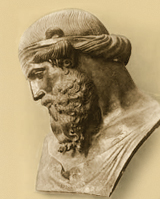
References
Read more about Benjamin Jowett, translator of the first comprehensive collection of Plato’s Dialogues in English.