- Via Christa
- » Library
- » Plato’s Dialogues
- » Epinomis, W. R. M. Lamb, Introduction and Translation
Epinomis
By Plato of Athens
Introduction and Translation
By W. R. M. Lamb
The name of this short dialogue denotes that it was intended to serve as an appendix to Plato’s Laws. It is improbable, however, that Plato would have appended this scanty and unsatisfactory chapter to that comprehensive treatise, instead of correcting and expanding the latter in many places where it would apparently have benefited by the author’s revision. And when we consider the Epinomis in detail, we very soon become aware of contact with an inferior mind, which feebly strays and stumbles among the last physical and metaphysical speculations of Plato. The Epinomis appears to have been grouped with the Laws and the Minos, to form a set of three, by Aristophanes of Byzantium, the librarian at Alexandria, about 200 B.C. Already a number of dialogues had been attributed to Plato which by that time were commonly rejected as spurious: many forgeries were doubtless produced to meet the book-collecting zeal of the Ptolemies in the third century B.C., and the Epinomis, like the Minos, contrived to pass muster. Its inclusion here with the Platonic writings may be justified, partly as providing a curious illustration of such forgery, and of the superficial acquaintance with Plato’s genius and manner which must account for the mistake made by the Alexandrian scholars in accepting it as genuine; but it also has some undoubted merits of its own—in its treatment of astronomical and mathematical theories and its earnest, if rather vague, manner of exposition—which deserve the attention of Platonic students. |425|
The primary object of the work is to supplement the passage at the end of the Laws (xii. 966-7), where the training of the Nocturnal Council is briefly sketched. The speakers are the same—the Athenian stranger, Megillus the Spartan, and Cleinias the Cretan—and they are continuing the conversation that they had the day before, as described at the beginning of the Laws (i. 625), on a walk from Cnossos to the temple of Zeus beneath Mount Ida in Crete. As before, the Athenian does most of the speaking. He expounds his scheme of education, consisting of arithmetic, geometry, and astronomy: the last of these is to be a kind of theology, involving a study of the cosmic soul or life-principle, and of the various degrees of divine beings (973-983); the writer here seems to have had his eye on the Timaeus. We proceed to consider the special kind of mathematics recommended in Laws, vii. 818-820, under the heads of arithmetic and geometry as applied to astronomy (990-992).
(Note.—The following version owes many improvements to the translation and commentary of J. Harward, Clarendon Press, 1928.)
Epinomis
[(Ancient Greek: Ἐπινομίς, Epi'nomis) or Philosopher, or Nocturnal Council 1
Characters: Cleinias of Crete, Athenian Visitor, Megillus of Sparta
Cleinias: True to our agreement, good sir, we have come all three—you and I and Megillus here—to consider the question of wisdom, and in what terms we ought to describe that which we say produces, when comprehended, the most excellent disposition of the human being for as much wisdom as is possible for man. For we claim that we have described all the other matters connected with law-giving; but the most important thing for us to discover and state—what it is that mortal man should learn in order to be wise—this we have neither stated nor discovered. Let us, however, now try to make good this defect: else we shall practically leave incomplete the quest on which we all set out, with the purpose of making our subject clear from beginning to end.
Athenian: My dear Cleinias, you are quite right, yet I |429| think you are about to hear a strange statement; and, in a sense, one that is not so strange either. For many on becoming acquainted with life have the same account to give—that the human race will not be blessed or happy. So follow me now and apprehend if you conceive me, as well as them, to be giving a proper account of this matter. I say it is impossible for men to be blessed and happy, except a few; that is, so long as we are living: I limit it to that. But one may rightly hope to attain after death all the things for whose sake one may strive both in life to live as nobly as one can and in death to find a noble end. 2 What I say is no subtle doctrine, but a thing that all of us, Greeks and foreigners alike, in some way perceive—that from the beginning existence is difficult for every live creature: first, partaking of the state of things conceived, then again, being born, and further, being reared and educated—all these processes involve a vast amount of toil, we all agree. And our time must be a short one, I do not say by a reckoning of our miseries, but of any supposition of what is tolerable. This seems in a way to give some breathing-space about the middle of human life: yet swiftly old age is upon us, and must make any of us loth ever to come to life again, when one reckons over the life one has lived—unless one happens to be a bundle of childish notions. And what can be my evidence for this? It is that such is the nature of the matter now under inquiry in our discussion. We are inquiring, you know, in what way we shall become wise, presuming that each of us has this power in some sort or other: but it evades and escapes us as soon as |431| we attempt any knowledge of reputed arts or knowledges or any of the ordinary sciences, as we suppose them to be; for none of them seems worthy to be called by the title of the wisdom that pertains to these human affairs. Yet the soul firmly believes and divines that somehow in nature she has it, but what it is that she has, or when, or how, she is quite unable to discover. Is not this a fair picture of our puzzle about wisdom and the inquiry that we have to make—a greater one than any of us could expect who are found able to examine ourselves and others intelligently and consistently by every kind and manner of argument? Shall we not agree that this, or the like, is the case?
Cleinias: We shall probably agree with you on that, my good sir, in the hope which in time your aid will surely give us of forming hereafter the truest opinion on these matters.
Athenian: Then first we must go through the other sciences, which are reputed as such, but do not render him wise who acquires and possesses them; in order that, having put them out of the way, we may try to bring forward those that we require, and having brought them forward, to learn them.
First, therefore, let us observe that while the sciences which are first needs of the human race are about the most necessary and truly the first, yet he who acquires a knowledge of them, though in the beginning he may have been regarded as wise in some sort, is now not reputed wise at all, but rather incurs reproach by the knowledge he has got. Now we will mention what they are, and that almost everyone who makes it his goal to be thought likely to prove himself in the end as good a man as possible avoids them, in order to gain the acquirements of understanding |433| and study. So first let us take that which removed us from the practice among animate beings of eating each other and, as the story goes, has made us refrain entirely from some, while it has settled us in the lawful eating of others. 3 May the men of old time be gracious to us, as they are: for we must take our leave of whatever men were the first of those we were just mentioning; 4 but at any rate the making of barley-meal and flour, with the sustenance thereof, is fine and good indeed, yet it is never like to produce a perfectly wise man. For this very name of making must produce 5 an irksomeness in the actual things that are made. Nor can it well be husbandry of land in general: for it is not by art but by a natural gift from Heaven, it seems, that we all have the earth put into our hands. Nor again is it the fabrication of dwellings and building in general, nor the production of all sorts of appliances—smiths’ work, and the supply of carpenters’, moulders’ and plaiters’ work, and, in fine, all kinds of implements; for this is of advantage to the public, but is not accounted for virtue. Nor again the whole practice of hunting, which although grown extensive and a matter of skilled art, gives no return of magnificence with its wisdom. Nor surely can it be divination or interpretation 6 as a whole; for these only know what is said, but have not learnt whether it be true.
And now that we see that the acquisition of necessaries is achieved by means of art, but that no such art makes any man wise, there may be some diversion remaining after this—imitative for the most part, but |435| in no way serious. For they imitate with many instruments, and with many imitative acts, not altogether seemly, of their very bodies, in performances of speech and of every Muse, and in those whereof painting is mother, and whereby many and most various designs are elaborated in many sorts, moist and dry; and though a man ply his craft in these with the greatest zeal, in nothing is he rendered wise by such imitation.
And when all these have been performed, there may yet remain assistance, in countless forms and countless cases: the greatest and most useful is called warfare, the art of generalship; most glorified in time of need, requiring most good fortune, but in nature assigned rather to valour than to wisdom. And that which they call medicine is likewise, of course, an assistance in almost every case towards things of which animal nature is deprived by seasons of untimely cold and heat and all such visitations. But none of these aids is of high repute for the truest wisdom: for they are borne along by opinion, as inaccurate matter of conjecture. We may, I suppose, speak of pilots and sailors also as giving assistance: yet you shall not report, to appease us, a single wise man from amongst them all; for none of them can know the wrath or amity of the wind, a desirable thing for all piloting. Nor again all those who say they can give assistance in law-suits by their powers of speech, men who by memory and skill in opinion pay attention to human character, but are far astray from the truth of what is really just.
There still remains, as a claimant to the name of wisdom, a certain strange power, which most people would call a natural gift rather than wisdom, appearing |437| when one perceives someone learning this or that lesson with ease, and remembering a great many things securely; or when a man recalls what is suitable to each case, as what should properly be done, and does it quickly. Some people will describe all this as nature, others as wisdom, and others as a natural readiness of mind: but no sensible person will ever call a man really wise for any of these gifts.
But surely there must be found some science, the possession of which will cause the wisdom of him who is really wise and not wise merely in men’s opinion. Well, let us see: for in this laborious discussion we are trying our hardest to find some other science, apart from those we have mentioned, which can really and reasonably be termed wisdom; such an acquirement as will not make one either a drudge or a witling, but will enable one to be a wise and good citizen,—just ruler and just subject—of his city, and also decorous. 7 So let us look for this one first, and see what single science it is of those that we now have which, by removing itself or being absent from human nature, must render mankind the most thoughtless and senseless of creatures. Well, there is no great difficulty in making that out. For if there is one more than another, so to speak, which will do this, it is the science which gave number to the whole race of mortals; and I believe God rather than some chance gave it to us, and so preserves us. And I must explain who it is that I believe to be God, though he be a strange one, and somehow not strange either: for why should we not believe the cause of all the good things that are ours to have been the cause also of what is far the greatest, understanding? And who is it that I magnify with the name of God, Megillus |439| and Cleinias? It must be Heaven, which has full claim, no less than all other spirits and gods also, to our honour, and especially to our prayers. That it has been the cause of all the other good things we have, we shall all admit: that it really gave us number also, we assert, and that it will add to this gift, if we will but follow its lead. For if one enters on the right theory about it, whether one be pleased to call it World-order or Olympus or Heaven—let one call it this or that, but follow where, in bespangling itself and turning the stars that it contains in all their courses, it produces the seasons and food for all. And thence, accordingly, we have understanding in general, we may say, together with all number, and all other good things: but the greatest of these is when, after receiving its gift of numbers, one explores the whole circuit. 8
Moreover, let us turn back some little way in our discussion and recall how entirely right we were in conceiving that if we should deprive human nature of number we should never attain to any understanding. For then the soul of that creature which could not tell 9 things would never any more be able, one may say, to attain virtue in entirety; and the creature that did not know two and three, or odd or even, and was completely ignorant of number, could never clearly tell of things about which it had only acquired sensations and memories. From the attainment of ordinary virtue—courage and temperance—it is certainly not debarred: but if a man is deprived of true telling he can never become wise, and he who has not the acquirement of wisdom |441|—the greatest part of virtue as a whole—can no more achieve the perfect goodness which may make him happy. Thus it is absolutely necessary to postulate number; but to show why this is necessary would need a still fuller argument than any that has been advanced. Yet here is one that will be particularly correct—that of the attributes of the other arts, which we granted them just now in going through the list of all the arts, not a single one can remain, but all of them are utterly discarded, when once you remove numeration.
And one may judge, perhaps, that the human race needs number for but slight uses, by glancing at the arts—and yet even that is a great matter—but if one could see the divinity of birth, and its mortality, in which awe of the divine will be taught, and number in its reality, 10 still it is not anybody who could tell how great is the power we should owe to the accompaniment of number as a whole—for it is clear that everything in music needs a distinct numeration of movement and notes—and above all, how it is the cause of all good things; and that it is the cause of no evil thing that may haply befall is a point that must be well understood. Nay, the motion that we may call unreasoned and unordered, lacking grace and rhythm and harmony, and everything that has a share of some evil, is deficient in number altogether; and in this light must the matter be regarded by him who means to end his life in happiness. And no one who does not know the just, the good, the honourable and all the rest of such qualities will ever, by |443| grasping true opinion, number them off so as fully to persuade both himself and his neighbour.
Now let us go on to inquire into the actual question of how we learnt to count in numbers. Tell me, whence have we got the conception of one and two, a natural gift that we have from the All to enable us to conceive of such things? Then again, many other living creatures are not endowed by nature even to the mere point of being enabled by the Father to learn to count; whereas in us, in the first place, God implanted this very faculty, so that we might be equal to comprehending a thing shown to us, and in the second place, he showed, and shows. Among such things, what one more singularly beautiful can a man behold than the world of day? Then he comes to the province of night with his vision; and there he will find quite another sight before him. And so the heaven, revolving these very objects for many nights and many days, never ceases to teach men one and two, until even the most unintelligent have learnt sufficiently to number; for that there are also three and four and many, each of us must further conceive on seeing those objects. And among them God made one thing that he wrought, the moon, which shows herself at one time larger, at another smaller, and runs her course, showing ever a new shape, 11 until fifteen days and nights are passed: this is her circuit, if one chooses to sum her orbit, as one and entire, in one; 12 so that, we may say, even the least intelligent creature must learn it, among those on whom God has bestowed the natural gift of being |445| able to learn. Within these limits, and in this sphere, every creature so enabled has been made fully apt for numeration,—when it considers any unit by itself. But as to reckoning number, as they all do in their relations to each other, I think that God, not only for a greater reason, but to this end installed, as we mentioned, the waxing and waning of the moon, and combined the months to make up the year, and they all began to comprehend number in relation to number by a happy fortune. Hence it is that we have fruits and the teeming of the earth, so that there may be food for all creatures, with no inordinate or immoderate occurrences of winds and rains: but if in spite of this something does occur in an evil way, we ought not to charge it upon the divine but upon the human nature, for not disposing our own lives aright.
Now in our inquiry about laws, you know we decided that all other things that are best for men are easy to discover, and that everyone may become competent both to understand and to per- form what he is told, if he discovers what is that which is likely to profit him, and what is not profitable: well, we decided, and we are still of the same mind, that all other studies are not very difficult, but that this of learning in what way we should become good men is one of the utmost difficulty. Everything else, again, that is good, as they say, is both possible and not difficult to acquire, and the amount of property that is wanted or not wanted, and the state of body that is wanted or not: everyone agrees that a good soul is wanted, and agrees, moreover, as to the manner of its goodness, that here again it must be just and temperate and brave; but whereas everyone |447| says it must be wise, no one any longer agrees at all with anyone else, in most cases—we have just now explained—as to what its wisdom should be. So now we are discovering, besides all those former kinds, a wisdom of no mean worth for this very purpose of showing how he is wise who has learnt the things that we have set forth. But whether he is wise who has knowledge of these things and is good at them, is what we must now examine.
Cleinias: Good sir, how properly you said that you are undertaking to speak great things on great subjects! 13
Athenian: Yes, for they are not small, Cleinias: but what is more difficult is to make sure that they are entirely and in every sense true.
Cleinias: Very much so. good sir: but still, do not weary of the task of stating your views.
Athenian: I will not, and therefore you two must not weary either of listening to me.
Cleinias: Agreed: I give you my word for us both.
Athenian: Thank you. To begin with, then, we must necessarily state first, it would seem—best of all, in a single word, if we are able so to put it—what is that which we suppose to be wisdom; but if we are utterly unable to do this, we must say in the second place what and how many kinds of it there are that a man must have acquired, if he is to be wise according to our story.
Cleinias: Pray speak on.
Athenian: And as to the next step, it will be no offence in the lawgiver that he speaks finer and higher things than have been previously said about the gods in his portrayal, making as it were a noble sport and |449| honouring the gods, with high tribute of his hymns and happiness throughout the period of his own life.
Cleinias: Well spoken, indeed, good sir. Yes, may you have this consummation of your laws, after making fine sport in praising the gods and having passed a purer life, to find thereby the best and fairest end!
Athenian: Then how, Cleinias, do we mean it? Should we honour the gods, think you, to the utmost with our hymns, praying that we may be moved to speak the fairest and best things about them? Do you mean it so, or how?
Cleinias: Nay, absolutely so. Now, my excellent friend, pray to the gods with confidence, and utter the fine specimen of a speech that you are moved to make about the gods and goddesses.
Athenian: It shall be done, if the god himself will be our guide. Do but join in my prayer.
Cleinias: Speak what follows next.
Athenian: It is necessary, then, it seems, that I should first portray in better terms, according to our previous statement, the generation of gods and of living creatures, which has been ill portrayed by those before us; I must resume the statement which I have attempted in speaking against the impious, 14 declaring that there are gods who have a care for all things, small and greater, and who are well-nigh inexorable in maintaining the claims of justice: that is, if you remember, Cleinias; for you did take memoranda 15 besides, and indeed what then was spoken was very true. And the most important part of it was that every soul was senior to each body: 16 do you |451| remember? Or in any case, surely, this must be so? For that which is better and more ancient and more godlike is credibly so in comparison with the ... 17 the junior, and the less honoured; and everywhere, a thing governing is senior to a thing governed, and the driver every way senior to the driven. So much, then, let us conclude—that soul is senior to body; and if this is the case, our first of first things in creation may be taken as a more credible foundation. So let us take it that our beginning of the beginning is more appropriate, and that we are most correctly entering upon the principal parts of wisdom relating to the generation of the gods.
Cleinias: Let this be so, in the best statement that we can give.
Athenian: Come then, shall we say that a living creature is most truly described by its nature, as a case of one combination of soul and body so uniting as to beget one shape?
Cleinias: Correct.
Athenian: And such a thing is most justly called a living creature?
Cleinias: Yes.
Athenian: On the most likely account there are to be reckoned five solid bodies. 18 from which one might fashion things fairest and best; but all the rest of creation has a single shape, 19 for there is nothing that could come to be without a body and never possessing any colour at all, except only that really most divine creature, the soul. And this alone, one may say, has the business of fashioning and manufacturing, whereas the body, as we call it, has that |453| of being fashioned and created and seen. But the other—let us repeat it, for not once only be it said—has the properties of being unseen, of knowing and being thought, and of being endowed with memory and reckoning by alternations of odd and even.
The bodies, then, being five, we must name them as fire, water, and thirdly air, earth fourth, and ether fifth; and by predominance of these are each of the many varieties of creatures perfected. We should learn this by single instances in the following way. Let us take first the earthy as one sort—all men, all things that have many feet or none, and those that move along and that stay still, held in place by roots; but we must conceive its unity thus,—though all these things are the outcome of all kinds, yet for the most part it is of earth and of solid substance. And another kind of creature we must regard as second in birth as well as one that can be seen: for its greatest part is of fire, though it has some earth and air, and has slight portions of all the others also, wherefore we must say that all sorts of creatures are born of them, things that are seen, and these again we must conceive to be the heavenly kinds of creatures, which altogether, we must agree, have been born as the divine race of stars, endowed with the fairest body as also with the happiest and best soul. 20 One or other of two lots we may very well, in our opinion, assign to them: for each of them is either imperishable and immortal, and by all necessity wholly divine, or has a certain longevity sufficient for the life of each, such that nothing could ever require a longer one.
Let us therefore first observe that, as we state it, |455| such creatures are of two sorts—for let us state it again—both visible, the one of fire, as would appear, entirely, and the other of earth; and the earthy moves in disorder, whereas that of fire has its motion in perfect order. Now that which has motion in disorder we should regard as unintelligent, acting like the animal creatures about us for the most part; but that which has an orderly and heavenly progress must be taken as strongly evincing its intelligence. For in passing on and acting and being acted upon always in the same respects and manner it must provide sufficient evidence of its intelligent life. The necessity 21 of a soul that has acquired mind will prove itself by far the greatest of all necessities; for it makes laws as ruler, not as ruled; and this inalterable state, when the soul has taken the best counsel in accord with the best mind, comes out as the perfect thing in truth and in accord with mind, and not even adamant could ever prove stronger than it or more inalterable; but in fact the three Fates have taken hold, and keep watch that what has been decided by each of the gods with the best counsel shall be perfect. And men ought to have found proof of the stars and the whole of that travelling system being possessed of mind in the fact that they always do the same things because they do what has been decided long ago for an incalculable time, not deciding differently this way and that, and doing sometimes one thing, sometimes another, in wanderings and changes of circuit. Most of us have thought just the opposite—that because they do the same things in the same way they have no soul: the multitude followed the lead of the unintelligent so far as to suppose that, whereas humanity was intelligent and |457| living because it moved about, divinity was unintelligent because it abode in the same courses. But if man had sided with the fairer and better and friendly part, he might have concluded that he ought to regard as intelligent—and for this very reason—that which acts always in the same respects, in the same way, and from the same causes; and that this is the nature of the stars, fairest to see, and passing along, dancing 22 the fairest and most magnificent of all dances in the world, they perform their service to all living creatures. And now, to see how justly we speak of their living spirit, let us first consider their great size. For they are not actually those small things that they appear to be, but each of them is immense in its bulk; we should do well to believe this, because there are ample proofs of such a conclusion. For we can rightly consider the whole of the sun as larger than the whole of the earth, and all the travelling stars are of amazing size. Let us conclude then how it can possibly be that any natural force revolves this great mass always in the same time as that in which it is now being revolved. God, then, I say, will be the cause, and never in any other way is it possible. For never can a thing get living spirit by any other means than by the act of God, as we have explained; and since God is able to do this, he has found it a perfectly easy matter, firstly that any body and a whole mass should be made a living creature, and secondly to move it in the course he considers best. So now I trust we may make one true statement about all these things: it cannot be that earth and heaven and all the stars and all the masses they comprise, without soul attached to each or resident in each, should pass along as they do, so |459| exactly to year and month and day, and that all the good things that happen should happen for us all.
And according as man is a meaner creature, he should show himself, not a babbler, but a speaker of clear sense. If, then, anyone shall speak of certain onrushes or natural forces of bodies or the like as causes, he will say nothing clear: but we must certainly recall what we have said, and see whether our statement is reasonable or is utterly at fault—namely, in the first place, that existence is of two kinds, the one soul, and the other body, and that many things are in either, though all are different from each other and those of the one kind from those of the other. 23 and that there is no other third thing common to any of them; and that soul excels body. Intelligent, of course, we shall hold it to be, and the other un- intelligent; the one governs, the other is governed; and the one is cause of all things, while the other is incapable of causing any of its experiences: so that to assert that the heavenly bodies have come into existence through anything else, and are not the offspring, as we have said, of soul and body, is great folly and unreason. However, if our statements on all such existences are to prevail, and the whole order of them is to be convincingly shown to be divine by their origin, we must certainly class them as one or the other of two things: either we must in all correctness glorify them as actual gods, or suppose them to be likenesses produced, as so many images, of the gods, creations of the gods themselves. For they are the work of no mindless or inconsiderable beings but, as we have said, we must class them as one or other of these things; and, if classed as the latter, we must |461| honour them far above all images: for never will fairer or more commonly owned images be found among all mankind, none established in more eminent places, none more eminent in purity, majesty, and life altogether, than in the way in which their existence is altogether fashioned. Well then, for the present let us attempt so much in treating of the gods, as to try—after observing the two living creatures visible to us, of which we call one immortal, and the other, the earthy, all a mortal creation—to tell of the three middle things of the five, 24 which come most evidently, according to the probable opinion, between those two. For let us consider ether as coming next after fire, and let us hold that soul fashions from it live creatures with their faculties,—as in the creatures of the other kinds,—belonging for the most part to that one substance, but in the lesser parts derived from the other elements for the sake of combination. After ether, there is fashioned by soul another kind of creature from air, and the third kind from water; and by having produced all these it is likely that soul filled the whole heaven with creatures, having made use of all the kinds so far as it could, and all the creatures having been made participators in life; but the second, third, fourth, and fifth kinds, starting from the birth of the manifest gods, end finally in us men. 25
Now the gods—Zeus and Hera and all the rest—each man must regard in what light he pleases, though according to the same law, 26 and must take this account as reliable. But as our visible gods, greatest |463| and most honourable and having keenest vision every way, we must count first the order of the stars and all else that we perceive existing with them; and after these, and next below these, the divine spirits, 27 and air-borne race, holding the third and middle situation, source of interpretation, which we must specially honour with prayers for the sake of an auspicious journey across.28 We must say of each of these two creatures—that which is of ether and, next to it, that of air—that it is not entirely plain to sight: when it is near by, it is not made manifest to us; but partaking of extraordinary intelligence, as belonging to an order which is quick to learn and strong in memory, we may say that they understand the whole of our thoughts, and show extraordinary kindness to anyone of us who is a good man and true, and hate him who is utterly evil, since they can have a feeling of pain. For we know that God, who has the privilege of the divine portion, is remote from these affections of pain and pleasure, but has a share of intelligence and knowledge in every sphere; and the heaven being filled full of live creatures, they interpret all men and all things both to one another and to the most exalted gods, because the middle creatures move both to earth and to the whole of heaven with a lightly rushing motion. The kind which is of water, 29 the fifth, we shall be right in representing as a semi-divine product of that element, and it is |465| at one time seen, but at another is concealed through becoming obscure, presenting a marvel in the dimness of vision. So these five being really existent creatures, wherever any of us came upon them, either happening upon them in the dream-world of sleep, or by something spoken to persons listening in health, or equally in sickness, through ominous utterances and prophecies, or again when they have met them at the end of life—opinions that occur to us both in private and in public, whence many sanctities of many beings have arisen, and others shall arise—in regard to all these the lawgiver who possesses even the slightest degree of mind will never dare by innovations to turn his city to a divine worship which is lacking in certainty. Nor indeed will he hinder men from what ancestral custom has ordained regarding sacrifices, when he knows nothing at all of the matter, just as it is not possible for mortal nature to know about such things. But of the gods who are really manifest to us 30 the same argument must surely hold—that those men are most evil who have not courage to tell us of them and make manifest that these are likewise gods, but without any frenzied rites, or any tribute of the honours that are their due. But as things are, we have a strange conjunction of proceedings: for suppose that one of us had seen the sun or moon being born and observing all of us, and uttered no word through some impotence of speech, and should not also at the same time be zealous, so far as in him lay, when they lacked their share of honour, to bring them in all evidence to an honoured place, and cause festivals and sacrifices to be offered to them, and apportion to each a reserved space of time for the greater or lesser length of its |467| year, 31 as may happen: would it not be agreed both by himself and by another who observed it that he would justly be described as an evil man?
Cleinias: To be sure he would, my good sir; nay, most evil.
Athenian: Well then, this, my dear Cleinias, is what, you may take it, is evidently happening to me now.
Cleinias: How do you mean?
Athenian: Let me tell you, there are eight powers of those contained in the whole heaven which are cognate to each other: these I have observed, and it is no great achievement; for it is easy enough for anybody. Three of them are that of the sun, for one, that of the moon for another, and a third that of the stars which we mentioned a little while ago; and there are five others besides. 32 Now in regard to all these and those beings who either have their own motion in these, or are borne in vehicles so as to make their progress thus, let none of us all ever idly suppose that some of them are gods, while others are not, or that some are legitimate, while others are of a certain kind which it is not permissible to any of us even to express; but let us all declare and say that they are all cognate and have cognate lots, and let us render them due honour, and not, while giving to one a year, to another a month, to others appoint neither a certain lot nor a certain time in which each travels through its particular orbit, completing the system which the divinest reason of all 33 appointed to be visible. At this first the man who is blest marvels, and then he feels a passion for understanding so much as is possible for mortal nature, believing that thus he |469| will best and most happily pass through life, and at the end of his days will arrive at regions meet for virtue; and having been truly and really initiated, and, himself one, partaken of wisdom that is one, he will continue for the rest of time to be a spectator of what is fairest, so far as sight can go. And now after this it remains for us to say how many and who these beings are: for we shall never be found to be deceivers. So much, at least, I asseverate with certainty: I say, once more, that there are eight of them, and that while three 34 of the eight have been told, five yet remain. The fourth 35 motion and transit together with the fifth, 36 are almost equal to the sun in speed, and on the whole are neither slower nor swifter. Of these three, the one who has sufficient mind must be leader. So let us speak of them as powers of the sun and of Lucifer, and of a third, 36 which we cannot express in a name because it is not known; and he is to blame for this who first observed these things, since he was a foreigner: for it was an ancient custom that nurtured those who first re- marked these things owing to the fairness of the summer season which Egypt and Syria amply possess, so that they constantly beheld the whole mass of stars, one may say, revealed to their sight, since they had got them continually without obstruction of clouds and rains in the sky; whence they have spread abroad in every direction and in ours likewise, after the testing of thousands of years, nay, of an infinite time. And therefore we should not hesitate to include them in the scope of our laws; for to say that some divine things should have no honour, while others should have it, is clearly a sign of witlessness; and as to their having got no names, the cause of it |471| should be stated as we have done. For indeed they have received titles of gods: thus, that Lucifer, or Hesperus (which is the same), should belong to Aphrodite, 37 we may take as reasonable, and quite befitting a Syrian lawgiver; 38 and that that which follows the same course as the sun and this 39 together may well belong to Hermes. 40 Let us also note three motions of bodies 41travelling to the right with the moon and the sun. One must be mentioned, the eighth, 42 which we may especially address as the world-order, and which travels in opposition to the whole company of the others, not impelling them, as might appear to mankind who may have scant knowledge of these matters. But we are bound to state, and do state, so much as adequate knowledge tells us. For real wisdom shows herself in some such way as this to him who has got even a little share of right and divine meditation. And now there remain three stars, of which one is distinguished from the others by its slowness, and some speak of it under the title of Saturn; the next after it in slowness is to be cited as Jupiter; and the next after this, as Mars, which has the ruddiest hue of all. Nothing in all this is hard to understand when someone expresses it; but it is through learning, as we declare, that one must believe it.
But there is one point which every Greek should bear in mind—that of all Greeks we have a situation which is about the most favourable to human excellence. 43 The praiseworthy thing in it that we have to |473| mention is that it may be taken as midway between a wintry and a summery climate; and our climate, being inferior in its summer to that in the region over there, 44 as we said, has been so much later in imparting the cognizance of the order of these deities. And let us take it that whatever Greeks acquire from foreigners is finally turned by them into something nobler; and moreover the same thing must be borne in mind regarding our present statements—that although it is hard to discover everything of this kind beyond dispute, there is hope, both strong and noble, that a really nobler and juster respect than is in the combined repute and worship which came from foreigners will be paid to all these gods by the Greeks, who have the benefit of their various education, their prophecies from Delphi, and the whole system of worship under their laws. And let none of the Greeks ever be apprehensive that being mortals we should never be concerned with divine affairs; 45 they should rather be of the quite opposite opinion, that the divine is never either unintelligent or in any ignorance of human nature, but knows that if it teaches us we shall follow its guidance and learn what is taught us. That it so teaches us, and that we learn number and numeration, it knows of course: for it would be most utterly unintelligent if it were ignorant of this; since it would truly, as the saying is, be ignorant of itself, vexed with that which was able to learn, instead of whole-heartedly rejoicing with one who became good by God s help. And indeed there is much good reason to suppose that formerly, when men had their first conceptions of how the gods came to exist and with what qualities, |475| and whence, and to what kind of actions they proceeded, they were spoken of in a manner not approved or welcomed by the prudent, nor were even the views of those who came later, among whom the greatest dignity was given to fire and water and the other bodies, while the wonderful soul was accounted inferior; and higher and more honoured with them was a motion assigned to the body for moving itself by heat and chills and everything of that kind, instead of that which the soul had for moving both the body and itself. 46 But now that we account it no marvel that the soul, once it is in the body, should stir and revolve this and itself, neither does our soul on any reckoning mistrust her power of revolving any weight. And therefore, since we now claim that, as the soul is cause of the whole, and all good things are causes of like things, while on the other hand evil things are causes of other things like them, it is no marvel that soul should be cause of all motion and stirring—that the motion and stirring towards the good are the function of the best soul, and those to the opposite are the opposite 47—it must be that good things have conquered and conquer things that are not their like.
All this we have stated in accordance with justice, which wreaks vengeance on the impious: but now, as regards the matter under examination, it is not possible for us to disbelieve that we must deem the good man to be wise; and let us see if we may perhaps be able to perceive this wisdom which we have all this while been seeking in either education or some art, which if we fail to perceive among those that are just, our condition will be that of ignorant persons. We can |477| succeed, it seems to me, and I must say how: for I have sought this wisdom high and low, and so far as it has been revealed to me I will try to render it plain to you. Now the fact that the greatest part of virtue is not properly practised is the cause of our condition: this is just now indicated—it seems clear to me—by what has been said. For let no one ever persuade us that there is a greater part of virtue, for the race of mortals, than piety; and I must say it is owing to the greatest stupidity that this has not appeared in the best natures. And the best are they which can only become so with the greatest difficulty, but the benefit is greatest if they do become so: for a soul that admits of slowness and the opposite inclination moderately and gently will be good-tempered; 48 and if it admires courage, and is easily persuaded to temperance, and, most important of all, in natures of this sort, has the strength to learn and a good memory, it will be able to rejoice most fully in these very things, so as to be a lover of learning. For these things are not easily engendered, but when once they are begotten, and receive due nourishment and education, they will be able to restrain the multitude of men, their inferiors, in the most correct way by their every thought, every action, and every word about the gods, in due manner and due season, as regards both sacrifices and purifications in matters concerning gods and men alike, so that men contrive no life of pretence, but truly honour virtue, which indeed is the most important matter of all for the whole state. That section 49 of us, then, we say is naturally the most |479| sovereign, and supremely able to learn the best and noblest lessons that it may be taught: but it cannot get this teaching either, unless God gives his guidance. If, however, it should be so taught, but should fail to get the proper instruction, it were better for it not to learn. Nevertheless it follows of necessity from our present statements, that I also state that the nature which is of this kind—the best—should learn these things. Let us try, then, to set forth in our statement what things these are, and of what kind, and how one should learn them, so far as our ability permits both me the speaker and those who are able to hear in what manner one will learn the proper reverence of the gods. It is, indeed, a rather strange thing to hear; but the name that we, at any rate, give it—one that people would never suppose, from inexperience in the matter—is astronomy; people are ignorant that he who is truly an astronomer must be wisest, not he who is an astronomer in the sense understood by Hesiod and all the rest of such writers, the sort of man who has studied settings and risings; but the man who has studied the seven 50 out of the eight orbits, each travelling over its own circuit in such a manner as could not ever be easily observed by any ordinary nature, that did not partake of a marvellous nature. As to this, we have now told it, and shall tell, as we propose, by what means and in what manner it ought to be learnt; and first let us make the following statement.
The moon travels through its orbit very swiftly, bringing the month and the full-moon first; and in the second place we must remark the sun, bringing his solstices as he travels the whole of his orbit, and with him his satellites. But to avoid repeating again and again the same things on the same subjects in |481| our discussion, the other courses of these bodies that we have previously set forth are not easily understood: we must prepare our faculties, such as they may possibly be, for these matters; and so one must continually strive hard to teach the pupil many things beforehand, and habituate him in childhood and youth. And therefore there will be need of studies: the most important and first is, in fact, of numbers in themselves; not of those which are corporeal, but of the whole origin of the odd and the even, and the greatness of their influence on the there comes next after these what they call by the very ridiculous name of geometry 51 when it proves to be a manifest likening 52 of numbers not like one another by nature by reference to the province of planes; and this will be clearly seen by him who is able to understand it to be a marvel not of human, but of divine origin. And then, after that, the numbers thrice increased and like to the solid nature, and those again which have been made unlike, he likens by another art, namely, that which its adepts called stereometry; and a divine and marvellous thing it is to those who envisage it and reflect how the whole of nature moulds off species and class, as power and its opposite 53 continually turn upon the double according to each analogy. Thus the first |483| analogy is of the double, passing by numerical scale in the proportion of one to two, and that which is according to power is double; that which passes to the solid and tangible is likewise again double, having proceeded from one to eight; but that passing to a mean of the double, as much more than the less as it is less than the greater, while the other mean 54 exceeds and is exceeded by the same portion of the extremes themselves—between six and twelve comes the whole-and-a-half (9 = 6 + 3) and whole-and-a-third (8 = 6 + 2)—turning between these very two, to one side or the other, this analogy assigned to men an accordant and proportioned use for the purpose of rhythm and harmony in their pastimes, and has been bestowed by the blessed dance of the Muses.
In this way then let all these things come to pass, and so let them be. But as to their crowning point, we must go to divine generation and therewith the fairest and divinest nature of visible things, so far as God has granted the vision of it to men; a vision that none of us may ever boast of having received at his ease without the conditions here laid down. And besides these requirements, one must refer the particular thing to its generic form in our various discussions, questioning and disproving what has been wrongly stated; for it 55 is rightly found to be altogether the finest and first of tests for the use of men, while any that pretend to be tests, without being so, are the vainest of all labours. And further, we must mark the exactness of the time, how exactly it completes all the processes of the heavens; for here he who is convinced of the truth of the statement |485| which has been made—that the soul is at once older and more divine than the body—will hold it a most admirable and satisfactory saying that all things are full of gods, and that we have never been disregarded in the least by any forgetfulness or neglect in these our superiors. And our view about all such matters must be that, if one conceives of each of them aright, it turns out a great boon to him who receives it in a proper way; but failing this, he had better always call on God. The way is this—for it is necessary to explain it thus far: every diagram, and system of number, and every combination of harmony, and the agreement of the revolution of the stars must be made manifest as one through all 56 to him who learns in the proper way, and will be made manifest if, as we say, a man learns aright by keeping his gaze on unity; for it will be manifest to us. as we reflect, that there is one bond naturally uniting all these things: but if one goes about it in some other way, one must call on Fortune, as we also put it. For never, without these lessons, will any nature be happy in our cities: no, this is the way, this the nurture, these the studies, whether they be difficult or easy, this is the path to pursue: to neglect the gods is not permissible, when the happiness that is properly referred to the fame of them all has been made manifest. And the man who has acquired all these things in this manner is he whom I account the most truly wisest: of him I also assert, both in jest and in earnest, that when one of his like completes his allotted span with |487| death, let me say if he still exists, though dead, he will not partake any more of the many sensations then as he does now, but having alone partaken of a single lot and having grown from many into one, will be happy and at the same time most wise and blessed, whether one has a blessed life in continents or in islands; and that such a man will partake always of the like fortune, and whether his life be spent in a public or in a private practice of these studies he will get the same treatment, in just the same manner, from the gods. And what we said at the beginning stands now also unchanged as a really true statement, that it is not possible for men to be completely blessed and happy, except a few—this has been correctly spoken. For as many as are divine and temperate also, and partakers of the rest of virtue in their nature, and have acquired besides all that pertains to blessed study—and all this we have explained—are the only persons by whom all the spiritual gifts are fully obtained and held. Those then who have thus worked through all these tasks we speak of privately, and publicly establish by law, as the men to whom, when they have attained the powers of seniority, the highest offices should be entrusted, while the rest should follow their lead, giving reverent praise to all gods and goddesses; and ordain that we most rightly incite all the Nocturnal Council to this wisdom, as we have now sufficiently distinguished and approved it.
Endnotes
1^ i.e. describing the special training of the members of the Nocturnal Council of the Laws, xii. 961 ff.: this Council of the projected Cretan colony, corresponding to the Athenian Areopagus, was to consist of high magistrates and retired officials, and hold its meetings at night. The characters and the scene (Crete) are the same as those of the Laws.
2^ The translation does not attempt to reproduce the alliteration of the last four words of this sentence.
3^ ‘Some’ means ‘men,’ and ‘others’ means ‘other animals.’
4^ i.e. the first men who practised a selective eating of flesh.
5^ The word ‘produce’ is repeated here in a strained sense of ‘declare,’ ‘indicate,’ or the like. The very idea of ‘making’ implies a certain annoyance incompatible with perfect wisdom.
6^ i.e. of omens, heavenly signs, etc.
7^ Literally, ‘in tune,’ and hence ‘fitting in gracefully,’ ‘behaving with good taste,’ etc.
8^ Apparently a metaphor from astronomy, meaning ‘the proper or prescribed course of study’; cf. Plato, Rep. 407e. Or the word ἔχοι may refer to the actual scheme of the celestial order.
9^ There is a curious play here on the two meanings of λόγος—‘reckoning,’ and ‘description.’ (Cf. the like English meanings of ‘tale’ or ‘account.’)
10^ i.e. our birth and death are alike under divine influence, and this means that they are governed by number—a Pythagorean argument.
11^ The meaning obviously required—‘shape’ or ‘phase’—cannot be extracted from ἡμέραν, which is probably a copyist’s error for ἰδέαν.
12^ This seems to mean that the fifteen days from the new moon to the full moon give the basis for summing her whole thirty days’ course—fifteen to the full, and fifteen back.
13^ This remark, however, does not appear to have been made.
14^ i.e. the statement made in Laws x., on the existence of the gods, and the reverence due to them.
15^ There is no hint of this in the Laws.
17^ νέου in the text is a corruption of a word not yet recovered.
18^ i.e. the elements fire, water, air, earth, and ether. Plato (Timaeus 40 a, 81 e) does not allow ether as one of the elements: our author includes it, because he wishes to make it the source of δαίμονες, or spirits that come midway between gods and men in the scale of existence; cf. 984 b, e.
19^ i.e. the generality of things that have come to be have assumed a unity of shape resulting from the afore-mentioned combination of soul and body.
20^ Here the author agrees with Plato, Timaeus 39 e ff.; Laws, x. 889 b.
21^ ‘Necessity’ is used here in the old poetic sense of a compelling or overriding power; cf. the mention of the Fates below, and Laws, 818 a.
23^ Soul and body, in their respective spheres, cover or account for the whole of existent things, of whatever kind, from the astral to the inanimate.
24^ i.e. fire, ether, air, water, earth; cf. 981 c.
25^ First come the stars, or ‘manifest gods’; then the creatures of ether, air and water (the second, third or fourth kinds); and fifth and last, the creatures of earth or mankind.
26^ i.e. the law governing the order or scale of animate creatures which has been described. The writer, like Plato (Timaeus 40 d-41 a), avoids any definite statement about the traditional deities: like Plato again (Timaeus 41a-42e), he is more concerned with the ‘visible gods,’ or stars.
27^ The daemons or divine spirits had their existence and activity ‘betwixt mortal and immortal,’ and they served as interpreters and conveyers of men’s prayers and offerings to the gods, and of the god’s behests and requitals to men (Plato, Sympos. 202 d). Good mortals might become daemons after death (Eurip. Alc. 1003; Plato, Cratyl. 398 b; Lucian, De morte Peregr. 36), and as such they were charged with the guidance and care of mankind (Plato, Laws 713 d; Plutarch, De genio Socr. 58S c).
28^ The ‘journey across’ seems to refer to one part of the ‘conveying’ that daemons performed—conducting the souls of deceased human beings from earth to the abode of the gods.
31^ ‘Year’ is used here for ‘circuit.’
32^ Cf. Plato, Timaeus 38 ff, where God is said to have made, besides the fixed stars, the sun, the moon, and the five planets—Venus. Mercury, Saturn, Jupiter, and Mars—for the generation of time.
33^ i.e. the supreme deity of Plato’s Timaeus.
34^ i.e. sun, moon, and fixed stars.
35^ Venus (or Lucifer); cf. Plato, Timaeus 38 d.
37^ Lucifer, or Hesperus, is for its beauty connected with Aphrodite (and so got the further name of Venus).
38^ The cult of Aphrodite flourished among all the eastern peoples.
40^ Hermes being the god of escort or attendance (whence this ‘power’ came to be known as Mercury).
41^ Mars, Jupiter, and Saturn.
42^ Here, after the sun, moon, Venus, Mercury, Mars, Jupiter, and Saturn, we return to the sphere of the fixed stars (mentioned as the "third power" in 986 b).
44^ Syria and Egypt; cf. 987 a.
45^ Cf. Plato, Laws, vii. 821 a.
46^ These later people, instead of attributing the highest power to the divine stars, attributed it to the ordinary physical forces; cf. Plato, Laws, x. 888 ff.
47^ The evil soul is just hinted at; cf. Plato, Laws, x. 896-897.
48^ Cf. Plato, Politicus, 307 b ff., where the danger of an extreme development of such qualities as temperance, calmness, slowness, and of their opposites in the citizens of a state is expounded.
49^ i.e. those who possess the natures mentioned in 989 b.
50^ i.e. of the sun, the moon, and the five planets; cf. 987 b. With the astronomy and mathematics of the rest of the Epinomis cf. Plato, Laws, vii. 818-820.
51^ Which means literally ‘measuring the earth’; this developed into the arithmetical calculation of squares, cubes, roots, etc. Of. the account Plato gives (Theaetetus 147 d ff.) of ‘quadrangular’ and ‘equilateral’ numbers, showing how the terms of geometry had to be used for arithmetic. As there was no number equal (or ‘like’) to the "square" root of 2, recourse was had to the geometrical symbol of the diagonal of a square whose side is 1; and similarly ‘cubic’ roots were reckoned with the aid of stereometry.
52^ ‘Likening’ here means ‘comparing in an exact manner,’ so as to obtain a ratio or proportion between numbers not directly commensurable; cf. Plato, Laws, viii. 820.
53^ ‘Power’ is multiplication, its ‘opposite’ is extension: 1 point doubled gives the beginning of a line; multiplying 2 by 2 gives 4 as a square surface, and by 2 again, 8 as the cube. So (see below) we proceed ‘from 1 to 8.’
54^ As between 3 and 6, 4 is greater than 3 by ⅓ of 3, and less than 6 by ⅓ of 6.
55^ i.e. Plato’s method of dialectic; see General Introduction.
56^ i.e. we must become aware of a single, unifying scheme of proportion running through geometrical figures and proportions (‘diagrams’), arithmetical proportions (‘systems of number’), harmonic proportions (‘combinations of harmony’)—corresponding to square, line and cube referred to in 991 a—and the rotations of the stars.
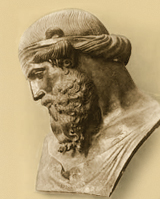
Plato of Athens
428 B.C. — 348 B.C.
Premier Greek philosopher, the Father of Idealism in its many facets: philosophy, metaphysics, ontology, theology, psychology, mysticism, aesthetics, ethics, education, literature, and politics
Reference
Plato. “Epinomis,” Loeb Classical Library, Vol. 12. W. R. M. Lamb, trans. Cambridge, MA, Harvard University Press; London. 1955, pp. 427-487. ISBN 978-0-674-99221-4.