- Via Christa
- » Library
- » Plato’s Dialogues
- » Timaeus, R. G. Bury, Introduction and Translation
Timaeus
By Plato of Athens
Introduction and Translation
By R. G. Bury
From the time of Aristotle downwards the Timaeus has been regarded as one of the most significant writings of Plato. It has arrested the attention of philosophic inquirers because of the scope of its speculations; while the literary genius displayed in the style and diction of its central Myth has compelled the admiration of the artistic reader. The theme of that central Myth is nothing less than the Creation of the Universe—“in the beginning How the Heaven and Earth rose out of Chaos”; and the oracular obscurity with which this abstruse theme is expounded has served to excite rather than repel the interest of the curious student of every age.
The Timaeus is professedly a sequel to the Republic, portions of which are recapitulated in the prefatory chapter, and it is also the first section of a projected trilogy, which was intended to contain also a Critias (of which only a fragment remains) and a Hermocrates. The interlocutors of the dialogue are Socrates, Timaeus, Hermocrates, and Critias. Of Timaeus of Locri nothing authentic is known beyond what we learn from the dialogue itself—that he was a man of high social position and wide culture, especially skilled in mathematics and astronomy: later tradition makes him out a leader of the Pythagorean school. Hermocrates |4| is generally identified with the famous Syracusan general of that name, who is said to have spent his later years in exile at Sparta and in Asia Minor. Critias, a connexion of Plato’s, poet and orator, chief of the 30 tyrants of 404 BC has already figured in the earlier dialogues, Charmides and Protagoras. Of him it was said, according to the Scholiast, that he was “an amateur among philosophers, a philosopher among amateurs.”
The dialogue may conveniently be divided into three main sections:
(1) The Introduction, including the Atlantis legend as related by Solon (19 a-27 c).
(2) The making of the Soul of the World; the doctrine of the Elements; and the theory of matter and of sense-objects (27 c-69 a).
(3) The making of Man’s Soul and Body; physiology and pathology (69 A-end).
Of the introductory section little need be said. The Atlantis legend serves as a connecting link between the Timaeus and the Critias, but how far the legend as here given is really based on earlier tradition, and whether there ever existed any island of the kind described, seems to be quite uncertain. The fact that it would lie somewhere near that volcanic belt of the earth’s crust which stretches from Etna and Vesuvius to Teneriffe may seem to lend some plausibility to the story. In any case the account of the ancient Athenians and the islanders of Atlantis whom they routed is a fine piece of literary fiction; and in its eulogy of Athens it has many points of resemblance to such appreciations as we find in the Menexenus and the third book of the Laws: “the men of Marathon” had their prototypes |5| in the saviours of Greece from Atlantis 9000 years before.
The central portion of the Timaeus is that which has chiefly won it fame. In it is handled the most tremendous of subjects, the construction of the Universe. We are transported in imagination to a point “before the beginning of years,” when time was not, and “the earth was without form and void.” There we follow, step by step, the process whereby the World was built up into a harmonious structure, and Cosmos evolved out of Chaos. We need not repeat here all the details of that process; nor can we deal at length with the many obscure problems and points of controversy which are raised by the mythical language in which the exposition is clothed. But it may be helpful to the reader unversed in Plato’s philosophy if we add some observations, mostly of a general character, calling attention to the most notable points of his doctrine as here set forth.
In a well-known passage of the Phaedo (96 a ff.) Plato had criticized the earlier philosophers for their failure to indicate the Cause of the physical processes by which they explained the World: even Anaxagoras, when he introduces his World-ordering “Reason,” makes very little use of it as a causative principle. A thorough-going teleological explanation of the Universe is what Plato desiderated in the Phaedo, and what he attempts to provide in the Timaeus. But in this connexion it is important to notice that a distinction is drawn between Cause proper, or final cause, and auxiliary Cause, which is the sum of necessary physical conditions. Related to this is the distinction between the operations of Intelligence and the works of Necessity in the formation of the |6| World; we have to recognize that the Divine Reason which in all things designs the best cannot always and completely realize its designs because of an intrinsic and incorrigible element which subsists always in the World.
Another distinction, fundamental in Plato’s philosophy, is that which meets us at the outset of this section—the distinction between Being and Becoming. Being is changeless, eternal, self-existent, apprehensible by thought only; Becoming is the opposite—ever-changing, never truly existent, and the object of irrational sensation. The one is the Ideal sphere, the other the Phenomenal; and it is evident that the visible Universe belongs to the latter. Consequently it cannot be an object of pure thought and does not admit of investigation by “science" in the strict sense of the term. And thus we find Plato emphasizing repeatedly the provisional character of his exposition: the true must be distinguished from the “likely” or probable, and it is only the latter which we can hope to attain in dealing with matters of this kind. In making this distinction Plato was not innovating: long before him Parmenides had divided his exposition into two sections, “the Way of Truth” and “the Way of Opinion,” while Democritus had drawn a sharp line of division between the “Dark Knowledge” we have of sensibles and the “Genuine Knowledge” which apprehends the only realities, the Atoms and the Void. But while Plato is thus careful to mark the hypothetical and uncertain character which attaches to all physical investigation as such, he is obviously serious with the explanations he gives, and regards them as a summary of the best knowledge available de rerum natura. |7|
The rôle of the World-Artificer, the “Demiurge,” is similar to that of the Anaxagorean “Nous” (Reason). He is not a Creator, in the strict sense; that is to say, he does not make things ex nihilo but only imposes order and system on pre-existing Chaos. Nor does he continue to act directly, in propria persona, throughout the process of world-building, but, at a certain stage, hands over his task to the created star-gods and retires into his primal solitude. This, at least, is what the mythical narrative tells us; but later on we hear of “God” (in the singular) or “the Divine” Power, as well as “the Gods” (in the plural), taking an active part in operations marked by rational purpose. The chief characteristic of the Demiurge is his goodness: he aims always at the best: he is, in fact, the embodiment of “the Good” regarded as efficient Cause. This inevitably reminds us of the famous passage in the Republic which describes “the Self-Good,” or supreme Idea of Good, as the source of all knowledge and all existence, the Sun of the intelligible sphere; and many interpreters of Platonism have identified the Demiurge with this Idea. But if the Demiurge is the Idea of the Good, what then is the “Model” or Pattern (paradeigma) in view of which he operates, the “Self-Animal”? Surely it must be an Idea, and a final cause, i.e. the Idea of the Good; in which case the Demiurge cannot be this (or any) Idea. And, in general, we may say that the Ideas are described as objects of intelligence, not intelligences, whereas the Demiurge obviously is an intelligence. Consequently there would seem to be no way of maintaining this identification of the Demiurge with the Idea of the Good except by supposing that there is no real |8| distinction between the Demiurge and his Model, he being at once subject and object, intellect and intelligible, equivalent, in fact, to Aristotle’s Deity—“Thought thinking upon Thought.” But there is no hint in the text of the Timaeus that this is Plato’s meaning. A more plausible identification finds the Demiurge in the “Cause of the Mixture” as expounded in the Philebus (23 d ff.), many phrases of which echo the language of the Timaeus, describing the efficient Cause as a “Demiurgic” power (27 b), “veritable and divine Reason” (22 c, 28 d, 30 c).
The primary operation of the Demiurge is to construct the World-Soul. In his description of this process Plato mixes myth with mathematics in a peculiarly baffling way. The World-Soul is said to be composed of three elements, Sameness, Otherness, and Being; or of “the indivisible and changeless essence,” “the divisible,” and a third essence which is a mean proportional between these two. Moreover, it is constructed so as to combine within itself one “Circle of the Same” and seven “Circles of the Other.” This fact, together with the mathematical details of the construction, suggests at once that the main purpose of the doctrine of the World-Soul is to supply an explanation of the heavenly bodies, their revolutions and periods, the “Circle of the Same” being that of the fixed stars, and the “Circles of the Other” those of the seven planets. The details of Plato’s astronomy (a subject in which he shows great interest both here and elsewhere) need not concern us, but his views about the nature of Soul are of such importance for his philosophy in general that further explanation may be desirable.
Although Timaeus mentions Motion and its kinds |9| before he treats of Soul, this order is really illogical inasmuch as there can be no motion apart from Soul. For already in the Phaedrus, and again in the Laws (896 a), Plato defines Soul as “the self-moving,” the first principle and originator of all movement. It is at once the cause of its own subjective affections (desire, emotion, opinion, etc., see Laws 897 a), and of all motion and change in the corporeal world, which give rise to the sense-qualities of material things. In the Timaeus (34 a) we have seven kinds or modes of Motion distinguished, and in the Laws ten kinds; but both dialogues agree in making one special kind correspond to “the revolutions and reckonings of Reason,” namely the uniform revolution of a sphere revolving on its own axis and in the same spot. That is the highest and best type of motion, the type proper to that prime embodiment of rational activity, the World-All; and in the outer Circle of the Cosmic Sphere, the heaven of the fixed stars, this type of motion is seen at its purest. Moreover, Plato seems to attach a special importance to this “revolution of Reason” because he sees in it an example of the union of opposites, Motion reconciled with Rest, “the Same” with “the Other.”
The precise relation of Reason to Soul is frequently left obscure. If the Demiurge is Reason personified, as one seems bound to suppose, and also the Constructor of Soul, it appears to follow that Reason is separate from Soul and prior thereto. On the other hand, if Soul is the first cause of Motion and Reason possesses Motion, Soul must be prior to Reason. To resolve this apparent contradiction it seems best to regard Reason as a species of Soul, or a part of Soul (as in the Republic, 435 e ff.); or, to use the language |10| of the Theaetetus (185 e), Reason is Soul functioning “itself by itself.” This view is supported not only by the assigning of “the Motion of Reason” to the (seven) Motions of the Soul, but also by the position ascribed to human reason as one of the three parts of the embodied soul. Further confirmation of this partial identity of Soul and Reason is afforded by the statement (in 37 b-c) that Soul apprehends intelligible objects through the action of “the Circle of the Same,” which is a part of herself, on the principle “like is known by like.” Taking all this into consideration we seem forced to the conclusion that the Demiurge is no separate Power or independent Divinity, but merely a part or faculty of the World-Soul, his apparent independence being due solely to the mythical form of the exposition.
Turning next to the account given of the Body of the Universe, there is no point more obscure or more vehemently disputed than the nature of the so-called “Platonic matter.” The passage which deals with this subject (48 e ff.) begins by stating that besides the Model and the Copy a third principle is necessary to the formation of the World. The Forms which pass in and out of the world of changing elements require a permanent substrate upon which they may imprint themselves. Such a substrate must itself be wholly formless, but capable of receiving forms of every kind; it is essentially “the all-receptive,” “that in which” the forms appear, or “place.” The view taken by Zeller, and other important authorities, identifies this with Space. No doubt there is a good deal in Plato’s account which seems to favour this view; but it does not seem quite satisfactory. For one thing, if Plato means simply “empty space,” or |11| “the void,” why does he not say so plainly? Why so much mystification about it? Again, irregular motion (52 d) and weight (53 a) are ascribed to the substrate, but are hardly attributes of empty space. The supporters of the identification with Space try to avoid some of the difficulties it involves by distinguishing between a “primary matter,/“ which is Space, and a “secondary matter” of a mythical character; but this device is neither legitimate nor successful. The fact that the assumption of this substrate is closely connected with Plato’s doctrine of the Elements (53 c ff.) leads us rather to the belief that it corresponds to the Democritean conception of a primitive ground-stuff, void of quality, from which the infinity of atoms are split off. So it may help us to understand the doctrine of the material substrate, regarded in itself, if we consider briefly the doctrine of the elements.
In 31 b ff. we are told that the Body of the Universe is compounded of the four elements—fire, air, water, earth—of which the second and third are mean proportionals between the first and last. In this Plato is merely adopting the doctrine of Empedocles, who affirmed these elements to be “the four roots of all things”; and he gives no hint that they are not basic substances. But when we come to 53 c ff. we are told that these so-called elements are not, strictly speaking, “elements” at all (in the sense of simple basic substances) but compounds; and they are analysed for us into their ultimate constituents. By the aid of the latest researches in Stereometry, Plato explains the formation of the five regular solids (the so-called “Platonic bodies”), four of which he assigns to the elements. Thus it is shown how each of these |12| is an aggregate of basic triangles. For the details of this analysis we must refer to the text itself; but one of the questions it raises deserves attention, since it bears on the problem of the material substrate. If the basic triangles are merely mathematical figures existent in pure space, how can they form solid bodies endowed with corporeal qualities? Is it not more likely that Plato conceived his triangles to be a kind of prisms, corresponding to the solid atoms of Democritus; and if so, must not the substrate in which they are located be something more substantial than pure space?
It is in connexion with the “dim and baffling form” of the Substrate and with the doctrine of the Elements that Plato makes his most positive statement about the Ideas (51 b ff.). Already, in 27 d ff., he had distinguished sharply between eternal Being, the object of thought, and that which is ceaselessly in process of Becoming and Perishing, the object of opinion and sense. This distinction was required in order to make clear the relation between the visible Universe and its Model, the “Self-Animal”; and this Idea of the Universe as a Living Whole is the only Idea referred to in the earlier passage. In the later passage it is the Idea of Fire which is specially mentioned, and other Ideas are implied, though not specified. The terms used in describing Ideas, or “intelligible Forms,” are very similar to those employed in such earlier dialogues as the Symposium, Phaedo, and Republic: the Ideas are eternal, immutable, self-subsistent essences, cognizable only by pure thought. And, what is most remarkable, the proof of the reality of the Ideas is made to lie in the difference between reason and opinion: since reason and |13| opinion are two distinct faculties, they must deal with two different classes of objects, and the objects of Reason can only be intelligible Forms or Ideas. Plato, as it appears from this, approaches the doctrine of the Ideas from the side of Epistemology rather than of Ontology: the reality of the Ideas is an assumption necessary to provide an objective basis for any valid science or system of knowledge. But it cannot be said that the Timaeus adds anything; new to our knowledge of the Ideal Theory, and no unprejudiced reader would venture to claim that “the Timaeus, and the Timaeus alone, enables us to recognize Platonism as a complete and coherent system of monistic idealism,” or to assert that “the Timaeus furnishes us with a master-key, whereby alone we may enter into Plato’s secret chambers.”
In truth, there is but little of metaphysics in the Timaeus; it is mainly occupied with the attempt to give a “probable” account of matters which belong to the sciences of physics and physiology. And the departments of “natural” science in which Plato displays most interest are those which admit of treatment by applied mathematics. Indeed we may fairly suppose that one of the main purposes of the Timaeus is to provide a permanent record of the discoveries of Plato’s friends Theaetetus and Eudoxus in the field of mathematics and astronomy, by enshrining them in a general treatise for which no fitter title could be found than the words “God geometrizes.” Nor was it only for its own sake that Plato valued this branch of learning: he valued it also as a help to the knowledge of law and order, measure and symmetry, uniformity and regularity, harmony and rhythm; and to the application of these to the art of life. By |14| discovering the “numbers and forms” of the divinely ordered Cosmos, and the laws of the motions of the stellar deities, we are determining a standard and pattern for our own souls and their emotions; since our well-being lies in conforming to the Universal Order, keeping step with the rhythm of the Cosmos and in tune with the celestial harmonies. So true is it that “in the image of God made He man,” and that the chief end of Man and his final felicity is “assimilation to God”—Man the visible Microcosm imaging God the invisible Macrocosm. Thus Cosmology is for the sake of Ethics and Politics: the Cosmic Goodness and Beauty are worth study if they teach us to make ourselves more beautiful and good “in the inner man”: for virtue is the first theme of Plato’s teaching and the last.
“Virtue is the first theme of Plato’s teaching and the last.”
In Plato’s view the “natural sciences” with which this dialogue is mainly occupied—physics, biology, and pathology—are precisely those branches of study which are least “scientific” in the proper sense of the word, inasmuch as they deal with objects of sense. Nevertheless they admit of degrees of probability; and in the Timaeus Plato, as we must assume, is giving us what he believes to be a summary of the best available knowledge about these subjects—a summary which might serve as an official hand-book for the members of the Academy. As regards his sources, he draws freely, no doubt, on the writings of earlier physicists, such as Empedocles and Alcmaeon, and of the medical Schools of Cos and Cnidos; and many friends and disciples of his own may have contributed to his knowledge by their researches and speculations; nor is it likely that there is much that is original in his treatment, beyond the strictly |15| teleological standpoint. And, unfortunately, it is just this standpoint which tends most to hamper the student of “nature” by luring him to look for “design” in the wrong place, and by fixing his gaze on what “ought” to be rather than what is. Plato, in fact, was too much of an idealist and too much of a mathematician to be a good naturalist; and yet we must give him the credit of making a brave effort, in the Timaeus, to master and set down the best that was then known about the world of Nature and of Man.
The text here printed is based on that of the Zurich edition (Zur.), the main deviations from which are indicated in the footnotes.
For help in the interpretation of the mathematical passage (35 a-36 d), with the relevant annotations, I am specially indebted to the kindness of Dr. A. L. Peck, of Christ’s College, Cambridge.
Besides the well-known edition by Mr. R. D. Archer-Hind, with its stylish translation, there is a recent English Commentary on the Timaeus, as well as a separate translation of the Timaeus and Critias, by Prof. A. E. Taylor.
R. G. Bury
Timaeus
[Timaeus (Ancient Greek: Τίμαιος, Ti'maios) or On Being: logical]
Characters: Socrates, Timaeus, Hermocrates, Critias
[17a]Socrates: One, two, three,—but where, my dear Timaeus, is thaze fourth
Timaeus: Some sickness has befallen him, Socrates; for he would never have stayed away from our gathering of his own free will.
Socrates: Then the task of filling the place of the absent one falls upon you and our friends here, does it not?
Timaeus: Undoubtedly, and we shall do our best not to come short; [17b] for indeed it would not be at all right, after the splendid hospitality we received from you yesterday, if we—that is, those who are left of us—failed to entertain you cordially in return.
Socrates: Well, then, do you remember the extent and character of the subjects which I proposed for your discussion?
Timaeus: In part we do remember them; and of what we have forgotten you are present to remind us. Or rather, if it is not a trouble, recount them again briefly from the beginning, so as to fix them more firmly in our minds.
1 This fourth guest cannot be identified. Some have supposed that Plato himself is intended.
[17c]Socrates: It shall be done. The main part of the discourse |19| I delivered yesterday
Timaeus: And in truth, Socrates, the polity you described was highly approved by us all.
Socrates: Did we not begin by dividing off the class of land-workers in it, and all other crafts, from the class of its defenders?
Timaeus: Yes.
Socrates: And when, in accordance with Nature, we had assigned to each citizen [17d] his one proper and peculiar occupation, we declared that those whose duty it is to fight in defence of all must act solely as guardians of the State, in case anyone from without or any of those within should go about to molest it; and that they should judge leniently such as are under their authority and their natural friends, [18a] but show themselves stern in battle towards all the enemies they encounter.
Timaeus: Very true.
Socrates: For we said, as I think, that the soul of the Guardians ought to be of a nature at once spirited and philosophic in a superlative degree, so that they might be able to treat their friends rightly with leniency and their foes with sternness.
Timaeus: Yes.
Socrates: And what of their training? Did we not say that they were trained in gymnastic, in music, and in all the studies proper for such men?
Timaeus: Certainly.
1 i.e. the Republic, of which the political part (books ii.-v.) is here briefly recapitulated.
2 See Republic 369 e if., 374 e ff.
3 Cf. Republic 375 b ff.
4 Cf. Republic 376 d ff.
|21| [18b]Socrates: And it was said, I believe, that the men thus trained should never regard silver or gold or anything else as their own private property; but as auxiliaries, who in return for their guard-work receive from those whom they protect such a moderate wage as suffices temperate men, they should spend their wage in common and live together in fellowship one with another, devoting themselves unceasingly to virtue, but keeping free from all other pursuits.
Timaeus: That too was stated as you say. [18c]
Socrates: Moreover, we went on to say about women
Timaeus: This matter also was stated exactly so.
Socrates: And what about the matter of child-production? Or was this a thing easy to recollect because of the strangeness of our proposals? For we ordained that as regards marriages and children all should have all in common, so that no one should ever recognize his own particular offspring, but all should regard all [18d] as their actual kinsmen—as brothers and sisters, if of a suitable age; as parents and grandparents, if more advanced in age; and as children and children’s children, if junior in age.
Timaeus: Yes, this also, as you say, is easy to recollect.
1 Cf. Republic 416 d ff.
2 Cf. Republic 451 c ff.
3 Cf. Republic 457 ff., 461 d.
Socrates: And in order that, to the best of our power, they might at once become as good as possible in their natural characters, do we not recollect how we said that the rulers, male and female, in dealing with marriage-unions must contrive to secure, by |23| some secret method of allotment, [18e] that the two classes of bad men and good shall each be mated by lot with women of a like nature, and that no enmity shall occur amongst them because of this, seeing that they will ascribe the allotment to chance?
Timaeus: We recollect. [19a]
Socrates: And do you recollect further how we said that the offspring of the good were to be reared, but those of the bad were to be sent privily to various other parts of the State; and as these grew up the rulers should keep constantly on the watch for the deserving amongst them and bring them back again, and into the place of those thus restored transplant the undeserving among themselves?
Timaeus: So we said.
Socrates: May we say then that we have now gone through our discourse of yesterday, so far as is requisite in a summary review; or is there any point omitted, my dear Timaeus, which we should like to see added? [19b]
Timaeus: Certainly not: this is precisely what was said, Socrates.
1 Cf. Republic 458 ff.
2 Cf. Republic 415 b, c, 459 d ff.
Socrates: And now, in the next place, listen to what my feeling is with regard to the polity we have described. I may compare my feeling to something of this kind: suppose, for instance, that on seeing beautiful creatures, whether works of art or actually alive but in repose, a man should be moved with desire to behold them in motion and vigorously engaged in some such exercise as seemed suitable to their physique; [19c] well, that is the very feeling I have regarding the State we have described. Gladly would I listen to anyone who should depict in words our State contending |25| against others in those struggles which States wage; in how proper a spirit it enters upon war, and how in its warring it exhibits qualities such as befit its education and training in its dealings with each several State whether in respect of military actions or in respect of verbal negotiations. And herein, Critias and Hermocrates, [19d] I am conscious of my own inability ever to magnify sufficiently our citizens and our State. Now in this inability of mine there is nothing surprising; but I have formed the same opinion about the poets also, those of the present as well as those of the past; not that I disparage in any way the poetic clan, but it is plain to all that the imitative
1 For poetry as an “imitative” art cf. Republic 392 d, 597 e ff.
2 Cf. Laws 638 b. The laws of Epizephyrian Locri were ascribed to Zaleucus (circa 650 BC).
|27| also attained, in my opinion, the very summit of eminence in all branches of philosophy. As to Critias, all of us here know that he is no novice in any of the subjects we are discussing. As regards Hermocrates, we must believe the many witnesses who assert that both by nature and by nurture [20b] he is competent for all these inquiries. So, with this in my mind, when you requested me yesterday to expound my views of the polity I gratified you most willingly, since I knew that none could deal more adequately than you (if you were willing) with the next subject of discourse; for you alone, of men now living, could show our State engaged in a suitable war and exhibiting all the qualities which belong to it. Accordingly, when I had spoken upon my prescribed theme, I in turn prescribed for you this theme which I am now explaining. And you, after consulting together among yourselves, [20c] agreed to pay me back today with a feast of words; so here I am, ready for that feast in festal garb, and eager above all men to begin.
Hermocrates: Of a truth, Socrates, as our friend Timaeus has said, we will show no lack of zeal, nor have we any excuse for refusing to do as you say. Yesterday, in fact, immediately after our return from you to the guest-chamber at Critias’s where we are lodging—aye, and earlier still, on our way there—we were considering these very subjects. [20d] Critias here mentioned to us a story derived from ancient tradition; and now, Critias, pray tell it again to our friend here, so that he may help us to decide whether or not it is pertinent to our prescribed theme.
Critias: That I must certainly do, if our third partner, Timaeus, also approves.
|29| Timaeus: Assuredly I approve.
Critias: Listen then, Socrates, to a tale which, though passing strange, is yet wholly true, as Solon, [20e] the wisest of the Seven, once upon a time declared. Now Solon—as indeed he often says himself in his poems—was a relative and very dear friend of our great-grandfather Dropides; and Dropides told our grandfather Critias—as the old man himself, in turn, related to us—that the exploits of this city in olden days, the record of which had perished through time and the destruction of its inhabitants, were great and marvellous, the greatest of all being one which it would be proper [21a] for us now to relate both as a payment of our debt of thanks to you and also as a tribute of praise, chanted as it were duly and truly, in honour of the Goddess on this her day of Festival.
Socrates: Excellent! But come now, what was this exploit described by Critias, following Solon’s report, as a thing not verbally recorded, although actually performed by this city long ago?
Critias: I will tell you: it is an old tale, and I heard it from a man not young. For indeed at that time, as he said himself, [21b] Critias was already close upon ninety years of age, while I was somewhere about ten; and it chanced to be that day of the Apaturia which is called “Cureotis.”
1 i.e. the lesser Panathenaea, held early in June, just after the Bendideia.
2 The Apaturia was a feast held in October in honour of Dionysus. On the third day of the feast the children born during the year were registered (hence the name Cureotis: κούροι = youths).
|31| thought so at the time or whether he was paying a compliment [21c] to Critias—declared that in his opinion Solon was not only the wisest of men in all else, but in poetry also he was of all poets the noblest. Whereat the old man (I remember the scene well) was highly pleased and said with a smile, “If only, Amynander, he had not taken up poetry as a by-play but had worked hard at it like others, and if he had completed the story he brought here from Egypt, instead of being forced to lay it aside owing to the seditions and all the other evils he found here on his return,—[21d] why then, I say, neither Hesiod nor Homer nor any other poet would ever have proved more famous than he.” “And what was the story, Critias?” said the other. “Its subject,” replied Critias, “was a very great exploit, worthy indeed to be accounted the most notable of all exploits, which was performed by this city, although the record of it has not endured until now owing to lapse of time and the destruction of those who wrought it.” “Tell us from the beginning," said Amynander, “what Solon related and how, and who were the informants who vouched for its truth.” [21e]
“In the Delta of Egypt,” said Critias, “where, at its head, the stream of the Nile parts in two, there is a certain district called the Saitic. The chief city in this district is Sais—the home of King Amasis,
1 Amasis (Aahmes) was king of Egypt 569-525 BC and a phil-Hellene; cf. Herodotus ii. 162 ff.
2 Neïth is identified by Plutarch with Isis; cf. Herodotus ii. 28.
|33| such of their priests [22a] as were most versed in ancient lore about their early history, he discovered that neither he himself nor any other Greek knew anything at all, one might say, about such matters. And on one occasion, when he wished to draw them on to discourse on ancient history, he attempted to tell them the most ancient of our traditions, concerning Phoroneus, who was said to be the first man, and Niobe; and he went on to tell the legend about Deucalion and Pyrrha after the Flood, and how they survived it, and to give the genealogy of their descendants; [22b] and by recounting the number of years occupied by the events mentioned he tried to calculate the periods of time.
“There have been and will be many and divers destructions of mankind, of which the greatest are by fire and water, and lesser ones by countless other means.”
“Whereupon one of the priests, a prodigiously old man, said, ‘O Solon, Solon, you Greeks are always children: there is not such a thing as an old Greek.’ And on hearing this he asked, ‘What mean you by this saying?’ And the priest replied, ‘You are young in soul, every one of you. For therein you possess not a single belief that is ancient and derived from old tradition, nor yet one science that is hoary with age. [22c] And this is the cause thereof: There have been and there will be many and divers destructions of mankind,
1 Cf. Laws 676 ff.
2 For the legend of Phaethon see Ovid, Metamorphoses i. 751 ff.
|35| round the earth, and a destruction of the things on the earth by fierce fire, which recurs at long intervals. At such times all they that dwell on the mountains and in high and dry places suffer destruction more than those who dwell near to rivers or the sea; and in our case the Nile, our Saviour in other ways, saves us also at such times from this calamity by rising high. And when, on the other hand, the Gods purge the earth with a flood of waters, all the herdsmen and shepherds that are in the mountains are saved,
1 Cf. Laws 677 b.
|37| land or in your own. Certainly the genealogies which you related just now, Solon, concerning the people of your country, are little better than children’s tales; for, in the first place, you remember but one deluge, though many had occurred previously; and next, you are ignorant of the fact that the noblest and most perfect race amongst men were born in the land where you now dwell, and from them both you yourself are sprung and the whole [23c] of your existing city, out of some little seed that chanced to be left over; but this has escaped your notice because for many generations the survivors died with no power to express themselves in writing. For verily at one time, Solon, before the greatest destruction by water, what is now the Athenian State was the bravest in war and supremely well organized also in all other respects. It is said that it possessed the most splendid works of art and the noblest polity of any nation under heaven of which we have heard tell.’
[23d] Upon hearing this, Solon said that he marvelled, and with the utmost eagerness requested the priest to recount for him in order and exactly all the facts about those citizens of old. The priest then said: “I begrudge you not the story, Solon; nay, I will tell it, both for your own sake and that of your city, and most of all for the sake of the Goddess who has adopted for her own both your land and this of ours, and has nurtured and trained them,—yours first by the space of a thousand years, when she had received the seed of you from Ge [23e] and Hephaestus,
1 i.e. from the elements earth and fire, cf. 31 b. For the end of Erechtheus, son of Ge and Hephaestus, and king of Athens (Homer Iliad ii. 547), see Euripides Ion.
|39| declare to you briefly certain of their laws and the noblest of the deeds they performed: [24a] the full account in precise order and detail we shall go through later at our leisure, taking the actual writings. To get a view of their laws, look at the laws here; for you will find existing here at the present time many examples of the laws which then existed in your city. You see, first, how the priestly class is separated off from the rest; next, the class of craftsmen, of which each sort works by itself without mixing with any other; then the classes of shepherds, hunters, and farmers, each distinct and separate. Moreover, the military class here, [24b] as no doubt you have noticed, is kept apart from all the other classes, being enjoined by the law to devote itself solely to the work of training for war. A further feature is the character of their equipment with shields and spears; for we were the first of the peoples of Asia 21 to adopt these weapons, it being the Goddess who instructed us, even as she instructed you first of all the dwellers in yonder lands. Again, with regard to wisdom, you perceive, no doubt, the law here,—how much attention [24c] it has devoted from the very beginning to the Cosmic Order, by discovering all the effects which the divine causes produce upon human life, down to divination and the art of medicine which aims at health, and by its mastery also of. all the other subsidiary studies. So when, at that time, the Goddess had furnished you, before all others, with all this orderly and regular system, she established your State, choosing the spot wherein you were born since she perceived therein a climate duly blended, and how that it would bring forth men of supreme wisdom. [24d] So it was that the Goddess, being
1 Egypt being reckoned as part of Asia.
|41| herself both a lover of war and a lover of wisdom, chose the spot which was likely to bring forth men most like unto herself, and this first she established. Wherefore you lived under the rule of such laws as these,—yea, and laws still better,—and you surpassed all men in every virtue, as became those who were the offspring and nurslings of gods. Many, in truth, and great are the achievements of your State, which are a marvel to men as they are here recorded; but there is one which stands out above all [24e] both for magnitude and for nobleness. For it is related in our records how once upon a time your State stayed the course of a mighty host, which, starting from a distant point in the Atlantic ocean, was insolently advancing to attack the whole of Europe, and Asia to boot. For the ocean there was at that time navigable; for in front of the mouth which you Greeks call, as you say, ‘the pillars of Heracles,’
1 i.e. the Straits of Gibraltar.
2 i.e. Africa.
3 i.e. the Mediterranean Sea, contrasted with the Atlantic Ocean.
|43| and over Europe as far as Tuscany. So this host, being all gathered together, made an attempt one time to enslave by one single onslaught both your country and ours and the whole of the territory within the Straits. And then it was, Solon, that the manhood of your State showed itself conspicuous for valour and might in the sight of all the world. For it stood pre-eminent above all [25c] in gallantry and all warlike arts, and acting partly as leader of the Greeks, and partly standing alone by itself when deserted by all others, after encountering the deadliest perils, it defeated the invaders and reared a trophy; whereby it saved from slavery such as were not as yet enslaved, and all the rest of us who dwell within the bounds of Heracles it ungrudgingly set free. But at a later time there occurred portentous earthquakes and floods, [25d] and one grievous day and night befell them, when the whole body of your warriors was swallowed up by the earth, and the island of Atlantis in like manner was swallowed up by the sea and vanished; wherefore also the ocean at that spot has now become impassable and unsearchable, being blocked up by the shoal mud which the island created as it settled down.”
You have now heard, Socrates, in brief outline, the account given by the elder Critias of what he heard from Solon; [25e] and when you were speaking yesterday about the State and the citizens you were describing, I marvelled as I called to mind the facts I am now relating, reflecting what a strange piece of fortune it was that your description coincided so exactly for the most part with Solon’s account. I was loth, however, [26a] to speak on the instant; for owing to lapse of time my recollection of his account was not |45| sufficiently clear. So I decided that I ought not to relate it until I had first gone over it all carefully in my own mind. Consequently, I readily consented to the theme you proposed yesterday, since I thought that we should be reasonably well provided for the task of furnishing a satisfactory discourse—which in all such cases is the greatest task. So it was that, as Hermocrates has said, the moment I left your place yesterday I began to relate to them the story as I recollected it, [26b] and after I parted from them I pondered it over during the night and recovered, as I may say, the whole story. Marvellous, indeed, is the way in which the lessons of one’s childhood “grip the mind,” as the saying is. For myself, I know not whether I could recall to mind all that I heard yesterday; but as to the account I heard such a great time ago, I should be immensely surprised if a single detail of it has escaped me. I had then the greatest pleasure and amusement in hearing it, [26c] and the old man was eager to tell me, since I kept questioning him repeatedly, so that the story is stamped firmly on my mind like the encaustic designs of an indelible painting. Moreover, immediately after daybreak I related this same story to our friends here, so that they might share in my rich provision of discourse.
Now, therefore,—and this is the purpose of all that I have been saying,—I am ready to tell my tale, not in summary outline only but in full detail just as I heard it. And the city with its citizens which you described to us yesterday, as it were in a fable, [26d] we will now transport hither into the realm of fact; for we will assume that the city is that ancient city of ours, and declare that the citizens you conceived are in |47| truth those actual progenitors of ours, of whom the priest told. In all ways they will correspond, nor shall we be out of tune if we affirm that those citizens of yours are the very men who lived in that age. Thus, with united effort, each taking his part, we will endeavour to the best of our powers to do justice to the theme you have prescribed. Wherefore, Socrates, we must consider whether this story is to our mind, or [26e] we have still to look for some other to take its place.
Socrates: What story should we adopt, Critias, in preference to this? For this story wall be admirably suited to the festival of the Goddess which is now being held, because of its connexion with her; and the fact that it is no invented fable but genuine history is all-important. How, indeed, and where shall we discover other stories if we let these slip? Nay, it is impossible. You, therefore, must now deliver your discourse (and may Good Fortune attend you!), while I, in requital for my speech of yesterday, must now [27a] keep silence in my turn and hearken.
Critias: Consider now, Socrates, the order of the feast as we have arranged it. Seeing that Timaeus is our best astronomer and has made it his special task to learn about the nature of the Universe, it seemed good to us that he should speak first, beginning with the origin of the Cosmos and ending with the generation of mankind. After him I am to follow, taking over from him mankind, already as it were created by his speech, and taking over from you [27b] a select number of men superlatively well trained. Then, in accordance with the word and law of Solon, I am to bring these before ourselves, as before a court of judges, and make them citizens of this State of ours, |49| regarding them as Athenians of that bygone age whose existence, so long forgotten, has been revealed to us by the record of the sacred writings; and thenceforward I am to proceed with my discourse as if I were speaking of men who already are citizens and men of Athens.
Socrates: Bounteous and magnificent, methinks, is the feast of speech with which I am to be requited. So then, Timaeus, it will be your task, it seems, to speak next, when you have duly invoked the gods.
[27c] Timaeus: Nay, as to that, Socrates, all men who possess even a small share of good sense call upon God always at the outset of every undertaking, be it small or great; we therefore who are purposing to deliver a discourse concerning the Universe, how it was created or haply is uncreate, must needs invoke Gods and Goddesses (if so be that we are not utterly demented), praying that all we say may be approved by them in the first place, and secondly by ourselves. Grant, then, that we have thus duly invoked the deities; [27d] ourselves we must also invoke so to proceed, that you may most easily learn and I may most clearly expound my views regarding the subject before us.
Now first of all we must, in my judgement, make the following distinction. What is that which is Existent always [28a] and has no Becoming? And what is that which is Becoming always and never is Existent? Now the one of these is apprehensible by thought with the aid of reasoning, since it is ever uniformly existent; whereas the other is an object of opinion with the aid of unreasoning sensation, since it becomes and perishes and is never really existent. Again, everything which becomes must of necessity become owing to some Cause; for without |51| a cause it is impossible for anything to attain becoming. But when the artificer of any object, in forming its shape and quality, keeps his gaze fixed on that which is uniform, using a model of this kind, that object, executed in this way, must of necessity [28b] be beautiful; but whenever he gazes at that which has come into existence and uses a created model, the object thus executed is not beautiful. Now the whole Heaven, or Cosmos, or if there is any other name which it specially prefers, by that let us call it,—so, be its name what it may, we must first investigate concerning it that primary question which has to be investigated at the outset in every case,—namely, whether it has existed always, having no beginning of generation, or whether it has come into existence, having begun from some beginning. It has come into existence; for it is visible and tangible and possessed of a body; and all such things are sensible, [28c] and things sensible, being apprehensible by opinion with the aid of sensation, come into existence, as we saw,
1 Cf. 28 a.
|53| into existence. But it is clear to everyone that his gaze was on the Eternal; for the Cosmos is the fairest of all that has come into existence, and He the best of all the Causes. So having in this wise come into existence, it has been constructed after the pattern of that which is apprehensible by reason and thought and is self-identical.
[29b] Again, if these premisses be granted, it is wholly necessary that this Cosmos should be a Copy of something. Now in regard to every matter it is most important to begin at the natural beginning. Accordingly, in dealing with a copy and its model, we must affirm that the accounts given will themselves be akin to the diverse objects which they serve to explain; those which deal with what is abiding and firm and discernible by the aid of thought will be abiding and unshakable; and in so far as it is possible and fitting for statements to be irrefutable and invincible, [29c] they must in no wise fall short thereof; whereas the accounts of that which is copied after the likeness of that Model, and is itself a likeness, will be analogous thereto and possess likelihood; for as Being is to Becoming, so is Truth to Belief. Wherefore, Socrates, if in our treatment of a great host of matters regarding the Gods and the generation of the Universe we prove unable to give accounts that are always in all respects self-consistent and perfectly exact, be not thou surprised; rather we should be content if we can furnish accounts that are inferior to none in likelihood, remembering that both I who speak [29d] and you who judge are but human creatures, so that it becomes us to accept the likely account of these matters and forbear to search beyond it.
Socrates: Excellent, Timaeus! We must by all means |55| accept it, as you suggest; and certainly we have most cordially accepted your prelude; so now, we beg of you, proceed straight on with the main theme.
Timaeus: Let us now state the Cause wherefore He that [29e] constructed it constructed Becoming and the All. He was good, and in him that is good no envy ariseth ever concerning anything; and being devoid of envy He desired that all should be, so far as possible, like unto Himself. This principle, then, we shall be wholly right in accepting from men of wisdom as being above all the supreme originating principle of Becoming and the Cosmos. [30a] For God desired that, so far as possible, all things should be good and nothing evil; wherefore, when He took over all that was visible, seeing that it was not in a state of rest but in a state of discordant and disorderly motion, He brought it into order out of disorder, deeming that the former state is in all ways better than the latter. For Him who is most good it neither was nor is permissible to perform any action save what is most fair. As He reflected, therefore, He perceived that of such creatures as are by nature visible, [30b] none that is irrational will be fairer, comparing wholes with wholes, than the rational; and further, that reason cannot possibly belong to any apart from Soul. So because of this reflexion He constructed reason within soul and soul within body as He fashioned the All, that so the work He was executing might be of its nature most fair and most good. Thus, then, in accordance with the likely account, we must declare that this Cosmos has verily come into existence as a Living Creature endowed with soul and reason owing to the providence of God. [30c]
This being established, we must declare that which |57| comes next in order. In the semblance of which of the living Creatures did the Constructor of the Cosmos construct it? We shall not deign to accept any of those which belong by nature to the category of “parts"; for nothing that resembles the imperfect would ever become fair. But we shall affirm that the Cosmos, more than aught else, resembles most closely that Living Creature of which all other living creatures, [30d] severally and generically, are portions. For that Living Creature embraces and contains within itself all the intelligible Living Creatures, just as this Universe contains us and all the other visible living creatures that have been fashioned. For since God desired to make it resemble most closely that intelligible Creature which is fairest of all and in all ways most perfect, He constructed it as a Living Creature, one and visible, containing within itself all the living creatures which are by nature akin to itself. [31a]
Are we right, then, in describing the Heaven as one, or would it be more correct to speak of heavens as many or infinite
1 Cf. 55 c ff. The Atomists held that there is an infinite number of worlds.
“It is not possible that two things alone should be conjoined without a third; for there must needs be some intermediary bond to connect the two: the natural property of proportion.”
|59| nor an infinite number, but there is and will continue to be this one generated Heaven, unique of its kind.
Now that which has come into existence must needs be of bodily form, visible and tangible; yet without fire nothing could ever become visible, nor tangible without some solidity, nor solid without earth. Hence, in beginning to construct the body of the All, God was making it of fire and earth. But it is not possible that two things alone should be conjoined without a third; for there must needs be some intermediary bond to connect the two. And the fairest of bonds is that which most perfectly unites into one both itself and the things which it binds together; and to effect this in the fairest manner is the natural property of proportion. For whenever the middle term of any three numbers, cubic or square,
1 Cf. 92 c.
2 Dealing first with “square” numbers, the proportion here indicated is—a2 : ab ∷ ab : b2; conversely, b2 : ab ∷ ab : a2; alternately, ab : a2 ∷ b2 : ab.
3 Two mean terms are required for a continuous proportion of “solid” (or cubic) numbers, e.g. a3 : a2b ∷ a2b: ab2 ∷ ab2 : b3.
|61| a like ratio one towards another—air being to water as fire to air, and water being to earth as air to water,—he joined together and constructed a Heaven visible and tangible. For these reasons [32c] and out of these materials, such in kind and four in number, the body of the Cosmos was harmonized by proportion and brought into existence. These conditions secured for it Amity, so that being united in identity with itself it became indissoluble by any agent other than Him who had bound it together.
Now of the four elements the construction of the Cosmos had taken up the whole of every one. For its Constructor had constructed it of all the fire and water and air and earth that existed, leaving over, outside it, no single particle or potency of any one of these elements. And these were his intentions: [32d] first, that it might be, so far as possible, a Living Creature, perfect and whole, with all its parts perfect; and next, that it might be One, [33a] inasmuch as there was nothing left over out of which another like Creature might come into existence; and further, that it might be secure from age and ailment, since He perceived that when heat and cold, and all things which have violent potencies, surround a composite body from without and collide with it they dissolve it unduly and make it to waste away by bringing upon it ailments and age. Wherefore, because of this reasoning, He fashioned it to be One single Whole, compounded of all wholes, perfect and ageless and unailing. [33b] And he bestowed on it the shape which was befitting and akin. Now for that Living Creature which is designed to embrace within itself all living creatures the fitting shape will be that which comprises within itself all |63| the shapes there are; wherefore He wrought it into a round, in the shape of a sphere, equidistant in all directions from the centre to the extremities, which of all shapes is the most perfect and the most self-similar, since He deemed that the similar is infinitely fairer than the dissimilar. And on the outside round about, it was all made smooth with great exactness, and that for many reasons. [33c] For of eyes it had no need, since outside of it there was nothing visible left over; nor yet of hearing, since neither was there anything audible; nor was there any air surrounding it which called for respiration; nor, again, did it need any organ whereby it might receive the food that entered and evacuate what remained undigested. For nothing went out from it or came into it from any side, since nothing existed; for it was so designed as to supply its own wastage as food for itself, [33d] and to experience by its own agency and within itself all actions and passions, since He that had constructed it deemed that it would be better if it were self-sufficing rather than in need of other things. Hands, too, He thought He ought not to attach unto it uselessly, seeing they were not required either for grasping or for repelling anyone; nor yet feet, nor any instruments of locomotion whatsoever. [34a] For movement He assigned unto it that which is proper to its body, namely, that one of the seven motions
1 For “the seven motions” see 43 b; and for the (rotatory) “motion of reason” cf. Laws 898 a. Cf. also 37 a ff. 42 c, 47 d, 77 b.
God fashioned the Cosmos to be “a Living Creature, perfect and whole…ageless and unailing…in the shape of a sphere, equidistant in all directions from the centre to the extremities, which of all shapes is the most perfect.”
|65| Such, then, was the sum of the reasoning of the ever-existing God concerning the god [34b] which was one day to be existent, whereby He made it smooth and even and equal on all sides from the centre, a whole and perfect body compounded of perfect bodies. And in the midst thereof He set Soul, which He stretched throughout the whole of it, and therewith He enveloped also the exterior of its body; and as a Circle revolving in a circle He stablished one sole and solitary Heaven, able of itself because of its excellence to company with itself and needing none other beside, sufficing unto itself as acquaintance and friend. And because of all this He generated it to be a blessed God.
Now as regards the Soul, although we are essaying to describe it after the body, [34c] God did not likewise plan it to be younger than the body;
Midway between the Being which is indivisible and remains always the same and the Being which is transient and divisible in bodies, He blended a third form of Being compounded out of the twain, that is to say, out of the Same and the Other; and in like manner He compounded it midway between that one of them which is indivisible and that one which is divisible in bodies. And He took the three of
1 For the priority of Soul cf. Laws 892 a, b, 896 c ff.; and for the right of the elder to rule cf. Laws 714 e.
|67| them, and blent them all together into one form, by forcing the Other into union with the Same, in spite of its being naturally difficult to mix. [35b] And when with the aid of Being He had mixed them, and had made of them one out of three, straightway He began to distribute the whole thereof into so many portions as was meet; and each portion was a mixture of the Same, of the Other, and of Being.
First He took one portion from the whole;
then He took a portion double of this;
then a third portion,
half as much again as the second portion, is,
three times as much as the first;
the fourth portion He took was twice as much as the second;
the fifth three times as much as the third; [35c]
the sixth eight times as much as the first; and
the seventh twenty-seven times as much as the first.
[36a] After that He went on to fill up the intervals in the series of the powers of 2 and the intervals in the series of powers of 3 in the following manner:
1 The choice of these three as constituents of the Soul is explained by the use of the same terms in the Sophist (244-245) to denote certain “Greatest Kinds” or main categories. As Professor Paul Shorey has aptly observed (American Journal of Philology ix. p. 298), “It is necessary that the Soul should recognize everywhere…the same, the other and essence, those three μέγιστα γένη of the…Sophist. Hence, on the Greek principle that like is known by like, Plato makes real substances out of these three abstractions and puts them as plastic material into the hands of the Demiurgus for the formation of the Soul.”
2 These seven numbers may be arranged in two branches, in order to show the two series of which Timaeus immediately goes on to speak:
1 (the 1st)
2 (the 2nd) 3 (the 3rd)
4 (the 4th) 9 (the 5th)
8 (the 6th) 27 (the 7th)
The left-hand branch contains the "double intervals," i.e. the powers of 2; the right-hand one the "triple intervals," i.e. the powers of 3.
2 (the 2nd) 3 (the 3rd)
4 (the 4th) 9 (the 5th)
8 (the 6th) 27 (the 7th)
3 Lit. "the double intervals and the triple intervals." See the preceding note.
4 The "harmonic Mean."
the |69| other a Mean which exceeded one Extreme by the same number or integer as it was exceeded by its other Extreme.
1 The "arithmetical Mean." The Means are inserted as follows:
In the "double intervals"
1. h.m. a.m. 2. h.m. a.m. 4. h.m. a.m. 8.
In the “triple intervals”
1. h.m. a.m. 3. h.m. a.m. 9. h.m. a.m. 27.
Evaluated, these Means are
In the "double intervals"
1. h.m. a.m. 2. h.m. a.m. 4. h.m. a.m. 8.
In the “triple intervals”
1. h.m. a.m. 3. h.m. a.m. 9. h.m. a.m. 27.
Evaluated, these Means are
In the "double intervals"
\[1. 1{1 \over 3}. 1 {1 \over 2}. 2. 2 {2 \over 3}. 3. 4. 5 {1 \over 3}. 6. 8. OR \]\[1. {4 \over 3}. {3 \over 2}. 2. {8 \over 3}.3.4.{16 \over 3}.6.\]
\[1. 1 {1 \over 2}. 2. 3. 4 {1 \over 2}. 6. 9. 13 {1 \over 2} 18. 27. OR \]\[1. {3 \over 7}. 2. 3. {9 \over 2} 6. 9. {29 \over 2} 18. 27:\]
2 The fresh intervals formed are:
| |
|
|
| |
|
|
| |
|
|
| |
|
|
| |
|
|
| |
|
|
| |
|
|
| |
|
|
| |
|
|
| |
|
|
Wherever there is an interval of 4 : 3, he fills it up with intervals of 9 : 8. There is room for two 9 : 8 intervals in every 4 : 3 interval; but there is also an odd fraction left over, which turns out to be an interval of 256 : 243. For example, between the terms \[1. 1 {1 \over 3}\] in the first series, which is an interval of 4 : 3, he inserts the terms \[{9 \over 8}. {81 \over 64}. thus: 1. {9 \over 8}. {81 \over 64}. {4 \over 3}.\]
The interval between the first and second and between the second and third is 9 : 8; between the last two 256 : 243. This occurs every time there is an interval of 4 : 3.
By thus filling up the intervals in the “double interval” series, we get a fresh series containing twenty-two terms, and therefore twenty-one intervals. These intervals come in the following succession: 9 : 8, 9 : 8, 256 : 243, 9 : 8, 9 : 8, 9 : 8, 256 : 243, the whole three times over.
Timaeus does not say how the intervals in the series of the “triple intervals” are to be filled up; but it can now be seen that the “double interval” series and the “triple interval” series are in reality but one series. For even when we have inserted no more than the harmonic and arithmetical Means (as shown above, note 1), out of all the terms in the “triple” series, so far as it covers the ground of the “double” series, only one is not also to be found in the “double” series, viz. \[{9 \over 2}\] and even this makes its appearance in the “double” series at the next step, when we fill up the 4 : 3 intervals with 9 : 8 intervals.
Hence, when we come to the end of the “double interval” series, with its harmonic and arithmetical Means inserted, and with the 9 : 8 intervals also inserted—that is, when we have got the series of 22 terms ending with the term 8 (as described above)—we continue the series till we reach as far as the remaining terms of the original “triple interval” series will take us, that is, as far as the term 27, building up the series by inserting terms in the same way as before: intervals of 9 : 8, 9 : 8, 256 : 243, 9 : 8, 9 : 8, 9 : 8, 256 : 243, and so on da capo. This gives us twelve more terms (among which are, of course, the \[9. {27 \over 2}. 18. and. 27\] which appeared in the second version of the “triple interval” series), the last of which is 27. The complete series of terms, from 1 to 27, making thirty-four terms in all, is intended to correspond with the notes of a musical scale, having a compass of four octaves and a major “sixth.”
For the sake of convenience, I give here a complete list of the terms of the series. An a indicates the relationship 9 : 8 between a term and its predecessor, a letter b the relationship 256 : 243. \[1. a. {9 \over 8}. a. {81 \over 64}. b, {4 \over 3}. a. {3 \over 2}. 2. {27 \over 16}. a. {234 \over 128}. b. 2. a. {9 \over 4}. a. {81 \over 32}. b. {8 \over 3}. a. 3. a. {27 \over 8}. a. {234 \over 64}. b.\] \[4. {9 \over 2}. a. {81\over 16}. b. {16 \over 3}. a. 6. a. {27 \over 4}. a. {234 \over 32}. b. 8. a. 9. a. {81 \over 8}. b. {32 \over 3}. a.\]\[ 12. a. {27 \over 2}. a. {243 \over 16}. b. 16. a. 18. a. {81 \over 4}. b. {64 \over 3}. a. 24. a. 27\] The octave-terms are naturally 1, 2, 4, 8, 16.
And thus the mixture, from which He had been cutting these portions off, was now all spent.
Next, He split all this that He had put together into two parts lengthwise; and then He laid the twain one against the other, the middle of one to the middle of the other, like a great cross +; [36c] and bent either of them into a circle, and joined them, each to itself and also to the other, at a point opposite to where they had first been laid together.
1 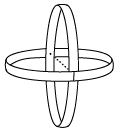 The accompanying figure indicates how the two strips were applied to each other. The place where they were originally laid together across each other is, in the diagram, on the further side, and is marked by a dot; the place where the two ends of each band are joined together, and where the two bands are themselves again joined together is, in the diagram, on the near side, and is indicated by a line on the outer band. The second place of meeting is, as the dotted line indicates, immediately opposite to the first. The outer band, as Timaeus goes on to say, is the Revolution of the Same, and the inner the Revolution of the Other.
And He compassed them about with the motion that revolves in the same spot continually, and He made the one circle outer and the other inner. And the outer motion He ordained to be the Motion of the Same, and the inner motion the Motion of the Other. And He made the Motion of the Same to be toward the right along the side, and the Motion of the Other to be toward the left along the |73| diagonal;
And when the construction of the Soul had all been completed to the satisfaction of its Constructor, then He fabricated within it all the Corporeal, [36e] and uniting them centre to centre He made them fit together. And the Soul, being woven throughout the Heaven every way from the centre to the extremity, and enveloping it in a circle from without, and herself revolving within herself, began a divine beginning of unceasing and intelligent life lasting throughout all time. And whereas the body of the Heaven is visible, the Soul is herself invisible but partakes in reasoning and in harmony, [37a] having come into existence by the agency of the best of things intelligible and ever-existing as the best of things generated.
1 He now tilts the inner band, so that it makes an oblique angle with the outer, which is set at the horizontal; from which we see that the Revolution of the Same represents the celestial Equator, moving “horizontally to the right” (from East to West), and the Revolution of the Other represents the Ecliptic, which moves in a contrary direction to the Equator (from West to East), and at an angle to it. The Ecliptic He divides into seven, to represent the seven planets.
2 Viz. 2, 3, 4, 8, 9, 27.
3 Viz. 2, 4, 8 double; 3, 9, 27 triple.
4 The three are Sun, Venus, Mercury; the four Moon, Mars, Jupiter, Saturn.
Inasmuch, then, as she is a compound, blended of the natures of the Same and the. Other and Being, these three portions, and is proportionately divided |75| and bound together, and revolves back upon herself, whenever she touches anything which has its substance dispersed or anything which has its substance undivided she is moved throughout her whole being and announces what the object is identical with [37b] and from what it is different, and in what relation, where and how and when, it comes about that each thing exists and is acted upon by others both in the sphere of the Becoming and in that of the ever-uniform. And her announcement, being identically true concerning both the Other and the Same, is borne through the self-moved without speech or sound; and whenever it is concerned with the sensible, and the circle of the Other moving in straight course proclaims it to the whole of its Soul, opinions and beliefs arise which are firm and true; and again, when it is concerned with the rational, [37c] and the circle of the Same, spinning truly, declares the facts, reason and knowledge of necessity result. But should anyone assent that the substance in which these two states arise is something other than Soul, his assertion will be anything rather than the truth.
And when the Father that engendered it perceived it in motion and alive, a thing of joy to the eternal gods, He too rejoiced;
1 Note the play on ἄγαλμα (“thing of joy” or “statue”) and ὴγά,σθ-η (“rejoiced”).
|77| planned to make a movable image of Eternity, and, as He set in order the Heaven, of that Eternity which abides in unity He made an eternal image, moving according to number, even that which we have named Time. For simultaneously with the construction of the Heaven He contrived the production of days and nights and months and years, which existed not before the Heaven came into being. And these are all portions of Time; even as “Was” and “Shall be” are generated forms of Time, although we apply them wrongly, without noticing, to Eternal Being. For we say that it “is” or “was” or “will be,” whereas, in truth of speech, “is” alone [38a] is the appropriate term; “was” and “will be,” on the other hand, are terms properly applicable to the Becoming which proceeds in Time, since both of these are motions; but it belongs not to that which is ever changeless in its uniformity to become either older or younger through time, nor ever to have become so, nor to be so now, nor to be about to be so hereafter, nor in general to be subject to any of the conditions which Becoming has attached to the things which move in the world of Sense, these being generated forms of Time, which imitates Eternity and circles round according to number. And besides these we make use of the following expressions,— [38b] that what is become is become, and what is becoming is becoming, and what is about to become is about to become, and what is non-existent is non-existent; but none of these expressions is accurate.
1 i.e. it is incorrect to use the term “is” (ἐστί) both as a mere copula and in the sense of “exists.”
Time, then, came into existence along with the |79| Heaven, to the end that having been generated together they might also be dissolved together, if ever a dissolution of them should take place; and it was made after the pattern of the Eternal Nature, to the end that it might be as like thereto as possible; for whereas the pattern is existent through all eternity, [38c] the copy, on the other hand, is through all time, continually having existed, existing, and being about to exist. Wherefore, as a consequence of this reasoning and design on the part of God, with a view to the generation of Time, the sun and moon and five other stars, which bear the appellation of “planets”, came into existence for the determining and preserving of the numbers of Time. And when God had made the bodies of each of them He placed them in the orbits along which the revolution of the Other was moving, seven orbits for the seven bodies.
1 Cf. 36 d.
2 i.e. Venus.
3 i.e. a tendency as to direction.
So when each of the bodies whose cooperation was required for the making of Time had arrived in its |81| proper orbit; and when they had been generated as living creatures, having their bodies bound with living bonds, [39a] and had learnt their appointed duties; then they kept revolving around the circuit of the Other, which is transverse and passes through the circuit of the Same and is dominated thereby; and part of them moved in a greater, part in a smaller circle, those in the smaller moving more quickly and those in the greater more slowly. And because of the motion of the Same, the stars which revolved most quickly appeared to be overtaken by those which moved most slowly, although in truth they overtook them; [39b] for, because of their simultaneous progress in two opposite directions,
1 i.e. a planet moving along the Ecliptic from W. to E. is at the same time drawn from E. to W. (in the plane of the Equator) by the regular motion of the sphere of the fixed stars (the circle of “the Same” which moves at a higher velocity than that of “the Other”).
2 i.e. Saturn appears to be nearest to the sphere of the fixed stars in point of velocity. Cf. Laws 822 a ff.
|83| have not been discovered by men (save for a few out of the many); wherefore they have no names for them, nor do they compute and compare their relative measurements, so that they are not aware, as a rule, [39d] that the “wanderings”
Now in all other respects this World had already, with the birth of Time, been wrought in the similitude of that whereunto it was being likened, but inasmuch as it did not a£ yet contain generated within it the whole range of living creatures, therein it was still dissimilar. So this part of the work which was still undone He completed by moulding it after the nature of the Model. According, then, as Reason perceives Forms existing in the Absolute Living Creature, such and so many as exist therein did He deem that this World also should possess. And these Forms are four,—one the heavenly kind of gods",
1 An allusion to the name “planets,” i.e. “wanderers”; cf. 38 c.
2 i.e. the Great World-Year, which is completed when all the planets return simultaneously to their original starting-points. Its length was variously computed: Plato seems to have put it at 36,000 years (cf. Republic 546 b ff.).
3 i.e. the stars.
|85| which goes on foot on dry land. The form of the divine class
1 i.e. the fixed stars, and their sphere which moves with the daily rotation of the spherical Cosmos (the motion proper to “intelligence,” cf. 36 c, Cratylus 411 d).
2 i.e. the “intelligent” outermost sphere of “the Same” (cf. the derivation of φρόνησις from φορά in Cratylus 411 d).
3 There is a play here on the word κόσμος, as meaning (1) “adornment,” (2) “universe.”
4 i.e. (1) the rotation of the star on its own axis; (2) the diurnal revolution of the sphere of fixed stars.
5 Cf. 34 a, 43 b.
6 The word εἵλλεσθαι (or (ἴλλεσθαι) is taken by some to imply “oscillation” or “rotation” (cf. Aristotle De caelo ii. 293 b 30); but it seems best to suppose that Plato is here regarding the Earth as stationary. Her potential motion (we may assume) is equal and opposite to that of the Universe, of which she is the centre, and by thus neutralizing it she remains at rest.
|87| another, and the relative reversals and progressions of their orbits, and which of the gods meet in their conjunctions, and how many are in opposition, and behind which and at what times they severally pass before one another and are hidden from our view, and again reappearing [40d] send upon men unable to calculate alarming portents of the things which shall come to pass hereafter,—to describe all this without an inspection of models
Concerning the other divinities, to discover and declare their origin is too great a task for us, and we must trust to those who have declared it aforetime, they being, as they affirmed, descendants of gods and knowing well, no doubt, their own forefathers.
Now when all the gods, both those who revolve manifestly
1 i.e. such instruments as a celestial globe or planetarium.
2 This is, obviously, ironical; cf. Cratylus 402 b, Philebus 66 c.
3 i.e. the Stars; the others are the deities of popular belief (such as Homer depicts).
|89| far as they choose, had come to birth, He that generated this All addressed them thus:
“Gods of gods,
1 An intensive form of expression, like the Biblical “King
of kings and Lord of lords.”
2 Viz. the inhabitants of air, of water, and of earth.
|91| creatures, and give them food that they may grow, and when they waste away receive them to yourselves again.”
Thus He spake, and once more into the former bowl, wherein He had blended and mixed the Soul of the Universe, He poured the residue of the previous material, mixing it in somewhat the same manner, yet no longer with a uniform and invariable purity, but second and third in degree of purity. And when He had compounded the whole He divided it into souls equal in number to the stars, and each several soul He assigned to one star, [41e] and setting them each as it were in a chariot
1 Cf. Laws 899 a.
2 i.e. star.
|93| in his native star, and shall gain a life that is blessed and congenial; but whoso has failed therein shall be changed into woman’s nature at the second birth;
When He had fully declared unto them all these ordinances, to the end that He might be blameless in respect of the future wickedness of any one of them, He proceeded to sow them, some in the Earth, some in the Moon, others in the rest of the organs of Time. Following upon this sowing, He delivered over to the young gods the task of moulding mortal bodies, and of framing and controlling all the rest of the human soul which it was still necessary to add, together with all that belonged thereto, [42e] and of governing this mortal creature in the fairest and best way possible, to the utmost of their power, except in so far as it might itself become the cause of its own evils.
So He, then, having given all these commands, was abiding in His own proper and wonted state. And as He thus abode, His children gave heed to their Father’s command and obeyed it. They took the immortal principle of the mortal living creature, and imitating their own Maker, they borrowed from the
1 Cf. 90 e.
|95| Cosmos portions of fire and earth and water and air, [43a] as if meaning to pay them back, and the portions so taken they cemented together; but it was not with those indissoluble bonds wherewith they themselves were joined that they fastened together the portions but with numerous pegs, invisible for smallness; and thus they constructed out of them all each several body, and within bodies subject to inflow and outflow they bound the revolutions of the immortal Soul. The souls, then, being thus bound within a mighty river neither mastered it nor were mastered, but with violence they rolled along and were rolled along themselves, [43b] so that the whole of the living creature was moved, but in such a random way that its progress was disorderly and irrational, since it partook of all the six motions:
1 i.e. omitting the seventh motion (“rotation”), cf. 34 a.
2 i.e. αἴσθησις (“sensation”) is here derived from άΐσσω (“dart,” “rush”).
|97| totally blocked the course of the Same by flowing contrary thereto, and hindered it thereby in its ruling and its going; while, on the other hand, they so shook up the course of the Other that in the three several intervals of the double and the triple,
1 Cf. 35 b.
2 Cf. 37 a.
|99| becomes at the first irrational.
The divine revolutions, which are two, they bound within a sphere-shaped body, in imitation of the spherical form
1 Cf. 86 e; Phaedo 81 c, 83 d.
2 i.e. ignorance; cf. 86 b ff., Laws 863 c ff.
3 Cf. 86 b ff.
4 Cf. 29 c, d.
5 Cf. 73 c, 81 d.
|101| other, they bestowed upon it the body as a vehicle and means of transport. And for this reason the body acquired length, and, by God’s contriving, shot forth four limbs, extensible and flexible, [45a] to serve as instruments of transport, so that grasping with these and supported thereon it was enabled to travel through all places, bearing aloft the chamber of our most divine and holy part. In this wise and for these reasons were legs and hands attached to all men; and inasmuch as they demand the forepart superior to the hinder part in honour and dignity, the Gods gave us the most part of our going in this direction. Thus it was necessary that man should have the forepart of his body distinct and dissimilar. Wherefore, dealing first with the vessel of the head, they set the face in the front thereof [45b] and bound within it organs for all the forethought of the Soul; and they ordained that this, which is the natural front, should be the leading part. And of the organs they constructed first light-bearing eyes, and these they fixed in the face for the reason following. They contrived that all such fire as had the property not of burning but of giving a mild light should form a body akin to the light of every day.
1 There is a play here on the words ἥμερον (“mild”)…ἡμέρας (“day”); cf. Cratylus 418 c.
2 Vision is explained on the principle that “like is known by like”: a fire-stream issuing from the eye meets a fire-stream coming from the object of vision (cf. the view of Empedocles).
|103| kindred substance along the path of the eyes’ vision, wheresoever the fire which streams from within collides with an obstructing object without. And this substance, having all become similar in its properties because of its similar nature, [45d] distributes the motions of every object it touches, or whereby it is touched, throughout all the body even unto the Soul, and brings about that sensation which we now term “seeing." But when the kindred fire vanishes into night, the inner fire is cut off; for when it issues forth into what is dissimilar it becomes altered in itself and is quenched, seeing that it is no longer of like nature with the adjoining air, since that air is devoid of fire. Wherefore it leaves off seeing, and becomes also an inducement to sleep. For the eyelids—whose structure the Gods devised [45e] as a safeguard for the vision,—when they are shut close, curb the power of the inner fire; which power dissipates and allays the inward motions, and upon their allaying quiet ensues; and when this quiet has become intense there falls upon us a sleep that is well-nigh dreamless; but when some greater motions are still left behind, according to their nature and the positions they occupy [46a] such and so great are the images they produce, which images are copied within and are remembered by the sleepers when they awake out of the dream. And it is no longer difficult to perceive the truth about the formation of images in mirrors and in bright and smooth surfaces of every kind. It is from the combination with each other of the inner and the outer fires, every time that they unite on the smooth surface and are variously deflected, [46b] that all such reflections necessarily result, owing to the fire of the reflected face coalescing with the fire of the vision |105| on the smooth and bright surface.
Now all these are among the auxiliary Causes
1 e.g. when a man looks at his own face reflected in a mirror. Cf. Sophist 266 c.
2 i.e. concave (and hemi-cylindrical).
3 These causes are “secondary,” as contrasted with the “primary” or First Cause (which is also the “final Cause”), “the Good”; cf. 29 e, 68 e, Phaedo 99 b.
4 e.g. Anaxagoras and the Atomists.
|107| also must act likewise. We must declare both kinds of Causes, but keep distinct those which, with the aid of thought, are artificers of things fair and good, and all those which are devoid of intelligence and produce always accidental and irregular effects.
Now regarding the auxiliary causes which have helped the eyes to acquire the power which they now possess, let this statement suffice. Next we must declare the most important [47a] benefit effected by them, for the sake of which God bestowed them upon us. Vision, in my view, is the cause of the greatest benefit to us, inasmuch as none of the accounts now given concerning the Universe would ever have been given if men had not seen the stars or the sun or the heaven. But as it is, the vision of day and night and of months and circling years has created the art of number and has given us not only the notion of Time
1 Cf. 37 d ff.
2 Cf. Philebus 16 c ff.
3 An echo of Euripides Phoenissae 1762 ἀλλὰ γὰρ τί ταῦτα θρηνῶ καὰ μότην όδύρομαι.
|109| revolutions of the God we might stabilize the variable revolutions within ourselves.
Concerning sound also and hearing, once more we make the same declaration, that they were bestowed by the Gods with the same object and for the same reasons; for it was for these same purposes that speech was ordained, and it makes the greatest contribution thereto; music too, in so far as it uses audible sound, [47d] was bestowed for the sake of harmony.
The foregoing part of our discourse, save for a small portion, has been an exposition· of the operations of Reason; but we must also furnish an account of what comes into existence through Necessity.
1 For the importance of music in education cf. Republic 401 d. Laws 666 d ff.; also Timaeus 80 b.
2 i.e. the sphere of mechanical causation, physical and physiological processes and results.
|111| beginning. Wherefore if one is to declare how it actually came into being on this wise, he must include also the form of the Errant Cause, in the way that it really acts. To this point, therefore, we must return, [48b] and taking once again a fresh starting-point suitable to the matter we must make a fresh start in dealing therewith, just as we did with our previous subjects. We must gain a view of the real nature of fire and water, air and earth, as it was before the birth of Heaven, and the properties they had before that time; for at present no one has as yet declared their generation, but we assume that men know what fire is, and each of these things, and we call them principles and presume that they are elements
1 στοιχεῖα, here applied to physical “elements,” was the regular term for “letters” of the alphabet; cf. Theaetetus 203 b ff., Republic 402 a ff.
2 i.e. a method which aims only at “probability” or “likelihood”: to attain to “first principles” we should need to employ the “dialectic” method.
3 Cf. 27 c.
|113| through a novel and unwonted exposition [48e] to a conclusion based on likelihood, and thus begin our account once more.
We must, however, in beginning our fresh account of the Universe make more distinctions than we did before; for whereas then we distinguished two Forms,
1 Cf. 28 a.
|115| contracted and quenched returning back to the form of air; and air once more uniting and condensing into cloud and mist; and issuing from these, when still further compressed, flowing water; and from water earth and stones again: thus we see the elements passing on to one another, as it would seem, [49d] in an unbroken circle the gift of birth. Accordingly, since no one of these ever remains identical in appearance, which of them shall a man definitely affirm to be any one particular element and no other without incurring ridicule? None such exists. On the contrary, by far the safest plan in treating of these elements is to proceed thus: Whatsoever object we perceive to be constantly changing from one state to another, like fire, that object, be it fire, we must never describe as “this” but as “suchlike,” nor should we ever call water “this” but “suchlike”; nor should we describe any other element, as though it possessed stability, [49e] of all those which we indicate by using the terms “this” and “that” and suppose ourselves to refer to a definite object. For such an object shuns and eludes the names “this” and “that” and every name which indicates that they are stable. Thus we must not call the several elements “these,” but in regard to each of them and all together we must apply the term “suchlike” to represent what is always circling round: thus we shall call that which is constantly “suchlike” by the name of fire, and so with everything else that is generated. But that “wherein" they are always, in appearance, [50a] coming severally into existence, and “wherefrom” in turn they perish, in describing that and that alone should we employ the terms “this” and “that”; whereas, in describing what is “suchlike”—hot, for instance, or |117| white, or any of the opposite qualities, or any compounds thereof—we ought never to apply to it any of these terms.
But we must bestir ourselves to explain this matter again yet more clearly. Now imagine that a man were to model all possible figures out of gold, and were then to proceed without cessation to remodel each of these into every other,—then, if someone were to point to one of the figures and ask what it is, [50b] by far the safest reply, in point of truth, would be that it is gold; but as for the triangle and all the other figures which were formed in it, one should never describe them as “being” seeing that they change even while one is mentioning them; rather one should be content if the figure admits of even the title “”suchlike” being applied to it with any safety. And of the substance which receives all bodies [50c] the same account must be given. It must be called always by the same name; for from its own proper quality it never departs at all; for while it is always receiving all things, nowhere and in no wise does it assume any shape similar to any of the things that enter into it. For it is laid down by nature as a moulding-stuff for everything, being moved and marked by the entering figures, and because of them it appears different at different times. And the figures that enter and depart are copies of those that are always existent, being stamped from them in a fashion marvellous and hard to describe, which we shall investigate hereafter.
1 Cf. 53 c.
For the present, then, we must conceive of three kinds,—the Becoming, that “Wherein” it becomes, and the source “Wherefrom” the Becoming [50d] is copied and produced. Moreover, it is proper to liken the |119| Recipient to the Mother, the Source to the Father, and what is engendered between these two to the Offspring; and also to perceive that, if the stamped copy is to assume diverse appearances of all sorts, that substance wherein it is set and stamped could not possibly be suited to its purpose unless it were itself devoid of all those forms which it is about to receive from any quarter. [50e] For were it similar to any of the entering forms, on receiving forms of an opposite or wholly different kind, as they arrived, it would copy them badly, through obtruding its own visible shape. Wherefore it is right that the substance which is to receive within itself all the kinds should be void of all forms; just as with all fragrant ointments, men bring about this condition by artistic contrivance and make the liquids which are to receive the odours as odourless as possible; and all who essay to mould figures in any soft material utterly refuse to allow any previous figure to remain visible therein, and begin by making it even and as smooth as possible before they execute the work. [51a] So likewise it is right that the substance which is to be fitted to receive frequently over its whole extent the copies of all things intelligible and eternal should itself, of its own nature, be void of all the forms. Wherefore, let us not speak of her that is the Mother and Receptacle of this generated world, which is perceptible by sight and all the senses, by the name of earth or air or fire or water, or any aggregates or constituents thereof: rather, if we describe her as a Kind invisible and unshaped, all-receptive, and in some most perplexing and most baffling way partaking of the intelligible, [51b] we shall describe her truly.
In so far as it is possible to arrive at the nature of |121| this kind from the foregoing account, one may state it most correctly in this way. That part of it which is made fiery appears each time as fire, that which has been liquefied as water; and it appears as earth and air in so far as it receives copies of these. But let us investigate the matter by more exact reasoning, and consider this question. Does there exist any self-subsisting fire [51c] or any of those other objects which we likewise term “self-subsisting realities”? Or is it only these things which we see, or otherwise perceive by means of bodily senses, that exist, possessed of sensible reality; beside which no other things exist anywhere or anyhow, and it is merely an idle assertion of ours that there always exists an intelligible Form of every object, whereas it is really nothing more than a verbal phrase? Now, on the one hand, it would be improper to dismiss the question before us without a trial and a verdict, and simply to asseverate that the fact is so; while, on the other hand, we ought not to burden a lengthy discourse with another subsidiary argument. [51d] If, however, it were possible to disclose briefly some main determining principle, that would best serve our purpose.
This, then, is the view for which I, for my part, cast my vote. If Reason and True Opinion are two distinct Kinds, most certainly these self-subsisting Forms do exist, imperceptible by our senses, and objects of Reason only; whereas if, as appears to some, True Opinion differs in naught from Reason, then, on the contrary, all the things which we perceive by our bodily senses must be judged to be most stable. [51e] Now these two Kinds must be declared to be two, because they have come into existence separately and are unlike in condition. For the one of |123| them arises in us by teaching, the other by persuasion; and the one is always in company with true reasoning, whereas the other is irrational; and the one is immovable by persuasion, whereas the other is alterable by persuasion; and of the one we must assert that every man partakes, but of Reason only the gods and but a small class of men. This being so, we must agree that One Kind [52a] is the self-identical Form, ungenerated and indestructible, neither receiving into itself any other from any quarter nor itself passing anywhither into another, invisible and in all ways imperceptible by sense, it being the object which it is the province of Reason to contemplate; and a second Kind is that which is named after the former and similar thereto, an object perceptible by sense, generated, ever carried about, becoming in a place and out of it again perishing, apprehensible by Opinion with the aid of Sensation; and a third Kind is ever-existing Place, [52b] which admits not of destruction, and provides room for all things that have birth, itself being apprehensible by a kind of bastard reasoning by the aid of non-sensation, barely an object of belief; for when we regard this we dimly dream and affirm that it is somehow necessary that all that exists should exist in some spot and occupying some place, and that that which is neither on earth nor anywhere in the Heaven is nothing. So because of all these and other kindred notions, we are unable also on waking up to distinguish clearly the unsleeping and truly subsisting substance, owing to our dreamy condition, [52c] or to state the truth—how that it belongs to a copy—seeing that it has not for its own even that substance for which it came into being, but fleets ever as a phantom of something else—to come into existence |125| in some other thing, clinging to existence as best it may, on pain of being nothing at all; whereas to the aid of the really existent there comes the accurately true argument, that so long as one thing is one thing, and another something different, neither of the two will ever come to exist in the other so that the same thing becomes simultaneously [52d] both one and two.
Let this, then, be, according to my verdict, a reasoned account of the matter summarily stated,—that Being and Place and Becoming were existing, three distinct things, even before the Heaven came into existence; and that the Nurse of Becoming, being liquefied and ignified and receiving also the forms of earth and of air, and submitting to all the other affections which accompany these, [52e] exhibits every variety of appearance; but owing to being filled with potencies that are neither similar nor balanced, in no part of herself is she equally balanced, but sways unevenly in every part, and is herself shaken by these forms and shakes them in turn as she is moved. And the forms, as they are moved, fly continually in various directions and are dissipated; just as the particles that are shaken and winnowed by the sieves and other instruments used for the cleansing of corn fall in one place if they are solid and heavy, [53a] but fly off and settle elsewhere if they are spongy and light. So it was also with the Four Kinds when shaken by the Recipient: her motion, like an instrument which causes shaking, was separating farthest from one another the dissimilar, and pushing most closely together the similar; wherefore also these Kinds occupied different places even before that the Universe was organized and generated out of them. |127| Before that time, in truth, all these things were in a state devoid of reason or measure, but when the work of setting in order this Universe was being undertaken, [53b] fire and water and earth and air, although possessing some traces of their own nature, were yet so disposed as everything is likely to be in the absence of God; and inasmuch as this was then their natural condition, God began by first marking them out into shapes by means of forms and numbers. And that God constructed them, so far as He could, to be as fair and good as possible, whereas they had been otherwise,—this above all else must always be postulated in our account. Now, however, it is the disposition and origin [53c] of each of these Kinds which I must endeavour to explain to you in an exposition of an unusual type; yet, inasmuch as you have some acquaintance with the technical method which I must necessarily employ in my exposition, you will follow me.
“All triangles derive their origin from two triangles, each having one angle right and the others acute….These we lay down as the principles of fire…but the principles which are still higher than these are known only to God and the man who is dear to God.”
In the first place, then, it is plain I presume to everyone that fire and earth and water and air are solid bodies; and the form of a body, in every case, possesses depth also. Further, it is absolutely necessary that depth should be bounded by a plane surface; and the rectilinear plane is composed of triangles. [53d] Now all triangles derive their origin from two triangles, each having one angle right and the others acute;
1 i.e. the rectangular isosceles triangle and the rectangular scalene; all other triangles can be built up from these two (e.g. see 54 e ff.).
|129| which are still higher than these are known only to God and the man who is dear to God. [53e] We must now declare what will be the four fairest bodies, dissimilar to one another, but capable in part of being produced out of one another by means of dissolution; for if we succeed herein we shall grasp the truth concerning the generation of earth and fire and the mean proportionals. For to no one will we concede that fairer bodies than these, each distinct of its kind, are anywhere to be seen. Wherefore we must earnestly endeavour to frame together these four kinds of bodies which excel in beauty, and to maintain that we have apprehended [54a] their nature adequately. Now of the two triangles, the isosceles possesses one single nature, but the scalene an infinite number; and of these infinite natures we must select the fairest, if we mean to make a suitable beginning. If, then, anyone can claim that he has chosen one that is fairer for the construction of these bodies, he, as friend rather than foe, is the victor. We, however, shall pass over all the rest and postulate as the fairest of the triangles that triangle out of which, when two are conjoined, [54b] the equilateral triangle is constructed as a third.
1 
i.e. the half cf an equilateral triangle; e.g. if the triangle ABC is bisected by the line AD, we have two such triangles in ADB and ADC.
2 i.e. in the triangle ADB (see last note) AB = 2BD, and (AB)2 = (BD)2 + (AD)2; therefore 4(BD)2 = (BD)2 + (AD)2, and so 3(BD)2 = (AD)2.
|131| Moreover, a point about which our previous statement was obscure must now be defined more clearly. It appeared as if the four Kinds, [54c] in being generated, all passed through one another into one another, but this appearance was deceptive. For out of the triangles which we have selected four Kinds are generated, three of them out of that one triangle which has its sides unequal, and the fourth Kind alone composed of the isosceles triangle. Consequently, they are not all capable of being dissolved into one another so as to form a few large bodies composed of many small ones, or the converse; but three of them do admit of this process. For these three are all naturally compounded of one triangle, so that when the larger bodies are dissolved many small ones will form themselves from these same bodies, receiving the shapes that befit them; [54d] and conversely, when many small bodies are resolved into their triangles they will produce, when unified, one single large mass of another Kind. So let thus much be declared concerning their generation into one another.
In the next place we have to explain the form in which each Kind has come to exist and the numbers from which it is compounded. First will come that form which is primary and has the smallest components, and the element thereof is that triangle which has its hypotenuse twice as long as its lesser side. And when a pair of such triangles are joined along the line of the hypotenuse, and this is done thrice, by drawing the hypotenuses [54e] and the short sides together as to a centre, there is produced from those triangles, six in number, one equilateral |133| triangle.
Now the first of the elemental triangles ceased acting when it had generated these three solids, the substance of the fourth Kind
1 As in the figure the equilateral triangle ABC is divided into 6 triangles of unequal sides by joining the vertical points A, B, C to the points of bisection of the opposite sides, viz. D, E, F. Then the hypotenuse in each such triangle is double the shortest side (e.g. AO = 2 FO). And < FAO = ⅓ right angle; while ∨ FOA = ⅔ right angle. The “three plane angles” are thus of 60° each = 180° = “the most obtuse” plane angle; so that the solid angle is one degree less, i.e. 179°.
2 i.e. the tetrahedron or pyramid (molecule of fire).
3 i.e. the octahedron (molecule of air).
4 i.e. the icosahedron (molecule of water).
5 i.e. the cube, composed of 6 x 4 rectangular isosceles triangles (molecule of earth).
|135| was cubic, having six plane equilateral quadrangular bases. And seeing that there still remained one other compound figure, the fifth,
“To earth let us give the cubic form; for of the four Kinds earth is the most immobile and the most plastic body, and of necessity the body which has the most stable bases must be pre-eminently of this character.”
Now in reasoning about all these things, a man might question whether he ought to affirm the existence of an infinite diversity of Universes or a limited number; and if he questioned aright he would conclude that the doctrine of an infinite diversity is that of a man unversed
1 i.e. the dodecahedron. How God “used it up” is obscure: the reference may be to the 12 signs of the Zodiac.
2 There is a play here on the two senses of ἄπεφος, “unlimited” and “unskilled”; cf. Philebus 17 e. The doctrine of an infinite number of worlds was held by the Atomists.
|137| the remaining figures the least mobile to water, and the most mobile to fire, and the intermediate figure to air; and, further, when we assign the smallest body to fire, and the greatest to water, and the intermediate to air; and again, the first in point of sharpness to fire, the second to air, and the third to water. As regards all these forms, that which has the fewest bases must necessarily be the most mobile, [56b] since it is in all ways the sharpest and most acute of all; and it must also be the lightest, since it is composed of the fewest identical parts; and the second comes second in point of these same qualities, and the third third.
Thus, in accordance with the right account and the probable, that solid which has taken the form of a pyramid shall be the element and seed of fire; the second in order of generation we shall affirm to be air, and the third water. Now one must conceive all these to be so small that none of them, [56c] when taken singly each in its several kind, is seen by us, but when many are collected together their masses are seen. And, moreover, as regards the numerical proportions which govern their masses and motions and their other qualities, we must conceive that God realized these everywhere with exactness, in so far as the nature of Necessity submitted voluntarily or under persuasion, and thus ordered all in harmonious proportion.
From all that we have hitherto said about these Kinds, [56d] they will, in all likelihood, behave themselves as follows. Earth will keep moving when it happens to meet with fire and has been dissolved by its acuteness, whether this dissolution takes place in pure fire or in a mass of air or of water; and this |139| motion will continue until the particles of earth happen to meet together somewhere and reunite one with another, when they become earth again; for assuredly earth will never change into another form. But water, when broken up by fire or even by air, is capable of becoming a compound of one corpuscle of fire with two of air; [56e] and the fractions of air which come from the dissolving of one particle will form two corpuscles of fire. And again, when a small quantity of fire is enclosed by a large quantity of air and water, or of earth, and moves within them as they rush along, and is defeated in its struggle and broken up, then two corpuscles of fire unite to make one form of air. And when air is defeated and disintegrated, from two whole forms of air and a half, one whole form of water will be compounded.
[57a]Once again let us reason out their character in this way. Whenever any of the other Kinds is caught within fire it is cut up thereby, owing to the acuteness of its angles and of the line of its sides, but when it has been re-composed into the substance of fire it ceases to be cut; for the Kind that is similar and uniform is in no case able either to cause any change in, or to suffer any affection from, a Kind which is in a uniform and similar state;
1 The affinity of “like to like” was an axiom in early Greek thought; cf. Lysis 215 c ff., Symposium 186 a ff.
|141| these or with any of the other Kinds, they do not cease from dissolution until either they are driven out to their own kindred, by means of this impact and dissolution, or else they are defeated and, instead of many forms, assume one form similar to the victorious Kind, and continue dwelling therewith as a united family. Moreover, it is owing to these affections [57c] that they all interchange their places; for while the bulk of each Kind keeps apart in a region of its own
Such are the causes which account for the generation of all the unmixed and primary bodies. But within these four Kinds other classes exist, whereof the cause must be sought in the construction of each of the two elemental triangles, each such construction having originally produced [57d] not merely a triangle of one definite size, but larger and smaller triangles of sizes as numerous as are the classes within the Kinds. Consequently, when these are combined amongst themselves and with one another they are infinite in their variety; and this variety must be kept in view by those who purpose to employ probable reasoning concerning Nature.
Now, unless we can arrive at some agreed conclusion concerning Motion and Rest, as to how and under what conditions they come about, [57e] our subsequent argument will be greatly hampered. The facts about them have already been stated in part;
1 The elements are conceived as having their proper abodes in concentric strata of space, one above another—earth in the centre, water next, then air, and fire at the circumference of the World-Sphere.
|143| but in addition thereto we must state further that motion never consents to exist within uniformity. For it is difficult, or rather impossible, for that which is to be moved to exist without that which is to move, or that which is to move without that which is to be moved; but in the absence of these there is no motion, and that these should ever be uniform is a thing impossible. Accordingly, we must always place rest in uniformity, [58a] and motion in non-uniformity; and the cause of the non-uniform nature lies in inequality. Now we have explained the origin of inequality;
1 Cf. 53 c ff.: the varying shapes and sizes of the primary triangles account for the “inequality.”
2 i.e. exerts a centripetal force. For this “compression” cf. Empedocles Fragment 185 Tιτὰν ηδ’ αίθὴρ σφίγγων περὶ κύκλον ἄπαντα.
|145| perpetually maintained, it brings about unceasingly, both now and for the future, the perpetual motion of these bodies.
In the next place, we must observe that there are many kinds of fire: for example, there is flame; and the kind issuing from flame, which does not burn but supplies light to the eyes; and the kind which, when the flame is quenched, is left behind among the embers. [58d] So likewise of air, there is the most translucent kind which is called by the name of aether, and the most opaque which is mist and darkness, and other species without a name, which are produced by reason of the inequality of the triangles. The kinds of water are, primarily, two, the one being the liquid, the other the fusible
1 i.e. metals are classed as “water,” cf. 59 b ff.
|147| compressed and recovering again its uniformity, because of the departure of the fire, the author of its non-uniformity, returns to its state of self-identity. And this cessation of the fire is termed “cooling,” and the combination which follows on its departure “solidification.”
[59b] Of all the kinds of water which we have termed “fusible,” the densest is produced from the finest and most uniform particles: this is a kind of unique form, tinged with a glittering and yellow hue, even that most precious of possessions, “gold,” which has been strained through stones and solidified. And the off-shoot of gold, which is very hard because of its density and black in colour, is called “adamant.”
And the rest of such phenomena it is no longer difficult to explain in full, if one aims at framing a description that is probable.
1 Perhaps haematite or platinum.
2 Cf. 29 b, d, 48 c, etc.
|149| proceed to expound in order the subsequent probabilities concerning these same phenomena in the following way.
The water that is mixed with fire, which is fine and fluid, is termed “fluid,” owing to its motion and the way it rolls over the earth.
Now as regards most forms of water that are intermingled one Math another, the kind as a whole, consisting of water that has been strained through earth-grown plants, [60a] is called “sap”; but inasmuch as the several sorts have become dissimilar owing to intermixture, most of the kinds thus produced are unnamed. Four of these kinds, however, being fiery and specially conspicuous, have received names. Of these, that which is heating to the soul as well as the body is called “wine”; that which is smooth and divisive of the vision, and therefore bright to look upon and gleaming and glistening in appearance, is the species “oil,” including pitch and castor oil and olive oil itself and all the others that are of the same character; [60b] and all that kind which tends to expand the contracted parts of the mouth, so far as their nature allows, and by this property produces sweetness,
1 Alluding to a fanciful derivation of ὑγρόν from ὑπὲρ γῆν ῥέον.
|151| has received as a general designation the name of “honey”; and the foamy kind, which tends to dissolve the flesh by burning, and is secreted from all the saps, is named “verjuice.”
Of the species of earth, that which is strained through water becomes a stony substance in the following way. When the water commingled there- with is divided in the process of mingling, it changes into the form of air; and when it has become air it rushes up to its own region; [60c] but because there was no void space above them, therefore it pressed against the adjacent air; and it, being heavy, when pressed and poured round the mass of earth, crushed it forcibly and compressed it into the spaces from which the new air was ascending. But when earth is thus compressed by the air so as to be indissoluble by water it forms “stone”; of which the fairer sort is that composed of equal and uniform parts and transparent, and the coarser sort the opposite. That kind from which all the moisture has been carried off by the rapidity of fire, and which is more brittle [60d] in its composition than the first kind, is the kind to which we have given the name of “earthenware.” But sometimes, when moisture is still left in the earth and it has been fused by fire and has cooled again, it forms the species which is black in hue. On the other hand there are two kinds, which, in exactly the same manner, are isolated after the mixture from much of their water, but are composed of finer parts of earth, and are saline: when these have become semi-solid and soluble again by water, one of them is purgative of oil and earth and forms the species called “lye”;
1 Perhaps a kind of fig-juice.
2 i.e. potash or saltpetre.
|153| substance which is customarily termed “beloved of the gods,”
As regards the kinds which are a blend of these two, and are dissoluble by fire and not by water, their composition is due to the following cause. Fire and air do not melt masses of earth; for, inasmuch as their particles are smaller then the interstices of its structure, they have room to pass through without forcible effort and leave the earth undissolved, with the result that it remains unmelted; whereas the particles of water, being larger, must use force to make their way out, and consequently dissolve and melt the earth. [61a] Thus earth when it is not forcibly condensed is dissolved only by water; and when it is condensed it is dissolved by fire only, since no entrance is left for anything save fire. Water, again, when most forcibly massed together is dissolved by fire only, but when massed less forcibly both by fire and air, the latter acting by way of the interstices, and the former by way of the triangles; but air when forcibly condensed is dissolved by nothing save by way of its elemental triangles, and when unforced it is melted down by fire only.
As regards the classes of bodies which are compounds of earth and water, [61b] so long as the water occupies the interspaces of earth which are forcibly contracted, the portions of water which approach from without find no entrance, but flow round the whole mass and leave it undissolved. But when portions of fire enter into the interspaces of the water they produce the same effects on water as water does on earth; consequently, they are the sole causes why the compound substance is dissolved and flows. And of these substances those which contain less water
1 Cf. Homer Iliad ix. 214 πάσσε δ’ πἁσσε θείοιο.
|155| than earth form the whole kind known as “glass,”[61c] and all the species of stone called “fusible”; while those which contain more water include all the solidified substances of the type of wax and frankincense.
And now we have explained with some fullness the Four Kinds, which are thus variegated in their shapes and combinations and permutations; but we have still to try to elucidate the Causes which account for their affective qualities. Now, first of all, the quality of sense-perceptibility must always belong to the objects under discussion; but we have not as yet described the generation of flesh and the appurtenances of flesh, nor of that portion of Soul which is mortal. But, in truth, these last cannot be adequately explained [61d] apart from the subject of the sensible affections, nor the latter without the former; while to explain both simultaneously is hardly possible. Therefore, we must assume one of the two, to begin with, and return later to discuss our assumptions. In order, then, that the affective properties may be treated next after the kinds, let us presuppose the facts about body and soul.
Firstly, then, let us consider how it is that we call fire “hot ”by noticing the way it acts [61e]upon our bodies by dividing and cutting. That its property is one of sharpness we all, I suppose, perceive; but as regards the thinness of its sides and the acuteness of its angles and the smallness of its particles and the rapidity of its motion—owing to all which properties fire is intense and keen and sharply cuts whatever it encounters,—these properties we must explain by recalling the origin of its form, how that it above all others is the one substance which so divides our bodies and minces them up as to produce naturally |157| both that affection which we call “heat” and its very name.
1 i.e. θερμόν (quasi κερμόν) is derived from κερματίζω (“mince up” or “mint”).
The opposite affection is evident, but none the less it must not lack description. When liquids with larger particles, which surround the body, enter into it they drive out the smaller particles; but as they cannot pass into their room they compress the moisture within us, so that in place of non-uniformity and motion they produce immobility and density, [62b] as a result of the uniformity and compression. But that which is being contracted contrary to nature fights, and, in accordance with its nature, thrusts itself away in the contrary direction. And to this fighting and shaking we give the names of “trembling ”and “shivering” ; while this affection as a whole, as well as the cause thereof, is termed “cold. ”
By the term “hard ”we indicate all the things to which our flesh gives way; and by the term “soft” all those which give way to our flesh; and these terms are similarly used relatively to each other. Now a substance gives way when it has its base small; but when it is constructed [62c] of quadrangular bases, being very firmly based, it is a most inelastic form; and so too is everything which is of very dense composition and most rigid.
The nature of “heavy” and “light” would be shown most clearly if, along with them, we examined also the nature of “above” and “below,” as they are called. That there really exist two distinct and totally opposite regions, each of which occupies one-half of the Universe,—the one termed “below,” towards which move all things possessing any bodily mass, and the other “above,” towards which everything goes against its will,— [62d] this is a wholly erroneous |159| supposition.
1 The reference here is, probably, to Democritus (Aristotle also speaks of τό ἄνω φύσει, Physics 208 b 14).
2 i.e. “above” and “below” are purely relative terms.
Now the origin of these names and their true meaning which accounts for our habit of making these verbal distinctions even about the whole Heaven, [63b] we must determine on the basis of the following principles. Suppose that a man were to take his stand in that region of the Universe in which the substance of fire has its special abode, and where also that substance
|161| to which it flies is collected in largest bulk; and suppose that, having the power to do so, he were to separate portions of the fire and weigh them, putting them on scales and lifting the balance and pulling the fire by force into the dissimilar air, it is obvious that he will force the smaller mass more easily than the larger. [63c] For if two masses are lifted up simultaneously by a single effort, the smaller will necessarily yield more and the larger less, owing to its resistance, to the force exerted; and the large mass will be said to be “heavy” and moving “down,” the small “light” and moving “up.” Now this is just what we ought to detect ourselves doing in our region here. Standing on the earth and detaching various earthy substances, and sometimes pure earth, we pull them into the dissimilar air by force and against nature, since both these kinds cleave to their own kindred; [63d] and the smaller mass yields more easily, and follows first, as we force it into the dissimilar kind; wherefore we name it “light,” and the region to which we force it “above”; and the conditions opposite thereto we name “heavy” and “below.” Thus, these must necessarily differ in their mutual relations, because the main masses of the Kinds occupy regions opposite to one another; for when we compare what is light in one region with what is light in the opposite region, and the heavy with the heavy, the “below” with the below, [63e] and the “above” with the above, we shall discover that these all become and are opposite and oblique and in every way different in their mutual relations. There is, however, this one fact to be noticed about them all, that it is the passage of each kind to its kindred mass which makes the moving body heavy, and the region |163| to which such a body moves “below”; while the opposite conditions produce the contrary results.
Of “smoothness” and “roughness” anyone might be able to discern the causes and explain them also to others. For the cause of the latter is hardness combined with irregularity, and of the former [64a] regularity combined with density.
In respect of the affections common to the whole body a very important point, which still remains, is the cause of the pleasures and pains attaching to the sense-affections we have been discussing; and the cause also of those affections which have become perceptible by means of the bodily parts and involve in themselves concomitant pains and pleasures. Let us, then, try to grasp the causes in connexion with every perceptible and imperceptible affection in the following way, [64b] bearing in mind the distinction we previously drew
1 i.e. the attraction takes different directions, therefore “up” and “down” are relative terms.
2 Cf. 54 b ff., 57 d, e.
|165| bones and the hair and all our other parts that are mainly earthy; whereas the former character belongs especially to the organs of sight and of hearing, owing to the fact that they contain a very large quantity of fire and air.
Now the nature of pleasure and pain we must conceive of in this way. [64d] When an affection which is against nature and violent occurs within us with intensity it is painful, whereas the return back to the natural condition, when intense, is pleasant;
1 Cf. Republic 583 c ff., Philebus 31 d ff.
2 Cf. 45 b.
|167| they furnish no pains to the mortal part of the soul, but the greatest pleasures—a result which is obvious in the case of perfumes. But all those parts which undergo violent alterations, and are restored gradually and with difficulty [65b] to their original condition, produce results the opposite of those last mentioned; and it is evident that this is what occurs in the case of burnings and cuttings of the body.
And now we have given a fairly complete statement of the affections which are common to the body as a whole, and of all the names which belong to the agents which produce them. Next we must try, if haply we are able, to describe what takes place in the several parts of our bodies, both the affections themselves and the agents to which they are ascribed.
[65c] Firstly, then, we must endeavour to elucidate so far as possible those affections which we omitted in our previous account of the flavours, they being affections peculiar to the tongue. It is evident that these also, like most others, are brought about by means of certain contractions and dilations;
1 Cf. 64 e.
2 The function of the nerves is here assigned to the veins.
|169| dissolve part of its substance—and such, for example, is the property of alkalies,— [65e] are all termed “bitter”; while those which have a property less strong than the alkaline, being detergent in a moderate degree, seem to us to be “saline,” and more agreeable, as being devoid of the rough bitterness. And those which share in the heat of the mouth and are made smooth thereby, when they are fully inflamed and are themselves in turn burning the part which heated them, fly upwards because of their lightness towards the senses of the head and cut all the parts on which they impinge; [66a] and because of these properties all such are called “pungent.” Again, when particles already refined by putrefaction, entering into the narrow veins, are symmetrical with the particles of earth and air contained therein, so that they cause them to circulate round one another and ferment, then, in thus fermenting they change round and pass into fresh places, and thereby create fresh hollows which envelop the entering particles. By this means, the air being veiled in a moist film, [66b] sometimes of earth, sometimes of pure moisture, moist and hollow and globular vessels of air are formed; and those formed of pure moisture are the transparent globules called by the name of “bubbles,” while those of the earthy formation which moves throughout its mass and seethes are designated “boiling” and “fermenting”; and the cause of these processes is termed “acid.”
An affection which is the opposite of all those last described [66c] results from an opposite condition. Whenever the composition of the particles which enter into the moist parts is naturally akin to the state of the tongue, they oil its roughened parts and smooth it, |171] contracting the parts that are unnaturally dilated or dilating those that are contracted, and thus settling them all, so far as possible, in their natural condition; and every such remedy of the forcible affections, being pleasant and welcome to everyone, is called “sweet.”
[66d] For this subject, then, let this account suffice. Next, as regards the property of the nostrils, it does not contain fixed kinds. For the whole range of smells is a half-formed class, and no kind possesses the symmetry requisite for containing any smell; for our veins in these organs are of too narrow a construction for the kinds of earth and of water and too wide for those of fire and air, so that no one has ever yet perceived any smell from any of these, but only from substances which are in process of being moistened or putrefied or melted or vaporized. [66e] For smells arise in the intermediate state, when water is changing into air or air into water, and they are all smoke or mist; and of these, the passage from air to water is mist, and the passage from water to air is smoke; whence it is that all the smells are thinner than water and thicker than air. Their nature is made clear whenever there is some block in the respiration and a man draws in his breath forcibly; for then no accompanying smell is strained through, but the breath passes in alone by itself isolated from the smells. So for these reasons the varieties of these smells have no name, [67a] not being derived either from many or from simple forms, but are indicated by two distinctive terms only, “pleasant” and “painful”; of which the one kind roughens and violently affects the whole of our bodily cavity which lies between the head and the |173| navel, whereas the other mollifies this same region and restores it agreeably to its natural condition.
The third organ of perception within us which we have to describe in our survey is that of hearing, [67b] and the causes whereby its affections are produced. In general, then, let us lay it down that sound is a stroke transmitted through the ears, by the action of the air upon the brain and the blood, and reaching to the soul; and that the motion caused thereby, which begins in the head and ends about the seat of the liver, is “hearing”; and that every rapid motion produces a “shrill” sound, and every slower motion a more “deep” sound; and that uniform motion produces an “even” and smooth sound and the opposite kind of motion a “harsh” sound; [67c] and that large motion produces “loud” sound, and motion of the opposite kind “soft” sound. The subject of concords of sounds must necessarily be treated in a later part of our exposition.
We have still remaining a fourth kind of sensation, which we must divide up seeing that it embraces numerous varieties, which, as a whole, we call “colours.” This consists of a flame which issues from the several bodies, and possesses particles so proportioned to the visual stream as to produce sensation; and as regards the visual stream, we have already stated
1 Cf. 80 a.
2 Cf. 45 c ff.
|175| while the larger and smaller particles—of which the one kind contracts, the other dilates the visual stream—are akin to the particles of heat and cold which affect the flesh, [67e] and to the astringent particles which affect the tongue, and to all the heating particles which we call “bitter”:
1 Cf. 65 e.
2 Cf. 45 c ff.
3 i.e. between the kinds of fire which produce “blackness” and “brightness.”
|177| reason. Red blended with black and white makes “purple”; [68c] but when these colours are mixed and more completely burned, and black is blended therewith, the result is “violet.” “Chestnut” comes from the blending of yellow and grey; and “grey” from white and black; and “ochre” from white mixed with yellow. And when white is combined with “bright” and is steeped in deep black it turns into a “dark blue” colour; and dark blue mixed with white becomes “light blue”; and chestnut with black becomes “green.” As to the rest, it is. fairly clear from these examples [68d] what are the mixtures with which we ought to identify them if we would preserve probability in our account. But should any inquirer make an experimental test of these facts, he would evince his ignorance of the difference between man’s nature and God’s—how that, whereas God is sufficiently wise and powerful to blend the many into one and to dissolve again the one into many, there exists not now, nor ever will exist hereafter, a child of man sufficient for either of these tasks.
“Whereas God is sufficiently wise and powerful to blend the many into one and to dissolve again the one into many, there exists not now, nor ever will exist hereafter, a child of man sufficient for either of these tasks.”
[68e] Such, then, being the necessary nature of all these things, the Artificer of the most fair and good took them over at that time amongst things generated when He was engendering the self-sufficing and most perfect God; and their inherent properties he used as subservient causes, but Himself designed the Good in all that was being generated. Wherefore one ought to distinguish two kinds of causes,
1 Cf. 46 d, 48 a.
|179| former it is impossible to discern by themselves alone the divine objects after which we strive, or to apprehend them or in any way partake thereof.
Seeing, then, that we have now lying before us and thoroughly sifted—like wood ready for the joiner,—the various kinds of causes, out of which the rest of our account must be woven together, let us once more for a moment revert to our starting-point,
As we stated at the commencement,
1 i.e. 47 e.
2 Cf. 30 a, 42 d ff.
3 Cf. 44 e.
|181| pleasure, a most mighty lure to evil; next, pains, which put good to rout;
1 Cf. 64 e.
|183] of sense in the body might quickly perceive through all the channels both the injunctions and the threats and in all ways obey and follow them, thus allowing their best part [70c] to be the leader of them all. And as a means of relief for the leaping of the heart, in times when dangers are expected and passion is excited—since they knew that all such swelling of the passionate parts would arise from the action of fire,—they contrived and implanted the form of the lungs. This is, in the first place, soft and bloodless; and, moreover, it contains within it perforated cavities like those of a sponge, so that, when it receives the breath and the drink, it might have a cooling effect and furnish relief and comfort [70d] in the burning heat. To this end they drew the channels of the windpipe to the lungs, and placed the lungs as a kind of padding round the heart, in order that, when the passion therein should be at its height, by leaping upon a yielding substance and becoming cool, the heart might suffer less and thereby be enabled the more to be subservient to the reason in time of passion.
And all that part of the Soul which is subject to appetites for foods and drinks, and all the other wants that are due to the nature of the body, they planted in the parts midway between the midriff and the boundary [70e] at the navel, fashioning as it were a manger in all this region for the feeding of the body; and there they tied up this part of the Soul, as though it were a creature which, though savage, they must necessarily keep joined to the rest and feed, if the mortal stock were to exist at all. In order, then, that this part, feeding thus at its manger and housed as far away as possible from the counselling part, and creating the least possible turmoil and din, should |185| allow the Supreme part to take counsel in peace [71a] concerning what benefits all, both individually and in the mass,—for these reasons they stationed it in that position. And inasmuch as they knew that it would not understand reason, and that, even if it did have some share in the perception of reasons, it would have no natural instinct to pay heed to any of them but would be bewitched for the most part both day and night by images and phantasms,—to guard of the liver and placed it in that part’s abode; [71b] and He fashioned it dense and smooth and bright and sweet, yet containing bitterness, that the power of thoughts which proceed from the mind, moving in the liver as in a mirror which receives impressions and provides visible images, should frighten this part of the soul; for when the mental power bears down upon it with stern threats, it uses a kindred portion of the liver’s bitterness
1 i.e. gall.
2 i.e. the right lobe, the biliary vesicle, and the vena porta; cf. Euripides Electra 827 ff.
|187| round the liver to be cheerful and serene, so that in the night it passes its time sensibly, being occupied in its slumbers with divination, seeing that in reason and intelligence it has no share.
For they who constructed us, remembering the injunction of their Father, when He enjoined upon them to make the mortal kind [71e] as good as they possibly could, rectified the vile part of us by thus establishing therein the organ of divination, that it might in some degree lay hold on truth. And that God gave unto man’s foolishness the gift of divination
1 Cf. Republic 364 b. Laws 772 d, Phaedrus 244 a ff.
2 Cf. Laws 871 c, Euripides Ion 413 ff.
|189| apparition, for whom the most fitting name would be “prophets of things divined.”
For these reasons, then, the nature of the liver is such as we have stated and situated in the region we have described, for the sake of divination. Moreover, when the individual creature is alive this organ affords signs that are fairly manifest, but when deprived of life
The structure of the organ which adjoins it,
Concerning the soul, then, what part of it is mortal, what part immortal, and where and with what companions and for what reasons these have been housed apart, only if God concurred could we dare to affirm that our account is true;
1 i.e. in the sacrificed victim; cf. Republic 364 c ff.
2 i.e. the spleen, which, in relation to the liver, is concave.
3 Cf. 68 d, 74 d.
[72e] The subject which comes next to this we must investigate on the same lines; and that subject is the way in which the remainder of the body has been |191] generated.
As regards the bones and the flesh and all such substances [73b] the position was this. All these had their origin in the generation of the marrow. For it was in this that the bonds of life by which the Soul is bound to the body were fastened, and implanted the roots of the mortal kind; but the marrow itself was generated out of other elements. Taking all those primary triangles
1 Cf. 61 c.
2 Literally “the lower belly,” as distinct from “the upper belly” or thorax.
3 Cf. 53 c ff.
|193| therein the various kinds of Soul
And bone He compounded in this wise. Having sifted earth till it was pure and smooth, He kneaded it and moistened it with marrow; then He placed it in fire, and after that dipped it in water, and from this back to fire, and once again in water; and by thus transferring it many times from the one element to the other He made it so that it was soluble by neither. This, then, He used, and fashioned thereof, by turning, a bony sphere round about the brain; and therein he left a narrow opening; and around the marrow [74a] of both neck and back He moulded vertebrae of bone, and set them, like pivots, in a vertical row, throughout all the trunk, beginning from the head. And thus for preserving the whole
1 i.e. the rational (νοῦς), “spirited” (θυμός), and “appetitive” (ἐπιθυμία) kinds or parts.
2 Cf. 44 d.
3 i.e. the vertebral column, cylindrical in shape.
|195| seed He closed it in with a ring-fence of stony substance; and therein He made joints, using as an aid the power of the Other
1 i.e. the principle of plurality, cf. 35 b.
2 Cf. 70 d.
|197| With these, then, God enclosed the bones and marrow, first binding them one to another with the sinews, and then shrouding them all over with flesh.
[74e] All the bones, then, that possessed most soul
1 i.e. those of the head and spine.
|199| healthier, to boot, and more free from pain. But as it is, when the Constructors of our being were cogitating [75c] whether they should make a kind that was more long-lived and worse or more short-lived and better, they agreed that the shorter and superior life should by all means be chosen by all rather than the longer and inferior. Wherefore they covered the head closely with thin bone, but not with flesh and sinews, since it was also without flexions. For all these reasons, then, the head that was joined to the body in every man was more perceptive and more intelligent but less strong.
It was on these grounds and in this way that God set the sinews at the bottom of the head [75d] round about the neck and glued them there symmetrically; and with these He fastened the extremities of the jaws below the substance of the face; and the rest of the sinews He distributed amongst all the limbs, attaching joint to joint.
And those who fashioned the features of our mouth fashioned it with teeth and tongue and lips, even as it is fashioned now, [75e] for ends both necessary and most good, contriving it as an entrance with a view to necessary ends, and as an outlet with a view to the ends most good. For all that enters in and supplies food to the body is necessary; while the stream of speech which flows out and ministers to intelligence is of all streams the fairest and most good.
Moreover, it was not possible to leave the head to consist of bare bone only, because of the excessive variations of temperature in either direction, due to the seasons; nor yet was it possible to allow it to be shrouded up, and to become, in consequence, stupid and insensitive owing to its burdensome mass of flesh.
[76a]|201| Accordingly, of the fleshy substance which was not being fully dried up a larger enveloping film was separated off, forming what is now called “skin.” And this, having united with itself because of the moisture round the brain and spreading, formed a vesture round about the head; and this was damped by the moisture ascending under the seams and closed down over the crown, being drawn together as it were in a knot; and the seams had all kinds of shapes owing to the force of the soul’s revolutions and of her food, being more in number when these are more in conflict with one another, and less when they are less in conflict. [76b] And the Deity kept puncturing all this skin round about with fire; and when the skin was pierced and the moisture flew out through it, all the liquid and heat that was pure went away, but such as was mixed with the substance whereof the skin also was composed was lifted up by the motion and extended far beyond the skin, being of a fineness to match the puncture; but since it was thrust back, because of its slowness, by the external air that surrounded it, it coiled itself round inside and rooted itself under the skin. [76c] Such, then, were the processes by which hair grew in the skin, it being a cord-like species akin to the skin but harder and denser owing to the constriction of the cold, whereby each hair as it separated off from the skin was chilled and constricted. Making use, then, of the causes mentioned our Maker fashioned the head shaggy with hair, purposing that, in place of flesh, the hair should serve as a light roofing for the part about the brain for safety’s sake, [76d] providing a sufficient shade and screen alike in summer and in winter, while proving no obstacle in the way of easy perception. |203]
And at the place in the fingers where sinew and skin and bone were interlaced there was formed a material blended of these three; and this when it was dried off became a single hard skin compounded of them all; and whereas these w r ere the auxiliary causes
And when all the limbs and parts of the mortal living creature had been naturally joined together, [77a] it was so that of necessity its life consisted in fire and air; and because of this it wasted away when dissolved by these elements or left empty thereby; wherefore the Gods contrived succour for the creature. Blending it with other shapes and senses they engendered a substance akin to that of man, so as to form another living creature: such are the cultivated trees and plants and seeds which have been trained by husbandry and are now domesticated amongst us; but formerly the wild kinds only existed, [77b] these being older than the cultivated kinds. For everything, in fact, which partakes of life may justly and with perfect truth be termed a living creature. Certainly that creature which we are now describing partakes of the third kind of soul, which is seated, as
1 Cf. 68 e ff.
2 Cf. 90 e ff.
|205| we affirm, between the midriff and the navel,
And when our Superiors had generated all these kinds as nutriment for us inferior beings, they channelled out our body itself, like as if they were cutting channels in gardens, to the end that it might be irrigated as it were by an inflowing stream. And firstly, beneath the junction [77d] of the skin and flesh they cut for hidden channels two veins
1 Cf. 70 d ff., 72 e ff.
2 i.e. the aorta and the vena cava. The distinction between veins and arteries was unknown in Plato’s time.
|207| by sinews at the crown; and in order, also, that the sense-impressions derived from the parts on either side might be manifest to the whole body.
[78a] Thereupon they arranged the irrigation on some such plan as this—a plan which we shall perceive more easily when we have first agreed upon the following postulates. All bodies composed of smaller particles shut in the larger, but those composed of larger particles cannot shut in the smaller; and fire, because of all the elements it has the smallest particles,
1 Cf. 56 a, 58 a ff.
2 A rough diagram (based on Galen) will best serve to explain this obscure account:  a = upper ἐγκύρτιον ("inner-weel").
b = lower ἐγκύρτιον ("inner-weel").
c = outer stratum of air.
d = inner stratum of fire.
e = double air-passages through nostrils.
f = single food-passage through mouth.
|209| Now the inward parts of the veil [78c] He constructed wholly of fire, but the inner-weels and the envelope of air; and taking this He placed it round about the living creature that was moulded in the following manner. The part consisting of the inner-weels He let down into the mouth; and since this part was two-fold, He let down one inner-weel by way of the windpipe into the lungs, and the other into the belly alongside the windpipe. And cleaving the former of these weels in two He gave to both sections a common outlet by way of the channels of the nose, so that when the first conduit by way of the mouth failed to act, [78d] its streams as well should be plenished from this. The rest of the enveloping mesh-work He made to grow round all the hollow part of our body; and He caused all this at one time to flow gently into the inner-weels, seeing they were of air, and at another time the weels to flow back into it. And inasmuch as the body was porous, He caused the veil to pass in through it and out again; and the inner rays of fire that were enclosed within it He made to follow the air as it moved in either direction; whence it comes that, so long as the mortal living creature preserves its structure, this process goes on unceasingly. [78e] And to this kind of process the Giver of Titles
1 A mythical figure, like Adam in Genesis 2:19-20; cf. Cratylus 438-439.
|211] it disperses them through the outlets by which it passes and draws them off to the veins, like water drawn into channels from a spring; and thus it causes the streams of the veins to flow through the body as through a pipe.
Once again let us consider the process of respiration, and the causes in virtue of which it has come to be such as it now is. [79b] This, then, is the way of it. Inasmuch as no void exists
1 Cf. 58 a.
|213| that heat, by Nature’s law, goes out into its own region to its kindred substance; and inasmuch as there are two outlets, the one out by way of the body, [79e] the other by way of the mouth and the nose, whenever the fire rushes in one direction it propels the air round to the other, and the air which is thus propelled round becomes heated by streaming into the fire, whereas the air which passes out becomes cooled. And as the heat changes its situation and the particles about the other outlet become hotter, the hotter body in its turn tends in that direction, and moving towards its own substance propels round the air which is at the former outlet; and thus the air, by continually undergoing and transmitting the same affections, causes inspiration and expiration to come about as a result of this double process, as it were a wheel that oscillates backwards and forwards.
Moreover, we must trace out in this way the causes of the phenomena connected with medical cupping-glasses, [80a] and the causes of deglutition, and of projectiles, whether discharged aloft or flying over the surface of the earth; and the causes also of all the sounds
1 Cf. 67 a ff.
|215| them the beginning of a slower motion in accord with that which was quicker but is tending to cease; and thus from shrill and deep they blend one single sensation, furnishing pleasure thereby to the unintelligent, and to the intelligent that intellectual delight
[80d] Moreover, the process of respiration—with which our account commenced—came about, as we previously stated, in this manner and by these means. The fire divides the foods, and rises through the body following after the breath; and as it rises, with the breath it fills the veins from the belly by drawing into them from thence the divided particles. And it is owing to this that in all living creatures the streams of nutriment course in this way through the whole body. And inasmuch as these nutritive particles are freshly divided [80e] and derived from kindred substances,—some from fruits, and some from cereals, which God planted for us for the express purpose of serving as food,
1 εὐφροσύνη (quasi εὐφεροσννη), derived from φέρω, φορά (“motion”); cf. Cratylus 419 d. The two kinds of sound, quicker and slower, are supposed to be blended by the time they reach the ear.
2 Cf. 47 c ff.
3 i.e. amber.
4 i.e. the loadstone or magnet; cf. Ion 533 d.
5 Cf. 77 a.
|217| —they get all varieties of colours because of their commingling, but red is the colour that runs through them most of all, it being a natural product of the action of the fire in dividing the liquid food and imprinting itself thereon.
1 Cf. 68 b, c.
2 Cf. 53 d ff.
|219| divides and overcomes them with its own new triangles, and thus renders the creature large by feeding it on many similar substances. But when the root of the triangles
1 i.e. the radical structure of the primary triangles; cf. 53 d ff.
The origin of disease is plain, of course, to everyone. [82a] For seeing that there are four elements of which the body is compacted,—earth, fire, water and air,—when, contrary to nature, there occurs either an excess or a deficiency of these elements, or a transference thereof from their native region to an alien region; or again, seeing that fire and the rest have each more than one variety, every time that the body admits an inappropriate variety, then these and all similar occurrences bring about internal disorders and disease. For when any one element suffers a change of condition that is contrary to
|221| nature, all its particles that formerly were being cooled [82b] become heated, and the dry presently become moist, and the light heavy, and they undergo every variety of change in every respect. For, as we maintain, it is only the addition or subtraction of the same substance from the same substance in the same order and in the same manner and in due proportion which will allow the latter to remain safe and sound in its sameness with itself. But whatsoever oversteps any of these conditions in its going out or its coming in will produce alterations of every variety and countless diseases and corruptions.
[82c] Again, in the structures which are naturally secondary 165 in order of construction, there is a second class of dise
1 Cf. 41 d ff.
2 Cf. 74 d.
3 i.e. the synovial fluid.
|223] smooth and very oily, filters through [82e] the density of the bones, and, as it oozes and drips from the bones, moistens the marrow. Now when each of these substances is produced in this order, health as a rule results; but if in the reverse order, disease. For whenever the flesh is decomposed and sends its decomposed matter back again into the veins, then, uniting with the air. the blood in the veins, which is large in volume and of every variety, is diversified by colours and bitter flavours, as well as by sharp and saline properties, and contains bile and serum and phlegm of every sort. For when all the substances become reversed and corrupted, they begin by destroying the blood itself, and then they themselves cease to supply [83a] any nourishment to the body; for they move through the veins in all directions and no longer preserve the order of their natural revolutions, being at enmity with themselves because they have no enjoyment of themselves, and being at war also with the established and regular constitution of the body, which they corrupt and dissolve. Therefore all the oldest part of the flesh that is decomposed becomes tough and is blackened by the continued combustion; and because it is eaten away on every side it is bitter, and therefore dangerous [83b] in its attack on any part of the body that is not as yet corrupted. And at one time the black matter acquires a sharpness in place of its bitterness, when the bitter substance becomes more diluted; and at another time the bitter substance acquires a redder colour through being dipped in blood, while if the black matter is blended with this it turns greenish; and again, whenever new flesh also is decomposed by the fire |225] of the inflammation, a yellow matter is commingled with the bitter substance.
[83c] To all these humours the general designation “bile” has been given,
Serum is of two kinds: one is the mild whey of the blood; the other, being derived from black and acid bile, is malignant whenever it is imbued with a saline quality through the action of heat; and this kind is termed “acid phlegm.” Another kind involves air and is produced by dissolution from new and tender flesh. And when this is inflated [83d] and enclosed by a fluid, and when as a result of this process bubbles
And the whey of phlegm that is newly formed is “sweat” and “tears,” and all other such humours as pour forth in the daily purgings of the body. And all these are factors in disease, whenever the blood is not replenished naturally from meats and drinks but receives its mass from opposite substances contrary to Nature’s laws.
1 Cf. 71 b.
2 Cf. 68 d.
3 Cf. 66 b.
Now, when the flesh in any part is being decomposed by disease, but the bases thereof still remain |227] firm, the force of the attack is reduced by half, for it, still admits of easy recovery; but whenever the substance which binds the flesh to the bones
But although these bodily ailments are severe, still more grave are those which precede them, whenever the bone by reason of the density of the flesh fails to receive sufficient inspiration, and becoming heated because of its mouldiness decays and does not admit its nutriment, but, on the contrary, falls back itself, as it crumbles, into its nutriment which then passes into flesh, and this flesh falling into the blood causes all such maladies to be more violent than those previously described. And the most extreme case of all occurs whenever the substance of the marrow becomes diseased either from deficiency or from excess; for this results in the gravest of diseases and the most potent in causing death, inasmuch as the whole substance of the body, by the force of necessity, streams in the reverse direction.
1 Cf. 82 d.
A third class of diseases takes place, as we must |229] conceive, in three ways, being due partly to air, partly to phlegm, and partly to bile. Whenever the lungs, which are the dispensers of air, to the body, fail to keep their outlets clean through being blocked up with rheums, then the air, being unable to pass one way while entering by another way in more than its proper volume, causes the parts deprived of respiration to rot, but forces and distorts the vessels of the veins, and as it thus dissolves the body it is itself shut off within the centre thereof which contains the midriff; and as a result of this countless diseases of a painful kind are produced, accompanied by much sweating. And often, when the flesh is disintegrated, air which is enclosed in the body and is unable to pass out brings about the same pangs as those caused by the air that enters from without; and these pangs are most severe when the air surrounds the sinews and the adjacent veins and by its swelling up strains backwards the tendons and the sinews attached to them; hence it is actually from this process of intense strain that these maladies have derived their names of “tetanus” and “opisthotonus.” Of these maladies the cure also is severe; for what does most to relieve them is, in fact, an attack of fever.
White phlegm, also, is dangerous when it is blocked inside because of the air in its bubbles; but when it has air-vents outside the body it is milder, although it marks the body with spots by breeding white scabs and tetters {sic} and the maladies akin thereto. And when this phlegm is blended with black bile and spreads over the revolutions of the head, which are the most divine, and perturbs them, its action is more gentle during sleep, but when it attacks persons who are awake it is harder to shake off; and because it |231] is a disease of the sacred substance it is most justly termed “the sacred disease.”
All those diseases which are called inflammations, owing to the burning and inflaming of the body which they involve, are caused by bile. This, when it gains an external outlet, boils and sends up all kinds of eruptions; but when it is confined inside it produces many burning diseases; and of these the gravest occurs when the bile, being mixed with pure blood, displaces the matter of the fibrine from its proper position. For this fibrine is dispersed through the blood in order that the blood may have a due proportion of both rarity and density, and may neither flow out from the porous body through being liquefied by heat, nor yet prove immobile through its density and circulate with difficulty in the veins. Of these qualities the fibrine preserves the due amount owing to the nature of its formation.
1 i.e. epilepsy; cf. Laws 916 a.
2 Cf. 82 d.
|233] heat it contains, and shakes it into disorder by its boiling up; and should it be capable of thus overpowering the fibrine continuously, it penetrates to the substance of the marrow and loosens from thence, by burning, the mooring-ropes of the soul,
When a body has become diseased mainly from an excess of fire, it produces constant inflammations and fevers; when from air, quotidian fevers; when from water, tertian fevers, because that element is more sluggish than air or fire; and when from earth, which is the fourth and most sluggish of the elements and is purged in four-fold periods of time,
Such is the manner in which diseases of the body come about; and those of the soul which are due to the condition of the body arise in the following way. We must agree that folly is a disease of the soul;
1 Cf. 73 d, 81 d.
2 i.e. the fever recurs after an interval of two days.
3 Cf. Republic 571 d, Sophist 228 a, Laws 689 a ff.
|235] to hear anything correctly, and he is at such a time distraught and wholly incapable of exercising reason. And whenever a man’s seed grows to abundant volume in his marrow,
1 Cf. 73 c, 91 c.
2 For this Socratic dictum cf. Protagoras 345 d ff., Laws 731 c ff.
For whenever the humours which arise from acid and saline phlegms, and all humours that are bitter and bilious wander through the body and find no external vent but are confined within, and mingle their vapour with the movement of the soul and are blended therewith, they implant diseases of the soul of all kinds, varying in intensity and in extent; and |237] as these humours penetrate to the three regions
1 Cf. 73 d ff.
Again, it is reasonable and proper to set forth in turn the subject complementary to the foregoing, namely the remedial treatment of body and mind, and the causes which conserve this. For what is good merits description more than what is evil. All that is good is fair, and the fair is not void of due measure; wherefore also the living creature that is to be fair must be symmetrical. Of symmetries we distinguish and reason about such as are small, but of the most important and the greatest we have no rational comprehension. For with respect to health and disease, virtue and vice, there is no symmetry or want of symmetry greater than that which exists between the soul itself and the body itself. But as regards these, we wholly fail to perceive or reflect |239] that, whenever a weaker and inferior type of body is the vehicle
1 Cf. 44 e, 69 c.
And, on the other hand, when a large and overbearing body is united to a small and weak intellect, inasmuch as two desires naturally exist amongst men,—the desire of food for the body’s sake, and the desire of wisdom for the sake of the most divine part we have,—the motions of the stronger part prevail and augment their own power, but they make that of |241] the soul obtuse and dull of wit and forgetful, and thereby they produce within it. that greatest of diseases, ignorance.
From both these evils the one means of salvation is this—neither to exercise the soul without the body nor the body without the soul,
The various parts, likewise, must be treated in the same manner, in imitation of the form of the Universe. For as the body is inflamed or chilled within by the particles that enter it, and again is dried or moistened by those without, and suffers the affections consequent on both these motions, whenever a man delivers his body, in a state of rest, to these motions, it is overpowered and utterly perishes; whereas if a man imitates that which we have called the nurturer and nurse of the Universe,
1 Cf. Laws 728 e.
2 i.e. “music” in the wide sense of “mental culture.”
3 Cf. 49 a, 52 d.
4 Cf. 33 a.
|243] to breed war in the body and disease, but he will cause friend to be set beside friend so as to produce sound health.
Further, as concerns the motions, the best motion of a body is that caused by itself in itself; for this is most nearly akin to the motion of intelligence and the motion of the Universe. Motion due to the agency of another is less good; and the least good motion is that which is imparted to a body lying in a state of rest and which moves it piecemeal and by means of others. Wherefore the motion that is best for purgings and renovations of the body consists in gymnastic exercises; and second-best is the motion provided by swaying vehicles,
1 Cf. Laws 789 c.
|245] few and slight, are wont to occur. Wherefore one ought to control all such diseases, so far as one has the time to spare, by means of dieting rather than irritate a fractious evil by drugging.
Concerning both the composite living creature and the bodily part of it, how a man should both guide and be guided by himself so as to live a most rational life, let our statement stand thus. But first and with special care we must make ready the part which is to be the guide to the best of our power, so that it may be as fair and good as possible for the work of guidance. Now to expound this subject alone in accurate detail would in itself be a sufficient task.
1 Education is the theme of Republic vii. and Laws vii. and xii. ad fin.
2 Cf. 69 d, 79 d, 87 a.
3 i.e. “genius” or “guardian-angel”; cf. Laws 732 c, 877 a.
And herein |247] we speak most truly; for it is by suspending our head and root from that region whence the substance of our soul first came that the Divine Power keeps upright our whole body.
Whoso, then, indulges in lusts or in contentions and devotes himself overmuch thereto must of necessity be filled with opinions that are wholly mortal, and altogether, so far as it is possible to become mortal, fall not short of this in even a small degree, inasmuch as he has made great his mortal part. But he who has seriously devoted himself to learning and to true thoughts, and has exercised these qualities above all his others, must necessarily and inevitably think thoughts that are immortal and divine, if so be that he lays hold on truth, and in so far as it is possible for human nature to partake of immortality,
1 Cf. Symposium 212 a.
2 Literally, “with a good daemon” (a play on δαίμων and εύδαίμων).
3 Cf. 37 a ff.
|249| And now the task prescribed for us at the beginning to give a description of the Universe up to the production of mankind, would appear to be wellnigh completed. For as regards the mode in which the rest of living creatures have been produced we must make but a brief statement, seeing that there is no need to speak at length; for by such brevity we will feel ourselves to be preserving a right proportion in our handling of these subjects. Wherefore let this matter be treated as follows.
According to the probable account, all those creatures generated as men who proved themselves cowardly and spent their lives in wrong-doing were transformed, at their second incarnation,
1 Cf. 41 d ff.
2 Cf. 73 c, 86 c.
|251] owing to the same causes, whenever the matrix or womb, as it is called,—which is an indwelling creature desirous of child-bearing,—remains without fruit long beyond the due season, it is vexed and takes it ill; and by straying all ways through the body and blocking up the passages of the breath and preventing respiration it casts the body into the uttermost distress, and causes, moreover, all kinds of maladies; until the desire and love of the two sexes unite them. Then, culling as it were the fruit from trees, they sow upon the womb, as upon ploughed soil, animalcules that are invisible for smallness and unshapen; and these, again, they mould into shape and nourish to a great size within the body; after which they bring them forth into the light and thus complete the generation of the living creature.
In this fashion, then, women and the whole female sex have come into existence.
And the tribe of birds are derived by transformation, growing feathers in place of hair, from men who are harmless but light-minded
1 Cf. Republic 529 a ff.
2 Cf. 69 e ff.
|253] every shape, according as their several revolutions have been distorted by disuse. On this account also their race was made four-footed and many-footed, since God set more supports under the more foolish ones, so that they might be dragged down still more to the earth. And inasmuch as there was no longer any need of feet for the most foolish of these same creatures, which stretched with their whole body along the earth, the gods generated these footless and wriggling upon the earth. And the fourth kind, which lives in the water, came from the most utterly thoughtless and stupid of men, whom those that remoulded them deemed no longer worthy even of pure respiration, seeing that they were unclean of soul through utter wickedness; wherefore in place of air, for refined and pure respiring, they thrust them into water, there to respire its turbid depths. Thence have come into being the tribe of fishes and of shellfish and all creatures of the waters, which have for their portion the extremest of all abodes in requital for the extremity of their witlessness. Thus, both then and now, living creatures keep passing into one another in all these ways, as they undergo transformation by the loss or by the gain of reason and unreason.
And now at length we may say that our discourse concerning the Universe has reached its termination. For this our Cosmos has received the living creatures both mortal and immortal and been thereby fulfilled; it being itself a visible Living Creature embracing the visible creatures, a perceptible God made in the image of the Intelligible, most great and good and fair and perfect in its generation—even this one Heaven sole of its kind.
1 Cf. 30 c ff., 31 b.
.
Plato of Athens
428 BC—348 BC
Premier Greek philosopher, the Father of Idealism in its many facets: philosophy, metaphysics, ontology, theology, psychology, mysticism, aesthetics, ethics, education, literature, and politics
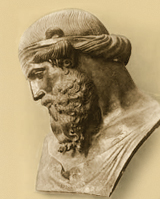
Works Cited
Burnet, John, Platonis opera, Oxonii : E. typographeo Clarendoniano, 1900.
Plato. “Timaeus,” Loeb Classical Library, Vol. 9, R. G. Bury, trans. Cambridge, MA: Harvard University Press; London: William Heinemann Ltd. 1929, pp. 3-249. ISBN 978-0-674-99257-3.