- Via Christa
- » Appendices
- » Epistemology
Epistemology, the Theory of Knowledge
Epistemology is the theory of knowledge,
1856, coined by Scottish philosopher James F. Ferrier (1808-1864) from Greek episteme knowledge, acquaintance with (something), skill, experience,
from Ionic Greek epistasthai know how to do, understand,
literally overstand,
from epi over, near
+ histasthai to stand.
–Online Etymology Dictionary
The prefix epi- is a word-forming element meaning “in addition to,” “on,” “upon,” “above,” also “after” “near,” “at,” “against,” “behind.” A productive prefix in Greek, e.g. episteme knowledge,
especially scientific knowledge.–Online Etymology Dictionary
Plato and Parmenides distinguished between mere
sense-based knowledge and the true
knowledge of The One as Mind, Being, Reality, the Good, the Real, the True and the Beautiful. True knowledge is apprehension of the Ideas, the Forms of the One. We may truly know
by study of the real through the application of logic and right reason in syzygy with the One.
Syzygy can be traced to the Greek syzygos (“yoked together”), a combination of syn- (“with, together with”) and zygon (“yoke”). Zygon is also the source of zygote (a cell formed by the union of two gametes) and zygoma, which refers to several bones and processes of the skull. Zygon is also related to the Old English geoc—the source of the Modern English yoke—and the Latin jungere, from which the English words join and junction are derived.
–Merriam-Webster Dictionary
History of Epistemology
Encyclopedia Britannica
All major Greek philosophers held that knowledge must not itself change or be changeable in any respect. Parmenides, for example, held that thinking is identical with “being” (i.e., all objects of thought exist and are unchanging) and that it is impossible to think of “nonbeing” or “becoming” in any way.
Plato accepted the Parmenidean constraint that knowledge must be unchanging. As Plato pointed out in the Theaetetus, sense experience cannot be a source of knowledge, because the objects apprehended through it are subject to change. To the extent that humans have knowledge, they attain it by transcending sense experience to discover unchanging objects through the exercise of reason.
The Platonic theory of knowledge thus contains two parts: first, an investigation into the nature of unchanging objects and, second, a discussion of how those objects can be known through reason. Of the many literary devices Plato used to illustrate his theory, the best known is the allegory of the cave, which appears in Book VII of the Republic. The allegory depicts people living in a cave, which represents the world of sense-experience. In the cave, people see only unreal objects, shadows, or images. Through a painful intellectual process, which involves the rejection and overcoming of the familiar sensible world, they begin an ascent out of the cave into reality. That process is the analogue of the exercise of reason, which allows one to apprehend unchanging objects and thus to acquire knowledge. The upward journey, which few people are able to complete, culminates in the direct vision of the Sun, which represents the source of knowledge.
Plato’s investigation of unchanging objects begins with the observation that every faculty of the mind apprehends a unique set of objects: hearing apprehends sounds, sight apprehends visual images, smell apprehends odours, and so on. Knowing also is a mental faculty, according to Plato, and therefore there must be a unique set of objects that it apprehends. Roughly speaking, those objects are the entities denoted by terms that can be used as predicates—e.g., “good,” “white,” and “triangle.” To say “This is a triangle,” for example, is to attribute a certain property, that of being a triangle, to a certain spatiotemporal object, such as a figure drawn in the sand. Plato is here distinguishing between specific triangles that are drawn, sketched, or painted and the common property they share, that of being triangular. Objects of the former kind, which he calls “particulars,” are always located somewhere in space and time—i.e., in the world of appearance. The property they share is a “form” or “idea” (though the latter term is not used in any psychological sense). Unlike particulars, forms do not exist in space and time; moreover, they do not change. They are thus the objects that one apprehends when one has knowledge.
Reason is used to discover unchanging forms through the method of dialectic, which Plato inherited from his teacher Socrates. The method involves a process of question and answer designed to elicit a “real definition.” By a real definition Plato means a set of necessary and sufficient conditions that exactly determine the entities to which a given concept applies. The entities to which the concept “being a brother” applies, for example, are determined by the concepts “being male” and “being a sibling”: it is both necessary and sufficient for a person to be a brother that he be male and a sibling. Anyone who grasps these conditions understands precisely what being a brother is.
In the Republic, Plato applies the dialectical method to the concept of justice. In response to a proposal by Cephalus that “justice” means the same as “honesty in word and deed,” Socrates points out that, under some conditions, it is just not to tell the truth or to repay debts. Suppose one borrows a weapon from a person who later loses his sanity. If the person then demands his weapon back in order to kill someone who is innocent, it would be just to lie to him, stating that one no longer had the weapon. Therefore, “justice” cannot mean the same as "honesty in word and deed." By the technique of proposing one definition after another and subjecting each to possible counter-examples, Socrates attempts to discover a definition that cannot be refuted. In doing so he apprehends the form of justice, the common feature that all just things share.
Plato’s search for definitions and, thereby, forms is a search for knowledge. But how should knowledge in general be defined? In the Theaetetus Plato argues that, at a minimum, knowledge involves true belief. No one can know what is false. People may believe that they know something that is in fact false. But in that case they do not really know; they only think they know. Knowledge is more than simply true belief. Suppose that someone has a dream in April that there will be an earthquake in September and, on the basis of that dream, forms the belief that there will be an earthquake in September. Suppose also that in fact there is an earthquake in September. The person has a true belief about the earthquake but not knowledge of it. What the person lacks is a good reason to support that true belief. In a word, the person lacks justification. Using such arguments, Plato contends that knowledge is justified true belief.
.
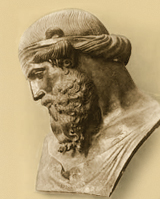
Plato of Athens
428 B.C. — 348 B.C.
Premier Greek philosopher, the Father of Idealism in its many facets: philosophy, metaphysics, ontology, theology, psychology, mysticism, aesthetics, ethics, education, literature, and politics
Reference
History of Epistemology,
Encyclopedia Britannica, April 19, 2024.
Epistemology.Encyclopedia Britannica, April 19, 2024.