- Via Christa
- » Via Christa Life
- » Appendix
- » Plato’s Doctrine of Recollection
Plato’s Doctrine of Recollection
Edna Lister frequently spoke of soul knowing
; throughout the papers contained within the Via Christa we refer to Plato’s Doctrine of Recollection as soul memory, soul knowing, and soul knowledge.
Following is Plato’s record of how Socrates expressed these ideas on the day he was executed on trumped-up charges. From the Phaedo and other dialogues, it is obvious that recollection or anamnesis was a commonly held belief among Socrates’ and Plato’s followers, dating from Pythagoras (570—495 B.C.) at least; he said that he had lived before and remembered his lives.
From Plato’s Phaedo 72c—75d
My dear Cebes, if all things that have life should die, and, when they had died, the dead should remain in that condition, is it not inevitable that at last all things would be dead [72d] and nothing alive? For if the living were generated from any other things than from the dead, and the living were to die, is there any escape from the final result that all things would be swallowed up in death?
“I see none, Socrates,” said Cebes. “What you say seems to be perfectly true.”
“I think, Cebes,” said he, “it is absolutely so, and we are not deluded in making these admissions, but the return to life is an actual fact, and it is a fact that the living are generated from the dead and that the souls of the dead [72e] exist.”
“And besides,” Cebes rejoined, “if it is true, Socrates, as you are fond of saying, that our learning is nothing else than recollection, then this would be an additional argument that we must necessarily have learned in some previous time what we now remember. But this is impossible if [73a] our soul did not exist somewhere before being born in this human form; and so by this argument also it appears that the soul is immortal.”
“But, Cebes,” said Simmias, “what were the proofs of this? Remind me; for I do not recollect very well just now.”
“Briefly,” said Cebes, “a very good proof is this: When people are questioned, if you put the questions well, they answer correctly of themselves about everything; and yet if they had not within them some knowledge and right reason, they could not do this. And that this is so is shown most clearly if you take them [73b] to mathematical diagrams or anything of that sort.”
“And if you are not convinced in that way, Simmias,” said Socrates, “see if you don't agree when you look at it in this way. You are incredulous, are you not, how that which is called learning can be recollection?”
“I am not incredulous,” said Simmias, “but I want just what we are talking about, recollection. And from what Cebes undertook to say I already begin to recollect and be convinced; nevertheless, I should like to hear [73c] what you were going to say.”
“It was this,” said he. “We agree, I suppose, that if anyone is to remember anything, he must know it at some previous time?”
“Certainly,” said he.
“Then do we agree to this also, that when knowledge comes in such a way, it is recollection? What I mean is this: If a man, when he has heard or seen or in any other way perceived a thing, knows not only that thing, but also has a perception of some other thing, the knowledge of which is not the same, but different, are we not right in saying that [73d] he recollects the thing of which he has the perception?”
…[74c] “Whenever the sight of one thing [74d] brings you a perception of another, whether they be like or unlike, that must necessarily be recollection. …[74e] we must have had knowledge of equality [75a] before the time when we first saw equal things and thought, ‘All these things are aiming to be like equality but fall short.’… [75a] Then it is through the senses that we must learn [75b] that all sensible objects strive after absolute equality and fall short of it. …Then before we began to see or hear or use the other senses we must somewhere have gained a knowledge of abstract or absolute equality, if we were to compare with it the equals which we perceive by the senses, and see that all such things yearn to be like abstract equality but fall short of it.…And we saw and heard and had the other senses as soon as we were born.…Then it appears that we must have acquired it before we were born.…Now if we had acquired that knowledge before we were born, and were born with it, we knew before we were born and at the moment of birth not only the equal and the greater and the less, but all such abstractions.…For our present argument is no more concerned with the equal than with absolute beauty and the absolute good and the just and the holy, and, in short, [75d] with all those things which we stamp with the seal of absolute in our dialectic process of questions and answers; so that we must necessarily have acquired knowledge of all these before our birth.”
To remember implies that a thing exists in the memory, not that it is actually present in the thoughts at the moment, but that it recurs without effort. Recollect means that a fact, forgotten or partially lost to memory, is after some effort recalled and present to the mind. Remembrance is the store-house, recollection the act of culling out this article and that from the repository. He remembers everything he hears, and can recollect any statement when called on. The words, however, are often confounded, and we say we cannot remember a thing when we mean we cannot recollect it.
—Century Dictionary, 1895
Anamnesis (n.) is recollection, remembrance, reminiscence,
1650s, from Greek anamnēsis a calling to mind, remembrance,
noun of action from stem of anamimnēskein
remember, remind (someone) of (something), make mention of,
from ana back
(see ana-) + mimnēskesthai to recall, cause to remember,
related to mnēmnōn mindful,
mnēmē memory.
—Etymonline.com In Platonic philosophy, anamnesis is the recollection of a prior life.
.
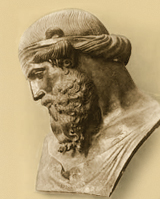
Plato of Athens
428 BC–348 BC
Premier Greek philosopher, the Father of Idealism in its many facets: philosophy, metaphysics, ontology, theology, psychology, mysticism, aesthetics, ethics, education, literature, and politics.
Etymology of memory: Latin memoria, from memor, "mindful."
Etymology of recollection: Latin recollectionem, from stem of recolligere "to take up again, regain," etymologically "to collect again," from re- "again" (see re-) + colligere "gather" (see collect (v.)). The meaning "act of recalling to the memory" is from 1680s.
Etymology of anamnesis: Greek anamnesis, "a calling to mind, remembrance," from anamimnēskein "remember, remind"
References
Harper, Douglas. "Memory, Recollection," Online Etymology Dictionary, 2024.
Hicks, R.D. Lives of the Eminent Philosophers,
(2 vol. ed.). Loeb Classical Library; 1925.
Huffman C. A., ed. A History of Pythagoreanism. Cambridge University Press; 2014.
Plato. “Phaedo,” Loeb Classical Library, Vol. 1 translated by H. N. Fowler. New York: G. P. Putnam’s Sons, pp. 195-403. First Printed, 1914. Reprinted, 1917, 1919. ISBN 978-0-674-99040-1.