- Via Christa
- » Library
- » Plato
- » Epistles, R. G. Bury, Introduction and Translation
Epistles
By Plato of Athens
Introduction and Translation
By R. G. Bury
In our manuscripts of Plato this collection of Thirteen Epistles is placed at the end, just before the spurious dialogues. This arrangement dates from the time of Thrasyllus, a contemporary of the Emperor Tiberius, who arranged the Platonic writings in tetralogies,
or groups of four, and placed the Epistles in his last tetralogy. But as we have them numbered in the manuscripts the Epistles do not seem to be arranged on any intelligible principle; and for purposes of study it would be better either to group them according to the persons to whom they were addressed, or to arrange them in chronological order. In chronological order the sequence should probably be this—xiii, ii, xi, x, iv, iii, vii, viii, vi (omitting i, v, ix, and xii as certainly spurious). While if we arrange them according to the persons to whom the Letters are addressed they will naturally fall into three main groups, viz.:—
(1) Letters to Dionysius—i, ii, iii, xiii.
(2) Letters to Dion and Dion’s friends—iv, vii, viii, x.
(3) Letters to various Rulers and Statesmen—v, vi, ix, xi, xii.
It will be noticed that eight Letters, out of the thirteen, including the most important, are concerned with the Sicilian rulers, Dion and Dionysius; and |386| it may be helpful to insert here a brief summary of the course of affairs in Sicily in so far as they affected Plato.
Dionysius the Elder was the tyrant of Syracuse when Plato, then about forty years of age, paid his first visit to Italy and Sicily (388-387 B.C.). At Syracuse Plato fell in with Dion, the brother-in-law of Dionysius, who was then about twenty years old, and was greatly struck with his character and abilities. A firm friendship, based on their enthusiasm for philosophy, sprang up between the two and lasted, without a break, till Dion’s death some thirty-three years later. On his return to Athens from this expedition Plato founded the Academy. During the next twenty years, until his death in 367 B.C., Dionysius was active in extending and consolidating his empire in Sicily and S. Italy, and in making Syracuse a centre of light and learning as well as a military capital. Unfortunately his son and successor, Dionysius the Younger, when weighed in the balance of all-testing Time, was found wanting in all those qualities which go to make a successful governor. To practical incompetence and want of judgement he added vanity, jealousy, and mutability. During the early days of his reign he was guided in the government by his uncle Dion; and it was because of Dion’s influence that Plato was persuaded to make his second visit to Syracuse (367 B.C.). By the aid of Dion Plato hoped to realize there his ideal of a state ruled by a philosopher-king. Unfortunately the reforms initiated by Dion raised enemies against him in the city; and the young Dionysius also became impatient of the Spartan life inculcated by Plato and by Dion, so that he lent only too ready an ear to the enemies |387| who insinuated doubts of Dion’s loyalty. So it came about that within a few months of Plato’s arrival Dion, the champion of his political ideals, was driven into exile, and Dionysius, whom he had hoped to train up in the paths of philosophy, showed no desire to submit to the discipline proposed. Plato, therefore, after some efforts to secure the restoration of Dion and to bring Dionysius to a better mind, decided to leave Sicily.
During the next five years Plato, it would seem, continued to interest himself in Sicilian affairs, and helped, for one thing, to promote a friendly understanding between Archytas of Tarentum and Dionysius, which resulted in the latter aiding the Tarentines in their war against the Lucanians. Apparently Dionysius was anxious at this time to exploit his friendship with Plato for his own advantage, being ambitious to pose not only as a patron of letters but a man of science himself. So he surrounded himself with sophists or scientists before whom he could display his erudition as a full-fledged member of the great Academy of Athens, and his enthusiasm for the ideal philosophy. Meanwhile, however, he showed no disposition to recall Dion. Finally, his ambition to make of his court a centre of Hellenic culture roused him to make fresh overtures to Plato, so as to induce him to revisit Syracuse. Against his own better judgement (as he protests) Plato yielded to his entreaties, backed as it was by Dion’s advice and that of other friends, hoping against hope that he might yet intercede successfully for Dion and convert Dionysius to a serious interest in philosophic politics.
But alas! his hopes were doomed to disappointment. |388| The third visit to Sicily (361-360 B.C.) proved an utter failure. In spite of his utmost efforts Plato could not induce the tyrant either to restore Dion or to undertake the serious study of philosophy and the prosecution of the political reforms which he professed to believe in. Consequently before long the relations between the two became strained, Plato being disgusted with the fickleness and jealousy of Dionysius, and Dionysius resenting Plato’s loyalty to the interests of Dion and his own intellectual reputation. In the end Dionysius showed increased bitterness against Dion, whose property he confiscated, and deprived him even of his wife and child; while he treated Plato with marked disrespect, making him a virtual prisoner in the precincts of the palace, until he went actually in fear of his life from the violence of the soldiery. From this humiliating position Plato was only rescued by the intervention of his friend Archytas of Tarentum, to whom he had appealed for help.
On his return from this third visit to Sicily, in 360 B.C., Plato made a journey to Olympia, where he met Dion at the Festival, and discussed with him the situation of affairs at Syracuse. Rather against the wishes of Plato, Dion resolved on military operations against Dionysius, and summoned all his friends to help him. His attack on Syracuse in 357 was welcomed by the popular party, and he gained possession of the city without difficulty, although the tyrant continued to hold out in his palace in the island of Ortygia. But when Dion proceeded to put his political reforms into execution he lost the favour of the populace, who united against him under the leadership of Heracleides. After a series of disturbances |389| Dion found himself obliged to execute Heracleides; but this strong measure instead of securing peace only increased his unpopularity and caused further trouble; until the climax of misfortune came with the assassination of Dion by a pair of Athenians who had posed as his friends, Callippus and his brother (353 B.C.).
After the death of their chief Dion’s friends retired to Leontini, while Callippus held sway in Syracuse. But his hold on the city was far from secure, and after little more than a year the partisans of Dion, under his nephew Hipparinus, succeeded in capturing Syracuse. But though Dion’s adherents thus held Syracuse and Leontini, the rest of Sicily remained a prey to civil war, and repeated incursions of foreign foes, Carthaginians and Italians, added to the general distress. Nor did the position of affairs at either Syracuse or Leontini continue satisfactory, from the point of view of Dion’s friends, for any length of time. Hipparinus, the ruler of Syracuse, died in 350 B.C.; and his brother Nysaeus did not long survive him. At Leontini things took a still worse course; for Hicetas, who had assumed control as the nominee of Dion’s party, fell out with them and even went so far as to destroy all the members of Dion’s family upon whom he could lay hands.
It was thus that the last years of Plato, who died in 347 B.C., were saddened by the sight of the storm-clouds which rolled ever darkly over Sicily, the land for which his beloved Dion had spent his life, and spent it, alas! in vain.
Whatever view we take of the authenticity of the Epistles it is certain at least that some of them represent an ancient tradition, within a century of |390| Plato’s time, regarding the historical and biographical details which they relate. Their interest and value consist mainly in the welcome light they throw on the practical activity of Plato and on the political influence of the Academy. They show us that Plato was really in earnest with the Ideal State which he had sketched in the Republic; and they put before us all the practical measures he took, with Dion as his colleague, to realize that Ideal. They also help us to understand how, in default of the Ideal, he was led to fall back upon the rule of Law, as a second-best; so that the Laws, rather than a new Republic, was the main work of his declining years.
The epistle as a special literary type was well established by the second and first centuries B.C. We have several letters, probably genuine, of Epicurus; and Isocrates, the contemporary of Plato, is credited with quite a number of letters, some of them addressed to Philip of Macedon, of which a few may be accepted as genuine. Some of these Isocratean letters are obviously not private but what we should term open
letters, intended for publication. And in attempting to decide the question of authenticity it is important to bear in mind this distinction between the private and personal letter and the open
letter, which is really a manifesto or essay under the guise of a letter and meant for the edification of a public far wider than the persons to whom it is nominally addressed. For it is evident that the chances of preservation, and therefore the chances of authenticity, are far greater in the case of the open letter.
It stands on much the same footing as the oration or the dialogue. In the case of the purely private letter, on the other hand, we have to assign |391| a reason for its preservation. Did the writer retain a duplicate of his letters? Or did the recipient file and preserve them? And if a few have been thus preserved, why not all? Thus one is justified in doubting a priori the genuineness of the private letter unless there is overwhelming evidence in its favour. And this all the more because it is so easy to account for the origin of the spurious letter; since we have it on Galen’s authority that good prices were paid by the libraries for letters signed with illustrious names. This put a premium upon forgeries, especially skillful forgeries; so that it was well worthwhile for an unscrupulous man of letters to study the style of a celebrated author such as Plato with a view to foisting on the learned world a plausibly fabricated epistle. In some cases, too, school-exercises composed by his scholars of the first or second generation might be mistaken at a later age for genuine compositions of the master himself. Or again, some teacher or propagandist, innocent of any real intention to deceive, might adopt the device of issuing his own views and theories under cover of the name of some earlier authority. And thus in one way or another spurious documents would come to be accepted at their face-value, and ascribed to the authors whose names they ostensibly bear.
If we turn now to the Platonic collection of thirteen Epistles we find that the only two which we can with any confidence regard as genuine are precisely those two open
letters, the seventh and the eighth. Fortunately these are the longest, most important, and most informative of the thirteen. Of the other letters, iii, iv, and xiii are admitted to be genuine by a good many modern scholars; some also admit |392| vi, x, and xi, and, less confidently, ii; while i, v, ix, and xii are generally acknowledged to be forgeries. The readiness of so many recent scholars to ascribe as many Epistles as possible to Plato is in marked contrast to the attitude of the great Platonic students of fifty or a hundred years ago (such as Ast and Zeller) who unhesitatingly pronounced the whole collection apocryphal. It would seem that the swing of the pendulum has now gone too far in the other direction; and the most reasonable view is that the two great letters, seventh and eighth, are really from Plato’s hand, while all the rest are fabrications after his manner. For further justification of this view the reader may be referred to the Prefatory Notes at the head of the individual Epistles.
The Greek text here printed is based on that of the Zurich edition, the chief deviations being indicated in the footnotes.
Epistle I
Prefatory Note.—In this letter the writer reproaches Dionysius for the ill-treatment he has received from him and his friends. In return for his public services he has been dismissed with ignominy, and has been offered a paltry sum to meet his travelling-expenses. He rejects the offer with scorn, and prophesies for the tyrant an evil future bereft of friends,
embellishing his tirade with quotations from tragic poets.
Such a letter, if written by Plato, could only belong to the year 360, immediately after his return from his third visit to Sicily and his final break with Dionysius. But Plato could never have described himself as the sole Dictator
(αὐτοκράτωρ) of Syracuse; nor does the account here given of his abrupt dismissal agree with what we are told in Epistle vii. Accordingly, it has been suggested (by Ficinus) that Dion was the writer, since he was driven out with ignominy
(Ep. vii. 329 c). But neither is this a probable hypothesis, since Dion was never Dictator,
nor would he, a native of the place, have spoken of himself as sojourning in Syracuse, in the way the writer speaks in the opening sentence. The letter is of interest mainly for the poetical quotations it preserves; and the very manner in which these are introduced is in itself sufficient disproof of Platonic authorship.
Plato to Dionysius Wishes Well-Doing 1
After I had spent so long a time with you and was trusted above all others in my administration of your government, while you were enjoying the benefits I was enduring the slanders, grievous as they were. For I knew that men would not believe that any of your more brutal acts were done with my consent, seeing that I have for my witnesses all those who take a part in your government, many of whom I have helped in their times of trial and saved them from no small damage. But after I had oftentimes kept guard over your City as sole Dictator, I was dismissed with more ignominy than a beggar would deserve who had stayed with you for so long a time, were you to pack him off and order him to sail away.
For the future, therefore, I for my part will consult my own interests in less philanthropic fashion, while you, gross tyrant that you are, will dwell alone.
2 |397| And as for the splendid sum of gold which you gave for my journey home, Baccheius, the bearer of this letter, is taking it back to you. For it was neither a sufficient sum for my journey nor was it otherwise useful for my support; and since it reflects the greatest disgrace on you who offer it, and not much less on me if I accept it, I therefore refuse to accept it. But evidently neither the giving nor the accepting of such an amount makes any difference to you; take it, then, and befriend therewith some other companion of yours as you did me; for I, in sooth, have had enough of your befriending.
Indeed, I may appropriately quote the verse of Euripides—that one day, when other fortunes befall you,
Thou’lt pray for such a helper by thy side. 3
And I desire to remind you that most of the other tragedians also, when they show a tyrant on the stage slaughtered by someone, represent him as crying out—
Bereft of friends,—ah! woe is me,—I die. 4
But not one of them has represented him as dying for lack of gold. This other poem also to men of judgement seemeth not amiss
—
In this our human life, with halting hopes.
It is not glittering gold that rarest is:
Not diamond nor couches silver-wrought
Appear so brilliant in the eyes of men:
Nor do the fertile fields of Earth’s broad breast,
Laden with crops, so all-sufficing seem
As gallant men’s unanimous resolve. 5
Farewell; and may you learn how much you have lost in us, so that you may behave yourself better towards all others.
Epistle II
Prefatory Note.—Plato begins by replying to Dionysius’s complaint that he has recently been maligned by Plato’s friends. He says that he is not responsible for his friends’ conduct; yet, all the same, the reports Dionysius has heard about them are false. Next, he passes on to his main theme—the mutual relations which should subsist between himself and Dionysius, arguing that this is a matter of high importance because men everywhere love to discuss the mutual intercourse between potentates and sages, such as Cyrus and Solon. Nor is the verdict of future ages to be lightly esteemed by the wise. And we, unlike the earlier examples of power in contact with wisdom, have it still in our power to amend our behaviour towards each other.
After this lesson on behaviour, Plato proceeds to deal with a philosophic problem which was puzzling Dionysius, namely, the nature of the First
(principle). His explanation, he says, must be couched in enigmas
lest the secrets of his doctrine should fall into the hands of the profane vulgar. Realities must be distinguished from qualities; and knowledge of the three grades of Being can only be acquired by long study and travail of soul. The doubts and difficulties felt by Dionysius are common to all students of the subject; and Plato commends him |399| for consulting him about them, and advises him to go on doing so. Only he must never write down these doctrines; just as Plato himself has never put them in writing—the writings ascribed to him being really those of Socrates rejuvenated.
Even this letter must be burned, once it has been committed to memory.
The letter concludes with some personal observations and requests.
As regards the authenticity of this letter, it may be taken as fairly certain that it is not by Plato. The following considerations, amongst others, tell strongly against it.
The Olympic Games mentioned in the opening paragraph cannot well be those of 360 B.C. (as some have supposed), since the general tone of the letter shows that it must be earlier than Plato’s return from his third visit to Syracuse in that year. The reference, then, must be to the Games of 364 B.C.; and if so, the Syracusan visit alluded to in 312 a can only be the second visit of 367-366 B.C. But the account there given of the failure of that visit owing to the suspicious attitude of Dionysius plainly contradicts what we are told of Dionysius’s hospitable treatment of Plato in Ep. vii. (329 d ff.). Moreover, there is no other evidence that Plato visited Olympia in 364 B.C.; although we are told (Ep. vii. 350 b) that he did so in 360 B.C.
In addition to these historical inconsistencies there is much to arouse suspicion in the tone and matter of the letter. Can we imagine the real Plato saying that his object in visiting Syracuse was to make philosophy honoured by the multitude
? Or denying that he ever wrote serious books on philosophy? |400| Or bidding his correspondent burn a letter because it contained a doctrine which nobody else (as he says) could possibly understand since it was written in riddles
? Or trotting out a long list of sages and potentates to suggest his own magnanimity and the magnificence of Dionysius? Moreover, the numerous echoes of passages in other letters and dialogues (see the footnotes) are such as to confirm the suspicion that the writer of this letter was a rhetor of a later age and of Pythagorean leanings, who thought to glorify the memory of Plato by composing this epistolary exercise on the theme—How ought Plato and Dionysius to behave towards each other?
A word may be added regarding the secret doctrine
which professes to explain the nature of the First
in the passage 312 e ff. Among the interpretations offered, some identify the Three (principles) with the Idea of Good, Reason (νοῦς) and the Soul; others with God, the Ideas, the World-Soul; others with the Ideas, the World of Sense, Matter; others with the Idea of Good (= Reason), the World as known by Science (διάνοια), and the World as known by Sense. It has also been suggested that the writer had Ep. vii. 342 a ff. in mind and meant by his three the Name, the Definition, and the Idea. Now it is, perhaps, futile to attempt to interpret what seems a piece of willful mystification. If, however, we are to venture on the thankless task and credit the writer with at least the minimum of sense, we must suppose him to be referring to three grades of existence in each of which there is a plurality surrounding, or related to, a central Unity or common principle. Now what is here said of the King of All
is closely parallel to |401| the description given of the Idea of Good in Republic 509 b, d, 517 c; so it is natural to equate the First Principle and the first grade of Being with the Idea of Good and the other Ideas, or with the Divine Reason (cf. Philebus 30 d) and the realm of rational objects (νοητά). If so, the Second (principle) may probably be the form of intelligence which comes next to reason in the Republic, i.e. διάνοια, related to
which are the Mathematicals
(τὰ μετξύ); while in the Third place will come Sense-perception (αἴσθησις) and the world of sense-objects.
But it is impossible to be sure that this was what the writer really intended to convey in his oracular exposition, which, for its vagueness, may be compared with the cryptic allusion to two Divine Powers at the end of the sixth letter.
Plato to Dionysius Wishes Well-Doing
I hear from Archedemus 6 that you think that not only I myself should keep quiet but my friends also from doing or saying anything bad about you; and that you except Dion only.
7 Now your saying this, that Dion is excepted, implies that I have no control over my friends; for had I had this control over you and Dion, as well as the rest, more blessings would have come to us all and to the rest of the Greeks also, as I affirm. But as it is, my greatness consists in making myself follow my own instructions. 8 However, I do not say this as though what Cratistolus and Polyxenus 9 have told you is to be trusted; for it is said that one of these men declares that at Olympia 10 he heard quite a number of my companions maligning you. No doubt his hearing is more acute than mine; for I certainly heard no such thing. For the future, whenever anyone makes such a statement about any of us, what you ought, I think, to do is to send me a letter of inquiry; for I shall tell the truth without scruple or shame. |405|
Now as for you and me, the relation in which we stand towards each other is really this. There is not a single Greek, one may say, to whom we are unknown, and our intercourse is a matter of common talk; and you may be sure of this, that it will be common talk also in days to come, because so many have heard tell of it owing to its duration and its publicity. What, now, is the point of this remark? I will go back to the beginning and tell you. It is natural for wisdom and great power to come together, and they are for ever pursuing and seeking each other and consorting together. Moreover, these are qualities which people delight in discussing themselves in private conversation and hearing others discuss in their poems. For example, when men talk about Hiero 11 or about Pausanias the Lacedaemonian they delight to bring in their meeting with Simonides and what he did and said to them; and they are wont to harp on Periander of Corinth and Thales of Miletus, and on Pericles and Anaxagoras, and on Croesus also and Solon as wise men with Cyrus as potentate. 12 The poets, too, follow their example, and bring together Creon and Tiresias, Polyeidus and Minos, Agamemnon and Nestor, Odysseus and Palamedes; 13 and so it was, I suppose, that the earliest men also brought together Prometheus and Zeus. And of these some were—as the poets tell—at feud with each other, and others were |407| friends; while others again were now friends and now foes, and partly in agreement and partly in disagreement.
Now my object in saying all this is to make it clear, that when we ourselves die men’s talk about us will not likewise be silenced; so that we must be careful about it. We must necessarily, it seems, have a care also for the future, seeing that, by some law of nature, the most slavish men pay no regard to it, whereas the most upright do all they can to ensure that they shall be well spoken of in the future. Now I count this as a proof that the dead have some perception of things here on earth; 14 for the best souls divine that this is so, while the worst deny it; and the divinings of men who are godlike are of more authority than those of men who are not.
I certainly think that, had it been in their power to rectify what was wrong in their intercourse, those men of the past whom I have mentioned would have striven to the utmost to ensure a better report of themselves than they now have. 15 In our case, then—if God so grant—it still remains possible to put right whatever has been amiss in word or deed during our intercourse in the past. For I maintain that, as regards the true philosophy, men will think and speak well of it if we ourselves are upright, and ill if we are base. And in truth we could do nothing more pious than to give attention to this matter, nothing more impious than to disregard it.
How this result should be brought about, and what is the just course to pursue, I will now explain. I came to Sicily with the reputation of being by far |409| the most eminent of those engaged in philosophy; and I desired, on my arrival in Syracuse, to gain your testimony as well, in order that I might get philosophy held in honour even by the multitude. 16 In this, however, I was disappointed. But the reason I give for this is not that which is commonly given; rather it was because you showed that you did not fully trust me but wished rather to get rid of me somehow and invite others in my place; and owing, as I believe, to your distrust of me, you showed yourself inquisitive as to what my business was. Thereupon it was proclaimed aloud by many that you utterly despised me and were devoted to other affairs. This certainly was the story noised abroad.
And now I will tell you what it is right to do after this, that so I may reply also to your question how you and I ought to behave towards each other. If you altogether despise philosophy, leave it alone. If, again, you have been taught by someone else or have yourself invented better doctrines than mine, hold them in honour. 17 But if you are contented with my doctrines, then you should hold me also in special honour. So now, just as at the beginning, do you lead the way and I will follow. If I am honoured by you, I will honour you; but if I am not honoured I will keep to myself. Moreover, if you honour me and take the lead in so doing, you will be thought to be honouring philosophy; and the very fact that you have studied other systems as well will gain you the credit, in the eyes of many, of being a philosopher yourself. But if I honour you, while you do not honour me, I shall be deemed to be a man who worships and pursues after wealth; and to such conduct everyone, we know, gives a bad |411| name. So, to sum it all up, if you pay the honour, it will be a credit to both of us, but if I pay it a disgrace to both. So much, then, about this subject.
As to the globe, 18 there is something wrong with it; and Archedemus will point it out to you when he arrives. There is also another matter—much more valuable and divine than the globe—which he most certainly must explain, as you were puzzled about it when you sent him. For, according to his report, you say that you have not had a sufficient demonstration of the doctrine concerning the nature of the First.
19 Now I must expound it to you in a riddling way in order that, should the tablet come to any harm in folds of ocean or of earth,
he that readeth may not understand.
The matter stands thus: Related to the King of All are all things, and for his sake they are, and of all things fair He is the cause. And related to the Second are the second things; and related to the Third the third. About these, then, the human soul strives to learn, looking to the things that are akin to itself, whereof none is fully perfect. But as to the King and the objects I have mentioned, they are of quite different quality. In the next place the soul inquires—"Well then, what quality have they? But the cause of all the mischief, O son of Dionysius and Doris, lies in this very question, or rather in the travail which this question creates in the soul; and unless a man delivers himself from this he will never really attain the truth.
You, however, declared to me in the garden, under the laurels, that you had formed this notion yourself |413| and that it was a discovery of your own; and I made answer that if it was plain to you that this was so, you would have saved me from a long discourse. 20 I said, however, that I had never met with any other person who had made this discovery; on the contrary most of the trouble I had was about this very problem. So then, after you had either, as is probable, got the true solution from someone else, or had possibly (by Heaven’s favour) hit on it yourself, you fancied you had a firm grip on the proofs of it, and so you omitted to make them fast; thus your view of the truth sways now this way, now that, round about the apparent object; whereas the true object is wholly different. 21 Nor are you alone in this experience; on the contrary, there has never yet been anyone, I assure you, who has not suffered the same confusion at the beginning, when he first learnt this doctrine from me; and they all overcome it with difficulty, one man having more trouble and another less, but scarcely a single one of them escapes with but little.
So now that this has occurred, and things are in this state, we have pretty well found an answer, as I think, to the question how we ought to behave towards each other. For seeing that you are testing my doctrines both by attending the lectures of other teachers and by examining my teaching side by side with theirs, as well as by itself, then, if the test you make is a true one, not only will these doctrines implant themselves now in your mind, but you also will be devoted both to them and to us.
How, then, will this, and all that I have said, be brought to pass? You have done right now in sending Archedemus; and in the future also, after he returns to you and reports my answer, you will probably be |415| beset later on with fresh perplexities. Then, if you are rightly advised, you will send Archedemus back to me, and he with his cargo will return to you again. And if you do this twice or thrice, and fully test the doctrines I send you, I shall be surprised if your present difficulties do not assume quite, a new aspect. Do you, therefore, act so, and with confidence; for there is no merchandise more fair than this or dearer to Heaven which you can ever dispatch or Archedemus transport.
Beware, however, lest these doctrines be ever divulged to uneducated people. 22 For there are hardly any doctrines, I believe, which sound more absurd than these to the vulgar, or, on the other hand, more admirable and inspired to men of fine disposition. For it is through being repeated and listened to frequently for many years that these doctrines are refined at length, like gold, with prolonged labour. But listen now to the most remarkable result of all. Quite a number of men there are who have listened to these doctrines—men capable of learning and capable also of holding them in mind and judging them by all sorts of tests—and who have been hearers of mine for no less than thirty years 23 and are now quite old; and these men now declare that the doctrines that they once held to be most incredible appear to them now the most credible, and what they then held most credible now appears the opposite. So, bearing this in mind, have a care lest one day you should repent of what has now been divulged improperly. The greatest safeguard is to avoid writing and to learn by heart; for it is not |417| possible that what is written down should not get divulged. For this reason I myself have never yet written anything on these subjects, and no treatise by Plato exists or will exist, but those which now bear his name belong to a Socrates become fair and young. 24 Fare thee well, and give me credence; and now, to begin with, read this letter over repeatedly and then burn it up.
So much, then, for that. You were surprised at my sending Polyxenus to you; but now as of old I repeat the same statement about Lycophron 25 also and the others you have with you, that, as respects dialectic, you are far superior to them all both in natural intelligence and in argumentative ability; and I maintain that if any of them is beaten in argument, this defeat is not voluntary, as some imagine, but involuntary. All the same, it appears that you treat them with the greatest consideration and make them presents. So much, then, about these men: too much, indeed, about such as they!
As for Philistion, 26 if you are making use of him yourself by all means do so; but if not, lend him if possible to Speusippus 27 and send him home. Speusippus, too, begs you to do so; and Philistion also promised me, that, if you would release him, he would gladly come to Athens. Many thanks for releasing the man in the stone-quarries; and my request with regard to his household and Hegesippus, the son of Ariston, 28 is no hard matter; for in your |419| letter you said that should anyone wrong him or them and you come to know of it you would not allow it. It is proper for me also to say what is true about Lysicleides; for of all those who have come to Athens from Sicily he is the only one who has not misrepresented your association with me; on the contrary, he always speaks nicely about past events and puts the best construction on them.
Epistle III
Prefatory Note.—This letter begins with a piece of moralizing on the propriety or otherwise of commencing a letter by wishing joy
to the person addressed; Plato’s custom rather being to wish well-doing
to his friends. He then proceeds to complain that Dionysius has been spreading slanders about him by saying that it was Plato who had prevented him from carrying out the reforms he had always had in mind—namely, converting the tyranny at Syracuse into a constitutional monarchy and planting settlers in the Greek cities of Sicily. Other slanders, also, have been going about to the effect that all that was wrong in the administration of Dionysius was due to the mischievous interference and influence of Plato. The twofold charge calls for a twofold defence. This takes the form of a summary of Plato’s objects and activities in connexion with Syracusan affairs. In the first instance he went to Syracuse because of his interest in Dion, and when Dion was exiled he ceased to take part in Sicilian politics, except for attempting to reconcile Dionysius and Dion, and returned to Athens. The reason for his next visit was that Dionysius had made it a condition of his coming to terms with Dion, and that all his friends urged him to go to Syracuse. He did his duty as a friend in going, but the journey turned |422| out as fruitless as he himself expected. Though he did all he could in the interests of Dion, Dionysius kept constantly putting him off with promises he had no intention of keeping, while he was making away with Dion’s property in Sicily. At first by his promises he induced Plato to prolong his stay, and then he turned round and accused him of making plots against the tyranny, so as to scare him away. Thus the result of Plato’s loyalty to Dion was that he incurred the enmity of the tyrant. This narrative of events is sufficient to dispose of the charge that Plato was responsible for the political acts of Dionysius.
The other charge, that Plato had stood in the way of the reforms proposed by Dionysius, is refuted by recalling a conversation they had in the presence of witnesses. And Plato concludes by affirming that these still form part of the policy he recommends, and bidding Dionysius take back his false charge and sing a palinode.
It is clear that this letter, if written by Plato, belongs to a time subsequent to his third Syracusan visit, i.e. after 360 B.C.; and the tone of it seems rather to point to a date after Dion’s successful attempt to establish himself in Sicily in 357 B.C. It reads like an open
rather than a private letter, in fact a political manifesto intended to support Dion in his policy of political reform.
But it may well be doubted whether this letter is authentic. The preamble, to begin with, is suspiciously like the work of a sophistical rhetor of a later age. There are significant resemblances between the plan of the letter, with its twofold defence against earlier and more recent accusations, and the |423| plan of the Apology in which Socrates replies to two sets of accusers. Further, there are many obvious parallels between this letter and the seventh letter which suggest that the writer of the former was borrowing from the latter; for if either letter is really Plato’s, it is more likely to be the seventh than the third.
Plato to Dionysius
Plato to Dionysius wishes Joy!
If I wrote thus, should I be hitting on the best mode of address? Or rather, by writing, according to my custom, Wishes well-doing,
this being my usual mode of address, in my letters to my friends? You, indeed,—as was reported by the spectators then present—addressed even the God himself at Delphi in this same flattering phrase, and wrote, as they say, this verse—
I wish thee joy! And may’st thou always keep
The tyrant’s life a life of pleasantness.
But as for me, I would not call upon a man, and much less a god, and bid him enjoy himself—a god, because I would be imposing a task contrary to his nature (since the Deity has his abode far beyond pleasure or pain),—nor yet a man, because pleasure and pain generate mischief for the most part, since they breed in the soul mental sloth and forgetfulness and witlessness and insolence. 29 Let such, then, be my declaration regarding the mode of address; and you, when you read it, accept it in what sense you please.
It is stated by not a few that you related to some of the ambassadors at your Court, that upon one occasion I heard you speaking of your intention to |427| occupy the Greek cities in Italy and to relieve the Syracusans by changing the government to a monarchy instead of a tyranny, and at that time (as you assert) I stopped you from doing so, although you were most eager to do it, whereas now I am urging Dion to do precisely the same thing; and thus we are robbing you of your empire by means of your own plans. Whether you derive any benefit from this talk you know best yourself, but you certainly wrong me by saying what is contrary to the fact. For of false accusation I have had enough from Philistides 30 and many others who accused me to the mercenaries and to the Syracusan populace because I stayed in the acropolis; and the people outside, whenever a mistake occurred, ascribed it entirely to me, alleging that you obeyed me in all things. But you yourself know for certain that I willingly took part in some few of your political acts at the first, when I thought that I was doing some good by it; and that I gave a fair amount of attention to the Preludes of the laws, 31 besides other small matters, apart from the additions in writing made by you or anyone else—for I am told that some of you afterwards revised my Preludes; but no doubt the several contributions will be evident to those who are competent to appreciate my style.
Well then, as I said just now, what I need is not any further accusation to the Syracusans, or any others there may be who believe your story, but much rather a defence not only against the previous false accusations, but also against the graver and more violent accusation which is now being concocted |429| to follow it. Against the two accusations I must necessarily make a twofold defence—stating, firstly, that I reasonably avoided sharing in your political transactions; and, secondly, that neither the advice was mine, nor yet the hindrance you alleged,—when you said that I had stopped you when you proposed to plant colonists in the Greek cities. So, listen first to the origin of the first of the accusations I have mentioned.
It was on your invitation and Dion’s that I came to Syracuse. Dion was a tried comrade of mine and a guest-friend of old standing, and he was a man of staid middle age,—qualities that are specially required by men who possess even a particle of sense when they intend to advise concerning affairs so important as yours then were. You, on the other hand, were extremely young, and in your case I was quite without experience of those points regarding which experience was required, as I was totally unacquainted with you. Thereafter, some man or god or chance, with your assistance, cast out Dion, and you were left alone. Do you suppose, then, that I took any part with you in your political acts, when I had lost my wise partner and saw the unwise one left behind in the company of a crowd of evil men, not ruling himself, but being ruled by men of that sort, while fancying himself the ruler? In these circumstances what ought I to have done? Was I not bound to do as I did,—to bid farewell for the future to politics, shunning the slanders which proceed from envy, and to use every endeavour to make you and Dion as friendly to each other as possible, separated though you were and at variance with each other? Yea, you yourself also are a witness of |431| this, that I have never yet ceased to strive for this very object. And it was agreed between us—although with difficulty—that I should sail home, since you were engaged in war, 32 and that, when peace was restored, Dion and I should go to Syracuse and that you should invite us. And that was how things took place as regards my first sojourn at Syracuse 33 and my safe return home again.
But on the second occasion, when peace was restored, you did not keep to our agreement in the invitation you gave me but wrote that I should come alone, and stated that you would send for Dion later on. On this account I did not go; and, moreover, I was vexed also with Dion; for he was of opinion that it was better for me to go and to yield to your wishes. Subsequently, after a year’s interval, a trireme arrived with letters from you, and the first words written in the letters were to the effect that if I came I should find that Dion’s affairs would all proceed as I desired, but the opposite if I failed to come. And indeed I am ashamed to say how many letters came at that time from Italy and Sicily from you and from others on your account, or to how many of my friends and acquaintances they were addressed, all enjoining me to go and beseeching me to trust you entirely. It was the firm opinion of everyone, beginning with Dion, that it was my duty to make the voyage and not be faint-hearted. But I always made my age 34 an excuse; and as for you, I kept assuring them that you would not be able to withstand those who slander us and desire that we should quarrel; for I saw then, as I see now, that, |433| as a rule, when great and exorbitant wealth is in the hands either of private citizens or of monarchs, the greater it is, the greater and more numerous are the slanderers it breeds and the hordes of parasites and wastrels—than which there is no greater evil generated by wealth or by the other privileges of power. Notwithstanding, I put aside all these considerations and went, resolving that none of my friends should lay it to my charge that owing to my lack of energy all their fortunes were ruined when they might have been saved from ruin.
On my arrival—for you know, to be sure, all that subsequently took place—I, of course, requested, in accordance with the agreement in your letters, that you should, in the first place, recall Dion on terms of friendship—which terms I mentioned; and if you had then yielded to this request, things would probably have turned out better than they have done now both for you and Syracuse and for the rest of Greece—that, at least, is my own intuitive belief. Next, I requested that Dion’s family should have possession of his property, instead of the distributors, whom you wot of, having the distribution of it. And further, I deemed it right that the revenue which was usually paid over to him year by year should be forwarded to him all the more, rather than all the less, because of my presence. None of these requests being granted, I asked leave to depart. Thereupon you kept urging me to stop for the year, declaring that you would sell all Dion’s property and send one half of the proceeds to Corinth and retain the other half for his son. And I could mention many other promises none of which you fulfilled; but the number of them is so great that I cut it short. For when |435| you had sold all the goods, without Dion’s consent—though you had declared that without his consent you would not dispose of them—you put the coping-stone on all your promises, my admirable friend, in a most outrageous way: you invented a plan that was neither noble nor ingenious nor just nor profitable—namely, to scare me off from so much as seeking for the dispatch of the money, as being in ignorance of the events then going on. For when you sought to expel Heracleides 35 —unjustly, as it seemed to the Syracusans as well as to myself—because I had joined with Theodotes and Eurybius in entreating you not to do so, you took this as an ample excuse, and asserted that it had long been plain to you that I paid no regard to you, but only to Dion and Dion’s friends and connexions, and now that Theodotes and Heracleides, who were Dion’s connexions, were the subjects of accusations, I was using every means to prevent their paying the just penalty.
Such, then, was the course of events as regards our association in political affairs. And if you perceived any other estrangement in my attitude towards you, you may reasonably suppose that that was the way in which all these things took place. Nor need you be surprised; for I should justly be accounted base by any man of sense had I been influenced by the greatness of your power to betray my old and intimate guest-friend—a man, to say the least, in no wise inferior to you—when, because of you, he was in distress, and to prefer you, the man who did the wrong, and to do everything just as you bade me—for filthy lucre’s sake, obviously; for to this, and nothing else, men would have ascribed this change of front in me, if I had changed. Well, then, |437| it was the fact that things took this course, owing to you, which produced this wolf-love 36 and want of fellowship between you and me.
Practically continuous with the statement made just now there comes, I find, that other statement against which, as I said, I have to make my second defence. Consider now and pay the closest attention, in case I seem to you to be lying at all and not speaking the truth. I affirm that when Archedemus 37 and Aristocritus 38 were with us in the garden, some twenty days before I. departed home from Syracuse, you made the same complaint against me that you are making now—that I cared more for Heracleides and for all the rest than for you. And in the presence of those men you asked me whether I remembered bidding you, when I first arrived, to plant settlers in the Greek cities. I granted you that I did remember, and that I still believed that this was the best policy. But, Dionysius, I must also repeat, the next observation that was made on this occasion. For I asked you whether this and this only was what I advised, or something else besides; and you made answer to me in a most indignant and most mocking tone, as you supposed—and consequently the object of your mockery then has now turned out a reality instead of a dream; 39 for you said with a very artificial laugh, if my memory serves me—"You bade me be educated before I did all these things or else not do them. I replied that your memory was excellent. You then said—"Did you mean educated in land-measuring or what? But I refrained from making |439| the retort which it occurred to me to make, for I was alarmed about the homeward voyage I was hoping for, lest instead of having an open road I should find it shut, and all because of a short saying.
Well then, the purpose of all I have said is this: do not slander me by declaring that I was hindering you from colonizing the Greek cities that were ruined by the barbarians, and from relieving the Syracusans by substituting a monarchy for a tyranny. For you could never bring any false accusation against me that was less appropriate than these; and, moreover, in refutation of them I could bring still clearer statements—if any competent tribunal were anywhere to be seen—showing that it was I who was urging you, and you who were refusing, to execute these plans. And, verily, it is easy to affirm frankly that these plans, if they had been executed, were the best both for you and the Syracusans, and for all the Siceliots. But, my friend, if you deny having said this, when you have said it, I am justified; while if you confess it, you should further agree that Stesichorus 40 was a wise man, and imitate his palinode, and renounce the false for the true tale.
Epistle IV
Prefatory Note.—This letter belongs, ostensibly, to the same period as the Third, when Dion had already achieved some measure of success in his struggle for the mastery of Syracuse. The writer expresses his satisfaction at the progress of Dion’s cause; admonishes him and his followers that they must show by their deeds that they pay more than lip-service to virtue; warns Dion, in particular, that the eyes of the world are upon him and that he must not become a prey to jealousy or arrogance. He also expresses a desire for reliable news of Sicilian affairs.
This letter again, if it be Plato’s, may well be regarded as an open letter, intended to encourage Dion’s party, with a private postscript meant only for Dion’s eyes. But it contains nothing to convince us that it really was written by Plato. On the contrary, we should hardly expect Plato to write in this style to Dion, with a mixture of flattery and reproof, and quoting for his admonition the ancient instances of Cyrus and Lycurgus, and comparing himself to a child clapping an actor, and urging Dion to become a men-pleaser and cultivate the arts of a popular demagogue. Moreover, Plato’s attitude, in thus publicly supporting Dion’s military efforts, is hardly compatible with the attitude he professes to adopt in Ep. vii. (350 c), even allowing for the interval |441| which separates, we may suppose, the two letters. Nor does it decrease our doubts when we find a close parallel to the sentence about actors being stimulated by the applause of children in the Evagoras of Isocrates (xxxii. 3).
On the whole, then, it would seem that this is another epistolary composition of a later age falsely ascribed to Plato.
Plato to Dion of Syracuse Wishes Well Doing
It has been plain, I believe, all along that I took a keen interest in the operations 41 that have been carried out, and that I was most anxious to see them finally completed. In this I was mainly prompted by my jealous regard for what is noble; 42 for I esteem it just that those who are truly virtuous, and who act accordingly, should achieve the reputation they deserve. Now for the present (God willing) affairs are going well; but it is in the future that the chief struggle lies. For while it might be thought that excellence in courage and speed and strength might belong to various other men, everyone would agree that surpassing excellence in truth, justice, generosity and the outward exhibition of all these virtues naturally belongs to those who profess to hold them in honour.
Now the point of this remark is plain; but none the less it is right that we should remind ourselves that it behoves certain persons (who these are of course you know) 43 to surpass the rest of mankind as if they were less than children. 44 It is, therefore, |445| incumbent upon us to show plainly that we are the sort of men we claim to be, and that all the more because (God willing) it will be an easy task. For whereas all other men find it necessary to wander far afield if they mean to get themselves known, you are in such a position now that people all the world over—bold though it be to say so—have their eyes fixed on one place only, and in that place upon you above all men. Seeing, then, that you have the eyes of all upon you, prepare yourself to play the part of that ancient worthy Lycurgus and of Cyrus 45 and of all those others who have been famed hitherto for their excellence of character and of statesmanship; and that all the more because there are many, including nearly all the people here, who keep saying that, now that Dionysius is overthrown, there is every prospect that things will go to ruin owing to the jealous rivalry of yourself, and Heracleides and Theodotes 46 and the other notables. I pray, then, that no one, if possible, may suffer from this complaint; but in case anyone should, after all, do so, you must play the part of a physician; and so things will turn out best for you all.
Probably it strikes you as ridiculous that I should say this, seeing that you yourself also know it quite well; but I notice how even in the theatres the players are spurred on by the plaudits of the children—not to speak of their own friends—whenever a player believes them to be genuine and well-meaning in their encouragement. 47 So do you also play your parts now; and if you have need of anything send us word.
Affairs with us are in much the same state as when you were here. Send us word also about what you |447| have already done or happen to be doing now, since we know nothing although we hear many reports.
Even at this moment letters have come to Lacedaemon and Aegina from Theodotes and Heracleides; but we, as I said, know nothing, although we hear many reports from the people here. And, Dion, do you also bear in mind that you are thought by some to be unduly wanting in affability; so do not forget that successful action depends on pleasing people, whereas arrogance is next neighbour to isolation.
Good-luck attend thee!
Epistle V
Prefatory Note.—This is a letter of This letter, if genuine, must fall within the limits of the reign of Perdiccas, 365 and 360 B.C. But its genuineness is defended by few scholars. The curious passage (321 d) about the Plato to Perdiccas 48 Wishes Well Doing
I counselled Euphraeus, 49 in accordance with your message, to devote his time to the task of caring for your interests; and I feel myself bound also to give you friendly, and what is called Suppose, however, that on hearing this someone were to say: Prefatory Note.—The purpose of this letter is to urge Hermeias, the tyrant of Atarneus, to cultivate friendly relations with Erastus and Coriscus who lived in the neighbouring town of Scepsis. This, argues the writer, will be for the benefit of both parties by joining the practical efficiency of the one to the theoretical ability of the other. And to cement their union this letter, read over many times in common, should serve as a bond; and they should swear fidelity by the All-ruling God and his Lord and Father.
This letter was condemned long ago on the ground that what it says (in 322 e) of Plato’s personal ignorance of Hermeias is in conflict with the account of Hermeias given by Strabo. Possibly Strabo was misinformed; but even granting this, there are various other objections to the letter which make it difficult to believe in its authenticity. In its tone and style it has many points of resemblance to Ep. ii. In both the writer dwells on the value of combining Plato to Hermeias and Erastus and Coriscus, 52 Wishes Well Doing
Some God, as it seems plain to me, is preparing for you good fortune in a gracious and bountiful way, if only you accept it with grace. For you dwell near together as neighbours in close association so that you can help one another in the things of greatest importance. For Hermeias will find in his multitude of horses or of other military equipment, or even in the gaining of gold itself, no greater source of power for all purposes than in the gaining of steadfast friends possessed of a sound character; while Erastus and Coriscus, in addition to this fair Science of Ideas, need also—as I, old though I am, 53 assert—the science which is a safeguard in dealing with the wicked and unjust, and a kind of self-defensive power. For they lack experience owing to the fact that they have spent a large part of their lives in company with us who are men of moderation and free from vice; and for this reason, as I have said, they need these additional qualities, so that they may not be compelled to neglect the true Science, and to pay more attention than is right to that which is human |459| and necessitated. Now Hermeias, on the other hand, seems to me—so far as I can judge without having met him as yet—to possess this practical ability both by nature and also through the skill bred of experience.
What, then, do I suggest? To you, Hermeias, I, who have made trial of Erastus and Coriscus more fully than you, affirm and proclaim and testify that you will not easily discover more trustworthy characters than these your neighbours; and I counsel you to hold fast to these men by every righteous means, and regard this as a duty of no secondary importance. To Coriscus and Erastus the counsel I give is this—that they in turn should hold fast to Hermeias, and endeavour by thus holding to one another to become united in the bonds of friendship. But in case any one of you should be thought to be breaking up this union in any way— for what is human is not altogether durable—send a letter here to me and my friends stating the grounds of complaint; for I believe that— unless the disruption should happen to be serious—the arguments sent you from here by us, based on justice and reverence, will serve better than any incantation to weld you and bind you together 54 once again into your former state of friendship and fellowship. If, then, all of us—both we and you—practise this philosophy, as each is able, to the utmost of our power, the prophecy I have now made will come true; but if we fail to do this, I keep silence as to the consequence; for the prophecy I am making is one of good omen, and I declare that we shall, God willing, do all these things well.
All you three must read this letter, all together if |461| possible, or if not by twos; and as often as you possibly can read it in common, and use it as a form of covenant and a binding law, as is right; and with an earnestness that is not out of tune combined with the playfulness that is sister to earnestness, 55 swear by the God that is Ruler of all that is and that shall be, and swear by the Lord and Father of the Ruler and Cause, 56 Whom, if we are real philosophers, we shall all know truly so far as men well-fortuned 57 can.
Prefatory Note. —This is the longest and most important of the Platonic Epistles, and has the best claims to authenticity. From internal evidence we may infer that it was written after the murder of Dion (in 353 B.C.) and before the overthrow of the usurper Callippus in the following year.
While the letter purports to be a message of The letter is so long and so full of digressions that a brief summary may be found useful.
323 d-326 b. Plato’s policy the same as Dion’s. History of Plato’s early life, and how he came to form his political creed, and to stand aloof from public life at Athens owing to its corrupt state.
326 b-328 d. Plato’s first visit to Sicily. His view of its evil social and political conditions. The friendship he formed with Dion, who came to share his ethical and political creed. How he was urged by Dion, after the death of Dionysius the Elder, to revisit Syracuse, and aid him in effecting a political reformation by training up the young Dionysius to become a philosopher-king.
328 d-330 b. Plato’s second visit to Sicily. How he |464| was induced to go by the fear of seeming to prove false both to his friendship for Dion and to the cause of philosophy. But his visit proved a failure. Hostile factions slandered Dion and secured his banishment by the young Dionysius, while Plato himself was treated with suspicion. None the less, he kept doing his utmost to influence Dionysius aright.
330 c-331 d. Now Plato must turn to the main purpose of his letter, which is to give counsel to Dion’s friends. But a counsellor, like a doctor, can only prescribe for those who are willing to act on his advice. And it is a mistake to force the unwilling or to use violent means to rectify the conduct of a father or a fatherland.
331 d-334 c. So Plato’s present advice will be similar to that formerly given by him and Dion to Dionysius. They urged him to cultivate self-control and to make loyal friends, warning him by the unhappy example of his father; and they advised him as to his policy. But slander and treachery again prevailed and Dion was exiled. But he returned and by deeds instead of words taught Dionysius in severer fashion, until treachery and slander again attacked him with fatal results. He was accused of seeking to make himself a despot, and two false friends did him to death. It is true that his murderers were Athenians; but no slur should be cast on Athens on that account; for was not his best friend also an Athenian?
334 c-337 e. This account of the advice he gave Dionysius and its sequel is intended as an admonition also to those who consult him now. The policy advised was the abolition of despotism in |465| Sicily and the establishment of constitutional government, with just laws in all the cities. Dionysius, because he rejected this advice, now lives an ignoble life; Dion, because he followed it, has met a noble death. If only Dion had been successful he would have secured for all Sicily the blessings which can only come from the reign of Law. Let his friends, therefore, follow now in his footsteps; let them cease from party-strife and reprisals; let them practise moderation and self-control in the hour of victory; and, seeing that the Ideal State under a philosopher-king is now impracticable, let them form a constitution in which Law is King.
337 e-340 b. Plato, having thus concluded his 340 b-341 a. On this his third visit to Sicily Plato decided to begin by putting to the test the tyrant’s interest in philosophy. The test was made by explaining the toil and time it involved owing to the length of the necessary propaedeutic. Only those |466| who can face the ordeal of 341 b-345 c. A long digression is here made, dealing with Plato’s views on philosophy and its teaching. Dionysius, he says, was an unsatisfactory pupil, since he claimed to be already an expert in philosophy. Later on, it is said, he wrote a treatise on metaphysics himself which he claimed to be superior to Plato’s lectures. But he and all others who make such claims are impostors. The deepest doctrines do not admit of written expression, and can only be the fruit of lifelong study; hence, says Plato, I have never written them down myself, nor would the attempt be anything but harmful (342 a).
Why the ultimate realities are thus incommunicable is shown by an analysis of philosophic apprehension and expression. Knowledge, and the Real which is its object, are approached through sense-perception and verbal description. The elements of this last are the Name and the Definition; while what the senses perceive is the phenomenon or Image. And we must apprehend Name, Definition, Image and Knowledge ("the first Four") before we attain to the Real ("the Fifth") (342 e).
For we must be clear as to how the Real differs from the Sensible and its expression. The Name and the Definition give us quality, not essence. And Name and Definition, like the sensible Image, are never fixed but always shifting and relative. So because the nature of The approach to Philosophy being thus arduous, no 345 c-350 b. The narrative of the third Sicilian visit is now resumed, after the philosophic digression; and it is a narrative of the insults heaped on Plato by Dionysius. To begin with, the latter broke his agreement by refusing to allow the revenues of the exiled Dion to be sent to him. In anger at this Plato said he would return home; but on the tyrant’s proposing easier terms for Dion, he consented to remain until they got a reply from Dion. Presently, however, Dionysius turned round and said that he would have all Dion’s property sold, keep a half of it for Dion’s son, and let Plato take the balance to Dion (347 d).
As this happened when the sailing-season |468| (summer of 361 B.C.) was already over, it was useless to expostulate further; and Plato, caged like a bird, was intent only on escaping as soon as possible. Soon after this a mutiny arose among the mercenary force at Syracuse, owing to the attempt of Dionysius to cut down their pay. For this the blame was thrown on Heracleides, the democratic leader, and his arrest was ordered. Theodotes, however, pleaded for his life, and Dionysius agreed to let him leave the country unharmed. But this agreement he broke the next day, in spite of the renewed intervention of Theodotes and Plato, by sending out soldiers to hunt for Heracleides and seize him. Luckily, however, he made his escape (349 c).
Dionysius’s next piece of disrespect was to turn Plato out of the Acropolis and give him a lodging near the soldiers’ quarters. And he found a new pretext for quarrelling in the visits paid by Plato to Theodotes, the friend of Dion and Heracleides, which he regarded as a slight to himself. Plato found himself threatened also with violence at the hands of the soldiers amongst whom he lived; so he appealed for help to Archytas of Tarentum, and a Tarentine vessel was dispatched with a request to Dionysius that he should allow Plato to leave Sicily; which request was granted (350 b).
350 b-351 e. On his return from this third Sicilian expedition Plato visited Olympia where he met Dion. Dion was eager to begin military operations against Dionysius, but Plato refused his support on the ground that he had been the guest of the tyrant and was averse to fomenting discord, foreseeing the evils that would inevitably result from |469| civil war. But his counsels of moderation went unheeded. Yet Dion did not seek power for his own sake but for the sake of the public good; be was not selfish or avaricious or vengeful, but strove to establish the reign of Justice in the State by just means. Prudent though he was, his fall was due to an error of judgement: he failed to gauge accurately the depth of the wickedness of the men with whom he had to deal. The dagger that slew Dion in the hour of his success plunged deep into the very heart of Sicily (351 e).
351 e-352 a. Conclusion.—The From this summary it will be seen that the letter is, in the main, autobiographical. Its professed object, to offer These are the main points pressed as supplying a justification of Plato’s actions and their motives. But his actions, however well-intentioned, were not successful. Therefore much of the narrative, and of the underlying argument, is framed with the view of explaining this ill-success. The main cause lay in the character of Dionysius, who was fickle, treacherous and vain. Others who should share the blame are Dion’s enemies at the Court of Syracuse, who set the tyrant against him. Instance after instance is given of the suspicion and the treachery of Dionysius |471| in his dealings with Dion and with Plato, and of the prevalence of calumny at the Court of Syracuse. Nor was Dion himself wholly blameless, for it was against Plato’s advice that he set out on the final enterprise against Dionysius which cost him his life.
These, then, are the main points—apart from the philosophical digression—which emerge from this lengthy, and somewhat confused, narrative. And from a consideration of these points we may gather something of the reasons which moved Plato to write this letter of self-justification. Evidently he is trying to meet hostile criticism; and we may fairly suppose that the main points of the attack corresponded to the main points of his defence. After Dion’s failure and death in 353 B.C. no doubt his supporters were ready enough to throw the blame on someone, and Plato, as his most influential adviser, was the most obvious person to blame. He, like the murderer Callippus (they would say), was an Athenian; he, very likely, had helped to embroil Dion with Dionysius; all his pretended influence at the Court of Syracuse had only proved mischievous, judged by results; and, in fact, if only this Athenian had not come meddling with Sicilian affairs everything might have turned out much better. Possibly also they accused Plato of fraud in connexion with Dion’s property.
It is easy enough to understand how such attacks might be made at such a crisis on the probity and good sense and consistency of Plato, and how he might have felt himself driven to defend himself against such baseless charges. But it is rather more difficult to see the relevance of what is known as |472| As regards the philosophical exposition itself, there is little or nothing that is not either expressed or implied in the statements of Idealism contained in Plato’s Dialogues. Two points only need here be indicated, to supplement the paraphrase already given in our summary, and the references in the |473| footnotes. For one thing, the use of the term knowledge The other point of technical interest is that here Ideas are postulated of artificial as well as natural objects, contrary to what Aristotle says about the Platonic theory, as well as to some well-known recent expositions of Now while the apologetic character of this letter is sufficiently clear, doubts have been raised as regards its historical setting. Is it really likely that Dion’s followers, whether at Syracuse or at Leontini, would have written to Plato for advice, and put in writing also the criticisms and charges implied in this written answer? And can we easily imagine Plato penning this long narrative of events in Sicily for the benefit of people who must have been perfectly familiar with Sicilian history for years past? Moreover it is difficult to suppose that the tyrant Callippus would allow the dispatch of any non-official communications between Syracuse and foreign ports. These considerations seem to render it more [474| probable that not only is this letter an It may be noticed, further, that this view of the letter is supported by the points of contact it has with the Antidosis of Isocrates, a speech contemporary with the letter and, like it, largely autobiographical and apologetic. The way in which Isocrates there criticizes Plato and tries to belittle his work as a writer and teacher is sufficient to show the kind of misrepresentation and professional jealousy against which Plato had to contend at home. And in the defence contained in this letter there is probably much of pointed reference to those domestic critics—pseudo-philosophers of the Dionysian type, sophistical quibblers, and rhetors and writers the dupes of unstable words.
Lastly, the severity with which Sicilian luxury is |475| condemned, combined with the care taken to exculpate Athens from any complicity in the murder of Dion, helps to confirm the view that this seventh letter was published, in the first instance at least, for circulation in Athens and not in Syracuse.
Plato to Dion’s Associates and Friends, Wishes Well-Doing
You wrote to me that I ought to consider that your policy was the same as that which Dion had; and moreover you charged me to support it, so far as I can, both by deed and word. Now if you really hold the same views and aims as he, I consent to support them, but if not, I will ponder the matter many times over. And what was his policy and his aim I will tell you, and that, as I may say, not from mere conjecture but from certain knowledge. For when I originally arrived at Syracuse, being about forty years old, Dion was of the age which Hipparinus has now reached, 58 and the views which he had then come to hold he continued to hold unchanged; for he believed that the Syracusans ought to be free and dwell under the best laws. Consequently, it is no matter of surprise if some Deity has made Hipparinus also come to share his views about government and be of the same mind. Now the manner in which these views originated is a story well worth hearing for young and old alike, and I shall endeavour to narrate it to you from the beginning; for at the present moment it is opportune. |479|
In the days of my youth my experience was the same as that of many others. I thought that as soon as I should become my own master I would immediately enter into public life. But it so happened, I found, that the following changes occurred in the political situation.
In the government then existing, reviled as it was by many, a revolution took place; and the revolution was headed by fifty-one leaders, of whom eleven were in the City and ten in the Piraeus—each of these sections dealing with the market and with all municipal matters requiring management—and Thirty were established as irresponsible rulers of all. Now of these some were actually connexions and acquaintances of mine; 59 and indeed they invited me at once to join their administration, thinking it would be congenial. The feelings I then experienced, owing to my youth, were in no way surprising: for I imagined that they would administer the State by leading it out of an unjust way of life into a just way, and consequently I gave my mind to them very diligently, to see what they would do. And indeed I saw how these men within a short time caused men to look back on the former government as a golden age; and above all how they treated my aged friend Socrates, whom I would hardly scruple to call the most just of men then living, when they tried to send him, along with others, after one of the citizens, to fetch him by force that he might be put to death—their object being that Socrates, whether he wished or no, might be made to share in their political actions; he, however, refused to obey and risked the uttermost penalties rather than be a partaker in their unholy deeds. 60 So when I beheld all these actions and |481| others of a similar grave kind, 61 I was indignant, and I withdrew myself from the evil practices then going on. But in no long time the power of the Thirty was overthrown together with the whole of the government which then existed. Then once again I was really, though less urgently, impelled with a desire to take part in public and political affairs. Many deplorable events, however, were still happening in those times, troublous as they were, and it was not surprising that in some instances, during these revolutions, men were avenging themselves on their foes too fiercely; yet, notwithstanding, the exiles who then returned 62 exercised no little moderation. But, as ill-luck would have it, certain men of authority 63 summoned our comrade Socrates before the law-courts, laying a charge against him which was most unholy, and which Socrates of all men least deserved; for it was on the charge of impiety that those men summoned him and the rest condemned and slew him—the very man who on the former occasion, when they themselves had the misfortune to be in exile, had refused to take part in the unholy arrest of one of the friends of the men then exiled.
When, therefore, I considered all this, and the type of men who were administering the affairs of State, with their laws too and their customs, the more I considered them and the more I advanced in years myself, the more difficult appeared to me the task of managing affairs of State rightly. For it was impossible to take action without friends and trusty companions; and these it was not easy to find ready to hand, since our State was no longer managed according to the principles and institutions of our forefathers; while to acquire other new friends |483| with any facility was a thing impossible. Moreover, both the written laws and the customs were being corrupted, and that with surprising rapidity. Consequently, although at first I was filled with an ardent desire to engage in public affairs, when I considered all this and saw how things were shifting about anyhow in all directions, I finally became dizzy; and although I continued to consider by what means some betterment could be brought about not only in these matters but also in the government as a whole, yet as regards political action I kept constantly waiting for an opportune moment; until, finally, looking at all the States which now exist, I perceived that one and all they are badly governed; for the state of their laws is such as to be almost incurable without some marvellous overhauling and good-luck to boot. So in my praise of the right philosophy I was compelled to declare 64 that by it one is enabled to discern all forms of justice both political and individual. Wherefore the classes of mankind (I said) will have no cessation from evils until either the class of those who are right and true philosophers attains political supremacy, or else the class of those who hold power in the States becomes, by some dispensation of Heaven, really philosophic. 65
This was the view I held when I came to Italy and Sicily, at the time of my first arrival. And when I came I was in no wise pleased at all with What, then, do I mean by saying that my arrival in Sicily on that occasion was the foundation of everything? When I associated with Dion, who was then a youth, instructing him verbally in what I believed was best for mankind and counselling him to realize it in action, it seems that I was not aware that I was, in a way, unwittingly contriving the future overthrow of the tyranny. For Dion in truth, being |487| speed, before that any others 69 should encounter Dionysius and turn him aside to some way of life other than the best. And these were the terms—long though they are to repeat—in which his request was couched: By these and a vast number of other like arguments Dion kept exhorting me; but as regards my own opinion, I was afraid how matters would turn out so far as the young people were concerned—for the desires of such as they change quickly, and frequently in a contrary direction; although, as regards Dion’s own character, I knew that it was stable by nature and already sufficiently mature. Wherefore as I pondered the matter and was in doubt whether I should make the journey and take his advice, or what, I ultimately inclined to the view that if we were ever to attempt to realize our theories concerning laws and government, now was the time to undertake it; for should I succeed in convincing one single person sufficiently |491| I should have brought to pass all manner of good. Holding this view and in this spirit of adventure it was that I set out from home,—not in the spirit which some have supposed, but dreading self-reproach most of all, lest haply I should seem to myself to be utterly and absolutely nothing more than a mere voice and never to undertake willingly any action, and now to be in danger of proving false, in the first 71 instance, to my friendship and association with Dion, when he is actually involved in no little danger. Suppose, then, that some evil fate should befall him, or that he should be banished by Dionysius and his other foes and then come to us as an exile and question us in these words—"O Plato, I come to you as an exile not to beg for foot-soldiers, nor because I lack horse-soldiers to ward off mine enemies, but to beg for arguments and persuasion, whereby you above all, as I know, are able to convert young men to what is good and just and thereby to bring them always into a state of mutual friendliness and comradeship. And it is because you have left me destitute of these that I have now quitted Syracuse and come hither. My condition, however, casts a lesser reproach on you; but as for Philosophy, which you are always belauding, and saying that she is treated with ignominy by the rest of mankind, surely, so far as it depends on you, she too is now betrayed as well as I. Now if we had happened to be living at Megara, 72> you would no doubt have come to assist me in the cause for which I summoned you, on pain of deeming yourself of all men the most base; and now, forsooth, do you imagine that when you plead in excuse the length of the journey and the great strain of the voyage and of the labour involved |493| you can possibly be acquitted of the charge of cowardice? Far from it, indeed. If he had spoken thus, what plausible answer should I have had to such pleadings? There is none. Well then, I came for good and just reasons so far as it is possible for men to do so; and it was because of such motives that I left my own occupations, which were anything but ignoble, to go under a tyranny which ill became, as it seemed, both my teaching and myself. And by my coming I freed myself from guilt in the eyes of Zeus Xenios 73 and cleared myself from reproach on the part of Philosophy, seeing that she would have been calumniated if I, through poorness of spirit and timidity, had incurred the shame of cowardice.
On my arrival—I must not be tedious—I found Dionysius’s kingdom all full of civil strife and of slanderous stories brought to the court concerning Dion. So I defended him, so far as I was able, though it was little I could do; but about three months later, charging Dion with plotting against the tyranny, Dionysius set him aboard a small vessel and drove him out with ignominy. After that all of us who were Dion’s friends were in alarm lest he should punish any of us on a charge of being accomplices in Dion’s plot; and regarding me a report actually went abroad in Syracuse that I had been put to death by Dionysius as being responsible for all the events of that time. But when Dionysius perceived us all in this state of mind, he was alarmed lest our fears should bring about some worse result; so he was for receiving us all back in a friendly manner; and, moreover, he kept consoling me and bidding me be of good courage and begging me by all means |495| to remain. For my fleeing away from him would have brought him no credit, but rather my remaining; and that was why he pretended to beg it of me so urgently. But the requests of tyrants are coupled, as we know, with compulsory powers. So in order to further this plan he kept hindering my departure; for he brought me into the Acropolis 74 and housed me in a place from which no skipper would have brought me off, and that not merely if prevented by Dionysius but also if he failed to send them a messenger charging them to take me off. Nor would any trader nor any single one of the officers at the ports of the country have let me pass out by myself, without arresting me on the spot and bringing me back again to Dionysius, especially as it had already been proclaimed abroad, contrary to the former report, that These, then, were the causes which brought about my visit to Sicily and my sojourn there, on the first occasion. After this I went away, and I returned again on receiving a most urgent summons from Dionysius. That my motives for doing so and all my actions were reasonable and just, all this I will try to explain later on, for the benefit of those who ask what object I had in going the second time. But first I must counsel you as to the course you ought to adopt in view of the present circumstances, so as not to give the first place to matters of secondary importance. 76 What I have to say, then, is this:
Ought not the doctor that is giving counsel to a sick man who is indulging in a mode of life that is bad for his health to try first of all to change his life, and only proceed with the rest of his advice if the patient is willing to obey? But should he prove unwilling, then I would esteem him both manly and a true doctor if he withdraws from advising a patient of that description, and contrariwise unmanly and unskilled if he continues to advise. 77 So too with a State, whether it has one ruler or many, if so be that it asks for some salutary advice when its government is duly proceeding by the right road, then it is the act of a judicious man to give advice to such people. But in the case of those who altogether exceed the bounds of right government and wholly refuse to proceed in its tracks, and who warn their counsellor to leave the government alone and not |499| disturb it, on pain of death if he does disturb it, while ordering him to advise as to how all that contributes to their desires and appetites may most easily and quickly be secured for ever and ever—then, in such a case, I should esteem unmanly the man who continued to engage in counsels of this kind, and the man who refused to continue manly.
This, then, being the view I hold, whenever anyone consults me concerning any very important affair relating to his life—the acquisition of wealth, for instance, or the care of his body or his soul,—if I believe that he is carrying on his daily life in a proper way, or that he will be willing to obey my advice in regard to the matters disclosed, then I give counsel readily and do not confine myself to some merely cursory reply. But if he does not ask my advice at all or plainly shows that he will in no wise obey his adviser, I do not of my own instance come forward to advise such an one, nor yet to compel him, not even were he my own son. To a slave, however, I would give advice, and if he refused it I would use compulsion 78 But to a father or mother I deem it impious to apply compulsion, unless they are in the grip of the disease of insanity; but if they are living a settled life which is pleasing to them, though not to me, I would neither irritate them with vain exhortations nor yet minister to them with flatteries by providing them with means to satisfy appetites of a sort such that I, were I addicted to them, would refuse to live. So likewise it behoves the man of sense to hold, while he lives, the same view concerning his own State: if it appears to him to be ill governed he ought to speak, if so be that his speech is not likely to prove fruitless nor to cause his |501| death; 79 but he ought not to apply violence to his fatherland in the form of a political revolution, whenever it is impossible to establish the best kind of polity without banishing and slaughtering citizens, but rather he ought to keep quiet and pray for what is good both for himself and for his State.
This, then, is the way in which I would counsel you—even as Dion and I together used to counsel Dionysius that he should, in the first place, so order his daily life as to gain the greatest possible mastery over himself, and to win for himself trusty friends and companions; that so he might avoid the evils suffered by his father. For he, when he had recovered many great cities of Sicily which had been laid waste by the barbarians, was unable, when he settled them, to establish in each a loyal government composed of true comrades,—whether strangers from abroad or men of his own kin 80 whom he himself had reared up in their youth and had raised from a private position to one of authority and from a state of poverty to surpassing wealth. Neither by persuasion nor instruction, neither by benefits nor by ties of kindred, was he able to make any one of them worthy of a share in his government. Thus he was seven times more unhappy than Darius 81 who trusted men who neither were his brothers nor reared up by himself but merely colleagues who had helped him to crush the Mede and the Eunuch; and he divided amongst them seven provinces, each greater than the whole of Sicily; and these colleagues he found loyal, neither did they make any attack either |503| on himself or on one another. And thus he left an example of the character which should belong to the good lawgiver and king; for by the laws he framed he has preserved the empire of the Persians even until this day. Moreover, the Athenians also, after taking over many of the Greek cities which had fallen into the hands of the barbarians, though they had not colonized them themselves yet held their sway over them securely for seventy years because they possessed citizens who were their friends in each of those cities. 82 But Dionysius, though he amalgamated the whole of Sicily into one City-State, because in his wisdom he distrusted everyone, barely achieved safety; for he was poor in men who were loyal friends, and there exists no surer sign of a man’s virtue or vice than whether he is or is not destitute of men of that kind.
Such, then, was the counsel which Dion and I always gave to Dionysius. Inasmuch as the result of his father’s conduct was to leave him unprovided with education and unprovided with suitable intercourse, he should, in the first place, make it his aim to acquire other friends for himself from among his kindred and contemporaries who were in harmony about virtue; and to acquire, above all else, this harmony within himself, since in this he was surprisingly deficient. Not that we expressed this openly, for it would not have been safe; but we put it in veiled terms and maintained by argument that this is how every man will save both himself and all those under his leadership, whereas if he does not adopt this course he will bring about entirely opposite results. And if he pursued the course we describe, and made himself right-minded and sober-minded, |505| then, if he were to re-people the devastated cities of Sicily and bind them together by laws and constitutions so that they should be leagued both with himself and with one another against barbarian reinforcements, he would thus not merely double the empire of his father but actually multiply it many times over; for if this came to pass, it would be an easy task to enslave the Carthaginians far more than they had been enslaved in the time of Gelon, 83 whereas now, on the contrary, his father had contracted to pay tribute to the barbarians.
Such was the advice and exhortation given to Dionysius by us, who were plotting against him, as statements pouring in from many quarters alleged; which statements in fact so prevailed with Dionysius that they caused Dion’s expulsion and threw us into a state of alarm. Then—to cut a long story short—Dion came from the Peloponnesus and from Athens and admonished Dionysius by deed. 84 When, however, Dion had delivered the Syracusans and given them back their city twice, they showed the same feeling towards him as Dionysius had done. For when Dion was trying to train and rear him up to be a king worthy of the throne, that so he might share with him in all his life, Dionysius listened to the slanderers who said that Dion was plotting against the tyranny in all that he was then doing, his scheme being that Dionysius, with his mind infatuated with education, should neglect his empire and entrust it to Dion, who should then seize on it |507| for himself and expel Dionysius from his kingship by craft. And then, for the second time, these slanderous statements triumphed with the Syracusans, and that with a triumph that was most monstrous and shameful for the authors of the triumph.
Those who are urging me to address myself to the affairs of today ought to hear what then took place. I, a citizen of Athens, a companion of Dion, an ally of his own, went to the tyrant in order that I might bring about friendship instead of war; but in my struggle with the slanderers I was worsted. But when Dionysius tried to persuade me by means of honours and gifts of money to side with him so that I should bear witness, as his friend, to the propriety of his expulsion of Dion, in this design he failed utterly. And later on, while returning home from exile, Dion attached to himself two brothers from Athens, 85 men whose friendship was not derived from philosophy, but from the ordinary companionship out of which most friendships spring, and which comes from mutual entertaining· and sharing in religion and mystic ceremonies. 86 So, too, in the case of these two friends who accompanied him home; it was for these reasons and because of their assistance in his homeward voyage that they became his companions. But on their arrival in Sicily, when they perceived that Dion was slanderously charged before the Siceliots whom he had set free with plotting to become tyrant, they not only betrayed their companion and host but became themselves, so to say, the authors of his murder, since they stood beside the murderers, ready to assist, with arms in their hands. For my own part, I neither slur over the shamefulness and sinfulness of their action nor do I |509| dwell on it, since there are many others who make it their care to recount these doings and will continue to do so in time to come. But I do take exception to what is said about the Athenians, that these men covered their city with shame; for I assert that it was also an Athenian who refused to betray the very same man when, by doing so, he might have gained wealth and many other honours. For he had become his friend not in the bonds of a venal friendship but owing to association in liberal education; since it is in this alone that the judicious man should put his trust, rather than in kinship of soul or of body. Consequently, the two murderers of Dion are not important enough to cast a reproach upon our city, 87 as though they had ever yet shown themselves men of mark.
All this has been said by way of counsel to Dion’s friends and relatives. And one piece of counsel I add, as I repeat now for the third time to you in the third place the same counsel as before, and the same doctrine. Neither Sicily, nor yet any other State—such is my doctrine—should be enslaved to human despots but rather to laws; for such slavery is good neither for those who enslave nor those who are enslaved—themselves, their children and their children’s children; rather is such an attempt wholly ruinous, and the dispositions that are wont to grasp gains such as these are petty and illiberal, with no knowledge of what belongs to goodness and justice, divine or human, either in the present or in the future. Of this I attempted to persuade Dion in the first place, secondly Dionysius, and now, in the third place, you. Be ye, then, persuaded for the sake of Zeus, Third Saviour, 88 and considering also the case of Dionysius and of Dion, of whom the former was |511| unpersuaded and is living now no noble life, while the latter was persuaded and has nobly died. For whatsoever suffering a man undergoes when striving after what is noblest both for himself and for his State is always right and noble. For by nature none of us is immortal, and if any man should come to be so he would not be happy, as the vulgar believe; for no evil nor good worthy of account belongs to what is soulless, but they befall the soul whether it be united with a body or separated therefrom. But we ought always truly to believe the ancient and holy doctrines which declare to us that the soul is immortal and that it has judges and pays the greatest penalties, whensoever a man is released from his body; wherefore also one should’ account it a lesser evil to suffer than to perform the great iniquities and injustices. 89 But to these doctrines the man who is fond of riches but poor in soul listens not, or if he listens he laughs them (as he thinks) to scorn, while he shamelessly plunders from all quarters everything which he thinks likely to provide himself, like a beast, with food or drink or the satiating himself with the slavish and graceless pleasure which is miscalled by the name of the Goddess of Love; 90 for he is blind and fails to see what a burden of sin—how grave an evil—ever accompanies each wrong-doing; which burden the wrong-doer must of necessity drag after him both while he moves about on earth and when he has gone beneath the earth again on a journey that is unhonoured and in all ways utterly miserable.
Of these and other like doctrines I tried to persuade |513| Dion, and I have the best of rights to be angry with the men who slew him, very much as I have to be angry also with Dionysius; for both they and he have done the greatest of injuries both to me, and, one may say, to all the rest of mankind—they by destroying the man who purposed to practise justice, and he by utterly refusing to practise justice, when he had supreme power, throughout all his empire; although if, in that empire, philosophy and power had really been united in the same person the radiance thereof would have shone through the whole world of Greeks and barbarians, and fully imbued them with the true conviction that no State nor any individual man can ever become happy unless he passes his life in subjection to justice combined with wisdom, whether it be that he possesses these virtues within himself or as the result of being reared and trained righteously under holy rulers in their ways. Such were the injuries committed by Dionysius; and, compared to these, the rest of the injuries he did I would count but small. And the murderer of Dion is not aware that he has brought about the same result as Dionysius. For as to Dion, I know clearly—in so far as it is possible for a man to speak with assurance about men—that, if he had gained possession of the kingdom, he would never have adopted for his rule any other principle than this: when he had first brought gladness to Syracuse, his own fatherland, by delivering her from bondage, and had established her in a position of freedom, he would have endeavoured next, by every possible means, to set the citizens in order by suitable laws of the best kind; and as the next step after this, he would have done his utmost to colonize the whole of Sicily and |515| to make it free from the barbarians, by driving out some of them and subduing others more easily than did Hiero. 91 And if all this had been done by a man who was just and courageous and temperate and wisdom-loving, the most of men would have formed the same opinion of virtue which would have prevailed, one may say, throughout the whole world, if Dionysius had been persuaded by me, and which would have saved all. But as it is, the onset of some deity or some avenging spirit, by means of lawlessness and godlessness and, above all, by the rash acts of ignorance 92 —that ignorance which is the root whence all evils for all men spring and which will bear hereafter most bitter fruit for those who have planted it—this it is which for the second time has wrecked and ruined all.
But now, for the third time, let us speak good words, for the omen’s sake. Nevertheless, I counsel you, his friends, to imitate Dion in his devotion to his fatherland and in his temperate mode of life; and to endeavour to carry out his designs, though under better auspices; and what those designs were you have learnt from me clearly. But if any amongst you is unable to live in the Dorian fashion of his forefathers And follows after the Sicilian way of life and that of Dion’s murderers, him you should neither call to your aid nor imagine that he could ever perform a loyal or sound action; but all others you should call to aid you in repeopling all Sicily and giving it equal laws, calling them both from Sicily itself and from the whole of the Peloponnese, not fearing even Athens itself; for there too there are |517| those who surpass all men in virtue, and who detest the enormities of men who slay their hosts. But—though these results may come about later,—if for the present you are beset by the constant quarrels of every kind which spring up daily between the factions, then every single man on whom the grace of Heaven has bestowed even a small measure of right opinion must surely be aware that there is no cessation of evils for the warring factions until those who have won the mastery cease from perpetuating feuds by assaults and expulsions and executions, and cease from seeking to weak vengeance on their foes; and, exercising mastery over themselves, lay down impartial laws which are framed to satisfy the vanquished no less than themselves; and compel the vanquished to make use of these laws by means of two compelling forces, namely, Reverence and Fear 93 —Fear, inasmuch as they make it plain that they are superior to them in force; and Reverence, because they show themselves superior both in their attitude to pleasures and in their greater readiness and ability to subject themselves to the laws. In no other way is it possible for a city at strife within itself to cease from evils, but strife and enmity and hatred and suspicion are wont to keep for ever recurring in cities when their inner state is of this kind. 94
Now those who have gained the mastery, whenever they become desirous of safety, ought always to choose out among themselves such men of Greek origin as they know by inquiry to be most excellent—men who are, in the first place, old, and who have wives and children at home, and forefathers as numerous and good and famous as possible, and who |519| are all in possession of ample property; and for a city of ten thousand citizens, fifty such men would be a sufficient number. 95 These men they should fetch from their homes by means of entreaties and the greatest possible honours; and when they have fetched them they should entreat and enjoin them to frame laws, under oath that they will give no advantage either to conquerors or conquered, but equal rights in common to the whole city. And when the laws have been laid down, then everything depends upon the following condition. On the one hand, if the victors prove themselves subservient to the laws more than the vanquished, then all things will abound in safety and happiness, and all evils will be avoided; but should it prove otherwise, neither I nor anyone else should be called in to take part in helping the man who refuses to obey our present injunctions. For this course of action is closely akin to that which Dion and I together, in our plans for the welfare of Syracuse, attempted to carry out, although it is but the second-best; 96 for the first was that which we first attempted to carry out with the aid of Dionysius himself—a plan which would have benefited all alike, had it not been that some Chance, mightier than men, scattered it to the winds. Now, however, it is for you to endeavour to carry out our policy with happier results by the aid of Heaven’s blessing and divine good-fortune. 97
Let this, then, suffice as my counsel and my charge, and the story of my former visit to the court of Dionysius. In the next place, he that cares to listen may hear the story of my later journey by sea, and how naturally and reasonably it came about. For (as I said) I had completed my account of the first |521| period of my stay in Sicily 98 before I gave my counsel to the intimates and companions of Dion. What happened next was this: I urged Dionysius by all means possible to let me go, and we both made a compact that when peace was concluded (for at that time there was war in Sicily 99) Dionysius, for his part, should invite Dion and me back again, as soon as he had made his own powder more secure; and he asked Dion to regard the position he was now in not as a form of exile but rather as a change of abode; and I gave a promise that upon these conditions I would return. When peace was made he kept sending for me; but he asked Dion to wait still another year, although he kept demanding most insistently that I should come. Dion, then, kept urging and entreating me to make the voyage; for in truth constant accounts were pouring in from Sicily how Dionysius was now’ once more marvellously enamoured of philosophy; and for this reason Dion was strenuously urging me not to disobey his summons. I was of course well aware that such things often happen to the young in regard to philosophy; but none the less I deemed it safer, at least for the time, to give a wide berth both to Dion and Dionysius, and I angered them both by replying that I was an old man and that none of the steps which were now being taken were in accordance with our compact.
Now it seems that after this Archytas 100 arrived at the court of Dionysius; for when I sailed away, I had, before my departure, effected a friendly alliance between Archytas and the Tarentines and Dionysius; |523| and there were certain others in Syracuse who had had some teaching from Dion, and others again who had been taught by these, men who were stuffed with some borrowed philosophical doctrines. These men, I believe, tried to discuss these subjects with Dionysius, on the assumption that Dionysius was thoroughly instructed in all my system of thought. Now besides being naturally gifted otherwise with a capacity for learning Dionysius has an extraordinary love of glory. Probably, then, he was pleased with what was said and was ashamed of having it known that he had no lessons while I was in the country; and in consequence of this he was seized with a desire to hear my doctrines more explicitly, while at the same time he was spurred on by his love of glory: and we have already explained, in the account we gave a moment ago, 101 the reasons why he had not been a hearer of mine during my previous sojourn. So when I had got safely home and had refused his second summons, as I said just now, Dionysius was greatly afraid, I believe, because of his love of glory, lest any should suppose that it was owing to my contempt for his nature and disposition, together with my experience of his mode of life, that I was ungracious and was no longer willing to come to his court.
Now I am counsel
to Perdiccas the Third, king of Macedon, recommending him to avail himself of the counsels of Euphraeus. As every form of government has a voice
peculiar to itself, it requires study to distinguish these voices"; and Euphraeus will be of help in this study. If it be objected that Plato himself took no part in public life and thus gave no proof of his understanding the
Such were his words on this subject, but the rest it were tedious and inopportune to repeat. And other letters kept coming both from Archytas and from the men in Tarentum, eulogizing the philosophy of Dionysius, and saying that unless I come now I should utterly dissolve their friendship with Dionysius which I had brought about, and which was of no small political importance. Such then being the nature of the summons which I then received,—when on the one hand the Sicilians and Italians were pulling me in and the Athenians, on the other, were literally pushing me out, so to say, by their entreaties,—once again the same argument recurred, namely, that it was my duty not to betray Dion, nor yet my hosts and comrades in Tarentum. And I felt also myself |527| that there would be nothing surprising in a young man, who was apt at learning, attaining to a love of the best life through hearing lectures on subjects of importance. So it seemed to be my duty to determine clearly in which way the matter really stood, and in no wise to prove false to this duty, nor to leave myself open to a reproach that would be truly serious, if so be that any of these reports were true.
voice
of democracy, the answer is that the Athenian democracy in his time was incapable of profiting by his counsel.
But Perdiccas is open to advice and not incurable.
voices
of polities is obviously borrowed from Republic 493 a, b. The defence of Plato’s abstention from politics is not pertinent to the real subject of the letter; for it is the competence of Euphraeus, not Plato, that is in question. And the language here used about counsel
looks very much like the work of a later composer who had Ep. vii. 330 c ff. before him. Unless the writer were himself a monarchist, the ascription of this letter to Plato may have been due (as has been suggested) to a malicious desire to paint Plato as a supporter of Macedon and its tyrants.
sacred,
counsel both about the other matters you mention and as to how you ought now to make use of Euphraeus. For the man is useful for many things, the most important being that in which you yourself are deficient owing to your youth, and also because it is a matter about which there are not many counsellors available for the young. For forms of government, like animals, have each their own kind of language, 50 one for democracy, another for oligarchy, and a third kind for monarchy; and though a vast number of people would assert that they understand these languages, yet all but a few of them are very far indeed from discerning them. Now each of these polities, if it speaks its own language both to gods and to men, and renders its actions conformable to its language, remains always flourishing and secure; but if it imitates another it becomes corrupted. It is for this study, then, that Euphraeus will be specially useful to you, although there are also other studies in which he is competent. For he, I hope, will help you to |453| explore the speech of monarchy as well as any of the persons you employ. So if you make use of him for this purpose you will not only benefit yourself but will also be helping him immensely.
Plato, as it seems, is claiming to know what is of advantage to democracy; yet when he has had it in his powder to speak before the demos and to counsel it for the best he has never yet stood up and made a speech"—to this you may reply that
Plato was born late in the history of his country, and he found the demos already old and habituated by the previous statesmen to do many things at variance with his own counsel. 51 For he would have given counsel to it, as to his father, with the greatest possible pleasure, had he not supposed that he would be running risks in vain, and would do no good. And I suppose that he would do the same as regards counselling me. For if he deemed us to be in an incurable state, he would bid us a long farewell and leave off giving counsel about me or my affairs.
Good-luck be thine!
Epistle VI
wisdom
with power
(vi. 322 d ff., and ii. 310 e); in both he advises that, in case of dispute, reference should be made to himself (vi. 323 b and ii. 310 d); in both he charges his correspondents to read over his letter frequently (vi. 323 c, and ii. 314 c); and in both he makes obscure |455| references to Divine Principles. It seems, therefore, fairly safe to conclude that Ep. vi. is by the same author as Ep. ii.; and if further evidence were needed that the latter epistle is un-Platonic it is sufficiently provided by the former with its astounding conclusion that these three gentlemen are to swear by strange divinities, and, moreover (all-important though the matter is) not to be wholly in earnest about their oath but to take it with a blend of earnestness and jest
(an ill-timed reminiscence of some passages in the Laws). The ostensible date of this letter is circa 350 B.C.
Epistle VII
counsel
to Dion’s friends it really contains a description and a defence of the whole course of Plato’s participation in the political affairs of Sicily, and thus constitutes an elaborate Apologia pro vita sua.
counsel
to Dion’s friends, proceeds with the narrative of his relations with Dionysius. His second visit to Sicily had been ended by the outbreak of war, but he had promised to return after the war on condition that Dion was recalled from exile. But when the tyrant wished to defer the recall of Dion Plato was reluctant to return. Finally, however, he yielded to the urgent entreaties of Dionysius, backed up by the advice of Dion, his Athenian friends, and his friend Archytas of Tarentum. It was reported that Dionysius had recovered his enthusiasm for philosophy; and Plato felt that, if this were true, he dare not miss the possible chance of seeing his dreams and Dion’s fulfilled.
plain living and high thinking
survive this test.
the Four
is thus defective, the student who seeks to apprehend through them the Fifth
(Ideal Reality) is filled with confusion; for in seeking the essence he finds the quality always |467| intruding. And it is only by searching scrutiny of the First Four
concomitants of apprehension that the student can hope to win through to a vision of the Real—and then only if he be of his own nature akin to that Ideal Object of reason: and that vision comes, when it does come, by a sudden flash, as it were a light from heaven
(344 b).
serious
teacher would ever try to teach these serious
themes in public or write them down. So that if Dionysius has written on metaphysics it only shows that he misunderstands the subject, and that his motive is to gain a cheap reputation for culture. For he received one lesson only on metaphysics from Plato. But whatever be the tyrant’s views regarding philosophy and his own philosophic competence, it is monstrous that he should have shown such disrespect as he did to Plato, the acknowledged Master-philosopher (345 c).
counsel
based on the experiences now related has been already set forth. And the narrative of the third visit has been given at this length in order to refute distorted accounts in which Plato’s acts and motives had been misrepresented. If it serves to fulfil this purpose and convince his readers that he was justified in what he said and did, he will be well content.
counsel
to Dion’s friends, is obviously not its chief object, since only one page (336 e-337 e) out of nearly thirty is devoted to the actual statement of that counsel.
The chief object can only be that of pleading justification for the part played by Plato in the internal affairs of Sicily and in the struggle between the rival leaders Dionysius and Dion. The main points of the argument, as derived from the personal experiences narrated, would seem to be these: First, a strong re-assertion of his political creed, namely, that it is only under the rule of the philosopher-king, or, failing [470| that, under the rule of just laws in a constitutional republic, that any State can hope to flourish. Plato’s conviction of this was the outcome of his early experiences in Athens, and all that he saw later, both at home and abroad, only served to confirm it. Next, he wished to make it clear that this conviction, this political philosophy, was one of the main principles which had governed all his actions in regard to Sicilian affairs. He felt himself forced, as he puts it, to have dealings with Dionysius lest he should be betraying Philosophy.
When Providence seemed to be offering a splendid opportunity of realizing the philosopher’s dream of the Ideal State, he felt it incumbent upon him to seize that opportunity: his conscience compelled him. Another reason for his actions which is strongly emphasized throughout the letter was his close friendship with Dion, a friendship based on community of conviction. Dion was a convert to Plato’s ethical system and shared his political creed. Therefore Dion’s cause and the cause of Philosophy were inextricably intertwined; and the claims of friendship came to reinforce the claims of creed.
the philosophical digression"—a passage which some critics have condemned (not unnaturally) as a spurious insertion. It may be suggested that Plato’s purpose in stressing the abstruse and difficult nature of philosophy is to rebut the charge that he had failed to convert Dionysius to views shared by himself and Dion. We may also conjecture that his exposition of the nature of Reality, on which he bases his denial that metaphysics can be explained in writing, is inserted with the object of exploding the notion that Dionysius, or any of his other teachers, were philosophers at all in any true sense of the word.) For it appears that Dionysius claimed to be a competent exponent of Idealism, and that many were inclined to accept his claims; and doing so, they might be tempted to ascribe Plato’s quarrel with the tyrant to professional jealousy. Or else they might argue that if Dionysius could master the subject so easily and quickly, what need can there be for the prolonged course of training prescribed by Plato? And it is to correct such ignorance of the true nature of philosophy, and to expose the hollowness of the claims of philosophic impostors, and thereby to justify his own attitude towards Dionysius, that Plato writes at such length on the subject. He writes, also, with something like passion, because he feels that the criticisms levelled at him are levelled at Philosophy herself, and that her honour is at stake.
is somewhat confusing, since it sometimes seems to be equated with intellectual apprehension in general, and at other times with pure cognition by the reason. As applied to Reality, or the Ideas, it can, of course, only be used in this latter sense of scientific knowledge.
the later Platonism.
Without entering upon this controverted subject, it is enough to say here that, whether or not Plato ever adopted a later theory of the kind described, the Idealism propounded in this letter is, in all essentials, the same as the earlier theory
of the Phaedo and Republic. The Idea is the inexpressible and incommunicable Real which lies behind all existence, objective or subjective.
open
letter addressed rather to the general public than to the parties named in the superscription, but that superscription itself is merely a literary device. The letter was never meant to be sent to Sicily at all. And, this being so, the natural corollary is that the hypothetical letter from Dion’s party asking for advice is equally imaginary. So that what Plato is doing in this letter is to indulge in a literary fiction which enables him to publish in epistolary form what is at once a history, an apology and a manifesto. For what public, then, was this intended, if we rule out the Sicilians? There can be little doubt as to the answer: it was the public opinion of his own countrymen which Plato was chiefly concerned to influence: the ignorant gossip, the malicious rumours, the damaging misrepresentations current at Athens, were what annoyed him most and what he was most anxious to disprove.
the blissful life,
as it is there termed, replete as it is with Italian and Syracusan banquetings; 66 for thus one’s existence is spent in gorging food twice a day and never sleeping alone at night, and all the practices which accompany this mode of living. For not a single man of all who live beneath the heavens |485| could ever become wise if these were his practices from his youth, since none will be found to possess a nature so admirably compounded; nor would he ever be likely to become temperate; and the same may truly be said of all other forms of virtue. And no State would remain stable under laws of any kind, if its citizens, while supposing that they ought to spend everywhere to excess, yet believed that they ought to cease from all exertion except feastings and drinkings and the vigorous pursuit of their amours. Of necessity these States never cease changing into tyrannies, oligarchies, and democracies, 67 and the men who hold power in them cannot endure so much as the mention of the name of a just government with equal laws. Holding these views, then, as well as those previously formed, I travelled through to Syracuse—possibly as luck would have it, though it seems likely that one of the Superior Powers was contriving at that time to lay the foundation of the events which have now taken place in regard to Dion and in regard to Syracuse; and of still more events, as is to be feared, unless you now hearken to the counsel I offer you now, for the second time. 68
What opportunities (he asked) are we to wait for that could be better than those that have now been presented by a stroke of divine good fortune?
And he dwelt in detail on the extent of the empire in Italy and Sicily and his own power therein, and the youth of Dionysius, mentioning also how great a desire he had for philosophy and education, and he spoke of his own nephews 70 and connexions, and how they would be not only easily converted themselves to the doctrines and the life I always taught, but also most useful in helping to influence Dionysius; so that now, if ever (he concluded), all our hopes will be fulfilled of seeing the same persons at once philosophers and rulers of mighty States.
Dionysius is wonderfully devoted to Plato.
But what were the facts? For the truth must be told. He became indeed more and more devoted as time advanced, according as he grew familiar with my disposition and character, but he was desirous that I should praise him more than Dion and regard him rather than Dion as my special friend, and this triumph he was marvellously anxious to achieve. But the best way to achieve this, if it was to be achieved—namely, by occupying himself in learning and in listening to discourses on philosophy and by associating with me—this he always shirked owing to his dread of the talk of slanderers, lest he might be hampered in some measure and Dion might accomplish all his designs. 75 I, however, put up with all this, holding fast the original purpose with which I had come, in the hope |497| that he might possibly gain a desire for the philosophic life; but he, with his resistance, won the day.
bound to tell the truth, and to put up with it should anyone, after hearing what took place, come to despise, after all, my philosophy and consider that the tyrant showed intelligence. For, in fact, Dionysius, on this third occasion, 102 sent a trireme to fetch me, in order to secure my comfort on the voyage; and he sent Archedemus, one of the associates of Archytas, believing that I esteemed him above |525| all others in Sicily, and other Sicilians of my acquaintance; and all these were giving me the same account, how that Dionysius had made marvellous progress in philosophy. And he sent an exceedingly long letter, since he knew how I was disposed towards Dion and also Dion’s eagerness that I should make the voyage 103 and come to Syracuse; for his letter was framed to deal with all these circumstances, having its commencement couched in some such terms as these—"Dionysius to Plato,
followed by the customary greetings; after which, without further preliminary—"If you are persuaded by us and come now to Sicily, in the first place you will find Dion’s affairs proceeding in whatever way you yourself may desire—and you will desire, as I know, what is reasonable, and I will consent thereto; but otherwise none of Dion’s affairs, whether they concern himself or anything else, will proceed to your satisfaction.
So having blindfolded myself with this argumentation I made the journey, although, naturally, with many fears and none too happy forebodings. However, when I arrived the third time, I certainly did find it really a case of the Third to the Saviour
104: for happily I did get safely back again; and for this I ought to give thanks, after God, to Dionysius, seeing that, when many had planned to destroy me, he prevented them and paid some regard to reverence in his dealings with me. And when I arrived, I deemed that I ought first of all to gain proof of this point,—whether Dionysius was really inflamed by philosophy, as it were by fire, or all this persistent account which had come to Athens was empty rumour. Now there is a method of testing such matters which is not ignoble but really suitable in the case of tyrants, and especially such as are crammed with borrowed doctrines; and this was certainly what had happened to Dionysius, as I perceived as soon as I arrived. To such persons one must point out what the subject is as a whole, and what its character, and how many preliminary subjects it entails and how much labour. For on hearing this, if the pupil be truly philosophic, in sympathy with the subject and worthy of it, because divinely gifted, he believes that he has been show |529| a marvellous pathway and that he must brace himself at once to follow it, and that life will not be worth living if he does otherwise. After this he braces both himself and him who is guiding him on the path, nor does he desist until either he has reached the goal of all his studies, or else has gained such power as to be capable of directing his own steps without the aid of the instructor. It is thus, and in this mind, that such a student lives, occupied indeed in whatever occupations he may find himself, but always beyond all else cleaving fast to philosophy and to that mode of daily life which will best make him apt to learn and of retentive mind and able to reason within himself soberly; but the mode of life which is opposite to this he continually abhors. Those, on the other hand, who are in reality not philosophic, but superficially tinged by opinions,—like men whose bodies are sunburnt on the surface—when they see how many studies are required and how great labour, 105 and how the orderly mode of daily life is that which befits the subject, they deem it difficult or impossible for themselves, and thus they become in fact incapable of pursuing it; while some of them persuade themselves that they have been sufficiently instructed in the whole subject and no longer require any further effort.
Now this test proves the clearest and most infallible in dealing with those who are luxurious and incapable of enduring labour, since it prevents any of them from ever casting the blame on his instructor instead of on himself and his own inability to pursue all the studies which are accessory to his subject.
This, then, was the purport of what I said to |531| Dionysius on that occasion. I did not, however, expound the matter fully, nor did Dionysius ask me to do so; for he claimed that he himself knew many of the most important doctrines and was sufficiently informed owing to the versions he had heard from his other teachers. And I am even told that later on he himself wrote a treatise on the subjects in which I then instructed him, composing it as though it were something of his own invention and quite different from what he had heard; but of all this I know nothing. I know indeed that certain others have written about these same subjects; but what manner of men they are not even themselves know. 106 But thus much I can certainly declare concerning all these writers, or prospective writers, who claim to know the subjects which I seriously study, whether as hearers of mine or of other teachers, or from their own discoveries; it is impossible, in my judgement at least, that these men should understand anything about this subject. There does not exist, nor will there ever exist, any treatise of mine dealing therewith. For it does not at all admit of verbal expression like other studies, but, as a result of continued application to the subject itself and communion therewith, it is brought to birth in the soul on a sudden, 107 as light that is kindled by a leaping spark, and thereafter it nourishes itself. Notwithstanding, of thus much I am certain, that the best statement of these doctrines in writing or in speech would be my own statement; and further, that if they should be badly stated in writing, it is I who would be the person most deeply pained. And if I had thought that these subjects ought to be fully stated in writing or in speech to the public, 108 what nobler action could |533| I have performed in my life than that of writing what is of great benefit to mankind and bringing forth to the light for all men the nature of reality? But were I to undertake this task it would not, as I think, prove a good thing for men, save for some few who are able to discover the. truth themselves with but little instruction; for as to the rest, some it would most unseasonably fill with a mistaken contempt, and others with an overweening and empty aspiration, as though they had learnt some sublime mysteries.
But concerning these studies I am minded to speak still more at length; since the subject with which I am dealing 109 will perhaps be clearer when I have thus spoken. For there is a certain true argument which confronts the man who ventures to write anything at all of these matters,—an argument which, although I have frequently stated it in the past, seems to require statement also at the present time.
Every existing object has three things 110 which are the necessary means by which knowledge of that object is acquired; and the knowledge itself is a fourth thing; and as a fifth one must postulate the object itself which is cognizable and true. First of these comes the name; secondly the definition; thirdly the image; fourthly the knowledge. If you wish, then, to understand what I am now saying, take a single example and learn from it what applies to all. There is an object called a circle, which has for its name the word we have just mentioned; and, secondly, it has a definition, composed of names and verbs; for that which is everywhere equidistant from the extremities to the centre
will be the definition of that object which has for its name |535| round
and spherical
and circle.
111 And in the third place there is that object which is in course of being portrayed and obliterated, or of being shaped with a lathe, and falling into decay; but none of these affections is suffered by the circle itself, whereto all these others are related inasmuch as it is distinct therefrom. Fourth comes knowledge and intelligence and true opinion regarding these objects; and these we must assume to form a single whole, which does not exist in vocal utterance or in bodily forms but in souls; whereby it is plain that it differs both from the nature of the circle itself and from the three previously mentioned. And of those four intelligence approaches most nearly in kinship and similarity to the fifth, 112 and the rest are further removed.
The same is true alike of the straight and of the spherical form, and of colour, and of the good and the fair and the just, and of all bodies whether manufactured or naturally produced (such as fire and water and all such substances), and of all living creatures, and of all moral actions or passions in souls. For unless a man somehow or other grasps the four of these, he will never perfectly acquire knowledge of the fifth. Moreover, these four attempt to express the quality of each object no less than its real essence, owing to the weakness inherent in language; 113 and for this reason, no man of intelligence will ever venture to commit to it the concepts of his reason, especially when it is unalterable—as is the case with what is formulated in writing.
But here again you must learn further the meaning of this last statement. Every one of the circles which are drawn in geometric exercises or are turned by |537| the lathe is full of what is opposite to the fifth, since it is in contact with the straight everywhere; 114 whereas the circle itself, as we affirm, contains within itself no share greater or less of the opposite nature. And none of the objects, we affirm, has any fixed name, nor is there anything to prevent forms which are now called round
from being called straight,
and the straight
round
; 115 and men will find the names no less firmly fixed when they have shifted them and apply them in an opposite sense. Moreover, the same account holds good of the Definition also, that, inasmuch as it is compounded of names and verbs, it is in no case fixed with sufficient firmness. 116 And so with each of the Four, their inaccuracy is an endless topic; but, as we mentioned a moment ago, the main point is this, that while there are two separate things, the real essence and the quality, and the soul seeks to know not the quality but the essence, each of the Four proffers to the soul either in word or in concrete form that which is not sought; and by thus causing each object which is described or exhibited to be always easy of refutation by the senses, it fills practically all men with all manner of perplexity and uncertainty. In respect, however, of those other objects the truth of which, owing to our bad training, we usually do not so much as seek—being content with such of the images as are proffered,—those of us who answer are not made to look ridiculous by those who question, we being capable of analysing and convicting the Four. But in all cases where we |539| compel a man to give the Fifth as his answer and to explain it, anyone who is able and willing to upset the argument gains the day, and makes the person who is expounding his view by speech or writing or answers appear to most of his hearers to be wholly ignorant of the subjects about which he is attempting to write or speak; for they are ignorant sometimes of the fact that it is not the soul of the writer or speaker that is being convicted but the nature of each of the Four, which is essentially defective. But it is the methodical study of all these stages, passing in turn from one to another, up and down, which with difficulty implants knowledge, when the man himself, like his object, is of a fine nature; but if his nature is bad—and, in fact, the condition of most men’s souls in respect of learning and of what are termed morals
is either naturally bad or else corrupted,—then not even Lynceus 117 himself could make such folk see. In one word, neither receptivity nor memory will ever produce knowledge in him who has no affinity with the object, since it does not germinate to start with in alien states of mind ^ consequently neither those Who have no natural connexion or affinity with things just, and all else that is fair, although they are both receptive and retentive in various ways of other things, nor yet those who possess such affinity but are unreceptive and unretentive—none, I say, of these will ever learn to the utmost possible extent the truth of virtue nor yet of vice. For in learning these objects it is necessary to learn at the same time both what is false and what is true of the whole of Existence, 118 and that through the most diligent and prolonged investigation, as I said at the commencement; 119 and it |541| is by means of the examination of each of these objects, comparing one with another—names and definitions, visions and sense-perceptions,—proving them by kindly proofs and employing questionings and answerings that are void of envy—it is by such means, and hardly so, that there bursts out the light of intelligence and reason regarding each object in the mind of him who uses every effort of which mankind is capable.
And this is the reason why every serious man in dealing with really serious subjects 120 carefully avoids writing, lest thereby he may possibly cast them as a prey to the envy and stupidity of the public. In one word, then, our conclusion must be that whenever one sees a man’s written compositions—whether they be the laws of a legislator or anything else in any other form,—these are not his most serious works, if so be that the writer himself is serious: rather those works abide in the fairest region he possesses. 121 If, however, these really are his serious efforts, and put into writing, it is not the gods
but mortal men who Then of a truth themselves have utterly ruined his senses.
122
Whosoever, then, has accompanied me in this story and this wandering of mine will know full well that, whether it be Dionysius or any lesser or greater man who has written something about the highest and first truths of Nature, nothing of what he has written, as my argument shows, is based on sound teaching or study. Otherwise he would have reverenced these truths as I do, and would not have dared to expose them to unseemly and degrading treatment. For the writings of Dionysius were not meant as aids to memory, since there is no fear lest anyone should forget the truth if once he grasps it with his |543| soul, seeing that it occupies the smallest possible space; 123 rather, if he wrote at all, it was to gratify his base love of glory, either by giving out the doctrines as his own discoveries, or else by showing, forsooth, that he shared a culture which he by no means deserved because of his lust for the fame accruing from its possession. Well, then, if such was the effect produced on Dionysius by our one conversation, perhaps it was so; but how this effect was produced God troweth,
as the Theban says; 124 for as I said,125 I explained my doctrine to him then on one occasion only, and never again since then.
And if anyone is concerned to discover how it was that things actually happened as they did in regard to this matter, he ought to consider next the reason why we did not explain our doctrine a second time, or a third time, or still more often. Does Dionysius fancy that he possesses knowledge, and is his knowledge adequate, as a result of hearing me once only, or as the result of his own researches, or of previous instruction from other teachers? Or does he regard my doctrines as worthless? Or, thirdly, does he believe them to be beyond and above his capacity, and that he himself would be really incapable of living; a life devoted to wisdom and virtue? For if he deems them worthless he will be in conflict with many witnesses who maintain the opposite, men who should be vastly more competent judges of such matters than Dionysius. 126 While if he claims that he has found out these truths by research or by instruction, and if he admits their value for the liberal education of the soul, how could he possibly (unless he is a most extraordinary person) have treated the leading authority 127 on this subject with such ready |545| disrespect? And how he showed this disrespect I will now relate.
It happened next, after no long interval, that whereas Dionysius had previously allowed Dion to remain in possession of his own property and to enjoy the income, he now ceased to permit Dion’s trustees to remit it to the Peloponnese, just as though he had entirely forgotten the terms of his letter, claiming that the property belonged not to Dion but to his son, his own nephew, of whom he was the legal trustee. Such were his actions during this period up to this point; and when matters had turned out thus, I perceived clearly what kind of love Dionysius had for philosophy; and, moreover, I had good reason to be annoyed, whether I wished it or not. For by then it was already summer and the season for ships to sail. Still I judged that I had no right to be more angry with Dionysius than with myself and those who had forced me to come the third time to the straits adjoining Scylla—There yet again to traverse the length of deadly Charybdis
; 128 rather I should inform Dionysius that it was impossible for me to remain now that Dion was so insultingly treated. He, however, tried to talk me over and entreated me to remain, as he thought it would not be to his own credit that I should hurry away in person to convey such tidings; and when he failed to persuade me he promised to provide a passage for me himself. For I was proposing to embark and sail in the trading-vessels; because I was enraged and thought that I ought to stop at nothing, in case I were hindered, seeing that I was manifestly doing no wrong but suffering wrong. But when he saw that I had no inclination to remain he devised a |547| scheme of the following kind to secure my remaining over that sailing-season. On the following day he came and addressed me in these plausible terms:
You and I, he said, must get Dion and Dion’s affairs cleared out of the way, to stop our frequent disputes about them. And this,
said he, is what I will do for Dion for your sake. I require that he shall remove his property and reside in the Peloponnese, not, however, as an exile but possessing the right to visit this country also whenever it is mutually agreed by him and by me and by you his friends. But this is on condition that he does not conspire against me; and you and your associates 129 and Dion’s here in Sicily shall be the guarantors of these terms, and he shall furnish you with his security. And all the property he shall take shall be deposited in the Peloponnese and Athens with such persons as you shall think fit; and he shall enjoy the income from it but shall not be authorized to remove it without your consent. For I do not altogether trust him to act justly towards me if he had the use of these funds—for they will be by no means small; and I put more trust in you and your friends. So consider whether this arrangement contents you, and remain on these terms for the present year, and when next season arrives depart and take with you these funds of Dion. And I am well assured that Dion will be most grateful to you for having effected this arrangement on his behalf.
And I, when I heard this speech, was annoyed, but none the less I replied that 1 would think it over and let him know next day my decision about the matter; and to this we both then agreed. So after this, when I was by myself, I was thinking it over, very |549| much perturbed. And in my deliberation the first and foremost reflexion was this—"Come now, suppose that Dionysius has no intention of performing any of his promises, and suppose that on my departure he sends a plausible note to Dion—both writing himself and charging many of his friends also to do so—stating the proposal he is now making to me, and how in spite of his wish I had refused to do what he had invited me to do, and had taken no interest at all in Dion’s affairs; and beyond all this, suppose that he is no longer willing to send me away by giving his own personal order to one of the ship-masters, but makes it plain to them all that he has no wish for me to sail away in comfort—in this case would any of them consent to convey me as a passenger, 130 starting off from the residence. of Dionysius? For, in addition to my other misfortunes, I was lodging in the garden adjoining his residence, and out of this not even the doorkeeper would have allowed me to pass without a permit sent him from Dionysius. On the other hand, if I stay on for the year I shall be able to write and tell Dion the position in which I am placed and what I am doing; and if Dionysius should actually perform any of his promises, I shall have accomplished something not altogether contemptible—for Dion’s property, if it is rightly valued, amounts probably to as much as a hundred talents; whereas if the events now dimly threatening come to pass in the way that seems likely, I am at a loss to know what I shall do with myself. Notwithstanding, I am obliged, it appears, to endure another year of toil and endeavour to test by actual experience the devices of Dionysius.
When I had come to this decision, I said to |551| Dionysius on the following day—"I have decided to remain. I request you, however, I said, not to regard me as Dion’s master, but to join with me yourself in sending him a letter explaining what we have now decided, and asking him whether it satisfies him; and if not, and if he desires and claims other conditions, let him write them to us immediately; and do you refrain till then from taking any new step in regard to his affairs.
This is what was said, and this is what we agreed, pretty nearly in the terms I have now stated. 131
After this the vessels had put to sea and it was no longer possible for me to sail; and then it was that Dionysius remembered to tell me that one half of the property ought to belong to Dion, the other half to his son; and he said that he would sell it, and when sold he would give me the one half to convey to Dion, and leave the half intended for his son where it was; for that was the most equitable arrangement. I, then, although I was dumbfounded at his statement, deemed that it would be utterly ridiculous to gainsay him any more; I replied, however, that we ought to wait for the letter from Dion, and then send him back this proposal by letter. But immediately after this he proceeded to sell the whole of Dion’s property in a very high-handed fashion, where and how and to what purchasers he chose, without ever saying a single word to me about the matter; and verily I, in like manner, forbore to talk to him at all any longer about Dion’s affairs; for I thought that there was no longer any profit in so doing.
Now up to this time I had been assisting in this way philosophy and my friends; but after this, the |553| kind of life we lived, Dionysius and I, was this—I was gazing out of my cage, like a bird 132 that is longing to fly off and away, while he was scheming how he might shoo me back without paying away any of Dion’s money; nevertheless, to the whole of Sicily we appeared to be comrades.
Now Dionysius attempted, contrary to his father’s practice, to reduce the pay of the older members of his mercenary force, and the soldiers, being infuriated, assembled together and refused to permit it. And when he kept trying to force them by closing the gates of the citadel,133 they immediately rushed up to the walls shouting out a kind of barbaric war-chant; whereupon Dionysius became terribly alarmed and conceded all and even more than all to those of the peltasts that were then assembled.
Then a report quickly got abroad that Heracleides 134 was to blame for all this trouble; and Heracleides, on hearing this, took himself off and vanished. Then Dionysius was seeking to capture him, and finding himself at a loss he summoned Theodotes to his garden; and it happened that at the time I too was walking in the garden. Now the rest of their conversation I neither know nor heard, but I both know and remember what Theodotes said to Dionysius in my presence. Plato,
he said, I am urging this course on our friend Dionysius: if I prove able to fetch Heracleides here to answer the charges now made against him, in case it is decided that he must not reside in Sicily, I claim that he should have a |555| passage to the Peloponnese, taking
his son and his wife, and reside there without doing injury to Dionysius, and enjoying the income from his property. In fact I have already sent to fetch him, and I will now send again, in case he should obey either my former summons or the present one. And I request and beseech Dionysius that, should anyone meet with Heracleides, whether in the country or here in the city, no harm should be inflicted on him beyond his removal out of the country until Dionysius has come to some further decision. And addressing Dionysius he said, Do you agree to this?
I agree,
he replied, that even if he be seen at your house he shall suffer no harm beyond what has now been mentioned.
Now on the next day, at evening, Eurybius and Theodotes came to me hurriedly, in an extraordinary state of perturbation; and Theodotes said—"Plato, were you present yesterday at the agreement which Dionysius made with us both concerning Heracleides? Of course I was,
I replied. But now,
he said, peltasts 135 are running about seeking to capture Heracleides, and he is probably somewhere about here. But do you now by all means accompany us to Dionysius.
So we set off and went in to where he was; and while they two stood in silence, weeping, I said to him—"My friends here are alarmed lest you should take any fresh step regarding Heracleides, contrary to our agreement of yesterday; for I believe it is known that he has taken refuge somewhere hereabouts. On hearing this, Dionysius fired up and went all colours, just as an angry man |557| would do; and Theodotes fell at his knees and grasping his hand besought him with tears to do no such thing. And I interposed and said by way of encouragement—"Cheer up, Theodotes; for Dionysius will never dare to act otherwise contrary to yesterday’s agreement. Then Dionysius, with a highly tyrannical glare at me, said—"With you I made no agreement, great or small. Heaven is witness,
I replied, that you did,—not to do what this man is now begging you not to do.
And when I had said this I turned away and went out. After this Dionysius kept on hunting after Heracleides, while Theodotes kept sending messengers to Heracleides bidding him to flee. And Dionysius sent out Tisias and his peltasts with orders to pursue him; but Heracleides, as it was reported, forestalled them by a fraction of a day and made his escape into the Carthaginians’ province.
Now after this Dionysius decided that his previous plot of refusing to pay over Dion’s money would furnish him with a plausible ground for a quarrel with me; and, as a first step, he sent me out of the citadel, inventing the excuse that the women had to perform a sacrifice of ten days’ duration in the garden where I was lodging; so during this period he gave orders that I should stay outside with Archedemus. And while I was there Theodotes sent for me and was loud in his indignation at what had then taken place and in his blame of Dionysius; but the latter, when he heard that I had gone to the house of Theodotes, by way of making this a new pretext, akin to the old, for his quarrel against me, sent a man to ask me whether I had really visited Theodotes when he invited me. Certainly,
|559| I replied; and he said—"Well then, he ordered me to tell you that you are not acting at all honourably in always preferring Dion and Dion’s friends to him. Such were his words; and after this he did not summon me again to his house, as though it was now quite clear that I was friendly towards Theodotes and Heracleides but hostile to him; and he supposed that I bore him no goodwill because of the clean sweep he was making of Dion’s moneys.
Thereafter I was residing outside the citadel among the mercenaries; and amongst others some of the servants who were from Athens, fellow-citizens of my own, came to me and reported that I had been slanderously spoken of amongst the peltasts; and that some of them were threatening that if they could catch me they would make away with me. So I devised the following plan to save myself: I sent to Archytas and my other friends in Tarentum stating the position in which I found myself: and they, having found some pretext for an Embassy from the State, dispatched a thirty-oared vessel, and with it one of themselves, called Lamiscus; and he, when he came, made request to Dionysius concerning me, saying that I was desirous to depart, and begging him by all means to give his consent. To this he agreed, and he sent me forth after giving me supplies for the journey; but as to Dion’s money, neither did I ask for any of it nor did anyone pay me any.
On arriving at Olympia, 136 in the Peloponnese, I came upon Dion, who was attending the Games; and I reported what had taken place. And he, calling Zeus to witness, was invoking me and my |561| relatives and friends to prepare at once to take vengeance on Dionysius,—we on account of his treachery to guests (for that was what Dion said and meant), and he himself on account of his wrongful expulsion and banishment. And I, when I heard this, bade him summon my friends to his aid, should they be willing—But as for me,
I said, it was you yourself, with the others, who by main force, so to say, made me an associate of Dionysius at table and at hearth and a partaker in his holy rites; and he, though he probably believed that I, as many slanderers asserted, was conspiring with you against himself and his throne, yet refrained from killing me, and showed compunction. Thus, not only am I no longer, as I may say, of an age to assist anyone in war, but I also have ties in common with you both, in case you should ever come to crave at all for mutual friendship and wish to do one another good; but so long as you desire to do evil, summon others.
This I said because I loathed my Sicilian wandering 137 and its ill-success. They, however, by their disobedience and their refusal to heed my attempts at conciliation have themselves to blame for all the evils which have now happened; for, in all human probability, none of these would ever have occurred if Dionysius had paid over the money to Dion or had even become wholly reconciled to him, for both my will and my power were such that I could have easily restrained Dion. But, as things are, by rushing the one against the other they have flooded the world with woes.
And yet Dion had the same designs as I myself should have had (for so I would maintain) or anyone else whose purpose regarding his own power and his |563| friends and his city was the reasonable one of achieving the greatest height of power and privilege by conferring the greatest benefits. But a man does not do this if he enriches himself, his comrades, and his city by means of plotting and collecting conspirators, while in reality he himself is poor and not his own master but the cowardly slave of pleasures; nor does he do so if he proceeds next to slay the owners of property, dubbing them enemies,
and to dissipate their goods, and to charge his accomplices and comrades not to blame him if any of them complains of poverty. So likewise if a man receives honour from a city for conferring on it such benefits as distributing the goods of the few to the many by means of decrees; or if, when he is at the head of a large city which holds sway over many smaller ones, he distributes the funds of the smaller cities to his own, contrary to what is just. For neither Dion nor any other will ever voluntarily 138 aim thus at a power that would bring upon himself and his race an everlasting curse, but rather at a moderate government and the establishment of the justest and best of laws by means of the fewest possible exiles and executions.
Yet when Dion was now pursuing this course, resolved to suffer rather than to do unholy deeds—although guarding himself against so suffering 139—none the less when he had attained the highest pitch of superiority over his foes he stumbled. And therein he suffered no surprising fate. For while, in dealing with the unrighteous, a righteous man who is sober and sound of mind will never be wholly |565| deceived concerning the souls of such men; yet it would not, perhaps, be surprising if he were to share the fate of a good pilot, who, though he certainly would not fail to notice the oncoming of a storm, yet might fail to realize its extraordinary and unexpected violence, and in consequence of that failure might be forcibly overwhelmed. And Dion’s downfall was, in fact, due to the same cause; for while he most certainly did not fail to notice that those who brought him down were evil men, yet he did fail to realize to what a pitch of folly they had come, and of depravity also and voracious greed; and thereby he was brought down and lies fallen, enveloping Sicily in immeasurable woe.
What counsel I have to offer, after this narrative of events, has been given already, and so let it suffice. But I deemed it necessary to explain the reasons why I undertook my second journey to Sicily 140 because absurd and irrational stories are being told about it. If, therefore, the account I have now given appears to anyone more rational, and if anyone believes that it supplies sufficient excuses for what took place, then I shall regard that account as both reasonable and sufficient.
Epistle VIII
Prefatory Note.—This letter—assuming it to be Plato’s—appears to have been written some months after the seventh letter, i.e. in 353 B.C., shortly before Callippus, the murderer of Dion, had been driven out in turn by Hipparinus, the son of Dionysius the Elder and the nephew of Dion.
The argument of the letter is briefly this: The advice which Plato will now give is intended to benefit all parties alike—that of Dion, that of Dionysius, and the democrats. But these parties are now in conflict over one point only—the restoration or abolition of the tyranny. The history of the recent turmoils plainly shows that the continuation of this conflict can only end in general ruin. Compromise therefore is necessary, though it may be vain to suggest it—as t£ a prayer rather than a possibility. In recommending some compromise as the only escape from the present impasse, Plato begins (353 a) by bidding the other parties recollect how much Sicily owed in the past to the royal house of Dionysius, which had saved her from the domination of the barbarian. They should consider, too, that neither of the opposing parties, democrats or tyrants, is ever likely to defeat the other completely, so that the inevitable result of continued civil war will be the re-enslavement of Sicily by the Carthaginians. |567| All Greeks should unite to avert that catastrophe. The rulers, avoiding the role of tyrant, should don the mantle of constitutional monarchy; and as a check on the kingly power other magistrates and authorities should be established, after the wise example of Lycurgus (354 a-d). The popular party, likewise, should reflect on the dangers of extreme and unlimited freedom, how it leads to anarchy, and anarchy in turn breeds tyranny.
And herein Plato is speaking for Dion as well as for himself; and from this point (355 a) on to the end of the letter he acts as the mouthpiece of the lost leader of the warty he is addressing. Dion would bid the men of Syracuse seek first laws that are just and justly make money-making subservient to the well-being of body and of soul, instead of idolizing riches. He would also reiterate the advice already given by Plato that the warring parties should effect a compromise—the monarchical party accepting a power limited by such laws, and the democratic party accepting a liberty limited and controlled by the same laws; whereby a government would be established which would constitute a mean between the extremes of anarchy and despotism, the supreme power being in the hands of Justice and of Law. On this basis let three members of the royal house unite to share the kingship—the son of Dion, the son of Dionysius the Elder, and Dionysius the Younger (355 e ff.). Then, with these kings acting at least as the national chief-priests, let representatives of all parties associate with them in the government various magistrates, judges, and assemblies, so as to secure a balance of power. To establish thus a constitutional government (Dion would say) would have |569| been my first care, had I lived (357 a). And I should have tried next to re-colonize the Greek cities in Sicily. This double task now falls upon you; and if Hipparinus and my own son combine to undertake it, it is by no means impossible. Strive then by all means to realize this vision of the future which I have set before you, and may your efforts be crowned with success.
It is hardly to be supposed that Plato thought that he could influence the course of affairs in Sicily by this effusion. If it is really his we must regard it as a philosophic manifesto, under the guise of a letter, rather than as a serious contribution to practical politics seriously addressed to an actual Sicilian faction. What we have here, as the gist of this letter, is simply a reiteration of the theme so familiar to readers of the Republic and the Laws that the secret of the successful and happy State is ordered liberty, a balance of power, and the reign of Justice and of Law. The maxim Be temperate in all things,
or Nothing too much,
is once more enforced and illustrated in the sphere of politics by reference to the long history of misrule in Sicily with its unending succession of tyrants and tyrannicides, all equally vicious and vile. Dion alone stands out as the champion of moderation; and here again, as in the seventh letter, Plato represents Dion as sharing his own political convictions and advocating the very policy which he himself would advise. The suggestion, put into Dion’s mouth, that there should be three kings of Sicily may sound strange enough, and Plato, by putting it into Dion’s mouth, may have wished to avoid responsibility for it. But none the less it is logical enough if we may suppose that the |569| three represent conflicting interests amongst the monarchical party. And, moreover, Plato is careful to suggest that these so-called kings
should have no control except over matters of religion.
In connexion with this proposal for a triple kingship, there is considerable controversy regarding the identity of the first of the kings suggested—Dion’s son (355 e). For, according to Plutarch and Cornelius Nepos, Dion’s son Hipparinus died before his father, and therefore cannot be the person alluded to here. Some scholars accept this testimony, and, relying on another statement of Plutarch, suppose that the allusion is to a posthumous son of Dion, born in prison. Others regard the stories about Hipparinus ’s death as unreliable and believe that he is really the person intended by Plato. Both these views, however, seem open to grave objection. Even if we suspect the details of the death of Hipparinus as reported by Plutarch and Nepos, it would be rash indeed to suppose that there is no ground for the assertion that he did die before his father; in fact, apart from the references in this letter and the seventh, there is every reason to suppose that he did. And, on the other hand, granting that there was a posthumous son, after Callippus had imprisoned Dion’s wife Arete, it is quite incredible that Plato could have alluded to an infant in arms in the terms here employed, and seriously proposed him as a colleague of grown men, and fit to share the responsibilities of kingship. The most plausible solution of this crux is to suppose that the reference is really to Hipparinus, and that Plato remained in ignorance of his death until long after its occurrence. Nor is this so improbable as it might seem at first sight, when we |571| realize that under the rule of Callippus communication between Athens and Sicily was largely suspended, and if we assume, further, that this eighth letter was composed before the final expulsion of Callippus from the citadel of Syracuse.
If we accept this view 141 it allows us also to identify the Hipparinus mentioned in Ep. vii. 324 a with the same son of Dion; and it certainly is preferable, if possible, to suppose that the allusion there is to the son rather than the nephew, since the context all seems to point that way. And, conversely, the fact that Dion’s son is the person most likely to be indicated in 324 a goes to confirm the view that Plato was for long in ignorance of his death.
Further, the view that this letter was written during, rather than after, the rule of Callippus is borne out by several other indications. Thus, in speaking of Hipparinus (Dion’s nephew) as a candidate for the kingship, he mentions his present assistance,
and how he is in the act of freeing Sicily
; which language would hardly be natural if Hipparinus had already ousted Callippus and taken his place as master of Syracuse. And it would be still more strange for Plato to advocate his scheme for a threefold kingship if Hipparinus was already in possession of supreme power. The fitting time to propose such a scheme was rather while the monarchical party was as yet some way from achieving full success, and while it was advisable to hold all three sections of it together—that of Dion, and of his nephew Hipparinus, and of the exiled tyrant Dionysius—by promising all a share in the future [571| government, so that all might co-operate the more ardently in the common assault that was then being made against their common foe Callippus.
Failing the acceptance of this view as to the date of this letter and the identity of Dion’s son,
we should be constrained to fall back on the view of many of the earlier scholars that this, like so many of the other letters, is not really by Plato but the product of a later age.
Plato to the Relatives and Companions of Dion, Wishes Well-Doing
The policy which would best serve to secure your real well-doing
142 is that which I shall now endeavour as best I can to describe to you. And I hope that my advice will not only be salutary to you (though to you in special), but also to all the Syracusans, in the second place, and, in the third, to your enemies and your foes, unless any of them be a doer of impious deeds; 143 for such deeds are irremediable and none could ever wash out their stain. 144 Mark, then, what I now say.
Now that the tyranny is broken down over the whole of Sicily all your fighting rages round this one subject of dispute, the one party desiring to recover the headship, and the other to put the finishing touch to the expulsion of the tyrants. Now the majority of men always believe that the right advice about these matters is the advising of such action as will do the greatest possible harm to one’s enemies and the greatest possible good to one’s friends; whereas it is by no means easy to do much harm to others without also suffering in turn much harm oneself. And without going far afield one may |575| see such consequences dearly in the recent events in Sicily itself, where the one faction is trying to inflict injury and the other to ward off the injurers; and the tale thereof, if ever you told it to others, would inevitably prove a most impressive lesson. Of such policies, one may say, there is no lack; but as for a policy which would prove beneficial to all alike, foes as well as friends, or at least as little detrimental as possible to either, such a policy is neither easy to discern, nor, when discerned, easy to carry out; and to advise such a policy or attempt to describe it is much like saying a prayer. 145 Be it so, then, that this is nothing but a prayer (and in truth every man ought always to begin his speaking and his thinking with the gods); yet may it attain fulfilment in indicating some such counsel as this:—Now and almost ever since the war 146 began both you and your enemies have been ruled continuously by that one family which your fathers set on the throne in the hour of their greatest distress, when Greek Sicily was in the utmost danger of being entirely overrun by the Carthaginians and barbarized. On that occasion they chose Dionysius because of his youth and warlike prowess to take charge of the military operations for which he was suited, with Hipparinus, who was older, as his fellow-counsellor, appointing them dictators for the safeguarding of Sicily, with the title, as men say, of tyrants.
But whether one prefers to suppose that the cause which ultimately brought about their salvation was divine Fortune and the Deity, or the virtue of the rulers, or possibly the combination of both assisted by the citizens of that age—as to this let everyone form his own notion; in any case this was the way in which |577| salvation for the men of that generation came about. Seeing, then, that they proved themselves men of such a quality, it is surely right that they should be repaid with gratitude by all those whom they saved. But if in after times the tyrant’s house has wrongly abused the bounty of the city,the penalty for this it has suffered in part, 147 and in part it will have to pay. What, then, is the penalty rightly to be exacted from them under existing circumstances? If you were able to get quit of them easily, without serious dangers and trouble, or if they were able to regain the empire without difficulty, then, in either case, it would not have been possible for me so much as to offer the advice which I am now about to utter; but as it is, both of you ought to bear in mind and remember how many times each party has hopefully imagined that it lacked but a little of achieving complete success almost every time; and, what is more, that it is precisely this little deficiency which is always turning out to be the cause of great and numberless evils. And of these evils no limit is ever reached, but what seems to be the end of the old is always being linked on to the beginning of a new brood; and because of this endless chain of evil the whole tribe of tyrants and democrats alike will be in danger of destruction. But should any of these consequences—likely as they are though lamentable—come to pass, hardly a trace of the Greek tongue will remain in all Sicily, since it will have been transformed into a province or dependency of Phoenicians or Opicians. 148 Against this all the Greeks must with all zeal provide a remedy. If, therefore, any man |579| knows of a remedy that is truer and better than that which I am now about to propose, and puts it openly before us, he shall have the best right to the title Friend of Greece.
The remedy, however, which commends itself to me I shall now endeavour to explain, using the utmost freedom of speech and a tone of impartial justice. For indeed I am speaking somewhat like an arbitrator, and addressing to the two parties, the former despot and his subjects, as though each were a single person, the counsel I gave of old. And now also my word of advice to every despot would be that he should shun the despot’s title and his task, and change his despotism for kingship. That this is possible has been actually proved by that wise and good man Lycurgus; 149 for when he saw that the family of his kinsmen in Argos and in Messene had in both cases destroyed both themselves and their city by advancing from kingship to despotic power, he was alarmed about his own city as well as his own family, and as a remedy he introduced the authority of the Elders and of the Ephors to serve as a bond of safety for the kingly power; 150 and because of this they have already been kept safe and glorious all these generations since Law became with them supreme king over men instead of men being despots over the laws.
And now also I urgently admonish you all to do the same. Those of you who are rushing after despotic power I exhort to change their course and to flee betimes from what is counted as bliss
by men of insatiable cravings and empty heads, and to try to transform themselves into the semblance of a king, and to become subject to kingly laws, owing their possession of the highest honours to the voluntary |581| goodwill of the citizens and to the laws. And I should counsel those who follow after the ways of freedom, and shun as a really evil thing the yoke of bondage, to beware lest by their insatiable craving for an immoderate freedom they should ever fall sick of their forefathers’ disease, which the men of that time suffered because of their excessive anarchy, through indulging an unmeasured love of freedom. For the Siceliots of the age before Dionysius and Hipparinus began to rule were living blissfully, as they supposed, being in luxury and ruling also over their rulers; and they even stoned to death the ten generals who preceded Dionysius, without any legal trial, 151 to show that they were no slaves of any rightful master, nor of any law, but were in all ways altogether free. Hence it was that the rule of the despots befell them. For as regards both slavery and freedom, when either is in excess it is wholly evil, but when in moderation wholly good; and moderate slavery consists in being the slave of God, immoderate, in being the slave of men; and men of sound sense have Law for their God, 152 but men without sense Pleasure.
Since these things are naturally ordained thus, I exhort Dion’s friends to declare what I am advising to all the Syracusans, as being the joint advice both of Dion and myself; and I will be the interpreter of what he would have said to you now, were he alive and able to speak. 153 Pray then,
someone might say, what message does the advice of Dion declare to us concerning the present situation?
It is this: |583|
"Above all else, O ye Syracusans, accept such laws as do not appear to you likely to turn your minds covetously to money-making and wealth; but rather—since there are three objects, the soul, the body, and money besides,—accept such laws as cause the virtue of the soul to be held first in honour, that of the body second, subordinate to that of the soul, and the honour paid to money to come third and last, in subjection to both the body and the soul. 154 The ordinance which effects this will be truly laid down by you as law, since it really makes those who obey it blessed; 155 whereas the phrase which terms the rich blessed
is not only a miserable one in itself, being the senseless phrase of women and children, but also renders those who believe it equally miserable. That this exhortation of mine is true you will learn by actual experience if you make trial of what I am now saying concerning laws; for in all matters experience is held to be the truest test. 156
And when you have accepted laws of this kind, inasmuch as Sicily is beset with dangers, and you are neither complete victors nor utterly vanquished, it will be, no doubt, both just and profitable for you all to pursue a middle course—not only those of you who flee from the harshness of the tyranny, but also those who crave to win back that tyranny—the men whose ancestors in those days performed the mightiest deed in saving the Greeks from the barbarians, with the result that it is possible for us now to talk about constitutions; whereas, if they had then been ruined, no place would have been left at all for either talk or hope. So, then, let the one party of you gain freedom by the aid of kingly rule, and the other |585| gain a form of kingly rule that is not irresponsible, with the laws exercising despotic sway over the kings themselves as well as the rest of the citizens, in case they do anything illegal. On these conditions set up kings for all of you, by the help of the gods and with honest and sound intent,—my own son 157 first in return for twofold favours, namely that conferred by me and that conferred by my father; for he delivered the city from barbarians in his own day, while I, in the present day, have twice delivered it from tyrants, 158 whereof you yourselves are witnesses. And as your second king create the man who possesses the same name as my father and is son to Dionysius, 159 in return for his present assistance and for his pious disposition; for he, though he is sprung from a tyrant’s loins, is in act of delivering the city of his own free will, gaining thereby for himself and for his race everlasting honour in place of a transitory and unrighteous tyranny. And, thirdly, you ought to invite to become king of Syracuse—as willing king of a willing city—him who is now commander of your enemies’ army, Dionysius, son of Dionysius, if so be that he is willing of his own accord to transform himself into a king, being moved thereto by fear of fortune’s changes, and by pity for his country and the untended state of her temples and her tombs, lest because of his ambition he utterly ruin all and become a cause of rejoicing to the barbarians.
And these three,—whether you grant them the power of the Laconian kings 160 or curtail that power by a common agreement,—you should establish as |587| kings in some such manner as the following, which indeed has been described to you before, 161 yet listen to it now again.
If you find that the family of Dionysius and Hipparinus is willing to make an end of the evils now occurring in order to secure the salvation of Sicily provided that they receive honours both in the present and for the future for themselves and for their family, then on these terms, as was said before, convoke envoys empowered to negotiate a pact, such men as they may choose, whether they come from Sicily or from abroad or both, and in such numbers as may be mutually agreed. And these men, on their arrival, should first lay down laws and a constitution which is so framed as to permit the kings to be put in control of the temples and of all else that fitly belongs to those who once were benefactors. And as controllers of war and peace they should appoint Law-wardens, thirty-five in number, in conjunction with the People and the Council. And there should be various courts of law for various suits, but in matters involving death or exile the Thirty-five should form the court; and in addition to these there should be judges selected from the magistrates of each preceding year, one from each magistracy—the one, that is, who is approved as the most good and just; and these should decide for the ensuing year all cases which involve the death, imprisonment or transportation of citizens; and it should not be permissible for a king to be a judge of such suits, but he, like a priest, should remain clean from bloodshed and imprisonment and exile. 162 |589|
This is what I planned for you when I was alive, and it is still my plan now. With your aid, had not Furies in the guise of guests 163 prevented me, I should then have overcome our foes, and established the State in the way I planned; and after this, had my intentions been realized, I should have re-settled the rest of Sicily by depriving the barbarians of the land they now hold—excepting those who fought in defence of the common liberty against the tyranny—and restoring the former occupiers of the Greek regions to their ancient and ancestral homes. And now likewise I counsel you all with one accord to adopt and execute these same plans, and to summon all to this task, and to count him who refuses as a common enemy. Nor is such a course impossible; for when plans actually exist in two souls, and when they are readily perceived upon reflexion to be the best, he who pronounces such plans impossible is hardly a man of understanding. And by the two souls
I mean the soul of Hipparinus the son of Dionysius and that of my own son; for should these agree together, I believe that all the rest of the Syracusans who have a care for their city will consent.
Well then, when you have paid due honour, with prayer, to all the gods and all the other powers to whom, along with the gods, it is due, cease not from urging and exhorting both friends and opponents by gentle means and every means, until, like a heaven-sent dream presented to waking eyes, 164 the plan which I have pictured in words be wrought by you into plain deeds and brought to a happy consummation.
Epistle IX
Prefatory Note.—This letter, together with the twelfth, which also is addressed to Archytas, is generally recognized as a forgery, in spite of the evidence of Cicero, who quotes it as Plato’s twice (De fin. ii. 14, and De offic. i. 7). It is a colourless and common- place effusion which we would not willingly ascribe to Plato, and which no correspondent of his would be likely to preserve. Moreover, there are certain peculiarities of diction which point to a later hand.
If Platonic, the letter must be dated after Plato’s first voyage to Sicily, when he first met Archytas, i.e. after 387 B.C. And at that date the Echecrates mentioned in the Phaedo (if he is the person alluded to in 358 b) could not possibly be described as a youth.
Plato to Archytas 165 of Tarentum, Wishes Well-Doing
Archippus and Philonides and their party have arrived, bringing us the letter which you gave them, and also reporting your news. Their business with the city they have completed without difficulty—for in truth it was not at all a hard task; and they have given us a full account of you, telling us that you are somewhat distressed at not being able to get free from your public engagements. Now it is plain to almost everyone that the pleasantest thing in life is to attend to one’s own business, especially when the business one chooses is such as yours; yet you ought also to bear in mind that no one of us exists for himself alone, but one share of our existence belongs to our country, another to our parents, a third to the rest of our friends, while a great part is given over to those needs of the hour with which our life is beset. And when our country itself calls us to public duties, it were surely improper not to hearken to the call; 166 for to do so will involve the further consequence of leaving room to worthless men who engage in public affairs from motives that are by no means the best. |595|
Enough, however, of this subject. We are looking after Echecrates now and we shall do so in the future also, for your sake and that of his father Phrynion, as well as for the sake of the youth himself.
Epistle X
Prefatory Note.—Of Aristodorus, to whom this letter is addressed, nothing is known beyond what we learn from the letter itself. In it he is commended for his loyalty to Dion, who was—we may suppose—in exile. What is here said of the nature of true philosophy
and how it contrasts with mere expertness
has fairly close parallel in the Dialogues (e.g. cf. Republic 409 d, 499 a ff.; Theaetetus 176 c); but with purely moral qualities, with no reference to intellectual endowments, is foreign to Plato’s manner. There need be no hesitation, therefore, in rejecting this letter also as a spurious composition.
Plato To Aristodorus, Wishes Well-Doing
I hear that you now are and always have been one of Dion’s most intimate companions, since of all who pursue philosophy you exhibit the most philosophic disposition; for steadfastness, trustiness, and sincerity—these I affirm to be the genuine philosophy, but as to all other forms of science and cleverness which tend in other directions, I shall, I believe, be giving them their right names if I dub them parlour-tricks.
167
So farewell, and continue in the same disposition in which you are continuing now.
Epistle XI
Prefatory Note.—This letter is a reply to a request for help in drawing up a code of laws for a new colony. The Laodamas to whom it is addressed may be the mathematician of Thasos who is said to have invented the analytical method in geometry; but here he appears solely as a statesman. It has been conjectured that the colony alluded to may have been Crenidae or Datos—both founded about 360-359 B.C.; and if so, this letter, supposing it to be Plato’s, may be dated shortly after his return from his third visit to Sicily.
The Socrates
referred to (in 358 d-e) is generally supposed to be the younger Socrates
of the Politicus.
The authenticity of the letter might possibly be allowed but for one wholly un-Platonic phrase (about Plato To Laodamas, Wishes Well-Doing I wrote to you before that in view of all that you say it is of great importance that you yourself should come to Athens. But since you say that this is impossible, the second best course would have been that I, if possible, or Socrates should go to you, as in fact you said in your letter. At present, however, Socrates is laid up with an attack of strangury; while if I were to go there, it would be humiliating if I failed to succeed in the task for which you are inviting me. But I myself have no great hopes of success (as to my reasons for this, another long letter would be required to explain them in full), and moreover, because of my age, I am not physically fit to go wandering about and to run such risks as one encounters both by sea and land; and at present there is nothing but danger for travellers everywhere. 168 I am able, however, to give you and the settlers advice which may seem to be, as Hesiod 169 says, So it is both right and necessary that you should at first be eager for these results, but also that you should conceive of them in the way I suggest, and not be so foolish as to suppose that you will readily accomplish anything. Good-fortune attend you!
Prefatory Note.—Like the ninth, this letter, addressed to Archytas, is certainly spurious. In it Plato professes to have received certain treatises; he compliments their author; and he informs Archytas that he is sending him certain unfinished treatises of his own.
The treatises here mentioned as coming from Archytas are said by Diogenes Laertius (viii. 80 ) to have been those of Ocellos of Lucania, a Pythagorean. But, as the writings which bear his name are undoubtedly forgeries (perhaps of the first century B.C.), this letter is probably written by the same forger with the object of stamping his effusions with the authority of Plato.
Another indication that these letters to Archytas do not come from Plato is the fact that they spell the name Plato to Archytas of Tarentum Wishes Well-Doing We have been wonderfully pleased at receiving the treatises which have come from you and felt the utmost possible admiration for their author; indeed we judged the man to be worthy of those ancient ancestors of his. For in truth these men are said to be Myrians; and they were amongst those Trojans who emigrated in the reign of Laomedon 172—valiant men, as the traditional story declares. As to those treatises of mine about which you wrote, they are not as yet completed, but I have sent them to you just in the state in which they happen to be; as concerns their preservation 173 we are both in accord, so that there is no need to give directions.
(Denied to be Plato’s.)
Prefatory Note.—This letter to Dionysius is of a private character and—if genuine—would seem to have been written shortly after Plato’s return from his second visit to Sicily, i.e. in S66-365 B.C. In the letter Plato alludes to the friendly terms on which he had been with the tyrant and expresses a hope that this friendship may continue to the mutual benefit of both. Then he mentions certain treatises he is sending to Dionysius, and he commends to him a scientist called Helicon. From this he passes on to certain purchases Dionysius had asked him to make, and various presents he had bought; and he gives a summary of the domestic expenses he has to meet. This leads on to the subject of the tyrant’s financial standing at Athens and the difficulty of obtaining loans; and advice is given as to the expediency of prompt repayment. Next there is a reference to Dion, with a hint of certain proposals affecting him which Dionysius had made. And the epistle ends with a number of disjointed comments on various matters of private interest and on personal acquaintances.
It is obvious at a first reading that the Plato disclosed to us in this letter is quite a different Plato from that presented to us in the Dialogues or in the seventh epistle. He is no longer the sublime philosopher, |611| business man engrossed in the financial operations of the money-market, buying and borrowing and advising the Sicilian tyrant how best to maintain his hold on the bankers of Athens. This contrast between all the personal traits we had hitherto imputed to Plato and the portrait which he gives of himself in this letter inevitably suggests grave doubts in our minds as to its authenticity. And these doubts are confirmed by further reflexion. For, apart from the general improbability of its tone, the letter contains several statements or references which are highly suspicious. Thus the emphasis laid on the form of greeting with which the letter begins as a sign Among other stones of stumbling which the reader encounters are the following. The story told at the beginning (360 a-b) which exhibits the vanity of |612| Plato and his appetite for flattery. The vague description of certain treatises (360 b) as When we consider all these points we seem driven to the conclusion that this letter is spurious, the work of an artist in epistolary fabrication who specialized in the accumulation of private and personal details with the object of producing an impression of verisimilitude, gratifying the appetite of the public for biographical Epistle XIII Let this greeting not only commence my letter but serve at the same time as a token that it is from me. 174 Once when you were feasting the Locrian youths and were seated at a distance from me, you got up and came over to me and in a friendly spirit made some remark which I thought excellent, as also did my neighbour at the table, who was one of the beautiful youths. And he then said—"No doubt, Dionysius, you find Plato of great benefit as regards philosophy!the illness of Socrates") which seems to disprove it sufficiently.
And you replied—"Yes, and in regard to much else; since from the very moment of my inviting him I derived benefit at once from the very fact that I had invited him. This tone, then, should be carefully preserved, in order that the mutual benefit we derive from one another may always go on increasing. So by way of helping towards this end I am now sending you some of the Pythagorean works and of the Trivial when uttered by me, but hard to be understanded.
For they are mistaken if they believe that a constitution could ever be well established by any kind of legislation whatsoever without the |605| existence of some authority 170 in the State which supervises the daily life both of slaves and freemen, to see that it is both temperate and manly. And this condition might be secured if you already possess men who are worthy of such authority. If, however, you require someone to train them, you do not, in my opinion, possess either the trainer or the pupils to be trained; so it only remains for you to pray to the gods. 171 For, in truth, the earlier States also were mostly organized in this way; and they came to have a good constitution at a later date, as a result of their being confronted with grave troubles, either through war or other difficulties, whenever there arose in their midst at such a crisis a man of noble character in possession of great power.
Epistle XII
Archytas,
whereas Plato elsewhere spells it Archytes."
or Epistle XIII
token
of authenticity (360 a) sounds too much like the style of the third letter (i ad init.) to be easily accepted as Platonic. So too with the sign
on which so much stress is laid in 363 b as a mark of distinction between serious
and non-serious
letters: it looks much more like an invention of a later theologian than a genuine device of the author of the Timaeus. And in any case such precautions would be superfluous in regard to this letter seeing that it was to be conveyed by a messenger as trusty and well-informed as Leptines. The concluding sentence of the letter is also suggestive of a provident forger; for by making Plato
write preserve this letter
he tries to forestall any possible objection against it on the ground that such a letter was likely to have been destroyed as soon as the business it deals with had been completed.
Pythagoreans and Divisions,
which some scholars wish to identify with the Timaeus and the Sophist and Politicus, although it is more than doubtful whether these works had been written at the supposed date of this letter (366-365 B.C.). The mention of Isocrates and Polyxenus as amongst the teachers of Helicon, in the commendation of that scientist. The implication that Plato had been ill at Syracuse and nursed by Dionysius’s wife (361 a). The way in which Plato claims to dispose of other people’s money as if it were his own (361 c). The fact that several nieces died at the same time; and the strange incident of Plato refusing to wear a crown
(what sort of crown?) as an indication of the time (361 d). The niggardly spirit exhibited in connexion with the nieces’ portions,
together with the callous brevity of the reference to the prospective death of his mother. The unlikelihood of Plato, at the age of sixty-two, having a mother alive at all. The inherent improbability of the position here ascribed to Plato as the agent in full charge of the Athenian business of the Syracusan court, acting as a sort of Sicilian consul, and also of the description given of the financial standing of that court (362 a if.). The suggestion that loans should be promptly repaid not because honesty requires this but because it makes loans easy to get and profits the borrower (362 d, 363 d). The readiness of Plato to act in collusion with Dionysius in the matter of robbing Dion of his wife and handing her over to a favourite of the tyrant—no touch of John the Baptist here! (362 e). The way in which the name of Cebes is dragged in, for the |613| sake of bringing up an allusion to the Phaedo (363 a). The complacent reference to the praise of the ambassadors,
and the device by which what Philaedes said
is conveniently omitted (363 b-c). The number of details about persons and things which are quite unverifiable; and the studiously vague indications of date by means of the word then
or at that time.
gossip,
and imposing (as he has imposed) on a credulous posterity.
Plato to Dionysius, Tyrant of Syracuse, Wishes Well-DoingDivisions,
and also, as we arranged at that time, a man of whom you and Archytas—if Archytas has come to your court—may be able to make use. His name is Helicon, he is a native of Cyzicus, and he is a pupil of Eudoxus 175 and exceedingly well versed in all his doctrine. |617| Moreover, he has associated with one of the pupils of Isocrates and with Polyxenus, 176 one of Bryson’s companions; and, what is rare in these cases, he is not without charm of address nor is he of a churlish disposition; rather he would seem to be gay and good-tempered. This, however, I say with trepidation, since I am uttering an opinion about a man, and man though not a worthless is an inconstant creature, 177 save in very few instances and in few respects. For even in this man’s case my fears and suspicions were such that, when I met him, I observed him carefully myself and I made inquiry also from his fellow-citizens, and no one had anything bad to say of the man. But do you yourself also keep him under observation and be cautious. It were best, then, if you have any leisure at all, to take lessons from him in addition to your other studies in philosophy; but if not, get someone else thoroughly taught so that you may learn from him when you have leisure, and thereby make progress and gain glory,—that so the benefit you gain from me may still continue. So much, then, for this subject.
As regards the things you wrote to me to send you, I have had the Apollo made and Leptines 178 is bringing it to you. It is by a young and good craftsman named Leochares. 179 He had at his shop another piece which was, as I thought, very artistic; so I bought it with the intention of presenting it to your wife, 180 because she tended me both in health and sickness in a manner which did credit both to you and to me. So will you give it to her, unless you |619| prefer to do otherwise. I am also sending twelve jars of sweet wine for the children and two of honey. We arrived too late for the storing of the figs, and the myrtle-berries that were stored have rotted; but in future we shall take better care of them. About the plants Leptines will tell you.
The money to meet these expenses—I mean for the purchases mentioned and for certain State taxes—I obtained from Leptines, telling him what I thought it best became us to tell him, it being also true,—that the sum of about sixteen minas which we spent on the Leucadian ship belonged to us; this, then, was the sum I obtained, and on obtaining it I used it myself and sent off these purchases to you.
Next, let me tell you what your position is in regard to money, both what you have at Athens and my own. I shall make use of your money, as I told you previously, just as I do that of all my other friends; I use as little as I possibly can, only just so much as I and the man I get it from agree to be necessary or right or fitting. Now this is how I am situated at present. I have in my charge four daughters of those nieces of mine who died at the time when you bade me to wear a crown, and I refused; and of these one is of marriageable age, one eight years old, one a little over three years, and the fourth not yet a year old. To these girls I and my friends must give portions—to all of them, that is, whom I live to see married; as to the rest, they must look to themselves. Nor should I give portions to any whose fathers may get to be, richer than I; though at present I am the wealthiest of them, and it was I who, with the help of Dion and others, gave their mothers their portions. Now the eldest one is |621| marrying Speusippus, 181 she being his sister’s daughter. So for her I require no more than thirty minas, that being for us a reasonable dowry. Moreover, in case my own mother should die, no more than ten minas would be required for the building of her tomb. For such purposes, then, these are pretty well all my necessary requirements at the present time. And should any further expense, private or public, be incurred owing to my visit to your court, we must do as I said before: I must strive hard to keep the expense as low as possible, and if ever that is beyond my power, the charge must fall upon you. In the next place, as regards the spending of your own money at Athens, I have to tell you, first of all, that, contrary to what we supposed, you have not a single friend who will advance money in case I am required to spend something on furnishing a chorus or the like; and further, if you yourself have some urgent affair on hand in which prompt expenditure is to your advantage, whereas it is to your disadvantage to have the expenditure deferred until the arrival of a messenger from you, such a state of affairs is not only awkward but reflects also on your honour. And in fact I discovered this myself when I sent Erastus 182 to Andromedes the Aeginetan— from whom, as a friend of yours, you told me to borrow what I needed; as I wished to send you also some other valuable items which you had written for. He replied—naturally enough, as any man might—that when, on a previous occasion, he had advanced money on your father’s account he had had difficulty in recovering it, and that he would now loan a small amount but no more. That was how I came to borrow from Leptines; and for this Leptines is deserving of |623| praise, not that he gave it, but that he did so readily, and plainly showed his friendship and its quality in all else that he did or said regarding you. For it is surely right that I should report such actions, as well as the opposite kind, to show what I believe to be each man’s attitude towards you.
However, I will tell you candidly the position with regard to money matters; for it is right to do so, and, moreover, I shall be speaking from experience of your court. The agents who bring you the reports every time are unwilling to report anything which they think entails an expense, as being likely to bring them odium. Do you therefore accustom them and compel them to declare these matters as well as the rest; for it is right that you should know the whole state of affairs so far as you can and act as the judge, and not avoid this knowledge. For such a course will best serve to enhance your authority. For expenditure that is rightly laid out and rightly paid back is a good thing—as you yourself maintain and will maintain—not only for other purposes but also for the acquisition of money itself. Therefore, do not let those who profess to be devoted to you slander you before the world; for to have the reputation of being ill to deal with is neither good for your reputation nor honourable.
In the next place I shall speak about Dion. Other matters I cannot speak of as yet, until the letters from you arrive, as you said; with regard, however, to those matters which you forbade me to mention to him, 183 I neither mentioned nor discussed them, but I did try to discover whether he would take their occurrence hardly or calmly, and it seemed to me that if they occurred it would cause him no small |625| vexation. As to all else Dion’s attitude towards you seems to me to be reasonable both in word and deed.
To Cratinus the brother of Timotheus, and my own companion, let us present a hoplite’s corslet, one of the soft kind for foot-soldiers; and to the daughters of Cebes three tunics of seven cubits, not made of the costly Amorgos stuff but of the Sicilian linen. The name of Cebes you probably know; for he is mentioned in writing in the Socratic discourses as conversing with Socrates, in company with Simmias, in the discourse concerning the Soul, 184 he being an intimate and kindly friend of us all.
Concerning the sign 185 which indicates which of my letters are seriously written and which not, I suppose that you remember it, but none the less bear it in mind and pay the utmost attention; for there are many bidding me to write, whom it is not easy to repulse openly. God,
then, is at the head of the serious letter, but gods
of the less serious.
The ambassadors requested me to write to you, and naturally so; for they are everywhere lauding both you and me with the utmost zeal; and not least Philagrus, who was then suffering with his hand. Philaides also, on his arrival from the Great King, was talking about you; and if it had not required a very long letter I would have told you in writing what he said; but as it is, ask Leptines to tell you.
If you are sending the corslet or any of the other things I have written about, in case you have anyone you prefer yourself, give it to him, but if not, give it to Terillus; he is one of those who are constantly making the voyage, and he is a friend of ours who is skilled in philosophy as well as in other things. He |627| is also a son-in-law of Teison who was city-steward at the time when we sailed away.
Keep well and study philosophy and exhort thereto all the other young men; and greet for me your comrades at the game of ball; 186 and charge Aristocritus, as well as the rest, that if any message or letter from me should come to your palace, he must take care that you are informed of it as soon as possible; and bid him remind you not to neglect the contents of my letters. So too now, do not neglect to repay Leptines his money, but pay it back as promptly as possible, in order that the others also, seeing how you deal with him, may be the more ready to assist us.
Iatrocles, the man whom I released on that occasion, along with Myronides, is now sailing with the things that I am sending: I ask you, then, to give him some paid post, as he is well-disposed towards you, and employ him for whatever you wish. Preserve also this letter, either itself or a precis of it, and continue as you are.>/p>
Endnotes
1^ The Greek phrase εὖ πράττειν is purposely ambiguous, meaning either act well
or fare well
(i.e. prosper
); cf. Gorgias 495 e, Republic 353 e. It is the form of address regularly used in these Epistles, cf. Epistle iii. ad init.
2^ Apparently a tag
from some tragedy. Note that you
in this second paragraph refers to Dionysius alone, whereas in the first paragraph you,
in the plural, includes D.’s associates.
3^ Euripides Fragment 956 (Nauck).
4^ Trag. Gr. Frag. Adesp. 347 (Nauck).
5^ Lyr. Gr. Frag. Adesp. 138 (Bergk).
6^ A disciple of Archytas of Tarentum, the Pythagorean scientist; cf. Epp. iii. 319 a; vii. 339 a, 349 d.
8^ This closely resembles Laws 835 c (with μόνος for μέγας).
9^ Polyxenus was a Sophist and a disciple of Bryson of Megara, cf. 314 d, and Ep. xiii. 360 c. Of Cratistolus nothing further is known.
10^ Probably the Olympic Festival of 364 B.C. (not 360 B.C. as in Ep. vii. 350 b); see the Prefatory Note.
11^ Hiero, the elder, was tyrant of Gela and Syracuse 485-467 B.C. Pausanias defeated the Persians at Plataea 479 B.C.
12^ Simonides of Ceos was a famous lyric poet. Periander was tyrant of Corinth; Thales the first of the Ionian philosophers; Pericles the famous Athenian statesman; Anaxagoras, of Clazomenae, the philosopher; Croesus, king of Lydia, famed for his wealth; Solon, the Athenian legislator; Cyrus, the Persian king, who overthrew Croesus.
13^ Creon and Tiresias are characters in Sophocles’ Oedipus Tyrannus and Antigone; Polyeidus and Minos in Euripides Polyeidus; the rest in Homer; Aeschylus, in Prometheus Vinctus, tells us about Zeus and Prometheus.
14^ This question is also alluded to in Menexenus 248 c, Apology 40 c ff.
15^ On the subject of posthumous fame cf. Symposium 208 c ff.
16^ A most un-Platonic sentiment: contrast Republic 493 e ff., and 314 a below.
17^ For Dionysius as a philosopher cf. Ep. vii. 345 b; and for the discussion of honour and dishonour as between D. and P. cf. Ep. vii. 345 c, 350 c.
18^ Apparently some form of orrery, devised to illustrate the motions of the heavenly bodies; cf. Cicero, De Rep. i. 14; De nat. deor. ii. 34.
19^ For this phrase cf. Laws 886 c. The explanation of the Three
(principles) which follows is a piece of wanton mystification, of which it is impossible to suppose that Plato could ever have been guilty. For attempts to solve the riddle
see Prefatory Note.
20^ This phrase echoes Theaetetus 188 c.
21^ There are echoes here of Meno 97 e ff., 100 a, and Theaetetus 151 a ff. Cf. also Ep. vii. 340 b, 343 c, 344 b.
22^ A Pythagorean touch, cf. Horace’s odi profanum volgus et arceo.>/q>
23^ This would make Plato’s teaching go back to 393 B.C., i.e. five or six years before he founded the Academy—which seems improbable.
24^ This curious statement seems based on Ep. vii. 341 c, combined perhaps with an allusion to the Parmenides.
26^ A physician at the court of Dionysius.
27^ Plato’s nephew, who succeeded him as head of the Academy. If, as seems probable, S. was unknown to D. until he went to Sicily with Plato in 361 B.C., this request seems strange.
28^ Nothing further is known of any of the persons here mentioned.
29^ This discussion of the proper form of address is suspiciously like Charmides 164 d.
30^ To be identified, possibly, with the Sicilian historian Philistus, exiled by Dionysius I. and subsequently restored to favour (cf. Plutarch, Dion, c. 19).
32^ Probably the war against the Lucanians.
33^ For the events of Plato’s first visit cf. Ep. vii. 327 c ff., 338 a, b; for those of the second visit, Ep. vii. 338 b if., 345 c ff.
34^ In 361 B.C. Plato was about 67.
35^ A leading Syracusan noble, supporter of Dion; cf. Ep. iv. 320 e, vii. 348 b; Theodotes was a connexion of H.
36^ i.e. quarrelling. Cf. Republic 566 a; Phaedrus 241 c, d; Laws 906 d.
38^ Cf. Ep. xiii. 363 d. For in the garden
cf. Ep. ii, 313 a.
39^ This seems to mean that Plato’s scheme of education, scoffed at by Dionysius, was the secret of Dion’s success—the dream
of the philosopher-king
being realized in his person.
40^ A lyric poet, circa 600 B.C., said to have been struck blind for his attacks on the reputation of Helen of Troy, which he subsequently withdrew in his recantation (palinode
); cf. Phaedrus 243 a, b.
41^ This refers to Dion’s military operations in Sicily in 357 B.C., and perhaps later.
42^ The reference is to Dion’s plans for the political reformation of Sicily.
43^ The persons meant are Plato’s own pupils and Dion’s political supporters.
44^ For this (perhaps proverbial) phrase (cf. no better than a child") cf. Phaedrus 279 a.
45^ For Lycurgus, the Spartan lawgiver, cf. Ep. viii. 354 b; for Cyrus cf. Ep. ii. 311 a, Laws 693 d ff.
48^ Perdiccas was king of Macedon 365-360 B.C.
49^ A native of Euboea and pupil of Plato
51^ Cf. Ep. vii. 325 a, c ff.; and, for a theory of counsel,
Ep. vii. 330 c ff.
52^ Hermeias was tyrant of Atarneus, circa 351 B.C. Erastus and Coriscus were pupils of Plato who lived at Scepsis, near Atarneas.
53^ Plato would be about 77 in 351-350 B.C. The point of this allusion to his age may be that old men ought rather to cultivate other-worldliness.
54^ For the language here cf. Symposium 192 e, 215 c.
55^ For similar expressions cf. Laws 761 d, 803 c.
56^ The divine Ruler
and his Father
may perhaps be identified with the World-Soul and Demiurge of the Timaeus; or else with the Sun and the Idea of Good in the Republic (508 a, 516 b, c, 517 c). Cf. also Ep. ii. 312 e ff.
57^ ευδαίμων in Platonic usage, implies nobility of spirit as well as felicity; cf. Ep. viii. 354 c, 355 c.
58^ Dion was about twenty in 388-387 B.C., the date of Plato’s first visit to Syracuse; so if this letter was written in 353 B.C. the birth of Hipparinus (probably Dion’s son, not his nephew) should be put at about 373 B.C. Cf. Ep. viii. Prefatory Note and 355 e.
59^ Plato’s uncle Charmides and his cousin Critias were among the leaders of the Thirty.
60^ For this episode see Apol. Socr. 32 c.
61^ Possibly an allusion to the execution of Theramenes by Critias.
62^ i.e. the democrats under Thrasybulus and Thrasyllus.
63^ Meletus and Anytus, the accusers of Socrates; see the Apology 483.
64^ An obvious reference to Republic 473 d, 501 e.
65^ This echoes the famous passage in Republic v. 473 d; cf. 328 a infra.
67^ These are the three defective forms of government, contrasting with the three correct forms, monarchy, aristocracy, and constitutional republic; see Politicus 291 d ff., 302 b ff.
68^ The first occasion being· at Olympia in 360 B.C.; cf. 350 b ff.
69^ Among the philosophers and sophists who are said to have been entertained by Dionysius were Aristippus the Cyrenaic, Aeschines the Socratic, Polyxenus (cf. Ep. ii. 310 c), and Philistus (cf. Ep. iii. 315 e).
70^ Probably sisters’ sons of Dion, and not including Hipparinus (who would be too young at this date).
71^ The second danger was of proving false to Philosophy,
see 328 e infra.
72^ A town close to Athens, to which the disciples of Socrates retreated after his death.
73^ Zeus the Guardian of guests
is mentioned because Plato was a guest-friend of Dion.
74^ The citadel of Syracuse, where Plato was housed during both his visits, the tyrant thus having him under his eye.
75^ Philistus and the anti-reform party alleged that Dion was plotting against the tyrant, aided and abetted by Plato, cf. 333 e infra.
76^ i.e. first place
must be given to what is (ostensibly) the main object of the letter, viz. the advising of Dion’s friends; see further the Prefatory Note.
77^ For the comparison of the political adviser to a physician cf. Republic 4 25 e ff. Laws 720 a ff.
78^ On the subject of filial piety cf. Crito 51 c, Laws 717 b ff.
80^ The reference is to the two brothers of Dionysius the Elder, Leptines and Thearidas.
81^ Darius wrested the kingdom of Persia from the usurper Pseudo-Smerdis by the aid of six other Persian nobles, cf. Laws 695 b ff. For the numerical computation of comparative happiness cf. Republic 587 b ff.
82^ The maritime empire of the Athenians lasted for some seventy years after Salamis (480 B.C.).
83^ Gelon succeeded Hippocrates as tyrant of Gela about 490 B.C., and then captured Syracuse and made it his capital. His defeat of the Carthaginians at Himera, 480 B.C., was celebrated by the poet Simonides.
84^ i.e. by a military campaign ("deed as opposed to word") in 357 B.C.
85^ Callippus and Philostratus; cf. Plutarch, Dion, cc. 54 ff.
86^ After the Little Mysteries of Eleusis the initiated became a μυστής, after the Great Mysteries an έπόπτης.
88^ An allusion to the custom of offering the third (and last) cup at banquets as a libation to Zeus Soter; cf. Republic 583 b. Charmides 167 b.
89^ This theme is to be found also in the Gorgias and Republic; cf. also Lysis 217 b.
90^ Cf. Gorgias 493 e, Phaedo 81 b, Philebus 12 b.
91^ Hiero, tyrant of Syracuse (478-466), waged successful war against the Carthaginians.
92^ For the calamitous effects of ignorance
(or folly") cf. Laws 688 c ff., 863 c ff.
93^ Cf. Laws 646 ε ff., 671 d.
95^ For this scheme cf. Laws 752 d ff.; and for the qualifications of the law-givers cf. Laws 765 d.
96^ For the Law-governed State as the second-best, after the Ideal Republic, cf. Politicus 297 d ff.
97^ >Alluding to the attempt then being made by Dion’s party at Leontini, under Hipparinus (his nephew), to overthrow Callippus.
98^ This refers back to 330 c, d, just before he begins his counsel
to Dion’s friends.
100^ A famous scientist and statesman of Tarentum; cf. 350 a infra, Ep. xiii. 360 c.
102^ Plato had refused the second time; see 338 e.
106^ Probably an allusion to the proverbial maxim Know thyself.
107^ Cf. Symposium 210 e for the suddenness
of the mystic vision of the Idea.
108^ On the danger of writing such doctrines cf. Ep. ii. 314 c if.; and for philosophy as possible only for the few
cf. Republic 494 a.
110^ Cf. Laws 895 d, where Essence, Definition, and Name are enumerated; also Parmenides 142 a.
111^ For the definition of circle
cf. Timaeus: 38 b. Parmenides 137 e.
112^ This echoes the language of Republic 490 b.
114^ i.e. any number of straight tangents to a circle may be drawn; or, a circle, like a straight line, is composed of points, therefore the circular is full of the elements of the straight.
115^ Cf. Cratylus 384 d, e for the view that names are not natural but conventional fixities.
116^ Cf. Theaetetus 208 b ff. for the instability of Definitions.
117^ An Argonaut, noted for his keenness of sight; here, by a playful hyperbole, he is supposed to be also a producer of sight in others; cf. Aristophanes Plut. 210.
119^ Cf. 341 c. id="carat"href="#note120">^ For legislation as not aserioussubject but
playfulsee Laws 769 a; cf. Politicus 294 a.
121^ i.e. in his head, the abode of unexpressed thoughts; cf. Timaeus: 44 d.
122^ Homer, Iliad vii. 360, xii. 234.
123^ Cf. Phaedrus 275 d, 278 a.
124^ Cf. Phaedo 62 a, b; the allusion is to the Theban dialect (ἴττω for ἴστω) used by Cebes.
129^ Amongst Plato’s companions on this visit to Sicily were Speusippus and Xenocrates.
130^ For this use of the word ναύτης cf. Sophocles Philoctetes 901.
131^ For this part of the biographical details cf. Ep. iii. 318 a ff.
133^ The mercenaries lived in the island of Ortygia, but beyond the walls of the Acropolis; so when Plato had to quit the Acropolis he was surrounded by them in his new lodgings.
134^ Cf. Ep. iii. 318 c for Heracleides, Theodotes, and Eurybius.
135^ i.e. light-armed soldiers, so called from the kind of light shield they carried.
136^ i.e. for the festival of 360 B.C.
137^ Perhaps an allusion to the wanderings of Ulysses"; cf. 345 e.
138^ According to the Socratic dictum, No one sins voluntarily.
139^ For suffering
wrong as a bar to complete happiness cf. Laws 829 a.
140^ i.e. Plato’s third Sicilian visit (as he does not count the first), cf. 330 c, 337 e.
141^ This is the view taken by Mr. J. Harward: see his discussion in Classical Quarterly xxii. 3-4.
142^ For this reference to the phrasing of the opening salutation cf. Ep. iii. ad init.
143^ Alluding to Callippus, the murderer of Dion.
145^ Prayer
in the sense of a pious wish
unlikely to be fulfilled, or a last resort.
146^ The struggle against the Carthaginians, which had lasted, with hardly a break, since 409 B.C.
147^ Alluding to the expulsion of Dionysius from Sicily; he retired to Locri in Italy.
148^ Probably some tribes of central Italy, Samnites or Campanians.
151^ Plato is here in error, apparently: the stoning took place at an earlier date at Agrigentum.
152^ Law is divine as the dispensation of Reason
(νόμος being derived from νοῦς), cf. Laws 762 e. For evils of excessive freedom cf. Republic 564 a.
153^ For this artifice of putting words into the mouth of an absent speaker cf. Menexenus 246 c ff., Ep. vii. 328 d.
154^ For this classification of goods
cf. Gorgias 477 c; Laws 607 b, 726 a ff.
155^ Cf. Laws 631 b; also 355 c infra, Ep. vi. 323 d.
156^ Cf. Republic 408 e ff., 452 d ff.
157^ i.e. Hipparinus, who was about twenty years old at this time; cf. Prefatory Note, and Ep. vii. 324 a.
159^ i.e. Dionysius the Elder: cf. 357 c. This Hipparinus, Dion’s nephew, was now assisting Dion’s party in their attacks on Callippus from their base at Leontini.
160^ That power was little more than nominal, dealing chiefly with matters of religion.
162^ For the scheme here proposed cf. Ep. vii. 337 b ff. Laws 752 d ff., 762 c ff., 767 c ff., 855 c.
163^ Alluding to Dion’s murderers, Callippus and Philostratus; cf. Ep. vii. 333 e ff.
164^ Cf. Sophist 266 c, Republic 533 c.
165^ Cf. Εp. vii. 338 c, 350 a. Archippus and Philonides were also members of the Pythagorean School, as was Echecrates (in 358 b).
166^ Cf. Republic 347, 521, 540.
167^ Cf. Gorgias 486 c, 521 d.
168^ Probably an allusion to the prevalence of pirates (such as Alexander of Pherae) in the Aegean Sea.
169^ A fragment (229) of Hesiod, otherwise unknown: cf. Hesiod, Op. et D. 483-484.
170^ Cf. Laws 962 b, Ep. vii. 326 c, d.
171^ For prayer in cases where with men it is impossible
cf. Ep. viii. 352 e, Republic 540 d.
172^ Father of Priam, king of Troy. Nothing is told us elsewhere of this Trojan colony in Italy; so we may regard it as an invention of the writer.
173^ Cf. Ep. ii. 314 a, xiii. 363 e.
174^ For the significance of the greeting well-doing
see Ep. iii. ad init.; cf. 363 b infra.
176^ Cf. Εp. ii. 310 c. Bryson the Sophist
was a mathematician who claimed, it is said, to have squared the circle
(cf. Aristotle An. Post. i. 9, Rhet. iii. 2).
177^ Cf. Ep. vi. 323 b, vii. 335 e.
178^ A Pythagorean of this name is said to have murdered Callippus at Rhegium.
179^ A sculptor of some eminence, pupil of Scopas.
180^ Sophrosyne (Prudence
), daughter of Dionysius the Elder and niece of Dion.
182^ Cf. Ep. vi. 322 d (if this is the same person).
183^ This may be a reference to Dionysius’s plan for giving Dion’s wife Arete to a favourite of his own (cf. Plutarch, Dion 21).
186^ The Greek word fellow-spherists
suggests a play on the double meaning of sphere
as ball
and globe
(cf. Epinomis ii. 312 d); so that the real meaning maybe fellow-astronomers.
Plato of Athens
428 B.C. — 348 B.C.
Premier Greek philosopher, the Father of Idealism in its many facets: philosophy, metaphysics, ontology, theology, psychology, mysticism, aesthetics, ethics, education, literature, and politics
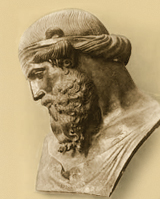
Reference
Plato. “Epistles,” Loeb Classical Library, Vol. 9, R. G. Bury, trans. Cambridge, MA: Harvard University Press; London: William Heinemann Ltd. 1929, pp. 385-627. ISBN 978-0-674-99257-3.