- Via Christa
- » Philosophy, Ethics, and Moral Law
- » Plato of Athens
Plato of Athens
By Linda Mihalic
The root of all greatness of mind and soul flourishes not in earth but in celestial realms whence it is fed of supernal Light. Without that Light, no embodied soul can overcome the gravity of sensory appetites, impulses, and urges. The soul needs to rise above the world of appearances, to stand aloft on the shoulders of the giants gone before it to see the spiritual truth of reality. Plato understood this, for he stood on the shoulders of such great men as Pythagoras and Socrates to see farther and more clearly than others of his time—and of all time—to comment and explicate the spiritual truths to which he became privy. Isaiah di Trani the Elder, a brilliant Jewish Talmudist of the 13th Century, wrote of Plato’s clear vision of reality:
“I applied to myself the parable of the philosophers. For I heard the following from the philosophers. The wisest of the philosophers asked: ‘We admit that our predecessors were wiser than we. At the same time we criticize their comments, often rejecting them and claiming that the truth rests with us. How is this possible?’ The wise philosopher responded: ‘Who sees further, a dwarf or a giant? Surely a giant for his eyes are situated at a higher level than those of the dwarf. But if the dwarf is placed on the shoulders of the giant who sees further?…So too we are dwarfs astride the shoulders of giants. We master their wisdom and move beyond it. Due to their wisdom we grow wise and are able to say all that we say, but not because we are greater than they.’”
–Alfred North Whitehead
Plato is rightly known as the father of Idealism with his doctrine of Ideas, which some today call Forms. However, no form can exist without the Idea from which it grows! Whether they are aware of him or not, Plato’s Ideas have through the ages inspired and fed mystics, metaphysicians, philosophers, astronomers, physicists and cosmologists—all those who seek to know God through His First Principles. In the Ideas, you find the Ideals. Everything you can perceive is authored by God’s universal, absolute, transcendent Mind operating as Intelligence and Wisdom throughout the whole of Creation.
Plato’s enormous impact on later philosophy, education, and culture can be traced to three interrelated aspects of his philosophical life: his written philosophical dialogues, the teaching and writings of his student Aristotle (whose interpretation of Plato’s meaning too often misses the mark), and the educational organization he created—“the Academy.” Plato founded the Academy in Athens in 387 BC, which lasted in various forms until the religiously intolerant emperor Justinian I closed the Academy (by then merely Neoplatonic) permanently with his Edict of 529 AD: “Closing of the Philosophical Schools.”
Plato’s Effect on Western Thought
The pervasiveness of Plato’s effect on Western thinking is incalculable, yet rarely considered beyond the seminary or the college of philosophy within a university; even there Aristotle's materialistic views hold sway while Plato's idealism is cast aside as quaint and outdated. The few religious and the scholastics have closely held his works as their domain, even creating a special jargon to describe it. To understand the history that shaped today’s culture, we must push aside much of what the world considers to be “conventional wisdom.” Let us begin then by piercing the veils that have been used to hide the truth. Truth often hides in plain sight.
However, by the late 20th Century, the hard-working clique of materialists, atheists, secular humanists, and agnostics had succeeded in setting the stage for a culture without God. Today they populate the ranks of teachers in public schools, instructors and professors in colleges, universities and seminaries, and write the textbooks as well. What passes for a “public school education” is really indoctrination, the brainwashing of the generations graduated since the late 1950s. As a result, culturally we have lost sight of the Platonic ideals of the good, the true, and the beautiful because our culture and education trains us to see only appearances and to accept them as truth unquestioningly. When viewed with a more discerning eye, most “truths”—religious, political, social, cultural, psychological—reveal themselves as fraudulent dogmas, enshrined through opinion and prejudice. Truth is “gold,” the most precious “element” known to man because truth is an aspect of the Godhead. Yet, as Shakespeare wrote, “All that glitters is not gold.”
How does the “truth of appearances” manage to overlay the “truth of reality?” Imagine that you are an artist and wish to create an oil painting. Before you begin painting, you must prime the canvas for the best results. The old masters used gesso, a combination of oil, a white pigment, such as chalk or plaster of Paris, and a water-soluble binder, such as animal glue. When you lightly “paint” the canvas with gesso, you create a uniform texture and level of absorbency. It’s similar to whitewashing a wall, the flaws and grime are still there, but it appears to be clean. “Whitewashing” has semantically extended the meaning to include “to give the appearance of innocence.” A lie is a distortion of reality, of the truth, like looking into a fun-house mirror. If “something is wrong with this picture,” stop! Immediately question your assumption that what you are seeing is the truth of reality. Reality is a mirror that reflects in utter perfection. The “truth” of appearances is innately distorted.
No student can study Plato without stumbling over Aristotle, that great favorite of the early Roman Catholic Church Fathers. More than one notable scholar has observed that Aristotle’s best work was derived from Plato, and that he both cherry-picked and misunderstood him as well. Besides Aristotle’s opinions, Plato’s Timaeus was the only common source of Plato’s works available to the early Church scholars. John Mustain, Rare Book Librarian and Selector for Classics, Stanford University, wrote, “Translations of Plato were practically non-existent in the Middle Ages.” During the 15th Century, the few translations of Plato were into Latin. “While interest in translations in general ran high in England during the Tudor period, Plato was virtually ignored save for reading foreign editions,” added Mustain.
Only two dialogues, the Apology and the Phaedo, were published anonymously in English in 1675. In 1804, Floyer Sydenham and Thomas Taylor translated fifty-five of Plato’s dialogues, and twelve epistles under the title, The Works of Plato, in five volumes. Taylor was a vehement atheist, which Plato certainly was not. Not until 1871 did Benjamin Jowett, the eminent British scholar, Anglican priest, and Master of Balliol College, Oxford, translate and introduce The Dialogues of Plato, the first truly comprehensive collection in English. Jowett’s edition of the Republic, on which he had worked for thirty years, was published posthumously in 1894. In the preface to his first edition of Plato’s Dialogs, Jowett wrote, “The aim of the Introductions in these volumes has been to represent Plato as the father of Idealism, who is not to be measured by the standard of utilitarianism or any other modern philosophical system. He is the poet or maker of ideas, satisfying the wants of his own age, providing the instruments of thought for future generations. He is no dreamer, but a great philosophical genius struggling with the unequal conditions of light and knowledge under which he is living. He may be illustrated by the writings of moderns, but he must be interpreted by his own, and by his place in the history of philosophy.”
Plato was an Idealist and an ardent devotee of the soul as partaking of God as the Idea of the True, the Beautiful and the Good. Alcinous, a Greek rhetorician circa 300 AD, wrote, “There are some things, say the wise, which the soul perceives through the body, as in seeing and hearing; there are other things which it discerns by itself without the aid of the body. Hence it follows that of existing things some are objects of sense and others objects of thought. Hence Plato said that, if we wish to take in at one glance the principles underlying the universe, we must first distinguish the ideas by themselves, for example, likeness, unity and plurality, magnitude, rest and motion; next we must assume the existence of beauty, goodness, justice and the like, each existing in and for itself; in the third place we must see how many of the ideas are relative to other ideas, as are knowledge, or magnitude, or ownership, remembering that the things within our experience bear the same names as those ideas because they partake of them; I mean that things which partake of justice are just, things which partake of beauty are beautiful. Each one of the ideas is eternal, it is a notion, and moreover is incapable of change. Hence Plato says that they stand in nature like archetypes, and that all things else bear a resemblance to the ideas because they are copies of these archetypes.”
Friedrich Schlegel, German poet and philosopher (1772-1829), said, “Plato’s philosophy is a dignified preface to future religion.” In 1929, mathematician and philosopher Alfred North Whitehead wrote in his work, Process and Reality, “The safest general characterisation of the European philosophical tradition is that it consists of a series of footnotes to Plato.” Author and lay theologian C. S. Lewis wrote, “Plato, with his transcendent Forms, is the doctor of Protestants; Aristotle, with his immanent Forms, the doctor of Catholics.”
Theoretical physicist Werner Heisenberg wrote, “In the philosophy of Democritus the atoms are eternal and indestructible units of matter, they can never be transformed into each other. With regard to this question modern physics takes a definite stand against the materialism of Democritus and for Plato and the Pythagoreans. The elementary particles are certainly not eternal and indestructible units of matter, they can actually be transformed into each other. As a matter of fact, if two such particles, moving through space with a very high kinetic energy, collide, then many new elementary particles may be created from the available energy and the old particles may have disappeared in the collision.
“Such events have been frequently observed and offer the best proof that all particles are made of the same substance: energy. But the resemblance of the modern views to those of Plato and the Pythagoreans can be carried somewhat further. The elementary particles in Plato’s Timaeus are finally not substance but mathematical forms. ‘All things are numbers’ is a sentence attributed to Pythagoras. The only mathematical forms available at that time were such geometric forms as the regular solids or the triangles which form their surface. In modern quantum theory there can be no doubt that the elementary particles will finally also be mathematical forms but of a much more complicated nature. The Greek philosophers thought of static forms and found them in the regular solids.
“Modern science, however, has from its beginning in the 16th and 17th Centuries started from the dynamic problem. The constant element in physics since Newton is not a configuration or a geometrical form, but a dynamic law. The equation of motion holds at all times, it is in this sense eternal, whereas the geometrical forms, like the orbits, are changing. Therefore, the mathematical forms that represent the elementary particles will be solutions of some eternal law of motion for matter. This is a problem which has not yet been solved.”
not substance but mathematical forms.”
The human mind, your mind, is your only and therefore precious contact with the divine Mind of the All That Is. Plato knew and understood this point of contact, which forms the basis for his proposed structure for the proper education of the mind, not its mere training. You can train a chimpanzee, but you must educate the human mind in how to think. The sources of Plato’s views on education reside within the Republic, the Laws and the Philebus dialogues.
Three hundred and fifty years later, Jesus gifted us with the next great steps onward and upward into comprehension—“Let this mind be in you, which was in Christ Jesus.”–Philippians 2:5. He tore down so many veils between God and man: “Fear not, little flock; for it is your Father’s good pleasure to give you the kingdom.”–Luke 12:32. “He that believeth on me, the works that I do shall he do also; and greater works than these shall he do; because I go unto my Father.”–John 14:12. “I have called you friends; for all things that I have heard of my Father I have made known unto you.”–John 15:15.
And Jesus armed his disciples and apostles to teach such eternal truths as “We have the mind of Christ” (1 Corinthians 2:16). “The Jews require a sign, and the Greeks seek after wisdom: But we preach Christ crucified, unto the Jews a stumblingblock, and unto the Greeks foolishness; but unto them which are called, both Jews and Greeks, Christ the power of God, and the wisdom of God” (1 Corinthians 1:22-24). Be assured: This is our true heritage in Christ, the Ideal.
Plato’s Dialogues
We include the Loeb Classical Library translations, including those by R. G. Bury, Harold N. Fowler, W. R. M. Lamb, and Paul Shorey. Also included are Benjamin Jowett’s Commentaries and Analyses of the Dialogues. Other translations include R. D. Archer-Hind, George Bruges, Thomas Maguire, and A. E. Taylor. These translations are variously based on the rescensions of John Burnet (Platonic Opera) C. F. Hermann, (Platonis Dialogi), Martin von Schanz (Platonis Opera quae feruntur omnia), the Codex Clarkianus, and the Codex Venetus.
» Read them here »
Life of Plato: Diogenes Laertius, Lives of Eminent Philosophers, R. D. Hicks, Translator. Loeb Classical Library edition.
» Read it here »
Plato, the Philosopher: In Representative Men: Seven Lectures, Ralph Waldo Emerson examined the lives and achievements of certain great men of history, beginning with Plato of Athens.
» Read it here »
Plato: For further biographical information on Plato, we have drawn upon A. E. Taylor’s meticulously researched and insightful biography, Plato.
» Read it here »
Plato: The Academy
» Read it here »
The Platonic Academy of Athens: The World’s First University, by Nick Kampouris.
» Read it here »
Plato’s Myths: The Soul’s Immortality, the Myth of the Afterlife, the Divine Judgment of Naked Souls, the Parable of the Ship, the Cave, the Myth of Er, the Soul’s Androgyne, Love’s Ascent to Beauty, and Prometheus and Epimetheus.
» Read them here »
Plato: The Man and His Work: A. E. Taylor, author of this scholarly exposition, considered Platonism to be the most original and influential of all philosophies.
» Read Volume I. here »
» Read Volume II. here »
Platonism and Its Influence: A. E. Taylor chronicled the astonishing and pervasive influence of Plato’s philosphy on Western life and religion.
» Read it here »
An Essay on The Platonic Ethics: Thomas Maguire, a classical scholar and metaphysician, was a thorough idealist in philosophy, whose chosen masters were Plato and Berkeley.
» Read it here »
An Essay on The Platonic Idea: Thomas Maguire, a classical scholar and metaphysician, was a thorough idealist in philosophy, whose chosen masters were Plato and Berkeley.
» Read it here »
The Unity of Plato’s Thought: Paul Shorey, translator of Plato’s Republic, Loeb Classical Library Edition, argues against the modern critics who use the statistical method to confirm, refute, or correct “alleged inconsistencies, contradictions, or developments in Platonic doctrine.” Shorey seeks to emend the resulting “misplaced emphasis, disregard of the context, and positive mistranslation.”
» Read it here »
.
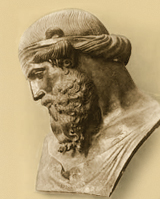
Plato of Athens
428 BC–348 BC
Premier Greek philosopher, the Father of Idealism in its many facets: philosophy, metaphysics, psychology, mysticism, esthetics, ethics, education, literature, and politics
Works Cited
Dictionary of Philosophy (Ancient, Medieval, Modern). Runes, Dagobert D., ed., 1942. Andrew Chrucky, digital ed. Meta-Encyclopedia of Philosophy, July 2004. [Accessed September 23, 2017.]
Di Trani, Isaiah. “Dwarfs on the Shoulders of Giants,” quoted by Shnayer Z. Leiman, in Tradition,, 27:3. The Rabbinical Council, 1993.
Enfield, William. The History of Philosophy: From the Earliest Times to the Beginning of the Present Century. London: Printed for J. Johnson, 1791.
Heisenberg, Werner. The History of Philosophy: From the Earliest Times to the Beginning of the Present Century. Physics and Philosophy: The Revolution in Modern Science, 1958. Lectures delivered at University of St. Andrews, Scotland, Winter 1955-56.
Hildebrand, David, "John Dewey", The Stanford Encyclopedia of Philosophy. (Winter 2018 Edition), Edward N. Zalta (ed.) Accessed June 17, 2026.
Kraut, Richard. "Plato," The Stanford Encyclopedia of Philosophy, Spring 2015, Edward N. Zalta (ed.). Accessed June 17, 2026.
Laertius, Diogenes. "Plato" in Lives and Opinions of Eminent Philosophers. Robert Drew Hicks, trans. London: Heinemann, 1926.
Laertius, Diogenes. “Plato” in Lives and Opinions of Eminent Philosophers, C. D. Yonge, trans. London: H.C. Bohn, 1853.
Meinwald, Constance C. “Plato”. Encyclopedia Britannica, June 11, 2026. Accessed June 17, 2026.
Nehamas, Alexander. "A Brief History of Translations: The development of translations into the English language, especially of the works of Plato," quoting John Mustain. The Stanford Presidential Lecture Series in the Humanities and Arts.
O’Connor, J.J. and E. F. Robertson. “Plato,” The MacTutor History of Mathematics archive, School of Mathematics and Statistics, University of St Andrews, Scotland, 1999. Accessed June 17, 2026.
O’Connor, J.J. and E. F. Robertson. “Mathematical Quotations by Plato,” The MacTutor History of Mathematics archive, School of Mathematics and Statistics, University of St Andrews, Scotland, 1999. Accessed June 17, 2026.
Taylor, Robert. The Diegesis: Being a Discovery of the Origin, Evidences, and Early History of Christianity. London: R. Carlile and J. Brooks, 1829.
Turner, William. "Aristotle." The Catholic Encyclopedia. Vol. 1. New York: Robert Appleton Company, 1907. [Accessed October 1, 2021].
Recommended Reading
Karderas, Nicholas, PhD. “The Greek Miracle: How Plato Can Save Your Life.” Accessed June 17, 2026.
Wolfe, Alexandra. “What Would Plato Say?” Rebecca Newberger Goldstein on Philosophy, Wall Street Journal, April 4, 2014. Accessed June 17, 2026.