- Via Christa
- » Library
- » Plato
- » The Myths of Plato
The Myths of Plato
By Benjamin Jowett, trans.
The myths of Plato are a phenomenon unique in literature. There are four longer ones: these occur in the Phaedrus (244–256), Phaedo (110–115), Gorgias (523–527), and Republic (x. 614–621). That in the Republic is the most elaborate and finished of them. Three of these greater myths, namely those contained in the Phaedo, the Gorgias and the Republic, relate to the destiny of human souls in a future life. The magnificent myth in the |317| Phaedrus treats of the immortality, or rather the eternity of the soul, in which is included a former as well as a future state of existence. To these may be added, (1) the myth, or rather fable, occurring in the Statesman (268–274), in which the life of innocence is contrasted with the ordinary life of man and the consciousness of evil: (2) the legend of the Island of Atlantis, an imaginary history, which is a fragment only, commenced in the Timaeus (21–26) and continued in the Critias: (3) the much less artistic fiction of the foundation of the Cretan colony which is introduced in the preface to the Laws (iii. 702), but soon falls into the background: (4) the beautiful but rather artificial tale of Prometheus and Epimetheus narrated in his rhetorical manner by Protagoras in the dialogue called after him (320–328): (5) the speech at the beginning of the Phaedrus (231–234), which is a parody of the orator Lysias; the rival speech of Socrates and the recantation of it (237–241). To these may be added (6) the tale of the grasshoppers, and (7) the tale of Thamus and of Theuth, both in the Phaedrus (259 and 274–5): (8) the parable of the Cave (Republic vii. ad init.), in which the previous argument is recapitulated, and the nature and degrees of knowledge having been previously set forth in the abstract are represented in a picture: (9) the fiction of the earthborn men (Republic iii. 414; cp. Laws ii. 664), in which by the adaptation of an old tradition Plato makes a new beginning for his society: (10) the myth of Aristophanes respecting the division of the sexes, Symposium 189: (11) the parable of the noble captain, the pilot, and the mutinous sailors (Republic vi. 488), in which is represented the relation of the better part of the world, and of the philosopher, to the mob of politicians: (12) the ironical tale of the pilot who plies between Athens and Aegina charging only a small payment for saving men from death, the reason being that he is uncertain whether to live or die is better for them (Gorgias 511): (13) the treatment of freemen and citizens by physicians and of slaves by their apprentices, — a somewhat laboured figure of speech intended to illustrate the two different ways in which the laws speak to men (Laws iv. 720).
There also occur in Plato continuous images; some of them extend over several pages, appearing and reappearing at intervals: such as the bees stinging and stingless (paupers and thieves) in the Eighth Book of the Republic (554), who are generated in the transition from timocracy to oligarchy: |318| the sun, which is to the visible world what the idea of good is to the intellectual, in the Sixth Book of the Republic (508–9): the composite animal, having the form of a man, but containing under a human skin a lion and a many-headed monster (Republic ix. 588–9): the great beast (vi. 493), i.e. the populace: and the wild beast within us, meaning the passions which are always liable to break out (ix. 571): the animated comparisons of the degradation of philosophy by the arts to the dishonoured maiden (vi. 495–6), and of the tyrant to the parricide, who ‘beats his father, having first taken away his arms’ (viii. 569): the dog, who is your only philosopher (ii. 376c): the grotesque and rather paltry image of the argument wandering about without a head (Laws vi. 752), which is repeated, not improved, from the Gorgias (509d): the argument personified as veiling her face (Republic vi. 503a), as engaged in a chase (iv. 427c), as breaking upon us in a first, second and third wave (v. 457c, 472c, 473c): — on these figures of speech the changes are rung many times over. It is observable that nearly all these parables or continuous images are found in the Republic; that which occurs in the Theaetetus (149 ff.), of the midwifery of Socrates, is perhaps the only exception. To make the list complete, the mathematical figure of the number of the state (Republic viii. 546), or the numerical interval which separates king from tyrant (ix. 587–8), should not be forgotten.
The Divine Judgment of Naked Souls. The myth in the Gorgias is one of those descriptions of another life which, like the Sixth Aeneid of Virgil, appear to contain reminiscences of the mysteries. It is a vision of the rewards and punishments which await good and bad men after death. It supposes the body to continue and to be in another world what it has become in this. It includes a Paradiso, Purgatorio, and Inferno, like the sister myths of the Phaedo and the Republic. The Inferno is reserved for great criminals only. The argument of the dialogue is frequently referred to, and the meaning breaks through so as rather to destroy the liveliness and consistency of the picture. The structure of the fiction is very slight, the chief point or moral being that in the judgments of another world there is no possibility of concealment: Zeus has taken from men the power of foreseeing death, and brings together the souls both of them and their judges naked and undisguised at the judgment-seat. Both are exposed to view, stripped of the veils and clothes |319| which might prevent them from seeing into or being seen by one another.
The Myth of the Afterlife. The myth of the Phaedo is of the same type, but it is more cosmological, and also more poetical. The beautiful and ingenious fancy occurs to Plato that the upper atmosphere is an earth and heaven in one, a glorified earth, fairer and purer than that in which we dwell. As the fishes live in the ocean, mankind are living in a lower sphere, out of which they put their heads for a moment or two and behold a world beyond. The earth which we inhabit is a sediment of the coarser particles which drop from the world above, and is to that heavenly earth what the desert and the shores of the ocean are to us. A part of the myth consists of description of the interior of the earth, which gives the opportunity of introducing several mythological names and of providing places of torment for the wicked. There is no clear distinction of soul and body; the spirits beneath the earth are spoken of as souls only, yet they retain a sort of shadowy form when they cry for mercy on the shores of the lake; and the philosopher alone is said to have got rid of the body. All the three myths in Plato which relate to the world below have a place for repentant sinners, as well as other homes or places for the very good and very bad. It is a natural reflection which is made by Plato elsewhere, that the two extremes of human character are rarely met with, and that the generality of mankind are between them. Hence a place must be found for them. In the myth of the Phaedo they are carried down the river Acheron to the Acherusian lake, where they dwell, and are purified of their evil deeds, and receive the rewards of their good. There are also incurable sinners, who are cast into Tartarus, there to remain as the penalty of atrocious crimes; these suffer everlastingly. And there is another class of hardly-curable sinners who are allowed from time to time to approach the shores of the Acherusian lake, where they cry to their victims for mercy; which if they obtain they come out into the lake and cease from their torments.
Neither this, nor any of the three greater myths of Plato, nor perhaps any allegory or parable relating to the unseen world, is consistent with itself. The language of philosophy mingles with that of mythology; abstract ideas are transformed into persons, figures of speech into realities. These myths may be compared |320| with the Pilgrim’s Progress of Bunyan, in which discussions of theology are mixed up with the incidents of travel, and mythological personages are associated with human beings: they are also garnished with names and phrases taken out of Homer, and with other fragments of Greek tradition.
The Myth of Er. The myth of the Republic is more subtle and also more consistent than either of the two others. It has a greater verisimilitude than they have, and is full of touches which recall the experiences of human life. It will be noticed by an attentive reader that the twelve days during which Er lay in a trance after he was slain coincide with the time passed by the spirits in their pilgrimage. It is a curious observation, not often made, that good men who have lived in a well-governed city (shall we say in a religious and respectable society?) are more likely to make mistakes in their choice of life than those who have had more experience of the world and of evil. It is a more familiar remark that we constantly blame others when we have only ourselves to blame; and the philosopher must acknowledge, however reluctantly, that there is an element of chance in human life with which it is sometimes impossible for man to cope. That men drink more of the waters of forgetfulness than is good for them is a poetical description of a familiar truth. We have many of us known men who, like Odysseus, have wearied of ambition and have only desired rest. We should like to know what became of the infants ‘dying almost as soon as they were born,’ but Plato only raises, without satisfying, our curiosity. The two companies of souls, ascending and descending at either chasm of heaven and earth, and conversing when they come out into the meadow, the majestic figures of the judges sitting in heaven, the voice heard by Ardiaeus, are features of the great allegory which have an indescribable grandeur and power. The remark already made respecting the inconsistency of the two other myths must be extended also to this: it is at once an orrery, or model of the heavens, and a picture of the Day of Judgment.
The three myths are unlike anything else in Plato. There is an Oriental, or rather an Egyptian element in them, and they have an affinity to the mysteries and to the Orphic modes of worship. To a certain extent they are un-Greek; at any rate there is hardly anything like them in other Greek writings which |321| have a serious purpose; in spirit they are mediaeval. They are akin to what may be termed the underground religion in all ages and countries. They are presented in the most lively and graphic manner, but they are never insisted on as true; it is only affirmed that nothing better can be said about a future life. Plato seems to make use of them when he has reached the limits of human knowledge; or, to borrow an expression of his own, when he is standing on the outside of the intellectual world. They are very simple in style; a few touches bring the picture home to the mind, and make it present to us. They have also a kind of authority gained by the employment of sacred and familiar names, just as mere fragments of the words of Scripture, put together in any form and applied to any subject, have a power of their own. They are a substitute for poetry and mythology; and they are also a reform of mythology. The moral of them may be summed up in a word or two: After death the Judgment; and ‘there is some better thing remaining for the good than for the evil.’
All literature gathers into itself many elements of the past: for example, the tale of the earth-born men in the Republic appears at first sight to be an extravagant fancy, but it is restored to propriety when we remember that it is based on a legendary belief. The art of making stories of ghosts and apparitions credible is said to consist in the manner of telling them. The effect is gained by many literary and conversational devices, such as the previous raising of curiosity, the mention of little circumstances, simplicity, picturesqueness, the naturalness of the occasion, and the like. This art is possessed by Plato in a degree which has never been equalled.
The Soul’s Immortality. The myth in the Phaedrus is even greater than the myths which have been already described, but is of a different character. It treats of a former rather than of a future life. It represents the conflict of reason aided by passion or righteous indignation on the one hand, and of the animal lusts and instincts on the other. The soul of man has followed the company of some god, and seen truth in the form of the universal before it was born in this world. Our present life is the result of the struggle which was then carried on. This world is relative to a former world, as it is often projected into a future. We ask the question, Where were men before |322| birth? as we likewise enquire, What will become of them after death? The first question is unfamiliar to us, and therefore seems to be unnatural; but if we survey the whole human race, it has been as influential and as widely spread as the other. In the Phaedrus it is really a figure of speech in which the ‘spiritual combat’ of this life is represented. The majesty and power of the whole passage — especially of what may be called the theme or proem (beginning ‘The mind through all her being is immortal’) — can only be rendered very inadequately in another language.
The myth in the Statesman relates to a former cycle of existence, in which men were born of the earth, and by the reversal of the earth’s motion had their lives reversed and were restored to youth and beauty: the dead came to life; the old grew middle-aged, and the middle-aged young; the youth became a child, the child an infant, the infant vanished into the earth. The connection between the reversal of the earth’s motion and the reversal of human life is of course verbal only, yet Plato, like theologians in other ages, argues from the consistency of the tale to its truth. The new order of the world was immediately under the government of God; it was a state of innocence in which men had neither wants nor cares, in which the earth brought forth all things spontaneously, and God was to man what man now is to the animals. There were no great estates, or families, or private possessions, nor any traditions of the past, because men were all born out of the earth. This is what Plato calls the ‘reign of Cronos;’ and in like manner he connects the reversal of the earth’s motion with some legend of which he himself was probably the inventor.
The question is then asked, under which of these two cycles of existence was man the happier, — under that of Cronos, which was a state of innocence, or that of Zeus, which is our ordinary life? For a while Plato balances the two sides of the serious controversy, which he has suggested in a figure. The answer depends on another question: What use did the children of Cronos make of their time? They had boundless leisure and the faculty of discoursing, not only with one another, but with the animals. Did they employ these advantages with a view to philosophy, gathering from every nature some addition to their store of knowledge? or, Did they pass their time in eating and drinking and telling stories to one another and to the beasts? — in either case there would be no |323| difficulty in answering. But then, as Plato rather mischievously adds, ‘Nobody knows what they did,’ and therefore the doubt must remain undetermined.
To the first there succeeds a second epoch. After another natural convulsion, in which the order of the world and of human life is once more reversed, God withdraws his guiding hand, and man is left to the government of himself. The world begins again, and arts and laws are slowly and painfully invented. A secular age succeeds to a theocratical. In this fanciful tale Plato has dropped, or almost dropped, the garb of mythology. He suggests several curious and important thoughts, such as the possibility of a state of innocence, the existence of a world without traditions, and the difference between human and divine government. He has also carried a step further his speculations concerning the abolition of the family and of property, which he supposes to have no place among the children of Cronos any more than in the ideal state.
It is characteristic of Plato and of his age to pass from the abstract to the concrete, from poetry to reality. Language is the expression of the seen, and also of the unseen, and moves in a region between them. A great writer knows how to strike both these chords, sometimes remaining within the sphere of the visible, and then again comprehending a wider range and soaring to the abstract and universal. Even in the same sentence he may employ both modes of speech not improperly or inharmoniously. It is useless to criticise the broken metaphors of Plato, if the effect of the whole is to create a picture not such as can be painted on canvas, but which is full of life and meaning to the reader. A poem may be contained in a word or two, which may call up not one but many latent images; or half reveal to us by a sudden flash the thoughts of many hearts. Often the rapid transition from one image to another is pleasing to us: on the other hand, any single figure of speech if too often repeated, or worked out too much at length, becomes prosy and monotonous. In theology and philosophy we necessarily include both ‘the moral law within and the starry heaven above,’ and pass from one to the other (cp. for examples Psalm xviii. 1–25, xix. 1–9, etc.). Whether such a use of language is puerile or noble depends upon the genius of the writer or speaker, and the familiarity of the associations employed. |324|
In the myths and parables of Plato the ease and grace of conversation is not forgotten: they are spoken, not written words, stories which are told to a living audience, and so well told that we are more than half-inclined to believe them (cp. Phaedrus 274). As in conversation too, the striking image or figure of speech is not forgotten, but is quickly caught up, and alluded to again and again; as it would still be in our own day in a genial and sympathetic society. The descriptions of Plato have a greater life and reality than is to be found in any modern writing. This is due to their homeliness and simplicity. Plato can do with words just as he pleases; to him they are indeed ‘more plastic than wax’ (Republic ix. 588d). We are in the habit of opposing speech and writing, poetry and prose. But he has discovered a use of language in which they are united; which gives a fitting expression to the highest truths; and in which the trifles of courtesy and the familiarities of daily life are not overlooked.
Top ↑The Soul’s Immortality: Phaedrus 245c–249d
The Phaedrus records a solitary conversation between Socrates and Phaedrus, the main subject of which is a satire about rhetoric and sophistry. However, a highlight of the dialogue is Plato’s tale about the immortality of the soul.
“No one can duly appreciate the dialogues of Plato, especially the Phaedrus, Symposium, and portions of the Republic, who has not a sympathy with mysticism. To the uninitiated, as he would himself have acknowledged, they will appear to be the dreams of a poet who is disguised as a philosopher. There is a twofold difficulty in apprehending this aspect of the Platonic writings. First, we do not immediately realize that under the marble exterior of Greek literature was concealed a soul thrilling with spiritual emotion. Secondly, the forms or figures which the Platonic philosophy assumes, are not like the images of the prophet Isaiah, or of the Apocalypse, familiar to us in the days of our youth. By mysticism we mean, not the extravagance of an erring fancy, but the concentration of reason in feeling, the enthusiastic love of the good, the true, the one, the sense of the infinity of knowledge and of the marvel of the human faculties. When feeding upon such thoughts the ‘wing of the soul’ is renewed and gains strength; she is raised above ‘the manikins of earth’ and their opinions, waiting in wonder to know, and working with reverence to find out what God in this or in another life may reveal to her.” —Benjamin Jowett
Socrates: Let us view the affections and actions of the soul divine and human, and try to ascertain the truth about them. The beginning of our proof is as follows: —
The soul through all her being is immortal, for that which is ever in motion is immortal; but that which moves another and is moved by another, in ceasing to move ceases also to live. Only the self-moving, never leaving self, never ceases to move, and is the fountain and beginning of motion to all that moves besides. Now, the beginning is unbegotten, for that which is begotten has a beginning; but the beginning is begotten of nothing, for if it were begotten of something, then the begotten would not come from a beginning. But if unbegotten,it must also be indestructible; for if beginning were destroyed, there could be no beginning out of anything, nor anything out of a beginning; and all things must have a beginning. And therefore the self-moving is the beginning of motion; and this can neither be destroyed nor |452| begotten, else the whole heavens and all creation would collapse and stand still, and never again have motion or birth. But if the self-moving is proved to be immortal, he who affirms that self-motion is the very idea and essence of the soul will not be put to confusion. For the body which is moved from without is soulless; but that which is moved from within has a soul, for such is the nature of the soul. But if this be true, must not the soul be the self-moving, and therefore of necessity unbegotten and immortal? Enough of the soul’s immortality.
Of the nature of the soul, though her true form be ever a theme of large and more than mortal discourse, let me speak briefly, and in a figure. And let the figure be composite — a pair of winged horses and a charioteer. Now the winged horses and the charioteers of the gods are all of them noble and of noble descent, but those of other races are mixed; the human charioteer drives his in a pair; and one of them is noble and of noble breed, and the other is ignoble and of ignoble breed; and the driving of them of necessity gives a great deal of trouble to him. I will endeavour to explain to you in what way the mortal differs from the immortal creature. The soul in her totality has the care of inanimate being everywhere, and traverses the whole heaven in divers forms appearing — when perfect and fully winged she soars upward, and orders the whole world; whereas the imperfect soul, losing her wings and drooping in her flight at last settles on the solid ground — there, finding a home, she receives an earthly frame which appears to be self-moved, but is really moved by her power; and this composition of soul and body is called a living and mortal creature. For immortal no such union can be reasonably believed to be; although fancy, not having seen nor surely known the nature of God, may imagine an immortal creature having both a body and also a soul which are united throughout all time. Let that, however, be as God wills, and be spoken of acceptably to him. And now let us ask the reason why the soul loses her wings!
The wing is the corporeal element which is most akin to the divine, and which by nature tends to soar aloft and carry that which gravitates downwards into the upper |453| region, which is the habitation of the gods. The divine is beauty, wisdom, goodness, and the like; and by these the wing of the soul is nourished, and grows apace; but when fed upon evil and foulness and the opposite of good, wastes and falls away. Zeus, the mighty lord, holding the reins of a winged chariot, leads the way in heaven, ordering all and taking care of all; and there follows him the array of gods and demigods, marshalled in eleven bands; Hestia alone abides at home in the house of heaven; of the rest they who are reckoned among the princely twelve march in their appointed order. They see many blessed sights in the inner heaven, and there are many ways to and fro, along which the blessed gods are passing, every one doing his own work; he may follow who will and can, for jealousy has no place in the celestial choir. But when they go to banquet and festival, then they move up the steep to the top of the vault of heaven. The chariots of the gods in even poise, obeying the rein, glide rapidly; but the others labour, for the vicious steed goes heavily, weighing down the charioteer to the earth when his steed has not been thoroughly trained: — and this is the hour of agony and extremest conflict for the soul. For the immortals, when they are at the end of their course, go forth and stand upon the outside of heaven, and the revolution of the spheres carries them round, and they behold the things beyond. But of the heaven which is above the heavens, what earthly poet ever did or ever will sing worthily? It is such as I will describe; for I must dare to speak the truth, when truth is my theme. There abides the very being with which true knowledge is concerned; the colourless, formless, intangible essence, visible only to mind, the pilot of the soul. The divine intelligence, being nurtured upon mind and pure knowledge, and the intelligence of every soul which is capable of receiving the food proper to it, rejoices at beholding reality, and once more gazing upon truth, is replenished and made glad, until the revolution of the worlds brings her round again to the same place. In the revolution she beholds justice, and temperance, and knowledge absolute, not in the form of generation or of relation, which men call existence, but knowledge absolute in existence absolute; and |454| beholding the other true existences in like manner, and feasting upon them, she passes down into the interior of the heavens and returns home; and there the charioteer putting up his horses at the stall, gives them ambrosia to eat and nectar to drink.
Such is the life of the gods; but of other souls, that which follows God best and is likest to him lifts the head of the charioteer into the outer world, and is carried round in the revolution, troubled indeed by the steeds, and with difficulty beholding true being; while another only rises and falls, and sees, and again fails to see by reason of the unruliness of the steeds. The rest of the souls are also longing after the upper world and they all follow, but not being strong enough they are carried round below the surface, plunging, treading on one another, each striving to be first; and there is confusion and perspiration and the extremity of effort; and many of them are lamed or have their wings broken through the ill-driving of the charioteers; and all of them after a fruitless toil, not having attained to the mysteries of true being, go away, and feed upon opinion. The reason why the souls exhibit this exceeding eagerness to behold the plain of truth is that pasturage is found there, which is suited to the highest part of the soul; and the wing on which the soul soars is nourished with this. And there is a law of Destiny, that the soul which attains any vision of truth in company with a god is preserved from harm until the next period, and if attaining always is always unharmed. But when she is unable to follow, and fails to behold the truth, and through some ill-hap sinks beneath the double load of forgetfulness and vice, and her wings fall from her and she drops to the ground, then the law ordains that this soul shall at her first birth pass, not into any other animal, but only into man; and the soul which has seen most of truth shall come to the birth as a philosopher, or artist, or some musical and loving nature; that which has seen truth in the second degree shall be some righteous king or warrior chief; the soul which is of the third class shall be a politician, or economist, or trader; the fourth shall be lover of gymnastic toils, or a physician; the fifth shall lead the life of a prophet or hierophant; to the sixth the |455| character of poet or some other imitative artist will be assigned; to the seventh the life of an artisan or husbandman; to the eighth that of a sophist or demagogue; to the ninth that of a tyrant-all these are states of probation, in which he who does righteously improves, and he who does unrighteously, improves, and he who does unrighteously, deteriorates his lot.
Ten thousand years must elapse before the soul of each one can return to the place from whence she came, for she cannot grow her wings in less; only the soul of a philosopher, guileless and true, or the soul of a lover, who is not devoid of philosophy, may acquire wings in the third of the recurring periods of a thousand years; he is distinguished from the ordinary good man who gains wings in three thousand years: — and they who choose this life three times in succession have wings given them, and go away at the end of three thousand years. But the others receive judgment when they have completed their first life, and after the judgment they go, some of them to the houses of correction which are under the earth, and are punished; others to some place in heaven whither they are lightly borne by justice, and there they live in a manner worthy of the life which they led here when in the form of men. And at the end of the first thousand years the good souls and also the evil souls both come to draw lots and choose their second life, and they may take any which they please. The soul of a man may pass into the life of a beast, or from the beast return again into the man. But the soul which has never seen the truth will not pass into the human form. For a man must have intelligence of universals, and be able to proceed from the many particulars of sense to one conception of reason; — this is the recollection of those things which our soul once saw while following God — when regardless of that which we now call being she raised her head up towards the true being. And therefore the mind of the philosopher alone has wings; and this is just, for he is always, according to the measure of his abilities, clinging in recollection to those things in which God abides, and in beholding which He is what He is. And he who employs |456| aright these memories is ever being initiated into perfect mysteries and alone becomes truly perfect. But, as he forgets earthly interests and is rapt in the divine, the vulgar deem him mad, and rebuke him; they do not see that he isinspired.
Thus far I have been speaking of the fourth and last kind of madness, which is imputed to him who, when he sees the beauty of earth, is transported with the recollection of the true beauty; he would like to fly away, but he cannot; he is like a bird fluttering and looking upward and careless of the world below; and he is therefore thought to be mad. And I have shown this of all inspirations to be the noblest and highest and the offspring of the highest to him who has or shares in it, and that he who loves the beautiful is called a lover because he partakes of it. For, as has been already said, every soul of man has in the way of nature beheld true being; this was the condition of her passing into the form of man. But all souls do not easily recall the things of the other world; they may have seen them for a short time only, or they may have been unfortunate in their earthly lot, and, having had their hearts turned to unrighteousness through some corrupting influence, they may have lost the memory of the holy things which once they saw. Few only retain an adequate remembrance of them; and they, when they behold here any image of that other world, are rapt in amazement; but they are ignorant of what this rapture means, because they do not clearly perceive. For there is no light of justiceor temperance or any of the higher ideas which are precious to souls in the earthly copies of them: they are seen through a glass dimly; and there are few who, going to the images, behold in them the realities, and these only with difficulty. There was a time when with the rest of the happy band they saw beauty shining in brightness — we philosophers following in the train of Zeus, others in company with other gods; and then we beheld the beatific vision and were initiated into a mystery which may be truly called most blessed, celebrated by us in our state of innocence, before we had any experience of evils to come, when we were admitted to the sight of apparitions innocent and simple and calm and happy, which we beheld shining in |457| pure light, pure ourselves and not yet enshrined in that living tomb which we carry about, now that we are imprisoned in the body, like an oyster in his shell. Let me linger over the memory of scenes which have passed away.
But of beauty, I repeat again that we saw her there shining in company with the celestial forms; and coming to earth we find her here too, shining in clearness through the clearest aperture of sense. For sight is the most piercing of our bodily senses; though not by that is wisdom seen; her loveliness would have been transporting if there had been a visible image of her, and the other ideas, if they had visible counterparts, would be equally lovely. But this is the privilege of beauty, that being the loveliest she is also the most palpable to sight. Now he who is not newly initiated or who has become corrupted, does not easily rise out of this world to the sight of true beauty in the other; he looks only at her earthly namesake, and instead of being awed at the sight of her, he is given over to pleasure, and like a brutish beast he rushes on to enjoy and beget; he consorts with wantonness, and is not afraid or ashamed of pursuing pleasure in violation of nature. But he whose initiation is recent, and who has been the spectator of many glories in the other world, is amazed when he sees any one having a godlike face or form, which is the expression of divine beauty; and at first a shudder runs through him, and again the old awe steals over him; then looking upon the face of his beloved as of a god he reverences him, and if he were not afraid of being thought a downright madman, he would sacrifice to his beloved as to the image of a god; then while he gazes on him there is a sort of reaction, and the shudder passes into an unusual heat and perspiration; for, as he receives the effluence of beauty through the eyes, the wing moistens and he warms. And as he warms, the parts out of which the wing grew, and which had been hitherto closed and rigid, and had prevented the wing from shooting forth, are melted, and as nourishment streams upon him, the lower end of the wings begins to swell and grow from the root upwards; and the growth extends under |458| the whole soul — for once the whole was winged.
During this process the whole soul is all in a state of ebullition and effervescence, — which may be compared to the irritation and uneasiness in the gums at the time of cutting teeth, — bubbles up, and has a feelingof uneasiness and tickling; but when in like manner the soul is beginning to grow wings, the beauty of the beloved meets her eye and she receives the sensible warm motion of particles which flow towards her, therefore called emotion (imeros), and is refreshed and warmed by them, and then she ceases from her pain with joy. But when she is parted from her beloved and her moisture fails, then the orifices of the passage out of which the wing shoots dry up and close, and intercept the germ of the wing; which, being shut up with the emotion, throbbing as with the pulsations of an artery, pricks the aperture which is nearest, until at length the entire soul is pierced and maddened and pained, and at the recollection of beauty is again delighted. And from both of them together the soul is oppressed at the strangeness of her condition, and is in a great strait and excitement, and in her madness can neither sleep by night nor abide in her place by day. And wherever she thinks that she will behold the beautiful one, thither in her desire she runs. And when she has seen him, and bathed herself in the waters of beauty, her constraint is loosened, and she is refreshed, and has no more pangs and pains; and this is the sweetest of all pleasures at the time, and is the reason why the soul of the lover will never forsake his beautiful one, whom he esteems above all; he has forgotten mother and brethren and companions, and he thinks nothing of the neglect and loss of his property; the rules and proprieties of life, on which he formerly prided himself, he now despises, and is ready to sleep like a servant, wherever he is allowed, as near as he can to his desired one, who is the object of his worship, and the physician who can alone assuage the greatness of his pain. And this state, my dear imaginary youth to whom I am talking, is by men called love, and among the gods has a name at which you, in your simplicity, may be inclined to mock; there are two lines in the apocryphal writings of Homer in which the name occurs. One of them is rather outrageous, and not altogether metrical. They are as follows: |459|
‘Mortals call him fluttering love,
But the immortals call him winged one,
Because the growing of wings is a necessity to him.’
You may believe this, but not unless you like. At any rate the loves of lovers and their causes are such as I have described.
Now the lover who is taken to be the attendant of Zeus is better able to bear the winged god, and can endure a heavier burden; but the attendants and companions of Ares, when under the influence of love, if they fancy that they have been at all wronged, are ready to kill and put an end to themselves and their beloved. And he who follows in the train of any other god, while he is unspoiled and the impression lasts, honours and imitates him, as far as he is able; and after the manner of his god he behaves in his intercourse with his beloved and with the rest of the world during the first period of his earthly existence. Every one chooses his love from the ranks of beauty according to his character, and this he makes his god, and fashions and adorns as a sort of image which he is to fall down and worship. The followers of Zeus desire that their beloved should have a soul like him; and therefore they seek out some one of a philosophical and imperial nature, and when they have found him and loved him, they do all they can to confirm such a nature in him, and if they have no experience of such a disposition hitherto, they learn of any one who can teach them, and themselves follow in the same way. And they have the less difficulty in finding the nature of their own god in themselves, because they have been compelled to gaze intensely on him; their recollection clings to him, and they become possessed of him, and receive from him their character and disposition, so far as man can participate in God. The qualities of their god they attribute to the beloved, wherefore they love him all the more, and if, like the Bacchic Nymphs, they draw inspiration from Zeus, they pour out their own fountain upon him, wanting to make him as like as possible to their own god. But those who are the followers of Herè seek a royal love, and when they have found him they do just the same with him; and in like manner the followers of Apollo, |460| and of every other god walking in the ways of their god, seek a love who is to be made like him whom they serve, and when they have found him, they themselves imitate their god, and persuade their love to do the same, and educate him into the manner and nature of the god as far as they each can; for no feelings of envy or jealousy are entertained by them towards their beloved, but they do their utmost to create in him the greatest likeness of themselves and of the god whom they honour. Thus fair and blissful to the beloved is the desire of the inspired lover, and the initiation of which I speak into the mysteries of true love, if he be captured by the lover and their purpose is effected. Now the beloved is taken captive in the following manner: —
As I said at the beginning of this tale, I divided each soul into three — two horses and a charioteer; and one of the horses was good and the other bad: the division may remain, but I have not yet explained in what the goodness or badness of either consists, and to that I will proceed. The right-hand horse is upright and cleanly made; he has a lofty neck and an aquiline nose; his colour is white, and his eyes dark; he is a lover of honour and modesty and temperance, and the follower of true glory; he needs no touch of the whip, but is guided by word and admonition only. The other is a crooked lumbering animal, put together anyhow; he has a short thick neck; he is flat-faced and of a dark colour, with grey eyes and blood-red complexion; the mate of insolence and pride, shag-eared and deaf, hardly yielding to whip and spur. Now when the charioteer beholds the vision of love, and has his whole soul warmed through sense, and is full of the prickings and ticklings of desire, the obedient steed, then as always under the government of shame, refrains from leaping on the beloved; but the other, heedless of the pricks and of the blows of the whip, plunges and runs away, giving all manner of trouble to his companion and the charioteer, whom he forces to approach the beloved and to remember the joys of love. They at first indignantly oppose him and will not be urged on to do terrible and unlawful deeds; but at last, when he persists in plaguing them, they yield and agree to do as he bids them. |461| And now they are at the spot and behold the flashing beauty of the beloved; which when the charioteer sees, his memory is carried to the true beauty, whom he beholds in company with Modesty like an image placed upon a holy pedestal. He sees her, but he is afraid and falls backwards in adoration, and by his fall is compelled to pull back the reins with such violence as to bring both the steeds on their haunches, the one willing and unresisting, the unruly one very unwilling; and when they have gone back a little, the one is overcome with shame and wonder, and his whole soul is bathed in perspiration; the other, when the pain is over which the bridle and the fall had given him, having with difficulty taken breath, is full of wrath and reproaches, which he heaps upon the charioteer and his fellow-steed, for want of courage and manhood, declaring that they have been false to their agreement and guilty of desertion. Again they refuse, and again he urges them on, and will scarce yield to their prayer that he would wait until another time. When the appointed hour comes, they make as if they had forgotten, and he reminds them, fighting and neighing and dragging them on, until at length he, on the same thoughts intent, forces them to draw near again. And when they are near he stoops his head and puts up his tail, and takes the bit in his teeth. and pulls shamelessly. Then the charioteer is worse off than ever; he falls back like a racer at the barrier, and with a still more violent wrench drags the bit out of the teeth of the wild steed and covers his abusive tongue and jaws with blood, and forces his legs and haunches to the ground and punishes him sorely. And when this has happened several times and the villain has ceased from his wanton way, he is tamed and humbled, and follows the will of the charioteer, and when he sees the beautiful one he is ready to die of fear. And from that time forward the soul of the lover follows the beloved in modesty and holy fear.
And so the beloved who, like a god, has received every true and loyal service from his lover, not in pretence but in reality, being also himself of a nature friendly to his admirer, if in former days he has blushed to own his passion |462| and turned away his lover, because his youthful companions or others slanderously told him that he would be disgraced, now as years advance, at the appointed age and time, is led to receive him into communion. For fate which has ordained that there shall be no friendship among the evil has also ordained that there shall ever be friendship among the good. And the beloved when he has received him into communion and intimacy, is quite amazed at the good-will of the lover; he recognises that the inspired friend is worth all other friends or kinsmen; they have nothing of friendship in them worthy to be compared with his. And when his feeling continues and he is nearer to him and embraces him, in gymnastic exercises and at other times of meeting, then the fountain of that stream, which Zeus when he was in love with Ganymede named Desire, overflows upon the lover, and some enters into his soul, and some when he is filled flows out again; and as a breeze or an echo rebounds from the smooth rocks and returns whence it came, so does the stream of beauty, passing through the eyes which are the windows of the soul, come back to the beautiful one; there arriving and quickening the passages of the wings, watering. them and inclining them to grow, and filling the soul of the beloved also with love. And thus he loves, but he knows not what; he does not understand and cannot explain his own state; he appears to have caught the infection of blindness from another; the lover is his mirror in whom he is beholding himself, but he is not aware of this. When he is with the lover, both cease from their pain, but when he is away then he longs as he is longed for, and has love’s image, love for love (Anteros) lodging in his breast, which he calls and believes to be not love but friendship only, and his desire is as the desire of the other, but weaker; he wants to see him, touch him, kiss him, embrace him, and probably not long afterwards his desire is accomplished. When they meet, the wanton steed of the lover has a word to say to the charioteer; he would like to have a little pleasure in return for many pains, but the wanton steed of the beloved says not a word, for he is bursting with passion which he understands not; — he throws his arms round the lover and embraces him as his dearest friend; and, when they are side by side, he is |463| not in a state in which he can refuse the lover anything, if he ask him; although his fellow-steed and the charioteer oppose him with the arguments of shame and reason.
After this their happiness depends upon their self-control; if the better elements of the mind which lead to order and philosophy prevail, then they pass their life here in happiness and harmony — masters of themselves and orderly — enslaving the vicious and emancipating the virtuous elements of the soul; and when the end comes, they are light and winged for flight, having conquered in one of the three heavenly or truly Olympian victories; nor can human discipline or divine inspiration confer any greater blessing on man than this. If, on the other hand, they leave philosophy and lead the lower life of ambition, then probably, after wine or in some other careless hour, the two wanton animals take the two souls when off their guard and bring them together, and they accomplish that desire of their hearts which to the many is bliss; and this having once enjoyed they continue to enjoy, yet rarely because they have not the approval of the whole soul. They too are dear, but not so dear to one another as the others, either at the time of their love or afterwards. They consider that they have given and taken from each other the most sacred pledges, and they may not break them and fall into enmity. At last they pass out of the body, unwinged, but eager to soar, and thus obtain no mean reward of love and madness. For those who have once begun the heavenward pilgrimage may not go down again to darkness and the journey beneath the earth, but they live in light always; happy companions in their pilgrimage, and when the time comes at which they receive their wings they have the same plumage because of their love.
Thus great are the heavenly blessings which the friendship of a lover will confer upon you, my youth. Whereas the attachment of the non-lover, which is alloyed with a worldly prudence and has worldly and niggardly ways of doling out benefits, will breed in your soul those vulgar qualities which the populace applaud, will send you bowling round the earth during a period of nine thousand years, and leave, you a fool in the world below.
And thus, dear Eros, I have made and paid my recantation, |464| as well and as fairly as I could; more especially in the matter of the poetical figures which I was compelled to use, because Phaedrus would have them. And now forgive the past and accept the present, and be gracious and merciful to me, and do not in thine anger deprive me of sight, or take from me the art of love which thou hast given me, but grant that I may be yet more esteemed in the eyes of the fair. And if Phaedrus or I myself said anything rude in our first speeches, blame Lysias, who is the father of the brat, and let us have no more of his progeny; bid him study philosophy, like his brother Polemarchus; and then his lover Phaedrus will no longer halt between two opinions, but will dedicate himself wholly to love and to philosophical discourses.
The Myth of the Afterlife: Phaedo 245c–249d
The myth of the Phaedo is of the same type, but it is more cosmological, and also more poetical. The beautiful and ingenious fancy occurs to Plato that the upper atmosphere is an earth and heaven in one, a glorified earth, fairer and purer than that in which we dwell. As the fishes live in the ocean, mankind are living in a lower sphere, out of which they put their heads for a moment or two and behold a world beyond. The earth which we inhabit is a sediment of the coarser particles which drop from the world above, and is to that heavenly earth what the desert and the shores of the ocean are to us. A part of the myth consists of description of the interior of the earth, which gives the opportunity of introducing several mythological names and of providing places of torment for the wicked. There is no clear distinction of soul and body; the spirits beneath the earth are spoken of as souls only, yet they retain a sort of shadowy form when they cry for mercy on the shores of the lake; and the philosopher alone is said to have got rid of the body. All the three myths in Plato which relate to the world below have a place for repentant sinners, as well as other homes or places for the very good and very bad. It is a natural reflection which is made by Plato elsewhere, that the two extremes of human character are rarely met with, and that the generality of mankind are between them. Hence a place must be found for them. In the myth of the Phaedo they are carried down the river Acheron to the Acherusian lake, where they dwell, and are purified of their evil deeds, and receive the rewards of their good. There are also incurable sinners, who are cast into Tartarus, there to remain as the penalty of atrocious crimes; these suffer everlastingly. And there is another class of hardly-curable sinners who are allowed from time to time to approach the shores of the Acherusian lake, where they cry to their victims for mercy; which if they obtain they come out into the lake and cease from their torments.
Neither this, nor any of the three greater myths of Plato, nor perhaps any allegory or parable relating to the unseen world, is consistent with itself. The language of philosophy mingles with that of mythology; abstract ideas are transformed into persons, figures of speech into realities. These myths may be compared |320| with the Pilgrim’s Progress of Bunyan, in which discussions of theology are mixed up with the incidents of travel, and mythological personages are associated with human beings: they are also garnished with names and phrases taken out of Homer, and with other fragments of Greek tradition.
Socrates had been tried and convicted of impiety toward the gods and corrupting the youth of Athens, and sentenced to death by drinking a decoction of poisonous hemlock. is awaiting his execution in an Athenian prison and speaks of the human soul with his pupils. Phaedo, who had been present, later relates the discussion to Echecrates: —
[107c] But then, O my friends, he [Socrates] said, if the soul is really immortal, what care should be taken of her, not only in respect of the portion of time which is called life, but of eternity! And the danger of neglecting her from this point of view does indeed appear to be awful. If death had only been the end of all, the wicked would have had a good bargain in dying, for they would have been happily quit not only of their body, but of their own evil together with their souls. But now, inasmuch as the soul is manifestly immortal, there is no release or salvation from evil except the attainment of the highest virtue and wisdom. For the soul when on her progress to the world below takes nothing with her but nurture and education; and these are said greatly to benefit or greatly to injure the departed, at the very beginning of his journey thither.
For after death, as they say, the genius of each individual, to whom he belonged in life, leads him to a certain place in which the dead are gathered together, whence after judgment has been given they pass into the world below, following the guide, who is appointed to conduct them from this world to the other: and when they have there received their due and remained their time, another guide brings them back again after many revolutions of ages. Now this way to the other world is not, as Aeschylus says in the Telephus, a |108| single and straight path — if that were so no guide would be needed, for no one could miss it; but there are many partings of the road, and windings, as I infer from the rites and sacrifices which are offered to the gods below in places where three ways meet on earth. The wise and orderly soul follows in the straight path and is conscious of her surroundings; but the soul which desires the body, and which, as I was relating before, has long been fluttering about the lifeless frame and the world of sight, is after many struggles and many sufferings hardly and with violence carried away by her attendant genius; and when she arrives at the place where the other souls are gathered, if she be impure and have done impure deeds, whether foul murders or other crimes which are the brothers of these, and the works of brothers in crime — from that soul every one flees and turns away; no one will be her companion, no one her guide, but alone she wanders in extremity of evil until certain times are fulfilled, and when they are fulfilled, she is borne irresistibly to her own fitting habitation; as every pure and just soul which has passed through life in the company and under the guidance of the gods has also her own proper home.
Now the earth has divers wonderful regions, and is indeed in nature and extent very unlike the notions of geographers, as I believe on the authority of one who shall be nameless.
What do you mean, Socrates? said Simmias. I have myself heard many descriptions of the earth, but I do not know, and I should very much like to know, in which of these you put faith.
And I, Simmias, replied Socrates, if I had the art of Glaucus would tell you; although I know not that the art of Glaucus could prove the truth of my tale, which I myself should never be able to prove, and even if I could, I fear, Simmias, that my life would come to an end before the argument was completed. I may describe to you, however, the form and regions of the earth according to my conception of them.
That, said Simmias, will be enough.
Well then, he said, my conviction is, that the earth is a round body in the centre of the heavens, and therefore has |109| no need of air or of any similar force to be a support, but is kept there and hindered from falling or inclining any way by the equability of the surrounding heaven and by her own equipoise. For that which, being in equipoise, is in the centre of that which is equably diffused, will not incline any way in any degree, but will always remain in the same state and not deviate. And this is my first notion.
Which is surely a correct one, said Simmias.
Also I believe that the earth is very vast, and that we who dwell in the region extending from the river Phasis to the Pillars of Heracles inhabit a small portion only about the sea, like ants or frogs about a marsh, and that there are other inhabitants of many other like places; for everywhere on the face of the earth there are hollows of various forms and sizes, into which the water and the mist and the lower air collect. But the true earth is pure and situated in the pure heaven — there are the stars also; and it is the heaven which is commonly spoken of by us as the ether, and of which our own earth is the sediment gathering in the hollows beneath. But we who live in these hollows are deceived into the notion that we are dwelling above on the surface of the earth; which is just as if a creature who was at the bottom of the sea were to fancy that he was on the surface of the water, and that the sea was the heaven through which he saw the sun and the other stars, he having never come to the surface by reason of his feebleness and sluggishness, and having never lifted up his head and seen, nor ever heard from one who had seen, how much purer and fairer the world above is than his own. And such is exactly our case: for we are dwelling in a hollow of the earth, and fancy that we are on the surface; and the air we call the heaven, in which we imagine that the stars move. But the fact is, that owing to our feebleness and sluggishness we are prevented from reaching the surface of the air: for if any man could arrive at the exterior limit, or take the wings of a bird and come to the top, then like a fish who puts his head out of the water and sees this world, he would see a world beyond; and, if the nature of man could sustain the sight, he would acknowledge that this other world was the place of the true heaven and the true light and the true earth. For our earth, and the stones, and the entire region which |110| surrounds us, are spoilt and corroded, as in the sea all things are corroded by the brine, neither is there any noble or perfect growth, but caverns only, and sand, and an endless slough of mud; and even the shore is not to be compared to the fairer sights of this world. And still less is this our world to be compared with the other. Of that upper earth which is under the heaven, I can tell you a charming tale, Simmias, which is well worth hearing.
And we, Socrates, replied Simmias, shall be charmed to listen to you.
The tale, my friend, he said, is as follows: — In the first place, the earth, when looked at from above, is in appearance streaked like one of those balls which have leather coverings in twelve pieces, and is decked with various colours, of which the colours used by painters on earth are in a manner samples. But there the whole earth is made up of them, and they are brighter far and clearer than ours; there is a purple of wonderful lustre, also the radiance of gold, and the white which is in the earth is whiter than any chalk or snow. Of these and other colours the earth is made up, and they are more in number and fairer than the eye of man has ever seen; the very hollows (of which I was speaking) filled with air and water have a colour of their own, and are seen like light gleaming amid the diversity of the other colours, so that the whole presents a single and continuous appearance of variety in unity. And in this fair region everything that grows — trees, and flowers, and fruits — are in a like degree fairer than any here; and there are hills, having stones in them in a like degree smoother, and more transparent, and fairer in colour than our highly-valued emeralds and sardonyxes and jaspers, and other gems, which are but minute fragments of them: for there all the stones are like our precious stones, and fairer still. The reason is, that they are pure, and not, like our precious stones, infected or corroded by the corrupt briny elements which coagulate among us, and which breed foulness and disease both in earth and stones, as well as in animals and plants. They are the jewels of the upper earth, which also |111| shines with gold and silver and the like, and they are set in the light of day and are large and abundant and in all places, making the earth a sight to gladden the beholder’s eye. And there are animals and men, some in a middle region, others dwelling about the air as we dwell about the sea; others in islands which the air flows round, near the continent; and in a word, the air is used by them as the water and the sea are by us, and the ether is to them what the air is to us. Moreover, the temperament of their seasons is such that they have no disease, and live much longer than we do, and have sight and hearing and smell, and all the other senses, in far greater perfection, in the same proportion that air is purer than water or the ether than air. Also they have temples and sacred places in which the gods really dwell, and they hear their voices and receive their answers, and are conscious of them and hold converse with them; and they see the sun, moon, and stars as they truly are, and their other blessedness is of a piece with this.
Such is the nature of the whole earth, and of the things which are around the earth; and there are divers regions in the hollows on the face of the globe everywhere, some of them deeper and more extended than that which we inhabit, others deeper but with a narrower opening than ours, and some are shallower and also wider. All have numerous perforations, and there are passages broad and narrow in the interior of the earth, connecting them with one another; and there flows out of and into them, as into basins, a vast tide of water, and huge subterranean streams of perennial rivers, and springs hot and cold, and a great fire, and great rivers of fire, and streams of liquid mud, thin or thick (like the rivers of mud in Sicily, and the lava streams which follow them), and the regions about which they happen to flow are filled up with them. And there is a swinging or see-saw in the interior of the earth which moves all this up and down, and is due to the following cause: — There is a chasm which is the vastest of them all, and pierces right |112| through the whole earth; this is that chasm which Homer describes in the words, —
‘Far off, where is the inmost depth beneath the earth’;
and which he in other places, and many other poets, have called Tartarus. And the see-saw is caused by the streams flowing into and out of this chasm, and they each have the nature of the soil through which they flow. And the reason why the streams are always flowing in and out, is that the watery element has no bed or bottom, but is swinging and surging up and down, and the surrounding wind and air do the same; they follow the water up and down, hither and thither, over the earth — just as in the act of respiration the air is always in process of inhalation and exhalation; — and the wind swinging with the water in and out produces fearful and irresistible blasts: when the waters retire with a rush into the lower parts of the earth, as they are called, they flow through the earth in those regions, and fill them up like water raised by a pump, and then when they leave those regions and rush back hither, they again fill the hollows here, and when these are filled, flow through subterranean channels and find their way to their several places, forming seas, and lakes, and rivers, and springs. Thence they again enter the earth, some of them making a long circuit into many lands, others going to a few places and not so distant; and again fall into Tartarus, some at a point a good deal lower than that at which they rose, and others not much lower, but all in some degree lower than the point from which they came. And some burst forth again on the opposite side, and some on the same side, and some wind round the earth with one or many folds like the coils of a serpent, and descend as far as they can, but always return and fall into the chasm. The rivers flowing in either direction can descend only to the centre and no further, for opposite to the rivers is a precipice.
Now these rivers are many, and mighty, and diverse, and there are four principal ones, of which the greatest and outermost is that called Oceanus, which flows round the earth in a circle; and in the opposite direction flows Acheron, which passes under the earth through desert places into the |113| Acherusian lake: this is the lake to the shores of which the souls of the many go when they are dead, and after waiting an appointed time, which is to some a longer and to some a shorter time, they are sent back to be born again as animals. The third river passes out between the two, and near the place of outlet pours into a vast region of fire, and forms a lake larger than the Mediterranean Sea, boiling with water and mud; and proceeding muddy and turbid, and winding about the earth, comes, among other places, to the extremities of the Acherusian lake, but mingles not with the waters of the lake, and after making many coils about the earth plunges into Tartarus at a deeper level. This is that Pyriphlegethon, as the stream is called, which throws up jets of fire in different parts of the earth. The fourth river goes out on the opposite side, and falls first of all into a wild and savage region, which is all of a dark blue colour, like lapis lazuli; and this is that river which is called the Stygian river, and falls into and forms the Lake Styx, and after falling into the lake and receiving strange powers in the waters, passes under the earth, winding round in the opposite direction, and comes near the Acherusian lake from the opposite side to Pyriphlegethon. And the water of this river too mingles with no other, but flows round in a circle and falls into Tartarus over against Pyriphlegethon; and the name of the river, as the poets say, is Cocytus.
Such is the nature of the other world; and when the dead arrive at the place to which the genius of each severally guides them, first of all, they have sentence passed upon them, as they have lived well and piously or not. And those who appear to have lived neither well nor ill, go to the river Acheron, and embarking in any vessels which they may find, are carried in them to the lake, and there they dwell and are purified of their evil deeds, and having suffered the penalty of the wrongs which they have done to others, they are absolved, and receive the rewards of their good deeds, each of them according to his deserts. But those who appear to be incurable by reason of the greatness of their crimes — who have committed many and terrible deeds of sacrilege, murders foul and violent, or the like — such are hurled into Tartarus which is their suitable destiny, and they never come out. Those again who have committed crimes, which, although great, are not irremediable — who in a moment of anger, for example, have done some violence to a father or a mother, and have repented for the remainder of their lives, or, who have taken |114| the life of another under the like extenuating circumstances — these are plunged into Tartarus, the pains of which they are compelled to undergo for a year, but at the end of the year the wave casts them forth —mere homicides by way of Cocytus, parricides and matricides by Pyriphlegethon — and they are borne to the Acherusian lake, and there they lift up their voices and call upon the victims whom they have slain or wronged, to have pity on them, and to be kind to them, and let them come out into the lake. And if they prevail, then they come forth and cease from their troubles; but if not, they are carried back again into Tartarus and from thence into the rivers unceasingly, until they obtain mercy from those whom they have wronged: for that is the sentence inflicted upon them by their judges.
Those too who have been pre-eminent for holiness of life are released from this earthly prison, and go to their pure home which is above, and dwell in the purer earth; and of these, such as have duly purified themselves with philosophy live henceforth altogether without the body, in mansions fairer still, which may not be described, and of which the time would fail me to tell.
Wherefore, Simmias, seeing all these things, what ought not we to do that we may obtain virtue and wisdom in this life? Fair is the prize, and the hope great!
A man of sense ought not to say, nor will I be very confident, that the description which I have given of the soul and her mansions is exactly true. But I do say that, inasmuch as the soul is shown to be immortal, he may venture to think, not improperly or unworthily, that something of the kind is true. The venture is a glorious one, and he ought to comfort himself with words like these, which is the reason why I lengthen out the tale. Wherefore, I say, let a man be of good cheer about his soul, who having cast away the pleasures and ornaments of the body as alien to him and working harm rather than good, has sought after the pleasures of knowledge; and has arrayed the soul, not in some foreign attire, but in her own proper jewels, temperance, and justice, and courage, and nobility, and truth — in these adorned she |115| is ready to go on her journey to the world below, when her hour comes. You, Simmias and Cebes, and all other men, will depart at some time or other. Me already, as a tragic poet would say, the voice of fate calls. Soon I must drink the poison; and I think that I had better repair to the bath first, in order that the women may not have the trouble of washing my body after I am dead.
When he had done speaking, Crito said: And have you any commands for us, Socrates — anything to say about your children, or any other matter in which we can serve you?
Nothing particular, Crito, he replied: only, as I have always told you, take care of yourselves; that is a service which you may be ever rendering to me and mine and to all of us, whether you promise to do so or not. But if you have no thought for yourselves, and care not to walk according to the rule which I have prescribed for you, not now for the first time, however much you may profess or promise at the moment, it will be of no avail.
We will do our best, said Crito: And in what way shall we bury you?
In any way that you like; but you must get hold of me, and take care that I do not run away from you. Then he turned to us, and added with a smile:— I cannot make Crito believe that I am the same Socrates who have been talking and conducting the argument; he fancies that I am the other Socrates whom he will soon see, a dead body — and he asks, How shall he bury me? And though I have spoken many words in the endeavour to show that when I have drunk the poison I shall leave you and go to the joys of the blessed, — these words of mine, with which I was comforting you and myself, have had, as I perceive, no effect upon Crito. And therefore I want you to be surety for me to him now, as at the trial he was surety to the judges for me: but let the promise be of another sort; for he was surety for me to the judges that I would remain, and you must be my surety to him that I shall not remain, but go away and depart; and then he will suffer less at my death, and not be grieved when he sees my body being burned or buried. I would not have him sorrow at my hard lot, or say at the burial, Thus we lay out Socrates, or, Thus we follow him to the grave or bury him; for false words are not only evil in themselves, but they infect the soul with evil. Be of good cheer then, my dear Crito, and say that you are burying my body only, and do with that whatever is usual, and what you |116| think best.
The Divine Judgment of Naked Souls: Gorgias 523a–527c
The myth in the Gorgias is one of those descriptions of another life which, like the Sixth Aeneid of Virgil, appear to contain reminiscences of the mysteries. It is a vision of the rewards and punishments which await good and bad men after death. It supposes the body to continue and to be in another world what it has become in this. It includes a Paradiso, Purgatorio, and Inferno, like the sister myths of the Phaedo and the Republic. The Inferno is reserved for great criminals only. The argument of the dialogue is frequently referred to, and the meaning breaks through so as rather to destroy the liveliness and consistency of the picture. The structure of the fiction is very slight, the chief point or moral being that in the judgments of another world there is no possibility of concealment: Zeus has taken from men the power of foreseeing death, and brings together the souls both of them and their judges naked and undisguised at the judgment-seat. Both are exposed to view, stripped of the veils and clothes which might prevent them from seeing into or being seen by one another. — Benjamin Jowett
Socrates: Listen, then, as story-tellers say, to a very pretty tale, which I dare say that you may be disposed to regard as a fable only, but which, as I believe, is a true tale, for I mean to speak the truth. Homer tells us, 1 how Zeus and Poseidon and Pluto divided the empire which they inherited from their father. Now in the days of Cronos there existed |417| a law respecting the destiny of man, which has always been, and still continues to be in Heaven, — that he who has lived all his life in justice and holiness shall go, when he is dead, to the Islands of the Blessed, and dwell there in perfect happiness out of the reach of evil; but that he who has lived unjustly and impiously shall go to the house of vengeance and punishment, which is called Tartarus. And in the time of Cronos, and even quite lately in the reign of Zeus, the judgment was given on the very day on which the men were to die; the judges were alive, and the men were alive; and the consequence was that the judgments were not well given. The Pluto and the authorities from the Islands of the Blessed came to Zeus, and said that the souls found their way to the wrong places. Zeus said: ‘I shall put a stop to this; the judgments are not well given, because the persons who are judged have their clothes on, for they are alive; and there are many who, having evil souls, are apparelled in fair bodies, or encased in wealth or rank, and, when the day of judgment arrives, numerous witnesses come forward and testify on their behalf that they have lived righteously. The judges are awed by them, and they themselves too have their clothes on when judging; their eyes and ears and their whole bodies are interposed as a veil before their own souls. All this is a hindrance to them; there are the clothes of the judges and the clothes of the judged. — What is to be done? I will tell you: — In the first place, I will deprive men of the foreknowledge of death, which they possess at present: this power which they have Prometheus has already received my orders to take from them: in the second place, they shall be entirely stripped before they are judged, for they shall be judged when they are dead; and the judge too shall be naked, that is to say, dead — he with his naked soul shall pierce into the other naked souls; and they shall die suddenly and be deprived of all their kindred, and leave their brave attire strewn upon the earth — conducted in this manner, the judgment will be just. I knew all about the matter before any of you, and therefore I have made my sons judges; two from Asia, Minos and Rhadamanthus, and one from Europe, Aeacus. And these, when they are dead, shall give judgment in the meadow at the parting of the ways, whence the |418| two roads lead, one to the Islands of the Blessed, and the other to Tartarus. Rhadamanthus shall judge those who come from Asia, and Aeacus those who come from Europe. And to Minos I shall give the primacy, and he shall hold a court of appeal, in case either of the two others are in any doubt: — then the judgment respecting the last journey of men will be as just as possible.’
“As the body is, so is the soul after death; they both retain the traces of what they were in life, and they are punished accordingly.”
From this tale, Callicles, which I have heard and believe, I draw the following inferences: — Death, if I am right, is in the first place the separation from one another of two things, soul and body; nothing else. And after they are separated they retain their several natures, as in life; the body keeps the same habit, and the results of treatment or accident are distinctly visible in it: for example, he who by nature or training or both, was a tall man while he was alive, will remain as he was, after he is dead; and the fat man will remain fat; and so on; and the dead man, who in life had a fancy to have flowing hair, will have flowing hair. And if he was marked with the whip and had the prints of the scourge, or of wounds in him when he was alive, you might see the same in the dead body; and if his limbs were broken or misshapen when he was alive, the same appearance would be visible in the dead. And in a word, whatever was the habit of the body during life would be distinguishable after death, either perfectly, or in a great measure and for a certain time. And I should imagine that this is equally true of the soul, Callicles; when a man is stripped of the body, all the natural or acquired affections of the soul are laid open to view. — And when they come to the judge, as those from Asia come to Rhadamanthus, he places them near him and inspects them quite impartially, not knowing whose the soul is: perhaps he may lay hands on the soul of the great king, or of some other king or potentate, who has no soundness in him, but his soul is marked with the whip, and is full of the prints and scars of perjuries and crimes with which each action has stained him, and he is all crooked with falsehood and imposture, and has no straightness, because he has lived without truth. Him Rhadamanthus beholds, full of all deformity and disproportion, which is caused by licence and luxury and insolence and incontinence, and despatches him ignominiously |419| to his prison, and there he undergoes the punishment which he deserves.
“The proper office of punishment is either to improve or to deter. The meaner sort of men are incapable of great crimes. Great men have sometimes been good men but power is apt to corrupt them.”
Now the proper office of punishment is twofold: he who is rightly punished ought either to become better and profit by it, or he ought to be made an example to his fellows, that they may see what he suffers, and fear and become better. Those who are improved when they are punished by gods and men, are those whose sins are curable; and they are improved, as in this world so also in another, by pain and suffering; for there is no other way in which they can be delivered from their evil. But they who have been guilty of the worst crimes, and are incurable by reason of their crimes, are made examples; for, as they are incurable, the time has passed at which they can receive any benefit. They get no good themselves, but others get good when they behold them enduring for ever the most terrible and painful and fearful sufferings as the penalty of their sins — there they are, hanging up as examples, in the prison-house of the world below, a spectacle and a warning to all unrighteous men who come thither. And among them, as I confidently affirm, will be found Archelaus, if Polus truly reports of him, and any other tyrant who is like him. Of these fearful examples, most, as I believe, are taken from the class of tyrants and kings and potentates and public men, for they are the authors of the greatest and most impious crimes, because they have the power. And Homer witnesses to the truth of this; for they are always kings and potentates whom he has described as suffering everlasting punishment in the world below: such were Tantalus and Sisyphus and Tityus. But no one ever described Thersites, or any private person who was a villain, as suffering everlasting punishment, or as incurable. For to commit the worst crimes, as I am inclined to think, was not in his power, and he was happier than those who had the power. No, Callicles, the very bad men come from the class of those who have power. 2 And yet in that very class there may arise good men, and worthy of all admiration they are, for where there is great power to do wrong, to live and to die justly is a hard thing, and greatly to be praised, and few there are who attain to this. Such good and true men, |420| however, there have been, and will be again, at Athens and in other states, who have fulfilled their trust righteously; and there is one who is quite famous all over Hellas, Aristeides, the son of Lysimachus. But, in general, great men are also bad, my friend.
As I was saying, Rhadamanthus, when he gets a soul of the bad kind, knows nothing about him, neither who he is, nor who his parents are; he knows only that he has got hold of a villain; and seeing this, he stamps him as curable or incurable, and sends him away to Tartarus, whither he goes and receives his proper recompense. Or, again, he looks with admiration on the soul of some just one who has lived in holiness and truth; he may have been a private man or not; and I should say, Callicles, that he is most likely to have been a philosopher who has done his own work, and not troubled himself with the doings of other men in his lifetime; him Rhadamanthus sends to the Islands of the Blessed. Aeacus does the same; and they both have sceptres, and judge; but Minos alone has a golden sceptre and is seated looking on, as Odysseus in Homer 3 declares that he saw him:
‘Holding a sceptre of gold, and giving laws to the dead.’
Now I, Callicles, am persuaded of the truth of these things, and I consider how I shall present my soul whole and undefiled before the judge in that day. Renouncing the honours at which the world aims, I desire only to know the truth, and to live as well as I can, and, when I die, to die as well as I can. And, to the utmost of my power, I exhort all other men to do the same. And, in return for your exhortation of me, I exhort you also to take part in the great combat, which is the combat of life, and greater than every other earthly conflict. And I retort your reproach of me, and say, that you will not be able to help yourself when the day of trial and judgment, of which I was speaking, comes upon you; you will go before the judge, the son of Aegina, and, when he has got you in his grip and is carrying you off, you will gape and your head will swim round, just as mine would in the courts of this world, and very likely some one will |421| shamefully box you on the ears, and put upon you any sort of insult.
Perhaps this may appear to you to be only an old wife’s tale, which you will contemn. And there might be reason in your contemning such tales, if by searching we could find out anything better or truer: but now you see that you and Polus and Gorgias, who are the three wisest of the Greeks of our day, are not able to show that we ought to live any life which does not profit in another world as well as in this. And of all that has been said, nothing remains unshaken but the saying, that to do injustice is more to be avoided than to suffer injustice, and that the reality and not the appearance of virtue is to be followed above all things, as well in public as in private life; and that when any one has been wrong in anything, he is to be chastised, and that the next best thing to a man being just is that he should become just, and be chastised and punished; also that he should avoid all flattery of himself as well as of others, of the few or of the many: and rhetoric and any other art should be used by him, and all his actions should be done always, with a view to justice.
Follow me then, and I will lead you where you will be happy in life and after death, as the argument shows. And never mind if some one despises you as a fool, and insults you, if he has a mind; let him strike you, by Zeus, and do you be of good cheer, and do not mind the insulting blow, for you will never come to any harm in the practice of virtue, if you are a really good and true man. When we have practised virtue together, we will apply ourselves to politics, if that seems desirable, or we will advise about whatever else may seem good to us, for we shall be better able to judge then. In our present condition we ought not to give ourselves airs, for even on the most important subjects we are always changing our minds; so utterly stupid are we! Let us, then, take the argument as our guide, which has revealed to us that the best way of life is to practise justice and every virtue in life and death. This way let us go; and in this exhort all men to follow, not in the way to which you trust and in which you exhort me to follow you; for that way, Callicles, is nothing worth.
Parable of the Ship: Republic 6.487–6.491s
Socrates is relating an earlier exchange between himself and Adeimantus:, the brother of Plato and Glaucon. Despite the surface allusion to state politics Plato plainly means to describe conditions of the human soul. — Benjamin Jowett
Here Adeimantus: interposed and said: … Then how can you be justified in saying that cities will not cease from evil until philosophers rule in them, when philosophers are acknowledged by us to be of no use to them?
Socrates: You ask a question, I said, to which a reply can only be given in a parable.
|185| Adeimantus:: Yes, Socrates; and that is a way of speaking to which you are not at all accustomed, I suppose.
“A parable: The noble captain whose senses are rather dull (the people in their better mind); the mutinous crew (the mob of politicians); and the pilot (the true philosopher).”
Socrates: I perceive, I said, that you are vastly amused at having plunged me into such a hopeless discussion; but now hear the parable, and then you will be still more amused at the meagreness of my imagination: for the manner in which the best men are treated in their own States is so grievous that no single thing on earth is comparable to it; and therefore, if I am to plead their cause, I must have recourse to fiction, and put together a figure made up of many things, like the fabulous unions of goats and stags which are found in pictures. Imagine then a fleet or a ship in which there is a captain who is taller and stronger than any of the crew, but he is a little deaf and has a similar infirmity in sight, and his knowledge of navigation is not much better. The sailors are quarrelling with one another about the steering — everyone is of opinion that he has a right to steer, though he has never learned the art of navigation and cannot tell who taught him or when he learned, and will further assert that it cannot be taught, and they are ready to cut in pieces any one who says the contrary. They throng about the captain, begging and praying him to commit the helm to them; and if at any time they do not prevail, but others are preferred to them, they kill the others or throw them overboard, and having first chained up the noble captain’s senses with drink or some narcotic drug, they mutiny and take possession of the ship and make free with the stores; thus, eating and drinking, they proceed on their voyage in such manner as might be expected of them. Him who is their partisan and cleverly aids them in their plot for getting the ship out of the captain’s hands into their own whether by force or persuasion, they compliment with the name of sailor, pilot, able seaman, and abuse the other sort of man, whom they call a good-for-nothing; but that the true pilot must pay attention to the year and seasons and sky and stars and winds, and whatever else belongs to his art, if he intends to be really qualified for the command of a ship, and that he must and will be the steerer, whether other people like or not — the possibility of this union of authority with the steerer’s art has never seriously entered into their thoughts or been made part |186| of their calling. 4 Now in vessels which are in a state of mutiny and by sailors who are mutineers, how will the true pilot be regarded? Will he not be called by them a prater, a star-gazer, a good-for-nothing?
Of course, said Adeimantus:.
Socrates: Then you will hardly need, I said, to hear the interpretation of the figure, which describes the true philosopher in his relation to the State; for you understand already.
Adeimantus:: Certainly.
Socrates: Then suppose you now take this parable to the gentleman who is surprised at finding that philosophers have no honour in their cities; explain it to him and try to convince him that their having honour would be far more extraordinary.
Adeimantus:: I will.
“The uselessness of philosophers arises out of the unwillingness of mankind to make use of them.”
Socrates: Say to him, that, in deeming the best votaries of philosophy to be useless to the rest of the world, he is right; but also tell him to attribute their uselessness to the fault of those who will not use them, and not to themselves. The pilot should not humbly beg the sailors to be commanded by him — that is not the order of nature; neither are ‘the wise to go to the doors of the rich’ — the ingenious author of this saying told a lie — but the truth is, that, when a man is ill, whether he be rich or poor, to the physician he must go, and he who wants to be governed, to him who is able to govern. The ruler who is good for anything ought not to beg his subjects to be ruled by him; although the present governors of mankind are of a different stamp; they may be justly compared to the mutinous sailors, and the true helmsmen to those who are called by them good-for-nothings and stargazers.
Adeimantus:: Precisely so, he said.
Socrates: For these reasons, and among men like these, philosophy, the noblest pursuit of all, is not likely to be much esteemed by those of the opposite faction; not that the greatest and most lasting injury is done to her by her opponents, but by her own professing followers, the same of whom you |187| suppose the accuser to say, that the greater number of them are arrant rogues, and the best are useless; in which opinion I agreed.
Adeimantus:: Yes.
Socrates: And the reason why the good are useless has now been explained?
Adeimantus:: True.
Socrates: Then shall we proceed to show that the corruption of the majority is also unavoidable, and that this is not to be laid to the charge of philosophy any more than the other?
Adeimantus:: By all means.
Socrates: And let us ask and answer in turn, first going back to the description of the gentle and noble nature. Truth, as you will remember, was his leader, whom he followed always and in all things; failing in this, he was an impostor, and had no part or lot in true philosophy.
Adeimantus:: Yes, that was said.
Socrates: Well, and is not this one quality, to mention no others, greatly at variance with present notions of him?
Adeimantus:: Certainly, he said.
“The true lover of knowledge is always striving after being — that is his nature; he will not rest in the multiplicity of individuals which is an appearance only, but will go on — the keen edge will not be blunted, nor the force of his desire abate until he have attained the knowledge of the true nature of every essence by a sympathetic and kindred power in the soul, and by that power drawing near and mingling and becoming incorporate with very being, having begotten mind and truth, he will have knowledge and will live and grow truly.”
Socrates: And have we not a right to say in his defence, that the true lover of knowledge is always striving after being — that is his nature; he will not rest in the multiplicity of individuals which is an appearance only, but will go on — the keen edge will not be blunted, nor the force of his desire abate until he have attained the knowledge of the true nature of every essence by a sympathetic and kindred power in the soul, and by that power drawing near and mingling and becoming incorporate with very being, having begotten mind and truth, he will have knowledge and will live and grow truly, and then, and not till then, will he cease from his travail.
Adeimantus:: Nothing, he said, can be more just than such a description of him.
Socrates: And will the love of a lie be any part of a philosopher’s nature? Will he not utterly hate a lie?
Adeimantus:: He will.
Socrates: And when truth is the captain, we cannot suspect any evil of the band which he leads?
Adeimantus:: Impossible.
|188| Socrates: Justice and health of mind will be of the company, and temperance will follow after?
Adeimantus:: True, he replied.
Socrates: Neither is there any reason why I should again set in array the philosopher’s virtues, as you will doubtless remember that courage, magnificence, apprehension, memory, were his natural gifts. And you objected that, although no one could deny what I then said, still, if you leave words and look at facts, the persons who are thus described are some of them manifestly useless, and the greater number utterly depraved; we were then led to enquire into the grounds of these accusations, and have now arrived at the point of asking why are the majority bad, which question of necessity brought us back to the examination and definition of the true philosopher.
Adeimantus:: Exactly.
Socrates: And we have next to consider the corruptions of the philosophic nature, why so many are spoiled and so few escape spoiling — I am speaking of those who were said to be useless but not wicked — and, when we have done with them, we will speak of the imitators of philosophy, what manner of men are they who aspire after a profession which is above them and of which they are unworthy, and then, by their manifold inconsistencies, bring upon philosophy, and upon all philosophers, that universal reprobation of which we speak.
Plato’s Cave: Republic 7.514a–7.521d
Plato’s doctrine of Ideas, the foundation of Western and Christian Idealism, appears as the Allegory of the Cave in his Republic, 7.514 to 7.521. According to Plato’s view, Truth does not exist in the world of the senses (the sensible), but in the realm of Ideas, and within your mind. Everything you perceive is merely the shadow of the invisible Ideal. The Allegory of the Cave appears in the Republic as a dialogue between Socrates and Glaucon, Plato’s older brother.
Location: The cave, the prisoners, the light at a distance, the low wall, and the moving figures of which the shadows are seen on the opposite wall of the cave.
Socrates: And now, I said, let me show in a figure how far our nature is enlightened or unenlightened: — Behold! human beings living in an underground den, which has a mouth open towards the light and reaching all along the den; here they have been from their childhood, and have their legs and necks chained so that they cannot move, and can only see before them, being prevented by the chains from turning round their heads. Above and behind them a fire is blazing at a distance, and between the fire and the prisoners there is a raised way; and you will see, if you look, a low wall built along the way, like the screen which marionette players have in front of them, over which they show the puppets.
Glaucon: I see.
Socrates: And do you see, I said, men passing along the wall carrying all sorts of vessels, and statues and figures of animals made of wood and stone and various materials, which appear over the wall? Some of them are talking, others silent.
Glaucon: You have shown me a strange image, and they are strange prisoners.
Socrates: Like ourselves, I replied; and they see only their own shadows, or the shadows of one another, which the fire throws on the opposite wall of the cave?
Glaucon: True, he said; how could they see anything but the shadows if they were never allowed to move their heads? Socrates: And of the objects which are being carried in like manner they would only see the shadows?
Glaucon: Yes, he said. Socrates: And if they were able to converse with one another, would they not suppose that they were naming what was actually before them?
Glaucon: Very true. Socrates: And suppose further that the prison had an echo which came from the other side, would they not be sure to fancy when one of the passers-by spoke that the voice which they heard came from the passing shadow?
Glaucon: No question, he replied. Socrates: To them, I said, the truth would be literally nothing but the shadows of the images.
Glaucon: That is certain. Socrates: And now look again, and see what will naturally follow if the prisoners are released and disabused of their error. At first, when any of them is liberated and compelled suddenly to stand up and turn his neck round and walk and look towards the light, he will suffer sharp pains; the glare will distress him, and he will be unable to see the realities of which in his former state he had seen the shadows; and then conceive some one saying to him, that what he saw before was an illusion, but that now, when he is approaching nearer to being and his eye is turned towards more real existence, he has a clearer vision, — what will be his reply? And you may further imagine that his instructor is pointing to the objects as they pass and requiring him to name them, — will he not be perplexed? Will he not fancy that the shadows which he formerly saw are truer than the objects which are now shown to him?
Glaucon: Far truer.
Socrates: And if he is compelled to look straight at the light, will he not have a pain in his eyes which will make him turn away to take refuge in the objects of vision which he can see, and which he will conceive to be in reality clearer than the things which are now being shown to him?
Glaucon: True, he said. Socrates: And suppose once more, that he is reluctantly dragged up a steep and rugged ascent, and held fast until he is forced into the presence of the sun himself, is he not likely to be pained and irritated? When he approaches the light his eyes will be dazzled, and he will not be able to see anything at all of what are now called realities.
Glaucon: Not all in a moment, he said.
Socrates: He will require to grow accustomed to the sight of the upper world. And first he will see the shadows best, next the reflections of men and other objects in the water, and then the objects themselves; then he will gaze upon the light of the moon and the stars and the spangled heaven; and he will see the sky and the stars by night better than the sun or the light of the sun by day?
Glaucon: Certainly. Socrates: Last of all he will be able to see the sun, and not mere reflections of him in the water, but he will see him in his own proper place, and not in another; and he will contemplate him as he is.
Glaucon: Certainly.
Socrates: He will then proceed to argue that this is he who gives the season and the years, and is the guardian of all that is in the visible world, and in a certain way the cause of all things which he and his fellows have been accustomed to behold?
Glaucon: Clearly, he said, he would first see the sun and then reason about him.
Socrates: And when he remembered his old habitation, and the wisdom of the den and his fellow-prisoners, do you not suppose that he would felicitate himself on the change, and pity them?
Glaucon: Certainly, he would.
Socrates: And if they were in the habit of conferring honours among themselves on those who were quickest to observe the passing shadows and to remark which of them went before, and which followed after, and which were together; and who were therefore best able to draw conclusions as to the future, do you think that he would care for such honours and glories, or envy the possessors of them? Would he not say with Homer, ‘Better to be the poor servant of a poor master,’ and to endure anything, rather than think as they do and live after their manner?
Glaucon: Yes, he said, I think that he would rather suffer anything than entertain these false notions and live in this miserable manner.
Socrates: Imagine once more, I said, such an one coming suddenly out of the sun to be replaced in his old situation; would he not be certain to have his eyes full of darkness?
Glaucon: To be sure, he said.
Socrates: And if there were a contest, and he had to compete in measuring the shadows with the prisoners who had never moved out of the den, while his sight was still weak, and before his eyes had become steady (and the time which would be needed to acquire this new habit of sight might be very considerable), would he not be ridiculous? Men would say of him that up he went and down he came without his eyes; and that it was better not even to think of ascending; and if any one tried to loose another and lead him up to the light, let them only catch the offender, and they would put him to death.
Glaucon: No question, he said.
Socrates: This entire allegory, I said, you may now append, dear Glaucon, to the previous argument; the prison-house is the world of sight, the light of the fire is the sun, and you will not misapprehend me if you interpret the journey upwards to be the ascent of the soul into the intellectual world according to my poor belief, which, at your desire, I have expressed — whether rightly or wrongly God knows. But, whether true or false, my opinion is that in the world of knowledge the idea of good appears last of all, and is seen only with an effort; and, when seen, is also inferred to be the universal author of all things beautiful and right, parent of light and of the lord of light in this visible world, and the immediate source of reason and truth in the intellectual; and that this is the power upon which he who would act rationally either in public or private life must have his eye fixed.
Glaucon: I agree, he said, as far as I am able to understand you.
Socrates: Moreover, I said, you must not wonder that those who attain to this beatific vision are unwilling to descend to human affairs; for their souls are ever hastening into the upper world where they desire to dwell; which desire of theirs is very natural, if our allegory may be trusted.
Glaucon: Yes, very natural.
Socrates: And is there anything surprising in one who passes from divine contemplations to the evil state of man, misbehaving himself in a ridiculous manner; if, while his eyes are blinking and before he has become accustomed to the surrounding darkness, he is compelled to fight in courts of law, or in other places, about the images or the shadows of images of justice, and is endeavouring to meet the conceptions of those who have never yet seen absolute justice?
Glaucon: Anything but surprising, he replied.
“The bewilderments of the eyes are of two kinds, and arise from two causes, either from coming out of the light or from going into the light, which is true of the mind’s eye, quite as much as of the bodily eye; and he who remembers this when he sees any one whose vision is perplexed and weak, will not be too ready to laugh; he will first ask whether that soul of man has come out of the brighter life, and is unable to see because unaccustomed to the dark, or having turned from darkness to the day is dazzled by excess of light.”
Socrates: Any one who has common sense will remember that the bewilderments of the eyes are of two kinds, and arise from two causes, either from coming out of the light or from going into the light, which is true of the mind’s eye, quite as much as of the bodily eye; and he who remembers this when he sees any one whose vision is perplexed and weak, will not be too ready to laugh; he will first ask whether that soul of man has come out of the brighter life, and is unable to see because unaccustomed to the dark, or having turned from darkness to the day is dazzled by excess of light. And he will count the one happy in his condition and state of being, and he will pity the other; or, if he have a mind to laugh at the soul which comes from below into the light, there will be more reason in this than in the laugh which greets him who returns from above out of the light into the den.
Glaucon: That, he said, is a very just distinction.
Socrates: But then, if I am right, certain professors of education must be wrong when they say that they can put a knowledge into the soul which was not there before, like sight into blind eyes.
Glaucon: They undoubtedly say this, he replied.
“The conversion of the soul is the turning round the eye from darkness to light.”
Socrates: Whereas, our argument shows that the power and capacity of learning exists in the soul already; and that just as the eye was unable to turn from darkness to light without the whole body, so too the instrument of knowledge can only by the movement of the whole soul be turned from the world of becoming into that of being, and learn by degrees to endure the sight of being, and of the brightest and best of being, or in other words, of the good.
Glaucon: Very true.
Socrates: And must there not be some art which will effect conversion in the easiest and quickest manner; not implanting the faculty of sight, for that exists already, but has been turned in the wrong direction, and is looking away from the truth?
Glaucon: Yes, he said, such an art may be presumed.
Socrates: And whereas the other so-called virtues of the soul seem to be akin to bodily qualities, for even when they are not originally innate they can be implanted later by habit and exercise, the virtue of wisdom more than anything else contains a divine element which always remains, and by this conversion is rendered useful and profitable; or, on the other hand, hurtful and useless. Did you never observe the narrow intelligence flashing from the keen eye of a clever rogue — how eager he is, how clearly his paltry soul sees the way to his end; he is the reverse of blind, but his keen eye-sight is forced into the service of evil, and he is mischievous in proportion to his cleverness?
Glaucon: Very true, he said.
“The virtue of wisdom has a divine power which may be turned either towards good or towards evil.”
Socrates: But what if there had been a circumcision of such natures in the days of their youth; and they had been severed from those sensual pleasures, such as eating and drinking, which, like leaden weights, were attached to them at their birth, and which drag them down and turn the vision of their souls upon the things that are below — if, I say, they had been released from these impediments and turned in the opposite direction, the very same faculty in them would have seen the truth as keenly as they see what their eyes are turned to now.
Glaucon: Very likely.
Socrates: Yes, I said; and there is another thing which is likely, or rather a necessary inference from what has preceded, that neither the uneducated and uninformed of the truth, nor yet those who never make an end of their education, will be able ministers of State; not the former, because they have no single aim of duty which is the rule of all their actions, private as well as public; nor the latter, because they will not act at all except upon compulsion, fancying that they are already dwelling apart in the islands of the blest.
Glaucon: Very true, he replied.
Socrates: Then, I said, the business of us who are the founders of the State will be to compel the best minds to attain that knowledge which we have already shown to be the greatest of all — they must continue to ascend until they arrive at the good; but when they have ascended and seen enough we must not allow them to do as they do now.
Glaucon: What do you mean?
Socrates: I mean that they remain in the upper world: but this must not be allowed; they must be made to descend again among the prisoners in the den, and partake of their labours and honours, whether they are worth having or not.
Glaucon: But is not this unjust? he said; ought we to give them a worse life, when they might have a better?
Socrates: You have again forgotten, my friend, I said, the intention of the legislator, who did not aim at making any one class in the State happy above the rest; the happiness was to be in the whole State, and he held the citizens together by persuasion and necessity, making them benefactors of the State, and therefore benefactors of one another; to this end he created them, not to please themselves, but to be his instruments in binding up the State.
Glaucon: True, he said, I had forgotten.
Socrates: Observe, Glaucon, that there will be no injustice in compelling our philosophers to have a care and providence of others; we shall explain to them that in other States, men of their class are not obliged to share in the toils of politics: and this is reasonable, for they grow up at their own sweet will, and the government would rather not have them. Being self-taught, they cannot be expected to show any gratitude for a culture which they have never received. But we have brought you into the world to be rulers of the hive, kings of yourselves and of the other citizens, and have educated you far better and more perfectly than they have been educated, and you are better able to share in the double duty. Wherefore each of you, when his turn comes, must go down to the general underground abode, and get the habit of seeing in the dark. 5 When you have acquired the habit, you will see ten thousand times better than the inhabitants of the den, and you will know what the several images are, and what they represent, because you have seen the beautiful and just and good in their truth. And thus our State, which is also yours, will be a reality, and not a dream only, and will be administered in a spirit unlike that of other States, in which men fight with one another about shadows only and are distracted in the struggle for power, which in their eyes is a great good. Whereas the truth is that the State in which the rulers are most reluctant to govern is always the best and most quietly governed, and the State in which they are most eager, the worst.
Glaucon: Quite true, he replied.
Socrates: And will our pupils, when they hear this, refuse to take their turn at the toils of State, when they are allowed to spend the greater part of their time with one another in the heavenly light?
Glaucon: Impossible, he answered; for they are just men, and the commands which we impose upon them are just; there can be no doubt that every one of them will take office as a stern necessity, and not after the fashion of our present rulers of State.
Socrates: Yes, my friend, I said; and there lies the point. You must contrive for your future rulers another and a better life than that of a ruler, and then you may have a well-ordered State; for only in the State which offers this, will they rule who are truly rich, not in silver and gold, but in virtue and wisdom, which are the true blessings of life. Whereas if they go to the administration of public affairs, poor and hungering after their own private advantage, thinking that hence they are to snatch the chief good, order there can never be; for they will be fighting about office, and the civil and domestic broils which thus arise will be the ruin of the rulers themselves and of the whole State.
Glaucon: Most true, he replied.
Socrates: And the only life which looks down upon the life of political ambition is that of true philosophy. Do you know of any other?
Glaucon: Indeed, I do not, he said.
Socrates: And those who govern ought not to be lovers of the task? For, if they are, there will be rival lovers, and they will fight.
Glaucon: No question.
Socrates: Who then are those whom we shall compel to be guardians? Surely they will be the men who are wisest about affairs of State, and by whom the State is best administered, and who at the same time have other honours and another and a better life than that of politics?
Glaucon: They are the men, and I will choose them, he replied.
And now shall we consider in what way such guardians will be produced, and how they are to be brought from darkness to light, — as some are said to have ascended from the world below to the gods?
Glaucon: By all means, he replied.
Socrates: The process, I said, is not the turning over of an oyster-shell, 6 but the turning round of a soul passing from a day which is little better than night to the true day of being, that is, the ascent from below, 7 which we affirm to be true philosophy.
The Myth of Er: Republic 10.614b–10.621d
In Plato’s time, the term ‘myth’ meant ‘word, speech,’ or ‘account,’ not a fictional ‘legend.’
Er was a warrior, killed in battle, although he was perhaps only in a coma. He awakened when placed on a funeral pyre, and told his tale of what happened to him while he was unconscious to the world. Because Er had not sipped the Cup of Lethe, 8 he could remember what he had experienced. His account includes details of his journey through the celestial spheres of the afterlife, an account of the soul’s immortality, reincarnation, and the nature of spiritual debt — the idea that all souls are recompensed according to how they spent their lives. Morally upright souls are rewarded, but immoral or twisted souls are punished. The symbolic spindle of Necessity 9 is a perfectly apropos simile for spiritual debt. —
Socrates: And now you must allow me to repeat of the just the blessings which you were attributing to the fortunate unjust. I shall say of them, what you were saying of the others, that as they grow older, they become rulers in their own city if they care to be; they marry whom they like and give in marriage to whom they will; all that you said of the others I now say of these. And, on the other hand, of the unjust I say that the greater number, even though they escape in their youth, are found out at last and look foolish at the end of their course, and when they come to be old and miserable are flouted alike by stranger and citizen; they are beaten and then come those things unfit for ears polite, as you truly term them; they will be racked and have their eyes burned out, as you were saying. And you may suppose that I have repeated the remainder of your tale of horrors. But will you let me assume, without reciting them, that these things are true?
Glaucon: Certainly, he said, what you say is true.
Socrates: These, then, are the prizes and rewards and gifts which are bestowed upon the just by gods and men in this present life, in addition to the other good things which justice of herself provides.
Glaucon: Yes, he said; and they are fair and lasting.
Socrates: And yet, I said, all these are as nothing, either in number or greatness in comparison with those other recompenses which await both just and unjust after death. And you ought to hear them, and then both just and unjust will have received from us a full payment of the debt which the argument owes to them.
Glaucon: Speak, he said; there are few things which I would more gladly hear.
“The vision of Er: The judgment, the two openings in heaven and the two in earth through which passed those who were beginning and those who had completed their pilgrimage.”
Socrates: Well, I said, I will tell you a tale; not one of the tales which Odysseus tells to the hero Alcinous, yet this too is a tale of a hero, Er the son of Armenius, a Pamphylian by birth. He was slain in battle, and ten days afterwards, when the bodies of the dead were taken up already in a state of corruption, his body was found unaffected by decay, and carried away home to be buried. And on the twelfth day, as he was lying on the funeral pile, he returned to life and told them what he had seen in the other world. He said that when his soul left the body he went on a journey with a great company, and that they came to a mysterious place at which there were two openings in the earth; they were near together, and over against them were two other openings in the heaven above. In the intermediate space there were judges seated, who commanded the just, after they had given judgment on them and had bound their sentences in front of them, to ascend by the heavenly way on the right hand; and in like manner the unjust were bidden by them to descend by the lower way on the left hand; these also bore the symbols of their deeds, but fastened on their backs. He drew near, and they told him that he was to be the messenger who would carry the report of the other world to men, and they bade him hear and see all that was to be heard and seen in that place. Then he beheld and saw on one side the souls departing at either opening of heaven and earth when sentence had been given on them; and at the two other openings other souls, some ascending out of the earth dusty and worn with travel, some descending out of heaven clean and bright. And arriving ever and anon they seemed to have come from a long journey, and they went forth with gladness into the meadow, where they encamped as at a festival; and those who knew one another embraced and conversed, the souls which came from earth curiously enquiring about the things above, and the souls which came from heaven about the things beneath. And they told one another of what had happened by the way, those from below weeping and sorrowing at the remembrance of the things which they had endured and seen in their journey beneath the earth (now the journey lasted a thousand years), while those from above were describing heavenly delights and visions of inconceivable beauty.
The Story, Glaucon, would take too long to tell; but the sum was this: — He said that for every wrong which they had done to any one they suffered tenfold; or once in a hundred years — such being reckoned to be the length of man’s life, and the penalty being thus paid ten times in a thousand years. If, for example, there were any who had been the cause of many deaths, or had betrayed or enslaved cities or armies, or been guilty of any other evil behaviour, for each and all of their offences they received punishment ten times over, and the rewards of beneficence and justice and holiness were in the same proportion. I need hardly repeat what he said concerning young children dying almost as soon as they were born. Of piety and impiety to gods and parents, and of murderers, there were retributions other and greater far which he described. He mentioned that he was present when one of the spirits asked another, ‘Where is Ardiaeus the Great?’ (Now this Ardiaeus lived a thousand years before the time of Er: he had been the tyrant of some city of Pamphylia, and had murdered his aged father and his elder brother, and was said to have committed many other abominable crimes.) The answer of the other spirit was: ‘He comes not hither and will never come. And this,’ said he, ‘was one of the dreadful sights which we ourselves witnessed. We were at the mouth of the cavern, and, having completed all our experiences, were about to reascend, when of a sudden Ardiaeus appeared and several others, most of whom were tyrants; and there were also besides the tyrants private individuals who had been great criminals: they were just, as they fancied, about to return into the upper world, but the mouth, instead of admitting them, gave a roar, whenever any of these incurable sinners or some one who had not been sufficiently punished tried to ascend; and then wild men of fiery aspect, who were standing by and heard the sound, seized and carried them off; and Ardiaeus and others they bound head and foot and hand, and threw them down and flayed them with scourges, and dragged them along the road at the side, carding them on thorns like wool, and declaring to the passers-by what were their crimes, and that they were being taken away to be cast into hell.’ And of all the many terrors which they had endured, he said that there was none like the terror which each of them felt at that moment, lest they should hear the voice; and when there was silence, one by one they ascended with exceeding joy. These, said Er, were the penalties and retributions, and there were blessings as great.
Now when the spirits which were in the meadow had tarried seven days, on the eighth they were obliged to proceed on their journey, and, on the fourth day after, he said that they came to a place where they could see from above a line of light, straight as a column, extending right through the whole heaven and through the earth, in colour resembling the rainbow, only brighter and purer; another day’s journey brought them to the place, and there, in the midst of the light, they saw the ends of the chains of heaven let down from above: for this light is the belt of heaven, and holds together the circle of the universe, like the under-girders of a trireme. From these ends is extended the spindle of Necessity, on which all the revolutions turn. The shaft and hook of this spindle are made of steel, and the whorl is made partly of steel and also partly of other materials. Now the whorl is in form like the whorl used on earth; and the description of it implied that there is one large hollow whorl which is quite scooped out, and into this is fitted another lesser one, and another, and another, and four others, making eight in all, like vessels which fit into one another; the whorls show their edges on the upper side, and on their lower side all together form one continuous whorl. This is pierced by the spindle, which is driven home through the centre of the eighth. The first and outermost whorl has the rim broadest, and the seven inner whorls are narrower, in the following proportions — the sixth is next to the first in size, the fourth next to the sixth; then comes the eighth; the seventh is fifth, the fifth is sixth, the third is seventh, last and eighth comes the second. The largest (of fixed stars) is spangled, and the seventh (or sun) is brightest; the eighth (or moon) coloured by the reflected light of the seventh; the second and fifth (Saturn and Mercury) are in colour like one another, and yellower than the preceding; the third (Venus) has the whitest light; the fourth (Mars) is reddish; the sixth (Jupiter) is in whiteness second. Now the whole spindle has the same motion; but, as the whole revolves in one direction, the seven inner circles move slowly in the other, and of these the swiftest is the eighth; next in swiftness are the seventh, sixth, and fifth, which move together; third in swiftness appeared to move according to the law of this reversed motion the fourth; the third appeared fourth and the second fifth. The spindle turns on the knees of Necessity; and on the upper surface of each circle is a siren, who goes round with them, hymning a single tone or note. The eight together form one harmony; and round about, at equal intervals, there is another band, three in number, each sitting upon her throne: these are the Fates, daughters of Necessity, who are clothed in white robes and have chaplets upon their heads, Lachesis and Clotho and Atropos, who accompany with their voices the harmony of the sirens — Lachesis singing of the past, Clotho of the present, Atropos of the future; Clotho from time to time assisting with a touch of her right hand the revolution of the outer circle of the whorl or spindle, and Atropos with her left hand touching and guiding the inner ones, and Lachesis laying hold of either in turn, first with one hand and then with the other.
When Er and the spirits arrived, their duty was to go at once to Lachesis; but first of all there came a prophet who arranged them in order; then he took from the knees of Lachesis lots and samples of lives, and having mounted a high pulpit, spoke as follows: ‘Hear the word of Lachesis, the daughter of Necessity. Mortal souls, behold a new cycle of life and mortality. Your genius will not be allotted to you, but you choose your genius; and let him who draws the first lot have the first choice, and the life which he chooses shall be his destiny. Virtue is free, and as a man honours or dishonours her he will have more or less of her; the responsibility is with the chooser — God is justified.’ When the Interpreter had thus spoken he scattered lots indifferently among them all, and each of them took up the lot which fell near him, all but Er himself (he was not allowed), and each as he took his lot perceived the number which he had obtained. Then the Interpreter placed on the ground before them the samples of lives; and there were many more lives than the souls present, and they were of all sorts. There were lives of every animal and of man in every condition. And there were tyrannies among them, some lasting out the tyrant’s life, others which broke off in the middle and came to an end in poverty and exile and beggary; and there were lives of famous men, some who were famous for their form and beauty as well as for their strength and success in games, or, again, for their birth and the qualities of their ancestors; and some who were the reverse of famous for the opposite qualities. And of women likewise; there was not, however, any definite character them, because the soul, when choosing a new life, must of necessity become different. But there was every other quality, and the all mingled with one another, and also with elements of wealth and poverty, and disease and health; and there were mean states also. And here, my dear Glaucon, is the supreme peril of our human state; and therefore the utmost care should be taken. Let each one of us leave every other kind of knowledge and seek and follow one thing only, if peradventure he may be able to learn and may find some one who will make him able to learn and discern between good and evil, and so to choose always and everywhere the better life as he has opportunity. He should consider the bearing of all these things which have been mentioned severally and collectively upon virtue; he should know what the effect of beauty is when combined with poverty or wealth in a particular soul, and what are the good and evil consequences of noble and humble birth, of private and public station, of strength and weakness, of cleverness and dullness, and of all the soul, and the operation of them when conjoined; he will then look at the nature of the soul, and from the consideration of all these qualities he will be able to determine which is the better and which is the worse; and so he will choose, giving the name of evil to the life which will make his soul more unjust, and good to the life which will make his soul more just; all else he will disregard. For we have seen and know that this is the best choice both in life and after death. A man must take with him into the world below an adamantine faith in truth and right, that there too he may be undazzled by the desire of wealth or the other allurements of evil, lest, coming upon tyrannies and similar villainies, he do irremediable wrongs to others and suffer yet worse himself; but let him know how to choose the mean and avoid the extremes on either side, as far as possible, not only in this life but in all that which is to come. For this is the way of happiness.
And according to the report of the messenger from the other world this was what the prophet said at the time: ‘Even for the last comer, if he chooses wisely and will live diligently, there is appointed a happy and not undesirable existence. Let not him who chooses first be careless, and let not the last despair.’ And when he had spoken, he who had the first choice came forward and in a moment chose the greatest tyranny; his mind having been darkened by folly and sensuality, he had not thought out the whole matter before he chose, and did not at first sight perceive that he was fated, among other evils, to devour his own children. But when he had time to reflect, and saw what was in the lot, he began to beat his breast and lament over his choice, forgetting the proclamation of the prophet; for, instead of throwing the blame of his misfortune on himself, he accused chance and the gods, and everything rather than himself. Now he was one of those who came from heaven, and in a former life had dwelt in a well-ordered State, but his virtue was a matter of habit only, and he had no philosophy. And it was true of others who were similarly overtaken, that the greater number of them came from heaven and therefore they had never been schooled by trial, whereas the pilgrims who came from earth, having themselves suffered and seen others suffer, were not in a hurry to choose. And owing to this inexperience of theirs, and also because the lot was a chance, many of the souls exchanged a good destiny for an evil or an evil for a good. For if a man had always on his arrival in this world dedicated himself from the first to sound philosophy, and had been moderately fortunate in the number of the lot, he might, as the messenger reported, be happy here, and also his journey to another life and return to this, instead of being rough and underground, would be smooth and heavenly. Most curious, he said, was the spectacle — sad and laughable and strange; for the choice of the souls was in most cases based on their experience of a previous life. There he saw the soul which had once been Orpheus choosing the life of a swan out of enmity to the race of women, hating to be born of a woman because they had been his murderers; he beheld also the soul of Thamyras choosing the life of a nightingale; birds, on the other hand, like the swan and other musicians, wanting to be men. The soul which obtained the twentieth lot chose the life of a lion, and this was the soul of Ajax the son of Telamon, who would not be a man, remembering the injustice which was done him the judgment about the arms. The next was Agamemnon, who took the life of an eagle, because, like Ajax, he hated human nature by reason of his sufferings. About the middle came the lot of Atalanta; she, seeing the great fame of an athlete, was unable to resist the temptation: and after her there followed the soul of Epeus the son of Panopeus passing into the nature of a woman cunning in the arts; and far away among the last who chose, the soul of the jester Thersites was putting on the form of a monkey. There came also the soul of Odysseus having yet to make a choice, and his lot happened to be the last of them all. Now the recollection of former tolls had disenchanted him of ambition, and he went about for a considerable time in search of the life of a private man who had no cares; he had some difficulty in finding this, which was lying about and had been neglected by everybody else; and when he saw it, he said that he would have done the same had his lot been first instead of last, and that he was delighted to have it. And not only did men pass into animals, but I must also mention that there were animals tame and wild who changed into one another and into corresponding human natures — the good into the gentle and the evil into the savage, in all sorts of combinations.
All the souls had now chosen their lives, and they went in the order of their choice to Lachesis, who sent with them the genius whom they had severally chosen, to be the guardian of their lives and the fulfiller of the choice: this genius led the souls first to Clotho, and drew them within the revolution of the spindle impelled by her hand, thus ratifying the destiny of each; and then, when they were fastened to this, carried them to Atropos, who spun the threads and made them irreversible, whence without turning round they passed beneath the throne of Necessity; and when they had all passed, they marched on in a scorching heat to the plain of Forgetfulness, which was a barren waste destitute of trees and verdure; and then towards evening they encamped by the river of Unmindfulness, whose water no vessel can hold; of this they were all obliged to drink a certain quantity, and those who were not saved by wisdom drank more than was necessary; and each one as he drank forgot all things. Now after they had gone to rest, about the middle of the night there was a thunderstorm and earthquake, and then in an instant they were driven upwards in all manner of ways to their birth, like stars shooting. He himself was hindered from drinking the water. But in what manner or by what means he returned to the body he could not say; only, in the morning, awaking suddenly, he found himself lying on the pyre.
“My counsel is that we hold fast ever to the heavenly way and follow after justice and virtue always, considering that the soul is immortal and able to endure every sort of good and every sort of evil.”
And thus, Glaucon, the tale has been saved and has not perished, and will save us if we are obedient to the word spoken; and we shall pass safely over the river of Forgetfulness and our soul will not be defiled. Wherefore my counsel is that we hold fast ever to the heavenly way and follow after justice and virtue always, considering that the soul is immortal and able to endure every sort of good and every sort of evil. Thus shall we live dear to one another and to the gods, both while remaining here and when, like conquerors in the games who go round to gather gifts, we receive our reward. And it shall be well with us both in this life and in the pilgrimage of a thousand years which we have been describing.
The Soul’s Androgyne: Symposium 189c–193e
“In the Phaedrus and Symposium love is not merely the feeling usually so called, but the mystical contemplation of the beautiful and the good. The same passion which may wallow in the mire is capable of rising to the loftiest heights — of penetrating the inmost secret of philosophy. The highest love is the love not of a person, but of the highest and purest abstraction. This abstraction is the far-off heaven on which the eye of the mind is fixed in fond amazement. The unity of truth, the consistency of the warring elements of the world, the enthusiasm for knowledge when first beaming upon mankind, the relativity of ideas to the human mind, and of the human mind to ideas, the faith in the invisible, the adoration of the eternal nature, are all included, consciously or unconsciously, in Plato’s doctrine of love.” — Benjamin Jowett
Agathon hosts a banquet/drinking party at which the guests (Apollodorus, Phaedrus, Pausanias, Eryximachus, Aristophanes, Socrates, and Alcibiades) take turns in a contest to see who can deliver the best speech about love. Now it is the turn of Aristophanes, the famous comic playwright. Apollodorus repeats Aristophanes’ soliloquy: 10
Aristophanes professed to open another vein of discourse; he had a mind to praise Love in another way, unlike that either of Pausanias or Eryximachus.
Mankind, he said, judging by their neglect of him, have never, as I think, at all understood the power of Love. For if they had understood him they would surely have built noble temples and altars, and offered solemn sacrifices in his honour; but this is not done, and most certainly ought to be done: since of all the gods he is the best friend of men, the helper and the healer of the ills which are the great impediment to the happiness of the race. I will try to describe his power to you, and you shall teach the rest of the world what I am teaching you.
In the first place, let me treat of the nature of man and what has happened to it; for the original human nature was not like the present, but different. The sexes were not two as they are now, but originally three in number; there was man, woman, and the union of the two, having a name corresponding to this double nature, which had once a real existence, but is now lost, and the word ‘Androgynous’ is only preserved as a term of reproach. In the second place, the primeval man was round, his back and sides forming a circle; and he had four hands and four feet, one head with |190| two faces, looking opposite ways, set on a round neck and precisely alike; also four ears, two privy members, and the remainder to correspond. He could walk upright as men now do, backwards or forwards as he pleased, and he could also roll over and over at a great pace, turning on his four hands and four feet, eight in all, like tumblers going over and over with their legs in the air; this was when he wanted to run fast.
Now the sexes were three, and such as I have described them; because the sun, moon, and earth are three; and the man was originally the child of the sun, the woman of the earth, and the man-woman of the moon, which is made up of sun and earth, and they were all round and moved round and round like their parents. Terrible was their might and strength, and the thoughts of their hearts were great, and they made an attack upon the gods; of them is told the tale of Otys and Ephialtes who, as Homer says, dared to scale heaven, and would have laid hands upon the gods. Doubt reigned in the celestial councils. Should they kill them and annihilate the race with thunderbolts, as they had done the giants, then there would be an end of the sacrifices and worship which men offered to them; but, on the other hand, the gods could not suffer their insolence to be unrestrained.
At last, after a good deal of reflection, Zeus discovered a way. He said: ‘Methinks I have a plan which will humble their pride and improve their manners; men shall continue to exist, but I will cut them in two and then they will be diminished in strength and increased in numbers; this will have the advantage of making them more profitable to us. They shall walk upright on two legs, and if they continue insolent and will not be quiet, I will split them again and they shall hop about on a single leg.’ He spoke and cut men in two, like a sorb-apple which is halved for pickling, or as you might divide an egg with a hair; and as he cut them one after another, he bade Apollo give the face and the half of the neck a turn in order that the man might contemplate the section of himself: he would thus learn a lesson of humility. Apollo was also bidden to heal their wounds and compose their forms. So he gave a turn to the face and pulled the skin from the sides all over that which in our language is called the belly, like the purses which draw in, and he made one mouth at the centre, which he fastened in a knot (the same which is called the navel); he also moulded the breast and took out most of the wrinkles, |191| much as a shoemaker might smooth leather upon a last; he left a few, however, in the region of the belly and navel, as a memorial of the primeval state.
After the division the two parts of man, each desiring his other half, came together, and throwing their arms about one another, entwined in mutual embraces, longing to grow into one, they were on the point of dying from hunger and self-neglect, because they did not like to do anything apart; and when one of the halves died and the other survived, the survivor sought another mate, man or woman as we call them, — being the sections of entire men or women, — and clung to that. They were being destroyed, when Zeus in pity of them invented a new plan: he turned the parts of generation round to the front, for this had not been always their position, and they sowed the seed no longer as hitherto like grasshoppers in the ground, but in one another; and after the transposition the male generated in the female in order that by the mutual embraces of man and woman they might breed, and the race might continue; or if man came to man they might be satisfied, and rest, and go their ways to the business of life: so ancient is the desire of one another which is implanted in us, reuniting our original nature, making one of two, and healing the state of man.
Each of us when separated, having one side only, like a flat fish, is but the indenture of a man, and he is always looking for his other half. Men who are a section of that double nature which was once called Androgynous are lovers of women; adulterers are generally of this breed, and also adulterous women who lust after men: the women who are a section of the woman do not care for men, but have female attachments; the female companions are of this sort. But they who are a section of the male follow the male, and while they are young, being slices of |192| the original man, they hang about men and embrace them, and they are themselves the best of boys and youths, because they have the most manly nature. Some indeed assert that they are shameless, but this is not true; for they do not act thus from any want of shame, but because they are valiant and manly, and have a manly countenance, and they embrace that which is like them.
And these when they grow up become our statesmen, and these only, which is a great proof of the truth of what I am saying. When they reach manhood they are lovers of youth, and are not naturally inclined to marry or beget children, — if at all, they do so only in obedience to the law; but they are satisfied if they may be allowed to live with one another unwedded; and such a nature is prone to love and ready to return love, always embracing that which is akin to him. And when one of them meets with his other half, the actual half of himself, whether he be a lover of youth or a lover of another sort, the pair are lost in an amazement of love and friendship and intimacy, and one will not be out of the other’s sight, as I may say, even for a moment: these are the people who pass their whole lives together; yet they could not explain what they desire of one another. For the intense yearning which each of them has towards the other does not appear to be the desire of lover’s intercourse, but of something else which the soul of either evidently desires and cannot tell, and of which she has only a dark and doubtful presentiment.
Suppose Hephaestus, with his instruments, to come to the pair who are lying side by side and to say to them, ‘What do you people want of one another?’ they would be unable to explain. And suppose further, that when he saw their perplexity he said: ‘Do you desire to be wholly one; always day and night to be in one another’s company? for if this is what you desire, I am ready to melt you into one and let you grow together, so that being two you shall become one, and while you live live a common life as if you were a single man, and after your death in the world below still be one departed soul instead of two — I ask whether this is what you lovingly desire, and whether you are satisfied to attain this?’ — there is not a man of them who when he heard the proposal would deny or would not acknowledge that this meeting and melting into one another, this becoming one instead of two, was the very expression of his ancient need And the reason is that human nature was originally one and we were a whole, and the desire and pursuit of the whole is called love. |193|
There was a time, I say, when we were one, but now because of the wickedness of mankind God has dispersed us, as the Arcadians were dispersed into villages by the Lacedaemonians. And if we are not obedient to the gods, there is a danger that we shall be split up again and go about in basso-relievo, like the profile figures having only half a nose which are sculptured on monuments, and that we shall be like tallies. Wherefore let us exhort all men to piety, that we may avoid evil, and obtain the good, of which Love is to us the lord and minister; and let no one oppose him — he is the enemy of the gods who opposes him. For if we are friends of the God and at peace with him we shall find our own true loves, which rarely happens in this world at present. I am serious, and therefore I must beg Eryximachus not to make fun or to find any allusion in what I am saying to Pausanias and Agathon, who, as I suspect, are both of the manly nature, and belong to the class which I have been describing.
But my words have a wider application — they include men and women everywhere; and I believe that if our loves were perfectly accomplished, and each one returning to his primeval nature had his original true love, then our race would be happy. And if this would be best of all, the best in the next degree and under present circumstances must be the nearest approach to such an union; and that will be the attainment of a congenial love. Wherefore, if we would praise him who has given to us the benefit, we must praise the god Love, who is our greatest benefactor, both leading us in this life back to our own nature, and giving us high hopes for the future, for he promises that if we are pious, he will restore us to our original state, and heal us and make us happy and blessed.
This, Eryximachus, is my discourse of love, which, although different to yours, I must beg you to leave unassailed by the shafts of your ridicule, in order that each may have his turn; each, or rather either, for Agathon and Socrates are the only ones left.
Top ↑Love’s Ascent to Beauty: Symposium 200e–212c
The Symposium tells of friends at a drinking party compete to see who can deliver the best extemporaneous speech about love. In his turn, Socrates relates his initiation into the mysteries of love by the enigmatic priestess, Diotima of Mantinea. The beginning conversation is between Socrates and Agathon, but Socrates is speaking to all the guests: — Benjamin Jowett
Then now, said Socrates, let us recapitulate the argument. First, is not love of something, and of something too which is wanting to a man?
|201| Yes, he replied.
Remember further what you said in your speech, or if you do not remember I will remind you: you said that the love of the beautiful set in order the empire of the gods, for that of deformed things there is no love — did you not say something of that kind?
Yes, said Agathon.
Yes, my friend, and the remark was a just one. And if this is true, Love is the love of beauty and not of deformity?
He assented.
And the admission has been already made that Love is of something which a man wants and has not?
True, he said.
Then Love wants and has not beauty?
Certainly, he replied.
And would you call that beautiful which wants and does not possess beauty?
Certainly not.
Then would you still say that love is beautiful?
Agathon replied: I fear that I did not understand what I was saying.
You made a very good speech, Agathon, replied Socrates; but there is yet one small question which I would fain ask: — Is not the good also the beautiful?
Yes.
Then in wanting the beautiful, love wants also the good?
I cannot refute you, Socrates, said Agathon: — Let us assume that what you say is true.
Say rather, beloved Agathon, that you cannot refute the truth; for Socrates is easily refuted.
And now, taking my leave of you, I will rehearse a tale of love which I heard from Diotima of Mantinea, a woman wise in this and in many other kinds of knowledge, who in the days of old, when the Athenians offered sacrifice before the coming of the plague, delayed the disease ten years. She was my instructress in the art of love, and I shall repeat to you what she said to me, beginning with the admissions made by Agathon, which are nearly if not quite the same which I made to the wise woman when she questioned me.
I think that this will be the easiest way, and I shall take both parts myself as well as I can. As you, Agathon, suggested, I must speak first of the being and nature of Love, and then of his works:
First I said to her in nearly the same words which he used to me, that Love was a mighty god, and likewise fair; and she proved to me as I proved to him that, by my own showing, Love was neither fair nor good.
‘What do you mean, Diotima,’ I said, ‘is love then evil and foul?’
‘Hush,’ she cried; ‘must that be foul which is not fair?’ |202|
‘Certainly,’ I said.
‘And is that which is not wise, ignorant? Do you not see that there is a mean between wisdom and ignorance?’
‘And what may that be?’ I said.
‘Right opinion,’ she replied; ‘which, as you know, being incapable of giving a reason, is not knowledge (for how can knowledge be devoid of reason? nor again, ignorance, for neither can ignorance attain the truth), but is clearly something which is a mean between ignorance and wisdom.’
‘Quite true,’ I replied.
‘Do not then insist,’ she said, ‘that what is not fair is of necessity foul, or what is not good evil; or infer that because love is not fair and good he is therefore foul and evil; for he is in a mean between them.’
‘Well,’ I said, ‘Love is surely admitted by all to be a great god.’
‘By those who know or by those who do not know?’
‘By all.’
‘And how, Socrates,’ she said with a smile, ‘can Love be acknowledged to be a great god by those who say that he is not a god at all?’
’And who are they?’ I said.
’You and I are two of them,’ she replied.
‘How can that be?’ I said.
‘It is quite intelligible,’ she replied; ‘for you yourself would acknowledge that the gods are happy and fair — of course you would — would you dare to say that any god was not?’
‘Certainly not,’ I replied.
‘And you mean by the happy, those who are the possessors of things good or fair?’
‘Yes.’
‘And you admitted that Love, because he was in want, desires those good and fair things of which he is in want?’
‘Yes, I did.’
‘But how can he be a god who has no portion in what is either good or fair?’
‘Impossible.’
‘Then you see that you also deny the divinity of Love.’
‘What then is Love (Eros)?’ I asked; ‘Is he mortal?’
‘No.’
‘What then?’
‘As in the former instance, he is neither mortal nor immortal, but in a mean between the two.’
‘What is he, Diotima?’
‘He is a great spirit (daimon), and like all spirits he is intermediate between the divine and the mortal.’
‘And what,’ I said, ‘is his power?’
‘He interprets,’ she replied, ‘between gods and men, conveying and taking across to the gods the prayers and sacrifices of men, and to men the commands and replies of the gods; he is the mediator who spans the chasm which divides them, and therefore in him all is bound together, and through him the arts of the prophet and the priest, their sacrifices and |203| mysteries and charms, and all prophecy and incantation, find their way. For God mingles not with man; but through Love all the intercourse and converse of God with man, whether awake or asleep, is carried on. The wisdom which understands this is spiritual; all other wisdom, such as that of arts and handicrafts, is mean and vulgar. Now these spirits or intermediate powers are many and diverse, and one of them is Love.’
‘And who,’ I said, ‘was his father, and who his mother?’
‘The tale,’ she said, ‘will take time; nevertheless I will tell you. On the birthday of Aphrodite there was a feast of the gods, at which the god Poros or Plenty, who is the son of Metis or Discretion, was one of the guests. When the feast was over, Penia or Poverty, as the manner is on such occasions, came about the doors to beg. Now Plenty, who was the worse for nectar (there was no wine in those days), went into the garden of Zeus and fell into a heavy sleep; and Poverty considering her own straitened circumstances, plotted to have a child by him, and accordingly she lay down at his side and conceived Love, who partly because he is naturally a lover of the beautiful, and because Aphrodite is herself beautiful, and also because he was born on her birthday, is her follower and attendant. And as his parentage is, so also are his fortunes. In the first place he is always poor, and anything but tender and fair, as the many imagine him; and he is rough and squalid, and has no shoes, nor a house to dwell in; on the bare earth exposed he lies under the open heaven, in the streets, or at the doors of houses, taking his rest; and like his mother he is always in distress. Like his father too, whom he also partly resembles, he is always plotting against the fair and good; he is bold, enterprising, strong, a mighty hunter, always weaving some intrigue or other, keen in the pursuit of wisdom, fertile in resources; a philosopher at all times, terrible as an enchanter, sorcerer, sophist. He is by nature neither mortal nor immortal, but alive and flourishing at one moment when he is in plenty, and dead at another moment, and again alive by reason of his father’s nature. But that which is always flowing in is always flowing out, and so he is never in want and never in wealth; and, further, he is in a mean between ignorance and knowledge. The truth of the matter is this: No god is a philosopher or seeker after wisdom, for he is wise already; nor does any man who is wise seek after wisdom. Neither do the ignorant seek after wisdom. For herein is the evil of ignorance, that he who is Love is of the beautiful, but in what? |204| for he is wise already; nor does any man who is wise seek after wisdom. Neither do the ignorant seek after wisdom. For herein is the evil of ignorance, that he who is neither good nor wise is nevertheless satisfied with himself: he has no desire for that of which he feels no want.’
‘But who then, Diotima,’ I said, ‘are the lovers of wisdom, if they are neither the wise nor the foolish?’
‘A child may answer that question,’ she replied; ‘they are those who are in a mean between the two; Love is one of them. For wisdom is a most beautiful thing, and Love is of the beautiful; and therefore Love is also a philosopher or lover of wisdom, and being a lover of wisdom is in a mean between the wise and the ignorant. And of this too his birth is the cause; for his father is wealthy and wise, and his mother poor and foolish. Such, my dear Socrates, is the nature of the spirit Love. The error in your conception of him was very natural, and as I imagine from what you say, has arisen out of a confusion of love and the beloved, which made you think that love was all beautiful. For the beloved is the truly beautiful, and delicate, and perfect, and blessed; but the principle of love is of another nature, and is such as I have described.’
I said: ‘O thou stranger woman, thou sayest well; but, assuming Love to be such as you say, what is the use of him to men?’
‘That, Socrates,’ she replied, ‘I will attempt to unfold: of his nature and birth I have already spoken; and you acknowledge that love is of the beautiful. But some one will say: Of the beautiful in what, Socrates and Diotima? — or rather let me put the question more clearly, and ask: When a man loves the beautiful, what does he desire?’
I answered her ‘That the beautiful may be his.’
‘Still,’ she said, ‘the answer suggests a further question: What is given by the possession of beauty?’
‘To what you have asked,’ I replied, ‘I have no answer ready.’
‘Then,’ she said, ‘let me put the word “good” in the place of the beautiful, and repeat the question once more: If he who loves loves the good, what is it then that he loves?’
‘The possession of the good,’ I said.
‘And what does he gain who possesses the good?’
‘Happiness,’ I replied; ‘there is less difficulty in answering that question.’ |205|
‘Yes,’ she said, ‘the happy are made happy by the acquisition of good things. Nor is there any need to ask why a man desires happiness; the answer is already final.’
‘You are right,’ I said.
‘And is this wish and this desire common to all? and do all men always desire their own good, or only some men? — what say you?’
‘All men,’ I replied; ‘the desire is common to all.’
‘Why, then,’ she rejoined, ‘are not all men, Socrates, said to love, but only some of them? whereas you say that all men are always loving the same things.’
‘I myself wonder,’ I said, ‘why this is.’
‘There is nothing to wonder at,’ she replied; ‘the reason is that one part of love is separated off and receives the name of the whole, but the other parts have other names.’
‘Give an illustration,’ I said.
She answered me as follows: ‘There is poetry, which, as you know, is complex and manifold. All creation or passage of non–being into being is poetry or making, and the processes of all art are creative; and the masters of arts are all poets or makers.’
‘Very true.’
‘Still,’ she said, ‘you know that they are not called poets, but have other names; only that portion of the art which is separated off from the rest, and is concerned with music and metre, is termed poetry, and they who possess poetry in this sense of the word are called poets.’
‘Very true,’ I said.
‘And the same holds of love. For you may say generally that all desire of good and happiness is only the great and subtle power of love; but they who are drawn towards him by any other path, whether the path of money-making or gymnastics or philosophy, are not called lovers — the name of the whole is appropriated to those whose affection takes one form only — they alone are said to love, or to be lovers.’
‘I dare say,’ I replied, ‘that you are right.’
‘Yes,’ she added, ‘and you hear people say that lovers are seeking for their other half; but I say that they are seeking neither for the half of themselves, nor for the whole, unless the half or the whole be also a good. And they will cut off their own hands and feet and cast them away, if they are evil; for they love not what is their own, unless perchance there be some one who calls what belongs to him the good, and what belongs to another |206| the evil. For there is nothing which men love but the good. Is there anything?’
‘Certainly, I should say, that there is nothing.’
‘Then,’ she said, ‘the simple truth is, that men love the good.’
‘Yes,’ I said.
‘To which must be added that they love the possession of the good?’
’Yes, that must be added.’
‘And not only the possession, but the everlasting possession of the good?’
‘That must be added too.’
‘Then love,’ she said, ‘may be described generally as the love of the everlasting possession of the good?’
‘That is most true.’
‘Then if this be the nature of love, can you tell me further,’ she said, ‘what is the manner of the pursuit? what are they doing who show all this eagerness and heat which is called love? and what is the object which they have in view? Answer me.’
‘Nay, Diotima,’ I replied, ‘if I had known, I should not have wondered at your wisdom, neither should I have come to learn from you about this very matter.’
‘Well,’ she said, ‘I will teach you: — The object which they have in view is birth in beauty, whether of body or soul.’
‘I do not understand you,’ I said; ‘the oracle requires an explanation.’
‘I will make my meaning clearer,’ she replied. ‘I mean to say, that all men are bringing to the birth in their bodies and in their souls. There is a certain age at which human nature is desirous of procreation — procreation which must be in beauty and not in deformity; and this procreation is the union of man and woman, and is a divine thing; for conception and generation are an immortal principle in the mortal creature, and in the inharmonious they can never be. But the deformed is always inharmonious with the divine, and the beautiful harmonious. Beauty, then, is the destiny or goddess of parturition who presides at birth, and therefore, when approaching beauty, the conceiving power is propitious, and diffusive, and benign, and begets and bears fruit: at the sight of ugliness she frowns and contracts and has a sense of pain, and turns away, and shrivels up, and not without a pang refrains from conception. And this is the reason why, when the hour of conception arrives, and the teeming nature is full, there is such a flutter and ecstasy about beauty whose approach is the alleviation of the pain of travail. For love, Socrates, is not, as you imagine, the love of the beautiful only.’
‘What then?’
‘The love of generation and of birth in beauty.’
‘Yes,’ I said.
‘Yes, indeed,’ she replied.
‘But why of generation?’
‘Because to the mortal creature, generation is a sort of eternity and immortality,’ she replied; ‘and if, as has been already admitted, love is of the everlasting possession |207| of the good, all men will necessarily desire immortality together with good: Wherefore love is of immortality.’
All this she taught me at various times when she spoke of love. And I remember her once saying to me, ‘What is the cause, Socrates, of love, and the attendant desire? See you not how all animals, birds, as well as beasts, in their desire of procreation, are in agony when they take the infection of love, which begins with the desire of union; whereto is added the care of offspring, on whose behalf the weakest are ready to battle against the strongest even to the uttermost, and to die for them, and will let themselves be tormented with hunger or suffer anything in order to maintain their young. Man may be supposed to act thus from reason; but why should animals have these passionate feelings? Can you tell me why?’
Again I replied that I did not know. She said to me: ‘And do you expect ever to become a master in the art of love, if you do not know this?’
‘But I have told you already, Diotima, that my ignorance is the reason why I come to you; for I am conscious that I want a teacher; tell me then the cause of this and of the other mysteries of love.’
‘Marvel not,’ she said, ‘if you believe that love is of the immortal, as we have several times acknowledged; for here again, and on the same principle too, the mortal nature is seeking as far as is possible to be everlasting and immortal: and this is only to be attained by generation, because generation always leaves behind a new existence in the place of the old. Nay even in the life of the same individual there is succession and not absolute unity: a man is called the same, and yet in the short interval which elapses between youth and age, and in which every animal is said to have life and identity, he is undergoing a perpetual process of loss and reparation — hair, flesh, bones, blood, and the whole body are always changing. Which is true not only of the body, but also of the soul, whose habits, tempers, opinions, desires, pleasures, pains, fears, never remain the same in any one of us, but are always coming and going; and equally true of knowledge, and what is still more surprising to us mortals, not only do the sciences in general spring |208| up and decay, so that in respect of them we are never the same; but each of them individually experiences a like change. For what is implied in the word “recollection,” but the departure of knowledge, which is ever being forgotten, and is renewed and preserved by recollection, and appears to be the same although in reality new, according to that law of succession by which all mortal things are preserved, not absolutely the same, but by substitution, the old worn-out mortality leaving another new and similar existence behind — unlike the divine, which is always the same and not another? And in this way, Socrates, the mortal body, or mortal anything, partakes of immortality; but the immortal in another way. Marvel not then at the love which all men have of their offspring; for that universal love and interest is for the sake of immortality.’
“The struggles and sufferings of human life are all of them animated by the desire of immortality.”
I was astonished at her words, and said: ‘Is this really true, O thou wise Diotima?’ And she answered with all the authority of an accomplished sophist:
‘Of that, Socrates, you may be assured; — think only of the ambition of men, and you will wonder at the senselessness of their ways, unless you consider how they are stirred by the love of an immortality of fame. They are ready to run all risks greater far than they would have run for their children, and to spend money and undergo any sort of toil, and even to die, for the sake of leaving behind them a name which shall be eternal. Do you imagine that Alcestis would have died to save Admetus, or Achilles to avenge Patroclus, or your own Codrus in order to preserve the kingdom for his sons, if they had not imagined that the memory of their virtues, which still survives among us, would be immortal? Nay,’ she said, ‘I am persuaded that all men do all things, and the better they are the more they do them, in hope of the glorious fame of immortal virtue; for they desire the immortal.
‘Those who are pregnant in the body only, betake themselves to women and beget children — this is the character of their love; their offspring, as they hope, will preserve their memory and give them the blessedness and immortality which they desire in the future. |209| But souls which are pregnant — for there certainly are men who are more creative in their souls than in their bodies — conceive that which is proper for the soul to conceive or contain. And what are these conceptions? — wisdom and virtue in general. And such creators are poets and all artists who are deserving of the name inventor. But the greatest and fairest sort of wisdom by far is that which is concerned with the ordering of states and families, and which is called temperance and justice. And he who in youth has the seed of these implanted in him and is himself inspired, when he comes to maturity desires to beget and generate. He wanders about seeking beauty that he may beget offspring — for in deformity he will beget nothing — and naturally embraces the beautiful rather than the deformed body; above all when he finds a fair and noble and well-nurtured soul, he embraces the two in one person, and to such an one he is full of speech about virtue and the nature and pursuits of a good man; and he tries to educate him; and at the touch of the beautiful which is ever present to his memory, even when absent, he brings forth that which he had conceived long before, and in company with him tends that which he brings forth; and they are married by a far nearer tie and have a closer friendship than those who beget mortal children, for the children who are their common offspring are fairer and more immortal. Who, when he thinks of Homer and Hesiod and other great poets, would not rather have their children than ordinary human ones? Who would not emulate them in the creation of children such as theirs, which have preserved their memory and given them everlasting glory? Or who would not have such children as Lycurgus left behind him to be the saviours, not only of Lacedaemon, but of Hellas, as one may say? There is Solon, too, who is the revered father of Athenian laws; and many others there are in many other places, both among Hellenes and barbarians, who have given to the world many noble works, and have been the parents of virtue of every kind; and many temples have been raised in their honour for the sake of children such as theirs; which were never raised in honour of any one, for the sake of his mortal children.
“He who would be truly initiated should pass from the concrete to the abstract,
from the individual to the universal,
from the universal to the universe of truth and beauty.”
‘These are the lesser mysteries of love, into which even you, Socrates, may enter; |210| to the greater and more hidden ones which are the crown of these, and to which, if you pursue them in a right spirit, they will lead, I know not whether you will be able to attain. But I will do my utmost to inform you, and do you follow if you can. For he who would proceed aright in this matter should begin in youth to visit beautiful forms; and first, if he be guided by his instructor aright, to love one such form only — out of that he should create fair thoughts; and soon he will of himself perceive that the beauty of one form is akin to the beauty of another; and then if beauty of form in general is his pursuit, how foolish would he be not to recognize that the beauty in every form is one and the same! And when he perceives this he will abate his violent love of the one, which he will despise and deem a small thing, and will become a lover of all beautiful forms; in the next stage he will consider that the beauty of the mind is more honourable than the beauty of the outward form. So that if a virtuous soul have but a little comeliness, he will be content to love and tend him, and will search out and bring to the birth thoughts which may improve the young, until he is compelled to contemplate and see the beauty of institutions and laws, and to understand that the beauty of them all is of one family, and that personal beauty is a trifle; and after laws and institutions he will go on to the sciences, that he may see their beauty, being not like a servant in love with the beauty of one youth or man or institution, himself a slave mean and narrow-minded, but drawing towards and contemplating the vast sea of beauty, he will create many fair and noble thoughts and notions in boundless love of wisdom; until on that shore he grows and waxes strong, and at last the vision is revealed to him of a single science, which is the science of beauty everywhere. To this I will proceed; please to give me your very best attention:
“He should view beauty, not relatively, but absolutely; and he should pass by stepping-stones from earth to heaven.”
‘He who has been instructed thus far in the things of love, and who has learned to see the beautiful in due order and succession, when he comes toward the end will suddenly perceive a nature of wondrous Beauty (and this, Socrates, is the final cause of all our former toils) — a nature which in the first place is everlasting, |211| not growing and decaying, or waxing and waning; secondly, not fair in one point of view and foul in another, or at one time or in one relation or at one place fair, at another time or in another relation or at another place foul, as if fair to some and foul to others, or in the likeness of a face or hands or any other part of the bodily frame, or in any form of speech or knowledge, or existing in any other being, as for example, in an animal, or in heaven, or in earth, or in any other place; but beauty absolute, separate, simple, and everlasting, which without diminution and without increase, or any change, is imparted to the ever–growing and perishing beauties of all other things. He who from these ascending under the influence of true love, begins to perceive that beauty, is not far from the end. And the true order of going, or being led by another, to the things of love, is to begin from the beauties of earth and mount upwards for the sake of that other beauty, using these as steps only, and from one going on to two, and from two to all fair forms, and from fair forms to fair practices, and from fair practices to fair notions, until from fair notions he arrives at the notion of absolute beauty, and at last knows what the essence of beauty is.
‘This, my dear Socrates,’ said the stranger of Mantinea, ‘is that life above all others which man should live, in the contemplation of Beauty absolute; a beauty which if you once beheld, you would see not to be after the measure of gold, and garments, and fair boys and youths, whose presence now entrances you; and you and many a one would be content to live seeing them only and conversing with them without meat or drink, if that were possible — you only want to look at them and to be with them. But what if man had eyes to see the true Beauty — the divine Beauty, I mean, pure and clear and unalloyed, not clogged with the pollutions of mortality and all the colours and vanities of human life — thither looking, and holding converse with the true beauty simple and divine? Remember |212| how in that communion only, beholding beauty with the eye of the mind, he will be enabled to bring forth, not images of beauty, but realities (for he has hold not of an image but of a reality), and bringing forth and nourishing true virtue to become the friend of God and be immortal, if mortal man may. Would that be an ignoble life?’
Such, Phaedrus — and I speak not only to you, but to all of you — were the words of Diotima; and I am persuaded of their truth. And being persuaded of them, I try to persuade others, that in the attainment of this end human nature will not easily find a helper better than love. And therefore, also, I say that every man ought to honour him as I myself honour him, and walk in his ways, and exhort others to do the same, and praise the power and spirit of love according to the measure of my ability now and ever. The words which I have spoken, you, Phaedrus, may call an encomium of love, or anything else which you please.
Prometheus and Epimetheus: Protagoras 320b–323a
Prometheus means ‘forethought’ and Epimetheus means ‘afterthought.’ One brother planned ahead, while the other suffered the unintended consequences of insufficient planning.
Protagoras, the sophist, is the archetype of today’s verbal con-man, the smarmy politician who, when he cannot answer the question changes the subject. Saul Alinsky, author of the communist training manual, ‘Rules for Radicals,’ is the consummate sophist. Atheists and secular humanists today class themselves as sophists — not believing in God, they are the true believers of homo mensura Protagoras’ creed that ‘man is the measure of all things.’
Socrates brings Hippocrates the physician to the house of Callias, a wealthy Athenian, to meet the famous sophist Protagoras. Socrates and Protagoras take up the question of whether virtue can be taught. Protagoras says that it can, and he cites this myth in defense of his belief. Socrates is describing all these events, which occurred the preceding day, to a companion. —Benjamin Jowett
Socrates: Do I understand you, I said; and is your meaning that you teach the art of politics, and that you promise to make men good citizens?
Protagoras: That, Socrates, is exactly the profession which I make.
Socrates: Then, I said, you do indeed possess a noble art, if there is no mistake about this; for I will freely confess to you, Protagoras, that I have a doubt whether this art is capable of being taught, and yet I know not how to disbelieve your assertion. And I ought to tell you why I am of opinion that this art cannot be taught or communicated by man to man. I say that the Athenians are an understanding people, and indeed they are esteemed to be such by the other Hellenes. Now I observe that when we are met together in the assembly, and the matter in hand relates to building, the builders are summoned as advisers; when the question is one of ship-building, then the ship-wrights; and the like of other arts which they think capable of being taught and learned. And if some person offers to give them advice who is not supposed by them to have any skill in the art, even though he be good-looking, and rich, and noble, they will not listen to him, but laugh and hoot at him, until either he is clamoured down and retires of himself; or if he persist, he is dragged |141| away or put out by the constables at the command of the prytanes. This is their way of behaving about professors of the arts. But when the question is an affair of state, then everybody is free to have a say — carpenter, tinker, cobbler, sailor, passenger; rich and poor, high and low — any one who likes gets up, and no one reproaches him, as in the former case, with not having learned, and having no teacher, and yet giving advice; evidently because they are under the impression that this sort of knowledge cannot be taught. And not only is this true of the state, but of individuals; the best and wisest of our citizens are unable to impart their political wisdom to others: as for example, Pericles, the father of these young men, who gave them excellent instruction in all that could be learned from masters, in his own department of politics neither taught them, nor gave them teachers; but they were allowed to wander at their own free will in a sort of hope that they would light upon virtue of their own accord.
“Is it possible to teach virtue?”
And not only is this true of the state, but of individuals; the best and wisest of our citizens are unable to impart their political wisdom to others: as for example, Pericles, the father of these young men, who gave them excellent instruction in all that could be learned from masters, in his own department of politics neither taught them, nor gave them teachers; but they were allowed to wander at their own free will in a sort of hope that they would light upon virtue of their own accord. Or take another example: there was Cleinias the younger brother of our friend Alcibiades, of whom this very same Pericles was the guardian; and he being in fact under the apprehension that Cleinias would be corrupted by Alcibiades, took him away, and placed him in the house of Ariphron to be educated; but before six months had elapsed, Ariphron sent him back, not knowing what to do with him. And I could mention numberless other instances of persons who were good themselves, and never yet made any one else good, whether friend or stranger. Now I, Protagoras, having these examples before me, am inclined to think that virtue cannot be taught. But then again, when I listen to your words, I waver; and am disposed to think that there must be something in what you say, because I know that you have great experience, and learning, and invention. And I wish that you would, if possible, show me a little more clearly that virtue can be taught. Will you be so good?
Protagoras: That I will, Socrates, and gladly. But what would you like? Shall I, as an elder, speak to you as younger men in an apologue or myth, or shall I argue out the question?
Socrates: To this several of the company answered that he should choose for himself.
Protagoras: Well, then, he said, I think that the myth will be more interesting.
Once upon a time there were gods only, and no mortal creatures. But when the time came that these also should be created, the gods fashioned them out of earth and fire and various mixtures of both elements in the interior of the earth; and when they were about to bring them into the light of day, they ordered Prometheus and Epimetheus to equip them, and to distribute to them severally their proper qualities. Epimetheus said to Prometheus: ‘Let me distribute, and do you inspect.’ This was agreed, and Epimetheus made the distribution. There were some to whom he gave strength without swiftness, while he equipped the weaker with swiftness; some he armed, and others he left unarmed; and devised for the latter some other means of preservation, making some large, and having their size as a protection, and others small, whose nature was to fly in the air or burrow in the ground; this was to be their way of escape. Thus did he compensate them with the view of preventing any race from becoming extinct. And when he had provided against their destruction by one another, he contrived also a means of protecting them against the seasons of heaven; clothing them with close hair and thick skins sufficient to defend them against the winter cold and able to resist the summer heat, so that they might have a natural bed of their own when they wanted to rest; also he furnished them with hoofs and hair and hard and callous skins under their feet. Then he gave them varieties of food, — herb of the soil to some, to others fruits of trees, and to others roots, and to some again he gave other animals as food. And some he made to have few young ones, while those who were their prey were very prolific; and in this manner the race was preserved. Thus did Epimetheus, who, not being very wise, forgot that he had distributed among the brute animals all the qualities which he had to give, — and when he came to man, who was still unprovided, he was terribly perplexed. Now while he was in this perplexity, Prometheus came to inspect the distribution, and he found that the other animals were suitably furnished, but that man alone was naked and shoeless, and had neither bed nor arms of defence. The appointed hour |143| was approaching when man in his turn was to go forth into the light of day; and Prometheus, not knowing how he could devise his salvation, stole the mechanical arts of Hephaestus and Athene, and fire with them (they could neither have been acquired nor used without fire), and gave them to man. Thus man had the wisdom necessary to the support of life, but political wisdom he had not; for that was in the keeping of Zeus, and the power of Prometheus did not extend to entering into the citadel of heaven, where Zeus dwelt, who moreover had terrible sentinels; but he did enter by stealth into the common workshop of Athene and Hephaestus, in which they used to practise their favourite arts, and carried off Hephaestus’ art of working by fire, and also the art of Athene, and gave them to man. And in this way man was supplied with the means of life. But Prometheus is said to have been afterwards prosecuted for theft, owing to the blunder of Epimetheus.
Now man, having a share of the divine attributes, was at first the only one of the animals who had any gods, because he alone was of their kindred; and he would raise altars and images of them. He was not long in inventing articulate speech and names; and he also constructed houses and clothes and shoes and beds, and drew sustenance from the earth. Thus provided, mankind at first lived dispersed, and there were no cities. But the consequence was that they were destroyed by the wild beasts, for they were utterly weak in comparison of them, and their art was only sufficient to provide them with the means of life, and did not enable them to carry on war against the animals: food they had, but not as yet the art of government, of which the art of war is a part. After a while the desire of self–preservation gathered them into cities; but when they were gathered together, having no art of government, they evil intreated one another, and were again in process of dispersion and destruction. Zeus feared that the entire race would be exterminated, and so he sent Hermes to them, bearing reverence and justice to be the ordering principles of cities and the bonds of friendship and conciliation. Hermes asked Zeus how he should impart justice and reverence among men: — Should he distribute them as the arts are distributed; |144| that is to say, to a favoured few only, one skilled individual having enough of medicine or of any other art for many unskilled ones? ‘Shall this be the manner in which I am to distribute justice and reverence among men, or shall I give them to all?’ ‘To all,’ said Zeus; ‘I should like them all to have a share; for cities cannot exist, if a few only share in the virtues, as in the arts. And further, make a law by my order, that he who has no part in reverence and justice shall be put to death, for he is a plague of the state.’
And this is the reason, Socrates, why the Athenians and mankind in general, when the question relates to carpentering or any other mechanical art, allow but a few to share in their deliberations; and when any one else interferes, then, as you say, they object, if he be not of the favoured few; which, as I reply, is very natural. But when they meet to deliberate about political virtue, which proceeds only by way of justice and wisdom, they are patient enough of any man who speaks of them, as is also natural, because they think that every man ought to share in this sort of virtue, and that states could not exist if this were otherwise. I have explained to you, Socrates, the reason of this phenomenon.
And that you may not suppose yourself to be deceived in thinking that all men regard every man as having a share of justice or honesty and of every other political virtue, let me give you a further proof, which is this. In other cases, as you are aware, if a man says that he is a good flute-player, or skilful in any other art in which he has no skill, people either laugh at him or are angry with him, and his relations think that he is mad and go and admonish him; but when honesty is in question, or some other political virtue, even if they know that he is dishonest, yet, if the man comes publicly forward and tells the truth about his dishonesty, then, what in the other case was held by them to be good sense, they now deem to be madness. They say that all men ought to profess honesty whether they are honest or not, and that a man is out of his mind who says anything else. Their notion is, that a man must have some degree of honesty; and that if he has none at all he ought not to be in the world.
I have been showing that they are right in admitting every man as a counsellor about this sort of virtue, as they are of |145| opinion that every man is a partaker of it. And I will now endeavour to show further that they do not conceive this virtue to be given by nature, or to grow spontaneously, but to be a thing which may be taught; and which comes to a man by taking pains. No one would instruct, no one would rebuke, or be angry with those whose calamities they suppose to be due to nature or chance; they do not try to punish or to prevent them from being what they are; they do but pity them. Who is so foolish as to chastise or instruct the ugly, or the diminutive, or the feeble? And for this reason. Because he knows that good and evil of this kind is the work of nature and of chance; whereas if a man is wanting in those good qualities which are attained by study and exercise and teaching, and has only the contrary evil qualities, other men are angry with him, and punish and reprove him — of these evil qualities one is impiety, another injustice, and they may be described generally as the very opposite of political virtue. In such cases any man will be angry with another, and reprimand him, — clearly because he thinks that by study and learning, the virtue in which the other is deficient may be acquired. If you will think, Socrates, of the nature of punishment, you will see at once that in the opinion of mankind virtue may be acquired; no one punishes the evil–doer under the notion, or for the reason, that he has done wrong, — only the unreasonable fury of a beast acts in that manner. But he who desires to inflict rational punishment does not retaliate for a past wrong which cannot be undone; he has regard to the future, and is desirous that the man who is punished, and he who sees him punished, may be deterred from doing wrong again. He punishes for the sake of prevention, thereby clearly implying that virtue is capable of being taught. This is the notion of all who retaliate upon others either privately or publicly. And the Athenians, too, your own citizens, like other men, punish and take vengeance on all whom they regard as evil doers; and hence, we may infer them to be of the number of those who think that virtue may be acquired and taught. Thus far, Socrates, I have shown you clearly enough, if I am not mistaken, that your countrymen are right in admitting the |146| tinker and the cobbler to advise about politics, and also that they deem virtue to be capable of being taught and acquired.
An Afterword: At the end of this dialogue, Protagoras said, ‘I have told many people how I regard you — as the man I admire far above any that I meet, and as quite an exception to men of your age; and I say I should not be surprised if you won high repute for wisdom. We shall pursue the subject on some other occasion, at your pleasure: for the present, it is time to turn to another affair.’
Socrates replied, ‘I quite agree, if you think so: for I was long ago due to be where I told you I was going; I stayed merely to oblige our excellent Callias.’ How beautifully Socrates phrased this verbal putdown.
Endnotes
5^ Glaucon’s name means ‘owl-eyed,’ which makes Socrates’ use of the ‘seeing in the dark’ metaphor particularly pointed, as was his custom in driving the argument home.
6^ In allusion to a game in which two parties fled or pursued according as an oyster-shell which was thrown into the air fell with the dark or light side uppermost.
8^ In Classical Greek, lethe (λήθη) literally means ‘oblivion,’ ‘forgetfulness," or "concealment.’
9^ The spindle of Necessity represents the North-South polar axis of our planet.
10^ Aristophanes’ speech appears as a single very long paragraph in Jowett’s transation. We have divided it into shorter portions of text for ease of finding your place in it.
Plato of Athens
428 B.C. — 348 B.C.
Premier Greek philosopher, the Father of Idealism in its many facets: philosophy, metaphysics, ontology, theology, psychology, mysticism, aesthetics, ethics, education, literature, and politics
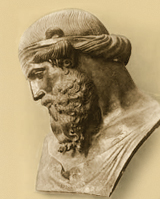
References
Read more about Benjamin Jowett, translator of the first comprehensive collection of Plato’s Dialogues in English.
Plato. “Gorgias,” The Dialogues of Plato, Benjamin Jowett, trans. Vol. 2 of 5. Oxford: Clarendon Press, 1892, pp. 416-421 This work is in the Public Domain.
Plato. “Phaedo,” The Dialogues of Plato, Benjamin Jowett, trans. 3rd ed. Vol. 2 of 5. Oxford: Clarendon Press, 1892, pp. 255-264. This work is in the Public Domain.
Plato, “Phaedrus,” The Dialogues of Plato, Benjamin Jowett, trans. 3rd ed. Oxford: Clarendon Press, 1892, pp. 316-324. This work is in the Public Domain.
Plato. “Protagoras,” The Dialogues of Plato, Benjamin Jowett, trans. 3rd ed. Vol. 1 of 5. Oxford: Clarendon Press, 1892, pp. 140–146. This work is in the Public Domain.
Plato. “Republic,” The Dialogues of Plato, Benjamin Jowett, trans. 3rd ed. Vol 3 of 5. Oxford: Clarendon Press, 1892, pp. 184-189, 214-222, 330-338. This work is in the Public Domain.
Plato. “Statesman,” The Dialogues of Plato, Benjamin Jowett, trans. 3rd ed. Vol. 4 of 5. Oxford: Clarendon Press, 1892, pp. 466-474. This work is in the Public Domain.
Plato. “Symposium,” The Dialogues of Plato, 3rd ed. Benjamin Jowett, trans. Vol. 1 of 5. Oxford: Clarendon Press, 1892, pp. 525-526, 558-563, 571–582. This work is in the Public Domain.